Tag Archives: loader

Low Risk ETFs Beating SPY In 2014 – ETF News And Commentary

The U.S. economy had a shaky start to this year with a cold snap taking away all the warmth from Q1. To add to this, overvaluation concerns, worries over the withdrawal of QE support in the U.S. and stress between Russia and the West on the Ukrainian issue triggered a flight to safety in the initial months (read: 3 Low Risk ETFs for Market Turmoil ). Though spring sprung more jobs, better housing and manufacturing numbers, and raised confidence in the U.S. citizens leading the economy to advance 4.6% in Q2 and 3.9% in Q3, the global financial market again faltered to close out the year. Concerns over global growth especially in the big three foreign regions ─ Euro zone, Japan and China ─ and rising risks of a sooner-than-expected hike in the U.S. interest rates weighed heavily on stocks this month. Iraq instability, a protest in Hong Kong and Ebola crisis in West Africa have also taken a bite out of stock market returns. If this was not enough, oil prices have moved back to the recession-ridden phase of 2009, losing about 45% since the start of the year (read: Volatility ETFs in Focus on Oil Upheaval ). Russia has once again started to hit headlines for all wrong reasons, with the latest being an upheaval in its currency and bond markets. Notably, Russia resorted to an extremely steep rate hike on December 16 to plug the plunge in its currency which has halved in price against the greenback this year. However, such a desperate move was in vein as the ruble did not find success in arresting its protracted downturn. It seems that Russian tumult and the oil crash will contaminate the risk-on trade sentiment at the end of the year. Investors are getting out of high-growth and high-beta stocks across the globe and seeking refuge in safe and income-oriented assets thanks to sluggish global economic indicators. If this was the snapshot of the year, low risk equities ETFs have all reasons to perform impressively. After all, the S&P has added 12% this year compared to a stellar 35% returned last year. The market sentiment simply moved back and forth with each economic release in the event-loaded 2014. This is especially true as low risk investments can prove quite effective in one’s portfolio in arresting downside risks as compared to high beta products. It is one of the most popular investing themes at present, given the occasional jump in volatility since the start of the year. Below, we have mentioned two low risk ETFs which soothed investors’ nerves in 2014 having returned more than the broader market ETF SPDR S&P 500 ETF (NYSEARCA: SPY ) in the time frame. S&P MidCap Low Volatility Portfolio (NYSEARCA: XMLV ) This overlooked ETF looks to follow the S&P MidCap 400 Low Volatility Index. The product invests about $53.2 million in assets in 80 stocks. From a sector look, financials takes half of the portfolio followed by about 15% of assets invested in utilities and 7.4% in materials. The portfolio has minimal company-specific concentration risk with no product accounting for more than 1.63%. Church & Dwight Co., Alleghany Corp and HCC Insurance Holdings are top three choices. The product charges about 25 bps in fees. The fund is up 16.8% so far this year. PowerShares S&P 500 Low Volatility Portfolio (NYSEARCA: SPLV ) This ETF provides exposure to about 100 U.S. stocks with the lowest realized volatility over the past 12 months by tracking the S&P 500 Low Volatility Index. Like other two choices, the fund is also widely spread across a number of securities as none of these holds more than 1.27% of assets. However, the product is tilted toward financials at nearly 33% share while utilities (18.1%), consumer staples (18.1%), industrials (12.2%) and health care (7.93%) round off to the top five (read: 3 Utility ETFs Surviving the Market Turmoil ). SPLV is the largest and the most popular ETF in the low volatility space with AUM of $4.98 billion. The fund charges 25 bps in annual fees and is up about 15.3% year to date.
Niska Gas Is Likely Undervalued Currently

Summary NKA is being sold at a heavy discount to book value and free cash flows based on historical financial analysis. NKA will likely do quite well financially during the current volatile gas price environment. Even if NKA decides to cut dividends, the current price seems very attractive. Investors should not take a large position currently in the case that dividends are cut and the units become even more attractively priced. Niska Gas Storage Partners LLC (NYSE: NKA ) is a company that operates gas storage assets totaling roughly 250 Bcf of natural gas storage capacity in certain areas of North America. Being in the storage industry, the effects of supply and demand in the natural gas industry may not affect NKA the same way as it affects other oil and natural gas concerns. While natural gas supply is relatively stable over the short term, demand may fluctuate quite a lot due to seasonal, weather or other reasons. Therefore, storage assets can be useful when prices are unduly low and used to save gas supplies for when prices rebound to higher levels. There are a few ways that NKA protects itself from the fluctuations in gas prices or perhaps more importantly, fluctuations in the usage of storage facilities by gas and utility companies. Storage might be thought of as a hedge against price volatility and therefore, it may even benefit from exceptionally low gas prices than normal. The company enters into long-term firm (LTF) contracts in which customers pay the company monthly reservation fees for the right to use the storage facilities over a multi-year agreement. These LTF fees must be paid regardless of the actually utilization of storage capacity by the customers. Then there are variable fees that are charged based on usage of the facilities but they represent a very small portion of the fees received under LTF contracts. Therefore, on a qualitative live, the greater part of NKA’s revenue stream should be relatively stable and constant under most circumstances regardless of the direction of gas prices. The extraordinary situation would be if the supply of natural gas were to actually become in danger of being disrupted or if NKA’s customers were to experience financial failure on a large scale. This would put severe stress on the company’s revenue stream and thus severely cripple its ability to service debt. This scenario would happen if gas prices stay below profitability levels for the producers over a prolonged period of time. In the short term, it may even positively impact NKA’s profitability as low prices would beckon more usage of storage capacity. (click to enlarge) NKA’s largest operation is in Alberta with a facility in each of Suffield and Countess which act as a single hub known as the AECO hub. The weighted average contract life of LTF storage contracts in the AECO hub was 2.3 years as of March 31, 2014. As long as those customer companies manage to stay solvent, NKA’s revenues from AECO should be able to weather a fairly long period of low oil prices. Especially since the fact that TransCanada, a large customer of NKA re-implemented its contract making the weighted average life 4.2 years. The weighted average contract life of the LTF storage contracts at Wild Goose is 2.0 years. Salt Plains is 3.0 years. While LTF contracts comprise of the larger part of NKA’s total revenues, they also have Short Term Firm (STF) contracts which also accounts for a material part of their revenues. The company uses a combination of LTF, STF and other revenue optimization techniques to obtain as high an amount of revenue as possible depending on the market situation. The nature of LTF contracts is that the revenue stream is set during the window of when the contracts expire and is renegotiated for the years going forward. Thus, the revenue from this stream have little to do with the day to day fluctuations of the gas markets and is determined by the conditions prevailing when the contract is being renegotiated. The STF contracts are negotiated on an opportunistic basis and this source is more susceptible to the shorter term fluctuations of the greater market. The current scenario The poor performance in the recent quarter was largely due to the inability of the company to find attractive STF contracts. This is partially attributable to the fact that there has been a lack of energy price volatility due to a moderately cool summer in the areas served by NKA. The trend has now reversed and storage capacity will likely be in high demand due to the recent fallout in oil and gas prices. NKA’s facilities will be in short supply when producers become very uncertain about the future prospects of oil prices since storage capacity basically acts as limited type of insurance protection against uncertain prices. In that sense, although I never like to depend on predictions for the future, NKA’s future prospects for both STF and LTF contracts are looking very bright at the moment. The greater the spread in energy prices, the more valuable will be NKA’s storage assets. Restrictive ownership structure The company is effectively controlled by its sponsor HoldCo and there really isn’t any effective control given to the general public shareholders. Furthermore, the company states that if the manager or any of their affiliates own 80% more of the outstanding units, then they have the right to purchase all of the remaining units from the public unit holders at the prevailing market price. This makes holding NKA very unattractive if you were to have paid the full price of $16.00 for the units. However, at $4.00 per unit, the potential risk is much lower and the reward potential is much greater and more attractive. Should the controlling sponsors decide to acquire the entire outstanding units, there is far less risk of selling it for lower than your acquisition price when purchased at $4.00 per unit. Financial analysis Reviewing the historical performance of NKA, it would seem that the current market cap of around $140 million is unduly cheap. The cash available for distribution metric that NKA discloses should be a rough approximation of free cash flow to equity. If we take the year over year results so far, the stock is trading at merely two times free cash flow. The stock was roughly $16.00 per share and has now dropped to less than $4.00 per share based only on one quarter of poor results due to a shortfall in STF business. The company pays out $1.40 in dividends per year which amounts to roughly $51 million in total. The 2nd quarter call conference suggested that the dividend may be reduced or cut altogether going forward which is what caused the collapse in share price. Analyzing the historical financial data along with the current drop in prices, NKA appears to be extremely cheap at the moment not only due to the free cash flow record, but it also trades at such a small fraction of book value. (click to enlarge) Conclusion Even if the dividends were to be cut completely, I believe the unit price should still be worth roughly $6.00 per share when taking into consideration all the risks. Indeed, the share price will likely drop if dividends were to be cut but the fundamentals of the company are sound and should even do quite well under the current volatile oil and gas price regime. The investment is certainly a portfolio of depreciating assets and the maintenance capital expenditures will increase to roughly $10 million per annum going forward. However, this will not affect the fundamental cash flows to equity going forward to warrant a 70-80% drop in the price. There is ample protection in terms of discount to book value as well as the historical free cash flow performance to warrant a small purchase for me at the current prevailing market price. I’ve only taken on a small position because I want to have a lot of dry powder left over if they should actually cut the dividend and the price would fall further. However, I believe that at the current price, NKA is attractive even if it does cut its dividends.

History Shows That Silver Prices Should Start To Grow

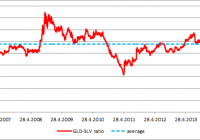
Summary The historical analysis of the gold-silver ratio shows that silver price should start to grow. The value of the gold-silver ratio is almost 75 which is significantly above the long term average. The last two tops (2003 and 2008) were just shy of the 80 level and they were followed by significant increases of the silver price (180% and 315%). There is a significant potential of another huge gains for the iShares Silver Trust ETF shareholders. Historical analysis shows that the iShares Silver Trust ETF (NYSEARCA: SLV ) shareholders may see some interesting gains in the coming years. There are two generally recognized wisdoms that contradict each other. The first one says that the historic results are no guarantee of future performance; the second one says that only a fool repeats the same thing and expects different results. Both of them are applicable to financial markets. Although you can be never sure what the markets will do, there are some patterns that tend to repeat themselves. When you follow such a pattern there is a high probability that the performance of the asset will be similar to the previous cases. There is approximately 19 times more silver than gold in nature. This number was somehow reflected in the historical fixed gold-silver ratios. The ratio was set at 12 in the Roman Empire and at 15 during the era of bimetallism in the 19th century. Today the ratio is not fixed, but moves according to the actual gold and silver prices. The average gold-silver ratio was approximately 55 during the last 44 years. But this is only the average value, the actual values ranged from 17 in January 1980 to 97 in February 1991. The current high valuations don’t reflect the difference in the abundance of gold and silver in the nature and moreover they, don’t reflect even the difference in the abundance of the disposable mined silver and gold. Almost all of the mined gold is being hoarded and most of the mined silver is being consumed by various industrial applications. As a result there is less disposable silver than gold in the world. The GLD-SLV ratio The gold-silver ratio can be tracked also using the SPDR Gold Trust ETF (NYSEARCA: GLD ) and the iShares Silver Trust ETF. During the lifetime of both (chart below), the average GLD-SLV ratio has been 5.77. The highest value was recorded on October 10th, 2008. The GLD price of $83.22 and SLV price of $9.8 resulted in the GLD-SLV ratio of 8.49. The lowest value (3.20) was recorded on April 25th, 2011 at the GLD price of $146.87 and SLV price of $45.83. As we can see, the way from the top to the bottom took 639 trading days. During this time period GLD gained 76.5% and SLV increased by whopping 440%. On the other hand, from April 2011 to present SLV lost 67% of its value while GLD declined only by 22%. (click to enlarge) Source: own calculations The outperformance of SLV during precious metals bull markets and its underperformance during precious metals bear markets is caused by its volatility, which is significantly higher compared to gold. The chart below shows the 20-day moving coefficients of variation for GLD and SLV. The volatility of SLV is significantly higher compared to GLD, regardless of the actual market trend. Source: own calculations But the changing GLD-SLV ratio itself doesn’t tell us anything about the market direction without a further analysis. It is a ratio which means that it is impacted by the price moves of both of the assets. When the GLD-SLV ratio grows it doesn’t mean that the GLD price must grow. The ratio can grow when GLD price declines, but the SLV price must decline even stronger and vice versa. The behavior of both of the assets during particular phases of the GLD-SLV ratio development are shown by the chart below. The chart shows that the declines of the GLD-SLV ratio are related to the growth phases of the gold and silver price cycle and the increases of the ratio usually happen during the decline phases of the gold and silver price cycle. (click to enlarge) Source: own calculations The Long term picture The chart below shows the long term development of the gold-silver ratio calculated from the average monthly gold and silver prices. The chart shows the major tops and bottoms of the gold-silver ratio as well as the metal prices related to the particular local extremes (gold price : silver price). The color of the number shows whether the price of the metal increased or decreased compared to the preceding extreme. (click to enlarge) Source: own calculations Thanks to this chart we can come to three important conclusions: The most important tops of the ratio are almost always associated with a decline of the silver price. The most important bottoms of the ratio are always related with an increase of the silver price. While the direction of the silver price is quite reliably predictable (as shown by points 1. and 2.), predictions of the gold price direction based on the gold-silver ratio development are much less reliable. We can also see that the ratio is approaching 80 right now. The last two approaches to this border were followed by strong declines of the gold-silver ratio and huge silver bull runs, when the silver price increased by 180% and 315% respectively. Conclusions The historical records show that the gold-silver price ratio as well as the GLD-SLV ratio should start to decline in the coming months and years. The major declines of this ratio are always accompanied by a strong silver bull market. The current value of the ratio is approximately 75. The last two times when the ratio attacked the level of 80, the value of the ratio collapsed and silver achieved triple digit gains. If the history should repeat itself once again, the holders of physical silver, SLV or another ETF that tracks the price of the physical silver, should record significant profits. Additional disclosure: The author is long physical silver.