Tag Archives: load

Our 10 Investing Rules For 2015

In 2015, investors should be more skeptical of expert market analysis, and be humble in their approach to new investment opportunities regardless of their past success. Investors should be diversified beyond stocks that Wall Street currently loves, and be wary of investing in overpriced dividend growth stocks. Investors should prepare a list of potential investments as an inevitable correction may finally occur in 2015. Investors should focus on alternative financial media to support their investment decisions, and focus on their entire portfolio’s performance. Investors should broaden their mid-cap stock exposure and strategically invest in out-of-favor dividend stocks with potential to become classic dividend growth stocks. As 2015 rapidly approaches, set forth below are our rules for investing in stocks for 2015. Many of the rules are perennial rules that will always stay with us, and should stay with most investors throughout their investing activities. Some investing rules for 2015, however, are more specific to the current investing environment of: 1) historically low interest rates that are likely to change in the near term; 2) investors engaging in riskier investments given such low interest rates; and 3) desperate search for income causing many dividend growth stocks to be vastly overpriced. With this in mind, below is a set of rules we will be following in 2015 as we make modest adjustments to our portfolio. 1 – Be Skeptical of Pundits and Experts The overall stock market has had an extraordinary run since the dark days of 2009. Most analysts and market pundits predict market indexes to advance further in 2015. We, however, remain skeptical of expert opinions about the near-term future of stocks and the market indexes. Why? The market has had an extraordinary run, and all good things must come to an end or at least take a rest. Although market indexes have advanced strongly since 2012, we have been highly skeptical of the strong surge in the overall market indexes. In our effort to add stocks to our portfolio during such period, we focused on and purchased only stocks that were out-of-favor, including Coach, Inc. (NYSE: COH ), FMC Corporation (NYSE: FMC ) and Patterson Companies (NASDAQ: PDCO ). 2 – Be Humble when making new Investments Since the market advance began in 2009, many institutional and individual investors have experienced significant returns on investment. In addition, there are pockets of the stock market where stocks are clearly overpriced, such as certain dividend growth stocks. With great success comes human nature to begin to think of oneself as invincible. A successful investor with many successful investments in their past begins to think they too are invincible. The current bull market has made many individual investors feel like geniuses when their success is part smart stock picking, part the actions of the U.S. Federal Reserve’s low interest rate policy and part luck. With that said, leave the arrogance to the professional traders and be humble when you are making changes to your stock portfolio. Over time, the stock market tends to humble all investors on a periodic basis. 3 – Be diversified An individual investor that chooses to invest in individual stocks should focus on being diversified throughout multiple industries. If an individual investor wants to own 40 stocks, then, for example, such an investor should own a few of each of the following types of stocks: 1) food stocks, 2) industrial stocks, 3) pharmaceutical stocks, 4) software stocks, 5) utilities, 6) consumer non-discretionary stocks, 7) consumer discretionary stocks, 8) chemical stocks, and 9) technology stocks. An investor should never overweight their portfolio with one or two stocks, no matter how much Wall Street, the financial media and individual investors love the stock. We are constantly amazed at how many investors overweight their portfolio with Apple, Inc. (NASDAQ: AAPL ) stock. No matter how wonderful you think AAPL is as an investment, one day the company will stumble and fall for a period of years. When AAPL does stumble you will not want to be overweight on the stock. Stay diversified. 4 – Be wary of overpriced dividend stocks The last several years have been extraordinarily kind to dividend growth stocks and any investor in such stocks. Now, however, is the time to turn more cautious on this crowded trade. The success of dividend growth stocks over the last several years has been due in large part to the U.S. Federal Reserve’s ultra-low interest rate policy to boost the sagging U.S. economy. The Federal Reserve’s policy has forced many investors to take on more risk to provide income. With banks providing near zero interest rate returns on bank accounts, investors have flocked to dividend growth stocks. With the Federal Reserve indicating that interest rates are set to rise in mid 2015, investors should begin to look more skeptically at dividend growth stocks to avoid overpaying for such stocks. 5 – Develop a List of Potential Investments Whether overall market indexes are hitting new highs or new lows, we believe there are always opportunities to invest in individual stocks in the markets. With that said, we prefer to invest in out-of-favor stocks when the overall market corrects more significantly. Therefore, we have a list of about 50 or so stocks that we are interested in under the right circumstances. Most of such 50 stocks we will never buy as such stocks will never reach a price that we believe is fair for the stock. There will be, however, instances where we will be able to buy a few of the stocks on our list each year. The purpose of such a list then is to provide us with a rough guide of what we can add to our portfolio when the stock market unexpectedly provides us with the opportunity to make a well-timed purchase of an out-of-favor stock that we believe in. 6 – Be prepared for a market correction We believe that the lack of a correction in the last few years has made investors complacent and feel invincible. Investors have forgotten what a severe correction looks like. For us, a severe correction tends make us feel that all we felt we knew about the stock market has been thrown out the window. A severe correction makes us look at our stocks in disbelief as they drop in multiple point increments day after day to levels we never thought imaginable. The feelings of being an investor during a severe market correction (such as the 2008-09 correction) are quite humbling. Being prepared for a correction means for us to: 1) stick with the investments we have, 2) not panic, 3) continue to reinvest dividends, 4) make new investments, and 5) stay calm. A more experienced investor sees a market correction as an opportunity rather than a tragic permanent event. 7 – Seek out alternative financial media discussions Anyone who has read some of our articles knows that we hold Wall Street, analysts and mainstream financial media in very low regard. Much of the financial news coming out of the most mainstream of news sources engages in loud headlines that send out signals of extreme euphoria or extreme pessimism regarding overall markets and individual stocks. We believe that such extreme headlines serve to confuse individual investors and push them to make rash buying and selling decisions. Apart from our favorite mainstream financial news source, Barron’s, we believe all other mainstream financial media should be viewed in an extremely skeptical manner. We also believe that the shouting headlines of mainstream financial media is what has driven many individual investors to Seeking Alpha for more rational discourse on overall markets and individual stocks. Aside from Barron’s and Seeking Alpha, we believe individual investors should seek out investing information from secondary sources. There are paid sources such as Morningstar, which we believe are very valuable to the individual investor and are worth the subscription fee. In addition, we believe that investors should conduct Internet searches for the companies they have invested in or are interested in investing in. Local newspapers, technological newspapers, industry journals and highly respected blogs are valuable sources of information for individual investors and can give greater clarity to an individual investor about what a company is really about. 8 – Focus on the whole of your portfolio We once told another investor that our portfolio of stocks was similar to a parent’s children. If a parent has 4 children and 3 have done well in school and are bound for excellent colleges, but one child is struggling in school, the parent will feel like a failure. Well, of course, a good parent wants all of their children to “succeed.” Our point is, however, that focusing on a minority of underperforming stocks in an overall portfolio prevents an individual investor from understanding and appreciating the successes of their portfolio. Just as children can reach their potential at different stages of their life, so too can stocks appreciate and perform well in varied periods. An individual investor with a portfolio of 40 to 50 stocks will recognize that individual stocks will perform well over multi-year periods, but will also move sideways or downward for multi-year periods as well. Over the long term, even the most successful stocks have their sideways and downward trading periods. Once an investor accepts that not all of their stocks will perform well every single investing year, the sooner they will accept that they do not need to trade in and out of stocks constantly. 9 – Seek out Mid Cap Stocks The vast majority of our stocks are “mega-market capitalization” companies with market capitalizations ranging from $40 to $50 billion to hundreds of billions of dollars. While “mega-market capitalization” stocks do have a place in an individual investor’s portfolio, lately we have come to appreciate owning stocks of companies in the $4 to $15 billion dollar market capitalization range. In particular, we focus on dividend paying mid-cap stocks that are out-of-favor with takeover potential. Mid-cap stocks offer greater share price appreciation, lower outstanding share counts and takeover potential. Our recent purchases of COH, FMC and PDCO fit into the mid-cap category that we are beginning to favor as an addition to the mega-market capitalization stocks that form the majority of our portfolio. We now believe that up to 25 percent of any individual investor’s portfolio should be comprised of such mid-cap stocks. 10 – Increase dividend income stream through strategic purchases Our final investing rule for 2015 is a rule that we have been following for many years. Now, however, as we indicated in an earlier rule, dividend growth stock investing has become a crowded trade, which makes us wary of investing in many dividend growth stocks. With that in mind, an investor must alter their dividend investing approach to adapt to the current market climate. Instead of focusing solely on the current yield of a stock and the length of years a company has raised its dividend, an investor should focus on a company’s recent dividend history and the potential for dividend growth in the company’s upcoming years. To use a baseball analogy, instead of trying to buy an expensive free agent baseball player with extraordinary past performance, look for a lower-priced minor-league baseball player at a more reasonable price with potential. A company with a 5-year history of dividend increases, a 1 percent dividend yield, and the potential to increase dividends for years to come is likely a better choice today than the most highly publicized (and overpriced) dividend growth stocks. In the current market climate, individual investors need to think differently about dividend growth investing and increasing their dividend income stream.
Are Rate-Sensitive ETFs Suggesting Economic Weakness Ahead?

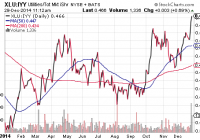
I am baffled by the economic acceleration certainty that nearly every respected voice has endorsed. In spite of the rosiest government data on jobs and GDP, which ETF asset classes proved most resilient in a month of volatile price movement? Utilities and REITs. The more the public is being told about the inevitability of rate increases, the greater the momentum for proxies like XLU and VNQ. Lost in the bull market euphoria is the reality that economists have been dead wrong about the direction of asset prices, particularly bond prices. Last December, when 55 of the most prestigious economists across a wide range of institutions had been polled by Bloomberg about where the 10-year yield (3.0%) would end the year, each of the 55 professionals anticipated higher rates. The average of those estimates? 3.41%. And yet, the 10-year will finish the year closer to 2.25%. That is one heck of an astonishing miss for the entire professional community. This December, polling of economists has produced an average forecast for the 10-year yield at 3.0% by the close of 2015. In other words, they expect intermediate term rates will climb in 2015, and yet, the projections merely approximate where 2013 ended. Even if the recent crop of poll respondents are correct this time around, what does this “non-normalization” of rates tell us about the highly touted strength of the U.S. economy? For all the hoopla, I am baffled by the economic acceleration certainty that nearly every respected voice has endorsed. Will Q4 gross domestic product (GDP) be as robust as the 5% in Q3? Not likely. Will Q1 2015 be better than the average of 2.1% sub-par growth that has existed each year since the Great Recession ended? Probably not. For one thing, lower bond yields have been warning U.S. investors that the world’s stagnation alongside regional recessions will eventually weigh down the U.S. It is one thing to pretend that the U.S. is a self-contained economic island, yet quite another thing to ignore the reality that close to 50% of corporate profits come from overseas. Moreover, there are a variety of potential crises that could sap the world (and yes, the U.S.) of economic demand, from a disorderly slowdown in China to an emerging market credit collapse to a second iteration of a euro-zone break-up scare. Need proof that scores of investors remain unconvinced by the notion that all is perfect in stock-land? In spite of the rosiest government data on jobs and GDP – in spite of strong retail sales as well as consumer confidence readings – which ETF asset classes proved most resilient in a month of volatile price movement? Utilities and REITs. Are The Bets On Lower Rates Still Continuing? MOM% SPDR Select Sector Utilities (NYSEARCA: XLU ) 9.0% iShares DJ Utilities (NYSEARCA: IDU ) 8.7% Vanguard Utilities (NYSEARCA: VPU ) 8.6% iShares Cohen Steers Realty Majors (NYSEARCA: ICF ) 4.2% Vanguard REIT (NYSEARCA: VNQ ) 4.2% SPDR DJ REIT (NYSEARCA: RWR ) 4.1% iShares DJ Total Market (NYSEARCA: IYY ) 1.0% If an investor is looking for modest growth in an area less tied to the economy, he/she may journey to the consumer staples segment or the health care sector. They are frequently identified as “non-cyclicals” since they represent things we need in good times and bad. And if an investor is looking for more total return in areas less tethered to economic well-being, he/she often travels to utilities and REITs. The exception to that rule? If rates are expected to rapidly rise across the yield curve, an investor would tend to shy away from the rate sensitivity associated with utilities and REITs. That’s not happening. In fact, the more the public is being told about the inevitability of rate increases, the greater the momentum for proxies like XLU and VNQ. The price-ratios for XLU:IYY as well as VNQ:IYY are at or near their highest points of 2014. I am not advocating that investors abandon economically sensitive stock assets let alone chase yield-sensitive stock segments. On the other hand, just as I recommended throughout 2014, I believe it makes sense to remain committed to longer-term bonds in funds like iShares 10-20 Year Treasury (NYSEARCA: TLH ) as well as lower volatility stocks across the sector spectrum. One of my largest client holdings, iShares USA Minimum Volatility (NYSEARCA: USMV ), is diversified across all of the economic sectors; the top 3 segments are health care, financials and information technology. What makes USMV particularly attractive in the current environment? The equities have lower volatility properties relative to the U.S. market at large, offering the possibility that losses during declining markets will be less dramatic. Similarly, gains in rising markets will emanate from exposure to strong economy stock sectors as well as weaker economy stock sectors. Click here for Gary’s latest podcast. Disclosure: Gary Gordon, MS, CFP is the president of Pacific Park Financial, Inc., a Registered Investment Adviser with the SEC. Gary Gordon, Pacific Park Financial, Inc, and/or its clients may hold positions in the ETFs, mutual funds, and/or any investment asset mentioned above. The commentary does not constitute individualized investment advice. The opinions offered herein are not personalized recommendations to buy, sell or hold securities. At times, issuers of exchange-traded products compensate Pacific Park Financial, Inc. or its subsidiaries for advertising at the ETF Expert web site. ETF Expert content is created independently of any advertising relationships.

Equity CEFs: Will 2015 Be The Year Of The Rotation?

Summary The bull market in US equities over the past 3-years has certainly been a boon to most equity CEFs though it all depended on what funds you were in. Equity CEFs that focused in healthcare, biotech or technology have been the greatest beneficiaries while commodity funds in energy, gold and metals have lagged the most. But could 2015 shape up to be a rotational year? If a more aggressive Federal Reserve and a reasonably strong global economy are at hand, than maybe so. A lot of my followers have asked why I am not writing as many articles as I used to. Part of the reason is that I don’t see as many opportunities in equity based CEFs as in years past and part of the reason is that as my investment advisory business has grown, I’ve had to dedicate more time to clients and less time to writing articles. But that’s not to say that I am following equity CEFs any less than I used to so before I go into my picks for 2015, let’s take a look back at how funds in my CEF universe have performed over the last 3-years since sometimes the best funds to pick going forward are the same ones that have performed well in the past. On the other hand, what has worked over the last one to three years has been so lopsided, so extreme compared to what hasn’t, that it probably makes sense to bottom fish for funds that could see rotational assets. The 3-Year Winner And Loser Lists The mostly uninterrupted ramp-up bull market in US equities really got started towards the end of 2011 so shown below are the best performing equity based CEFs I follow based on their total return market price performance since 2012. Note: Total return means all distributions are added back but not on a reinvested basis . I follow about 100 equity CEFs out of about 250 available and the ones I follow generally include the largest and the most liquid funds as well as the ones with the highest yields. I don’t follow country specific CEFs and I include only a few of the largest and most popular funds to represent the REIT and MLP specific CEFs. So with that said, here are the top 35 equity CEFs that I can show in a screen shot out of about the 100 that I follow. Funds shown in green have outperformed the S&P 500 over the past 3-years and those shown in red have underperformed. Note: the S&P 500, as represented by the popular SPDR S&P 500 Trust (NYSEARCA: SPY ) is up 74.3% since 2012 including quarterly dividends however most quoted S&P 500 returns do not include distributions and thus the S&P 500 would be up a more modest 66.1%. (click to enlarge) As you can see, it has been difficult for most equity CEFs to outperform the S&P 500 not just on a market price basis but also on an NAV price basis (column to the left of the Tot Ret Mkt column above). Though I place a lot more precedence on a fund’s NAV total return performance since that is the true performance of a fund to compare against its benchmarks, I realize that investors want to know what their actual return would be and so I have sorted the funds by their total return market price performance. Now there are reasons why most equity CEFs won’t outperform the S&P 500 during a bull market period. The biggest reason is that most equity CEFs list income as their primary objective with appreciation as a secondary objective. So for funds that use a defensive covered call write option strategy ( light blue above ) or include fixed-income securities ( most leveraged CEFs shown in orange ) or include international securities ( can be any income strategy shown above ), they generally won’t be able to keep pace with the S&P 500 when the US stock market averages run away from just about any other asset class around the globe. In fact, most of the equity CEFs that have outperformed the S&P 500 over the last 3-years are either the pure equity leveraged funds (mostly from Gabelli ) or funds that focus in sectors that have outperformed the S&P 500, such as healthcare and technology. Let’s now turn the table upside down and show you the bottom 35 or so equity CEFs I follow that have underperformed the S&P 500 the most. (click to enlarge) Here you can see that the funds lagging the worst in market price performance over the last 3-years are generally in the commodity sectors such as oil, gold and metals though funds that have a large percentage of their stock portfolio overseas also show up. So what can this tell us about what funds to own going forward into 2015? Well, I don’t try and make market predictions but I can certainly tell you what funds I am buying based on valuations as well as seasonal trends. So let’s get started. Equity CEFs For A Sector Rotation One could make a good argument that we will see a sector rotation that should, at least initially, help some of the CEF underperformers over years past. This tends to happen at the beginning of a new year and 2015 may actually see a more sustainable rotation if a rise in interest rates start to gain traction in response to a stronger global economy and a more hawkish Federal Reserve . If that happens, then funds like the Gabelli (GAMCO) Global Gold, Natural Resource and Income Trust (NYSEMKT: GGN ) , $6.76 market price, $7.30 NAV, -7.4% discount, 12.4% current market yield , and the Gabelli Natural Resources, Gold and Income Trust (NYSE: GNT ) , $8.04 market price, $8.72 NAV, -7.8% discount, 10.4% current market yield , should be in position to take advantage of that. Though I have mentioned GGN and GNT in past articles, I haven’t actually gone out on a limb and recommended them but there are reasons why I am doing so now. Both GGN and GNT have a lot in common beginning with their top holdings which are mostly gold and gold mining stocks (about 50% of portfolio) along with energy and energy service stocks (about 30% to 35% of portfolio). Both funds use an option income strategy writing both call options and to a lesser extent, put options on their individual stock holdings. This income strategy can generate a lot of income for the funds but can also work against them if their mostly gold and energy stock portfolios become too volatile, which is what we are seeing here late in the year. The major difference between the two funds is that GGN uses leverage and GNT also includes about 15% of its portfolio in other commodity sectors. In other words, both of these funds invest in some of the worst sectors you could possibly be in this year. What tends to happen to poor performing CEFs at year end, especially when other market sectors have performed well, is that tax-loss selling will drive their market price valuations to wider and wider discounts. For particularly volatile CEFs like GGN and GNT, this can become even more extreme. Here is GNT’s 3-year Premium/Discount chart where you can see the fund’s valuation tends to spike one direction at the end of the year only to reverse course and head the opposite direction at the beginning of the year. (click to enlarge) And here is GGN’s 3-year Premium/Discount chart showing much of the same reversal at year end. Note: each tick in the charts represents one week. (click to enlarge) Of course, any sustained move back up for GGN and GNT will depend on the gold and energy markets showing some turnaround strength, resulting in a more definitive rotation into these sectors. Keep in mind that GAMCO recently lowered both fund’s distributions from $0.09/share per month to $0.07/share per month beginning in January, 2015. That should take some pressure off the funds to cover their distributions while still offering an incredibly generous 12.4% current market yield for GGN and a 10.4% current market yield for GNT. Also keep in mind that as option-income CEFs, GGN’s and GNT’s NAVs have actually been more defensive than say, the SPDR Gold Shares ETF (NYSEARCA: GLD ) . Over the last 3-years, GGN’s NAV total return may be down a depressing -22.2% and GNT’s NAV is down -13.8% but compared to the most popular gold ETF, GLD is down a whopping -32.4%. Of course, CEF market prices can go wherever investors take them and that is where you will find opportunities in these funds when they stray too far from their NAVs. GGN and GNT may not be appropriate for income only investors despite their generous yields as they can be quite volatile, but if history is any guide, we could see a bounce in these funds at the beginning of the year even if it is only temporary. Equity CEFs For A Continued Strong Market You don’t have to go all in to the commodity sector to find funds that are undervalued. Going back to the best performers table above, there are a number of diversified funds that will give you exposure to a variety of sectors but yet continue to trade at heavy discounts. My favorite diversified funds are the Legg Mason Capital & Income fund (NYSE: SCD ) , $17.09 market price, $19.00 NAV, -10.1% discount, 6.6% current market yield , and the Cohen & Steers Infrastructure fund (NYSE: UTF ) , $23.20 market price, $26.10 NAV, -11.1% discount, 6.4% current market yield . Both of these funds use leverage and can also be quite volatile, but their diversified portfolios in income sectors such as energy MLPs, utilities, REITs and infrastructure stocks as well as fixed-income securities such as preferreds or convertibles, makes them very insulated from any one sector underperforming. Both fund sponsors have done an excellent job in overweighting the best performing sectors while lowering exposure in underperforming sectors. The other reason why I like both funds in a continued strong market environment is that based on their superior NAV performances over the past 3-years, both funds I feel are overdue for distribution increases. This should help narrow UTF’s and SCD’s wide double digit discounts which, compared to other equity CEFs that don’t have near the total return performances, continue to trade at ridiculously low valuations. Other Equity CEFs I Like For 2015 Energy MLP CEFs have come under intense pressure ever since the fallout in oil prices. This is another sector that should also benefit with any rotation back to energy stocks due to higher oil prices. I don’t necessarily have any favorites in this group since like the municipal bond CEF sector that I recommended in mid to late 2013, all of these funds tend to move up or down together. To get a list of energy MLP CEFs available to investors, go to this link, CEFConnect , and under the US Equity tab pull down menu, check the box marked MLP. If you are looking for more CEF investment ideas, I would suggest reading my article from late October, Funds To Buy And Sell Heading Into 2015 . In that article, I also reiterate the case for one of my all-time favorite funds, the Gabelli Healthcare & WellnessRX fund (NYSE: GRX ) , $10.59 market price, $11.86 NAV, -10.7% discount , 4.5% current yield as well as the Eaton Vance Tax-Advantaged Dividend Income fund (NYSE: EVT ) , $20.74 market price, $22.80 NAV, -9.0% discount , 6.7% current yield . Both funds have moved up nicely since I wrote that article even after multiple ordinary and capital gain distributions, but I also think both funds have performed so well this year that we may see another distribution increase for both by the end of the 1st quarter. Conclusion Finally, I hope all of my readers took my advice on the Nuveen equity option CEF restructurings and stuck it out with the merger between the Nuveen NASDAQ Premium Income & Growth fund (NASDAQ: QQQX ) and the Nuveen Equity Premium Advantage fund (JLA) , which closed last week at a 0.70225331 conversion ratio, to be exact. Because if you had held onto your JLA shares and even added as I suggested during periods when the arbitrage spread widened, you would have seen your JLA shares converted to QQQX shares at a nice bump up in valuation, not just from when the restructurings and mergers were first announced on May 1st but even as recently as several weeks ago. I wrote multiple articles and blogs during this tumultuous period when at times, it looked like the restructurings might not go forward due to shareholder apathy. But Nuveen ultimately got approval on all of the restructurings and today, all of the old Nuveen equity option CEFs cease to exist as they have all either merged or been renamed. This is rather sad for me since I had a long and rewarding relationship with these funds. Back in late 2007, I convinced Nuveen to drop the “buy-put” component of a collar option strategy ( sell call AND buy put ) that JSN, JPZ and JLA used at the time. I realized the funds received no valuation benefit from investors as “risk-adjusted” funds even during difficult market periods and during strong market periods, their uber defensive collar option strategy severely limited NAV growth. So it made sense to drop the added expense of buying put options and ultimately, that’s what Nuveen did. Fast forward to today and I can’t help but wonder at a time when even more equity CEFs are restructuring and dropping their defensive guards that this may be the time in which they are needed the most.