Tag Archives: handle

SPDR S&P 500 ETF: SPY’s 2014 And Fourth-Quarter Performance And Seasonality
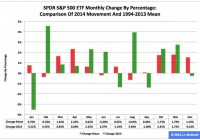
Summary The SPDR S&P 500 ETF ranked No. 1 in 2014 among the three most popular exchange-traded funds based on the S&P 1500’s constituent indexes. Most recently, the ETF’s adjusted closing daily share price last month declined to $205.54 from $206.06, a loss of -$0.52, or -0.25 percent. The last time the ETF had a negative return in the seasonally strong month of December was 2007. The SPDR S&P 500 ETF (NYSEARCA: SPY ) ranked first by return during 2014 among the three most popular ETFs based on the S&P 1500’s constituent indexes, which also encompass the SPDR S&P MidCap 400 ETF (NYSEARCA: MDY ) and the iShares Core S&P Small-Cap ETF (NYSEARCA: IJR ). SPY advanced to $205.54 from $181.15, a gain of $24.39, or 13.46 percent, in terms of adjusted closing daily share prices. Neither seasonality nor U.S Federal Reserve policy appears likely to be supportive of SPY at its current elevated level over the coming quarter. The Federal Open Market Committee announced the end of asset purchases under its third formal quantitative-easing program Oct. 29 and may announce the beginning of its next round of federal-funds-rate increases April 29. Figure 1: SPY Monthly Change, 2014 Vs. 1994-2013 Mean (click to enlarge) Source: This J.J.’s Risky Business chart is based on analyses of adjusted closing monthly share prices at Yahoo Finance . SPY behaved better in 2014 than it did over its initial 20 full years of existence based on the monthly means calculated by employing data associated with that historical time frame (Figure 1). The same data set shows the average year’s strongest quarter was the fourth, with an absolutely large positive return, and its weakest quarter was the third, with an absolutely small positive return. The last time the ETF had a negative return in the seasonally strong month of December was 2007. Figure 2: SPY Monthly Change, 2014 Vs. 1994-2013 Median (click to enlarge) Source: This J.J.’s Risky Business chart is based on analyses of adjusted closing monthly share prices at Yahoo Finance. SPY behaved worse in 2014 than it did over its initial 20 full years of existence based on the monthly medians calculated by using data associated with that historical time frame (Figure 2). The same data set shows the average year’s strongest quarter was the fourth, with an absolutely large positive return, and its weakest quarter was the third, with a relatively small positive return. Last year, the ETF performed best in the second quarter and worst in the third quarter. Disclaimer: The opinions expressed herein by the author do not constitute an investment recommendation, and they are unsuitable for employment in the making of investment decisions. The opinions expressed herein address only certain aspects of potential investment in any securities and cannot substitute for comprehensive investment analysis. The opinions expressed herein are based on an incomplete set of information, illustrative in nature, and limited in scope. In addition, the opinions expressed herein reflect the author’s best judgment as of the date of publication, and they are subject to change without notice. Now that you’ve read this, are you Bullish or Bearish on ? Bullish Bearish Sentiment on ( ) Thanks for sharing your thoughts. Why are you ? Submit & View Results Skip to results » Share this article with a colleague

2014 Portfolio Review – What Strategies Worked And Didn’t Work

2014 is officially in the books. And while I don’t like to put too much emphasis on one year of performance, it’s always helpful to look at what has worked and what hasn’t worked. After all, if you want to know where we’re going, it’s often helpful to know where we’ve been. So let’s take a look at some of the more popular portfolio constructions and see how they did in 2014: Global Financial Asset Portfolio (see construction here ) Total Return: 9.24% Standard Deviation: 5.64 Sharpe Ratio: 2.13 S&P 500 Total Return: 13.46% Standard Deviation: 11.53 Sharpe Ratio: 1.74 MSCI EAFE Total Return: -4.5% Standard Deviation: 13.22 Sharpe Ratio: 0.53 MSCI Emerging Markets Index Total Return: 0% Standard Deviation: 15.3 Sharpe Ratio: 0.75 US Long-Term Government Bonds (NYSEARCA: TLT ) Total Return: 27.31% Standard Deviation: 7.49 Sharpe Ratio: 2.93 Zero Coupon Bonds (NYSEARCA: EDV ) Total Return: 42.31% Standard Deviation: 11.19 Sharpe Ratio: 2.99 Goldman Sachs Commodity Index Total Return: -31.2% Standard Deviation: 16.32 Sharpe Ratio: -1.14 Gold Total Return: -3.75% Standard Deviation: 14.16 Sharpe Ratio: -0.32 Silver Total Return: -21.68% Standard Deviation: 25.32 Sharpe Ratio: -0.96 The big winners were US stocks and bonds while the big losers were foreign stocks and commodities. As I’ve long expected, the “high inflation is coming” trade just continued to get clobbered in 2014. The Global Financial Asset Portfolio was a strong performer in general and beat most portfolios on a risk adjusted and nominal basis. Let’s see how the so-called “passive indexing” strategies performed: US 60/40 Stock/Bond Portfolio Total Return: 10.48% Standard Deviation: 6.79 Sharpe Ratio: 2.08 Global 60/40 Stock/Bond Portfolio Total Return: 3.85% Standard Deviation: 8.15 Sharpe Ratio: 1.24 Betterment 60/40 Portfolio (see here for construction) Total Return: 6.48% Standard Deviation: 7.4 Sharpe Ratio: 1.54 WealthFront Aggressive Portfolio (see here for construction) Total Return: 4.83% Standard Deviation: 11.73 Sharpe Ratio: 1.15 Boglehead 3 Fund Portfolio Total Return: 6.91% Standard Deviation: 7.21 Sharpe Ratio: 1.58 Those are some pretty surprising numbers. Given the returns of the GFAP these are all pretty poor figures with the exception of the US focused 60/40. Not surprisingly, the Robo Advisor portfolio actually result in portfolio degradation as I suspected they would when I first analyzed them earlier this year. I still fail to understand why anyone would pay 25 bps or more for these “passively” managed Robo portfolios especially given the obviously misleading claims that their portfolios generate an “estimated additional return” of 4.6% or so. They actually led to portfolio degradation of almost 4.6% in 2014. In the case of Wealthfront’s most aggressive portfolio you actually took more risk than the S&P 500 and generated about 36% of the return. I can’t stress enough how bad that result is. The process by which many of the Robo Advisors construct their portfolios leaves much to be desired and the entire process appears to be hampered by Modern Portfolio Theory style thinking….The results speak for themselves. The other big surprise to many people will be the global 60/40. At a time when 60/40 is growing in popularity it’s likely to experience serious headwinds going forward as I explained here . 60/40 just won’t generate the types of returns going forward that it has in the last 30 years. The math is pretty simple there. Same basic story goes for the Boglehead 3 fund portfolio since it’s just a slightly altered version of what I used for the global 60/40. And as I’ve shown before , even the most prominent “passive indexers” consistently underperform the GFAP. Their asset picking approach just isn’t that sophisticated, generally results in diworsification and, unfortunately, it has been trumped up mostly by strawmanning stock picking closet indexing mutual funds. But at least it beats hedge fund investing where they charge you an arm and a leg for sub-optimal performance. What about more strategically diversified portfolios? Hedge Fund Replication HFRI Fund Weighted Composite Index (NYSEARCA: HDG ) Total Return: 2.05% Standard Deviation: 4.2 Sharpe Ratio: 1.21 Harry Browne Permanent Portfolio Total Return: 9.58% Standard Deviation: 5.31 Sharpe Ratio: 1.84 Salient Risk Parity Total Return: 13.99% Standard Deviation: 17 Sharpe Ratio: 1.70 It was a pretty mixed bag for more active approaches. Closet index funds mostly underperformed (as we should all expect) and dynamic asset allocation approaches were more mixed with some beating the GFAP and others underperforming. Hedge funds did not come close to earning their fees which, like the Robo situation, leaves me wondering why people continue to pour money into so many of those strategies. This was a pretty interesting year overall. Broadly diversified portfolios did okay if you followed the GFAP construction, but many of the most popular traditional approaches such as the Boglehead 3 fund, hedge funds and Robo Advisor portfolios significantly underperformed. If you didn’t have exposure to US assets you likely didn’t perform all that well. 2014 was a year where a more dynamic approach and some degree of specific asset picking was beneficial. Of course, if you’ve read my work on active vs. passive investing you know that all of the portfolios above are “active” to some degree. Some of them are simply constructed more intelligently than others. 2015 will be no different and the investors who construct the best dynamic “asset picking” portfolios will again generate the best returns. I still think the future of asset management is a battle over low fee dynamic asset allocation approaches. It’s the best of all worlds – low fee, diversified and dynamic asset allocation.