Tag Archives: function

Will Recent Strong Gains In The Greek ETF Last?

Although the Eurozone markets have perked up on the recent QE launch, Greece continues to trouble investors. The country is still deep in debt and its unemployment rate is a nagging concern. The malaise intensified in December 2014 when the Greek prime minister Antonis Samaras called snap elections in the wake of the political strife in Greece and lost it (read: Polls Indicate Syriza Win: More Pain for Greek ETF? ). Anti-austerity party Syriza came to power and kept on negotiating with the ECB to reach a debt-deal while reinforcing the cancellation of steep austerity measures. At the time of election, the leader of Syriza had vowed to cancel the austerities and quite expectedly, the intent to end austerities is flaring up a disagreement with the EU/IMF, lenders risking Greece’s stay in the Eurozone bloc. Last week, in an interview to Germany’s Stern magazine , Prime Minister Alexis Tsipras promised that Greece will be “a completely different country,” in the next six months. This positive vibe charged up the waning Greece ETF, at least for the time being, and pushed up Global X FTSE Greece 20 ETF (NYSEARCA: GREK ) by over 20% in the last five trading sessions (as of February 13, 2015), though the fund has added just 3% in the last one month. Shares of the country’s biggest bank National Bank of Greece S.A. (NYSE: NBG ) spiked on hopes that the country will retain its spot in the Euro bloc and get assistance from the ECB. The shares of NBG skyrocketed more than 45% in the last five trading sessions (as of February 13, 2015). Will the Uptrend Last? While the market was anticipating a positive outcome, the chances of a clean ending to this situation seem less likely. On February 16, dialogues between the foreign creditors and Athens failed as the latter proposed a six-month extension request of its international bailout package. If the parties fail to reach a unanimous decision by February 28, the date which connotes the expiry of the four-year bailout program offered to Greece, the country and its banks would crash into a cash crunch. The European Central Bank will decide on February 18 whether an emergency lending to the Greek banks, which definitely carry high interest rates, should be continued or not. Notably, the country is due for a hefty loan repayment in March, per Reuters. The Greece banks are already seeing signs of a capital flight at an expected rate of 2 billion euros ($2.27 billion) a week. Overall, Greece is in for trouble yet again and investors have nibbling doubts on this risky market. The Athens Stock Exchange General Index slipped more than 3.8% at the close on February 16 as drumbeats of losses were heard after the country failed to strike a debt deal (read: Greek ETF Faces Volatility on ECB Move ). Financials make up about 30% of GREK and is an important driver to the returns of the fund and the country’s current economic issues. The fund currently has a Zacks ETF Rank #3 (Hold). Bottom Line Investors should remember that despite the recent takeoff, GREK has been on a sale with a P/E (ttm) of 11 times versus the biggest European ETF Vanguard FTSE Europe ETF’s (NYSEARCA: VGK ) P/E of 15 times and the Euro zone powerhouse Germany’s iShares MSCI Germany’s (NYSEARCA: EWG ) 14 times of P/E (ttm) figure. So, a bit of a way up was probably long in arrears for GREK. This is more so given Greece’s Q3 2014 growth rate (0.7%) outstripped all other Eurozone countries (read: What is Behind the Greek ETF Surge? ). However, if the country fails to negotiate with its Eurozone associates, the rosy economy which Greece has just started to enjoy might wither away before being in full bloom. Moreover, a discord will find other Eurozone countries from Malta to Greece’s biggest creditor – Germany – in dire straits. So, all eyes should be now on the progression of the debt deal before one can surely predict the fate of the euro, Greece and the broader European market.
Why Value Works: Low Trading Volume

One aspect or explanation why value works is the low trading volume, which is often typical for companies in which we invest. A new paper by Roger Ibbotson and Thomas Idzorek , who work for GMO, a fund management group where James Montier works as well, in the Journal of Portfolio Management, which analysed 40 years of stock returns by putting them into a perspective to the average trading volume of the last year. The paper finds stocks in the least popular quartile outperformed those in the most popular segment by seven percent. In their paper “Dimensions of Popularity,” Ibbotson and Idzorek identify the most common market premiums and anomalies, such as: Small cap – Smaller capitalization stocks outperform larger capitalization stocks Valuation – Value companies beat growth companies Liquidity – Less liquid stocks beat those with more liquidity Momentum – Stocks trending up will continue to trend up Because the risk-return framework does not explain all these premiums and anomalies seen in the market, the researchers propose the unifying “theory of popularity.” The authors explain that the most common market premiums and anomalies are associated with a stock’s popularity or unpopularity. For example, if investors “vote with their dollars,” small cap companies have gotten fewer votes. Value companies commonly have something wrong with them, which makes them unpopular. If an asset has characteristics that investors really dislike, such as low liquidity, little name recognition, or high volatility, its price will be lower and therefore its expected future returns will be higher, all other things being equal. According to the theory of popularity, if an investor were to rank stocks by popularity, he or she could buy a basket of unpopular stocks and systematically rebalance as the stocks become more popular by buying a new portfolio of relatively less popular stocks. As some of the stocks in the portfolio become more popular over time, they become more valuable and the investor will see appreciation. This cycle happens normally in Deep Value situations where trends tend to revert to the mean. “Risk has become a catch-all for all of the attributes that investors do not like, but riskiness does not explain all the anomalies we see in the market. Value premiums are a perfect example. Stocks with low market-to-book ratios or low price-earnings ratios are not necessarily more volatile or less liquid, but we know that over time value stocks beat growth stocks. We need a new model for explaining investment performance that goes beyond risk and return. Popularity may be a better lens through which to view investment behavior,” Ibbotson said. “Many of the well-known market premiums are associated with unpopular stocks. Unpopular stocks tend to be smaller, less liquid, and perceived as lacking growth potential. These stocks, with their low relative prices, may offer investors better future performance as they move along the spectrum toward popularity.” Have a good week. Share this article with a colleague

It’s Time To Get Long Volatility

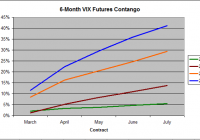
Contango-associated rollover losses have traditionally made holding volatility ETFs for more than a few weeks a dangerous proposition. Over the last two months, however, the VIX futures strip on which volatility ETFs are based has flattened reducing the expense of holding funds such as VXX and TVIX. There is an inverse relationship between VIX price and magnitude of contango. A VIX Risk/Reward score can be used to pinpoint ideal entrypoints for a buy-and-hold position in volatility ETFs. With a current value I have written multiple articles over the past 6 months- Here , Here , and Here -advocating shorting volatility ETFs to take advantage of monthly rollover losses. Recent develops in the VIX Futures market on which volatility ETFs are based, however, has made the sector more attractive as a longer term buy-and-hold position. Anybody who has traded volatility ETFs over the past five years knows that there is a constant uphill battle against the forces of contango. Volatility spikes can generate tremendous short-term gains in these ETFs, but the funds tend to underperform dramatically while awaiting these surges in volatility. While the volatility ETFs are traditionally associated with the VIX-the S&P 500 volatility index-the funds actually hold near-term VIX futures contracts. These contracts expire on a monthly basis and the fund must sell all of its front month contracts and role those funds over into the next month’s contract prior to expiration. Since the market bottom in March of 2009, these later month VIX futures contracts have been persistently more expensive than the front-month, expiring contract, a situation known as contango. This is not that surprising as volatility has been historically low as the markets have rallied these past five years keeping near term volatility low while the prospect of a future market correction has forced investors to pay premiums for later contracts. Unfortunately, this phenomenon has been devastating to short term volatility ETFs such as the iPath S&P 500 VIX Short-Term Futures ETN (NYSEARCA: VXX ) and the leveraged VelocityShares Daily 2x VIX Short-Term ETN (NASDAQ: TVIX ). Each time a fund roles over to a new contract that is in contango, it can buy fewer shares than it just sold, and over time, this results in a significant underperformance of the ETF versus the futures market on which it is based. In 2013, for example, the VIX front month futures lost 10.6% as volatility continued its decline while VXX was down a massive 62%. The 2x leveraged ETF TVIX fared even worse, down 89.8% versus a predicted loss of 21.2%. It is for this reason that I argued for shorting VXX and actively avoiding TVIX as a long term investment in previous articles. Over the past month or two, however, the VIX Futures pattern has evolved to one that I believe to be much more favorable to longer-term traders. Figure 1 below shows the % premium of each contract in the six-month VIX Futures Strip for February 2015 through July compared to the same period in 2014, 2013, and 2012. (click to enlarge) Figure 1: 6-Month Contango 2012-2015 (Source: Yahoo Finance Historical Quotes) It is clear that there has been a flattening of the VIX futures curve in 2015 versus previous years meaning that rollover losses will be limited for volatility ETFs. As of Friday’s close, holding VXX for the next sixth months would result in just a 5.5% rollover-associated loss, assuming no change to the Futures Strip. This compares to a 14% projected loss during the same period in 2014, 29% in 2013 and a disastrous 41% in 2012. Holders of the leveraged ETF TVIX can expect these losses to be doubled. However, this only tells half of the story. There is an inverse relationship between VIX future price and contango. Figure 2 below shows a scatterplot of front-month VIX price against 6-month contango using data for the past five years. As the price of the front-month VIX contract increases, the level of contango tends to decrease. In fact, once the VIX futures reach a certain level-somewhere above 20–the contacts tend slip into backwardation, the opposite of contango in which rollovers actually benefit the longs. (click to enlarge) Figure 2: Over the last 5+ Years, as VIX Futures Price decreases, Contango tends to increase (Source: Yahoo Finance Historical Quotes) At the same time, however, higher VIX levels have a much higher probability to mean revert to the average VIX level, which, over the last 5-years is somewhere around 18, as the market rallies. Figure 3 below shows the average peak six-month return based on the front-month VIX futures contract based on initial VIX starting price. (click to enlarge) Figure 3: Average Peak 6-month return by VIX range (Source: Yahoo Finance Historical Quotes) When the VIX price is less than 12, the average peak six-month return is over 100%, which stabilizes at around 35% between 14 and 20, and then slows to less than 8% when the front month VIX futures is above 30. What is needed, therefore, is a balance between a low VIX entry price while maintaining as minimal level of contango as possible. Sure, a cheap VIX may mean the possibility of a large return on a VIX spike, but you will pay for it through steep rollover losses awaiting for that singular moment. On the other hand, an elevated VIX means that rollover losses will be minimal and it will be cheap to hold the ETF for an extended period of time, but the probability of profiting from a spiking VIX will be much more limited. Overlaying the data from Figures 2-representing the expense curve-and Figure 3-representing the returns curve-produces the chart shown below in Figure 4. This graph implies that at VIX futures prices when the returns curve is greater than the expenses curve, the risk-reward profile is in favor of the longer term holder (that is, out to six-months). However, once the curves intersect at around 22, projected expenses equal projected returns and a buy-and-hold trade is no longer worthwhile. (click to enlarge) Figure 4: Historical projected 6-month return and expenses by VIX range (Source: Yahoo Finance Historical Quotes) This is a good theoretical exercise, but relies on historical averages. What does the current picture look like? A cheap VIX/low contango metric can be calculated simply by multiplying the absolute value of the contango (or backwardation) by the current front month VIX futures contract price. The lower that this number is, the greater the potential for profit while limiting rollover losses. Figure 5 below shows this VIX Risk/Reward Score over the past five years. (click to enlarge) Figure 5: VIX Risk/Reward Score Over the past 5+ years where lower values suggest favorable buying opportunities (Source: Yahoo Finance Historical Quotes) As of Friday’s closing front-month VIX Futures price of $19.18 with a six-month contango of 5.5%, the VIX Risk/Reward Score is 1.05 which, as figure 5 illustrates, is well below the 5-year average of 3.78, indicating a good risk/reward for going long volatility. Indeed, Friday’s close is in the 92nd percentile indicating a historically low score. This effectively allows us to take the projected VIX Expenses curve in Figure 4, which shows an historical average of about a 25% 6-month contango-associated loss at current levels, and shift it downward to match the current 5% projected loss. The proof, as they say, is in the pudding. The VIX risk/reward score has been