Tag Archives: function

RSX: The Bear Thesis

Summary Ruble will continue to weaken. The economy is in bad shape, and production was not helped by the weak ruble. The oil is looking weak too, which is very dangerous for the Russian oil producers and the economy. Despite recent weakness, the Russian Stock Market (NYSEARCA: RSX ) is still up almost 25% year-to-date. The wild moves seen in last December are almost forgotten. However, I see several reasons why RSX can go lower. The Russian Ruble The Russian currency has somewhat stabilized after falling to as much as 80 rubles per dollar in December of 2014. Currently, you can buy a dollar with 55 rubles. However, I see reasons why the ruble could go lower, hurting the dollar-denominated RSX. The first reason is the key interest rate. The key rate, which was increased to 17% by the Russian Central Bank at the height of the crisis, was recently lowered to 11.50%. This move helped the bank stop the rally in the Russian ruble. The Central Bank also started buying $200 million per day in order to bring the reserves back to $500 billion. At the end of May, international reserves stood at $356.8 billion. In my view, the key rate will be lowered further, because the economy is in a bad shape. In April, industrial production fell ( Google translate link ) by 4.5%. In comparison, industrial production fell by just 0.6% in March. This means that the ruble is not weak enough to help local producers, which will make the Central Bank more eager to bring interest rate down and push the ruble lower. The Economy As I mentioned above, production is stagnating. So is consumption. In May, real earnings of Russian citizens contracted ( Google translate link ) by 6.4%. According to official estimates, it would take three years to bring earnings back to the level of 2014. This fact means problems for the consumer-oriented part of RSX holdings like Sberbank ( OTCPK:SBRCY ), Magnit (retailer), VTB Bank, and Mobile Tele Systems (telecom). The decrease of consumer spending could especially hurt Magnit, which has been growing very fast and opened 1,618 new shops last year. The budget is stretched, and the Russian Ministry of Finance is even ready to cut the sacred cow – military spending. Oil Russia is still overly dependent on oil prices, and I’m bearish on oil. Brent oil managed to make a spectacular run from under $50 per barrel to almost $70 per barrel. The decline in the number of U.S. rigs and conflicts in the Middle East help oil gain ground. In my view, oil has run out of upside catalysts. The conflicts in Yemen and Iraq are very far from being resolved, but this does not lead to an upside in oil. The number of working rigs in the U.S. has dropped by more than 50% compared to 2014, but this fact no longer helps oil. Despite recent cuts, supply still exceeds demand, and this means more pressure on oil prices. Pressure on oil hurts the economy, and hurts Russian oil producers, like Surgutneftegas, Lukoil ( OTCPK:LUKOY ) (and Tatneft ( OTCPK:OAOFY ), which are heavily represented in RSX. Bullish Argument The eternal bullish argument for the Russian market is its undervaluation based on different metrics. Interestingly, in Russia, this argument, which was widely used five or ten years ago, is now stated with sarcasm. Yes, you can still choose the metric that you like, choose the peers and find out that Sberbank, Gazprom ( OTCPK:OGZPY ) and others are relatively undervalued. In fact, they have always been. This undervaluation is chronic and, in my view, nothing will change on this front unless the country goes through serious structural changes. Bottom line I am bearish on RSX. I believe that the combination of weaker oil, sluggish economy and falling ruble will send RSX closer to lows seen in December of 2014. Disclosure: I/we have no positions in any stocks mentioned, but may initiate a short position in RSX over the next 72 hours. (More…) I wrote this article myself, and it expresses my own opinions. I am not receiving compensation for it (other than from Seeking Alpha). I have no business relationship with any company whose stock is mentioned in this article.
PHK: Is It Time To Get Out While You Still Can?

Summary Pimco High Income Fund’s premium has fallen from over 50% to around 30%. The net asset value isn’t the issue, investor perception is. I strongly recommend investors reconsider their position here before it’s too late. Pimco High Income Fund (NYSE: PHK ) is a risky investment. Although the fund has a solid performance history and has steadily paid dividends through even the “worst of times,” it trades at an extreme premium over net asset value, or NAV. It’s easy to give short shrift to that little issue when times are good, it’s harder to ignore when the tide starts to shift. And just such a shift may be taking place right now. OK, it’s got a good record I’m not going to argue that PHK is a poorly run fund. Quite the contrary, it is a well run fund. For example, over the trailing 10-year period through May, the fund’s annualized NAV total return was around 11%. Total return includes reinvested distributions. That puts the fund in the top tier of its Morningstar peers. It’s performance over the trailing three- and five-year periods were even more impressive, at 19% and nearly 18%, respectively. Equally important, the fund’s distribution has been maintained through thick and thin. That includes through the disastrous 2007 to 2009 recession that led to distribution cuts throughout the CEF industry. I have concerns with the level of the distribution , at nearly 13% based on market price and 19% based on NAV, but that doesn’t diminish the consistency with which the dividend has so far been paid. So, yes, PHK has been a well run fund. If this were an open-end mutual fund the discussion would stop right there. But it isn’t, it’s a closed-end fund. Supply and demand Closed-end funds trade on supply and demand, which means their prices can vary from their net asset values. When investors are enamored of a CEF, they bid the shares up close to or above the NAV. When investors are less sanguine they push CEFs to discount prices – often very deep discount prices. This isn’t news to anyone who follows CEFs. PHK has been a market darling. It started the year with around a 50% premium over NAV. That’s massive and only exists because of investor sentiment. Investors at the start of the year were willing to pay $1.50 for $1 worth of assets. I have suggested a couple of times that this is a big risk. That stance had garnered a mixture of agreement and hostility. Those who disagree with my concerns basically suggest that the fund is so good that it deserves the premium pricing. Looking at more recent performance, however, suggests exactly why such a rich premium is a huge risk. Over the trailing three months through June 23rd, PHK’s market price return was a decline of over 18%. That’s a rough stretch to have lived through, even if the dividend has remained stable. And while investors can argue that impressive share price gains over the years means those losses are only taking back house money that misses the point. You see, PHK’s NAV return was a positive 5.5% over that same span. And since PHK’s NAV performance was positive during this span, it’s hard to suggest that the market price performance had anything to do with the fund’s NAV performance. It seems pretty clear to me that a significant number of investors have soured on the fund. Yes, there have been changes in the number of shares of PHK that are sold short . That, presumably, should ease negative sentiment. But, in the long run, this is noise. The short interest is a symptom of the bigger issue, which is the extreme overvaluation. A warning shot If you still own PHK, look at this swift reversal of fortune as a warning shot. Could the premium go right back up to 50%? Yes. Will it? Who knows. The drop, however, is clear evidence that investor perceptions are shifting. The value of a PHK share is still roughly 30% lower than where the shares trade today. In other words, there’s still plenty of downside left before it reaches NAV. Don’t underestimate that risk. Disclosure: I/we have no positions in any stocks mentioned, and no plans to initiate any positions within the next 72 hours. (More…) I wrote this article myself, and it expresses my own opinions. I am not receiving compensation for it (other than from Seeking Alpha). I have no business relationship with any company whose stock is mentioned in this article.

You Can Afford To Hold Cash

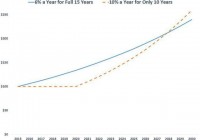
In my last post, I said stocks were too expensive. Instead of putting more of your money into diversified groups of stocks, you should just let cash build up in your brokerage account. A lot of people have a fear that those lost years of making zero percent on their idle cash can never be made up for. I’ve created a graph to show how much ground you’d have to make up. (click to enlarge) Let’s say you have two choices. One is to invest in an overpriced basket of stocks today and hold that basket from 2015 through 2030. This choice will compound your 2015 money at a rate of 6% a year. The second choice is to do nothing for all of 2015, 2016, 2017, 2018, and 2019. You just hold cash. That cash earns 0% for those 5 years. In 2020, you finally get an opportunity to make an investment that will return 10% a year from 2020 through 2030. If your investment horizon extends all the way out from today through 2030, the second approach overtakes the first approach about 15 years from now. Doing nothing for 5 years and then something smart for 10 years is a better 15-plus year strategy than “just doing anything” today. Here, we define something smart as 10% a year and “just doing anything” as 6% a year. You can decide for yourself whether your something smart is 10% a year or not. That’s subjective. What the “doing anything” returns is a lot more objective. So, let’s talk about that. Over the last 15 years, the S&P 500 (NYSEARCA: SPY ) returned about 5% a year. During that time period, the Shiller P/E ratio contracted from 43 to 27. The same percentage contraction – 37% – would be required to get the Shiller P/E down from today’s 27 to a historically “normal” 17. I see no reason why the S&P 500 should do better from 2015 to 2030 than it did from 2000 to 2015. That means I see no reason why buying the S&P 500 today and holding it through 2030 should be expected to return more than about 5% a year. (Almost all readers I talk to have a total return expectation for the S&P 500 that is greater than 5%, even for periods shorter than 15 years.) It’s also worth mentioning that while I have no predictions as to when idle cash would earn more than zero percent, the Fed does. And those predictions show cash earning a few percent in 2018 and 2019, instead of zero percent. For those reasons, the graph in this post is probably an underestimation of how quickly sitting and doing nothing till you can do something smart outperforms continuing to shovel cash into the S&P 500 at today’s prices. I think the reason people don’t feel secure in waiting for an opportunity to do something smart is that they’re not sure when that opportunity will appear. Maybe there will be no chance in all of 2015, 2016, 2017, 2018, 2019, 2020, or even 2021 to do something smart. If that’s true, isn’t it possible doing anything now could outperform waiting to do something smart later? If that later is sometime after 2021, couldn’t it be better to just buy the index today? Yes. I can only point to history. Pick any year in the past. Then move forward 6 years from that time. In the intervening years, was there an opportunity to do something smart? The hardest waiting period in history was during much of 1995 through 2007. Although stocks were often cheaper than they are today, the largest and best-known American stocks were almost always more expensive than they had been at any time before 1995. I think this is the real reason why investors I talk to are hesitant to hold cash. Much of their investing lifetime was spent during a time of high stock prices. There is no advantage in buying something that is unlikely to provide a good long-term return instead of holding cash till something good comes along. If we take 15 years as long term, we can say that the S&P 500 will not provide good long-term returns if bought today. You can afford to avoid 5%-a-year type long-term commitments if you have a real chance at finding 10%-a-year type long-term commitments sometime in the next 5 years. You don’t need to know exactly when or where this opportunity will come. A lot of investors who live outside the U.S. read this blog. They have an advantage. Their home countries’ stock markets might provide a 10%-a-year opportunity sometime in the next 5 years. American investors probably won’t notice such an opportunity when it appears. By buying into an index today, you are really saying you will just take whatever price Mr. Market gives you. You do this because you’re not sure he will ever give you a good price again. Or, if he does, it may come far more than 5 years in the future. Caving into Mr. Market’s mood is not something value investors think is appropriate when it comes to individual stock purchases. Yet, a lot of the people who read this blog – who are otherwise value investors – feel they have no choice but to continuously add to the actively and passively managed mutual funds in their brokerage account. The other choice is to hold cash. And the longer “long term” is for you, the more sense holding cash makes. It makes a lot of sense right now.