Tag Archives: earnings-center

Best And Worst Q3’15: Energy ETFs, Mutual Funds And Key Holdings
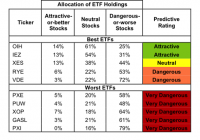
Summary The Energy sector ranks last in Q3’15. Based on an aggregation of ratings of 20 ETFs and 90 mutual funds in the Energy sector. OIH is our top-rated Energy ETF and FSESX is our top-rated Energy mutual fund. The Energy sector ranks last out of the 10 sectors as detailed in our Q3’15 Sector Ratings for ETFs and Mutual Funds report. It gets our Dangerous rating, which is based on aggregation of ratings of 20 ETFs and 90 mutual funds in the Energy sector. See a recap of our Q2’15 Sector Ratings here . Figures 1 and 2 show the five best and worst-rated ETFs and mutual funds in the sector. Not all Energy sector ETFs and mutual funds are created the same. The number of holdings varies widely (from 25 to 163). This variation creates drastically different investment implications and, therefore, ratings. Investors seeking exposure to the Energy sector should buy one of the Attractive-or-better rated ETFs or mutual funds from Figures 1 and 2. Figure 1: ETFs with the Best & Worst Ratings – Top 5 (click to enlarge) * Best ETFs exclude ETFs with TNAs less than $100 million for inadequate liquidity. Sources: New Constructs, LLC and company filings The PowerShares Dynamic Oil & Gas Services Portfolio ETF (NYSEARCA: PXJ ) is excluded from Figure 1 because its total net assets are below $100 million and do not meet our liquidity minimums. Figure 2: Mutual Funds with the Best & Worst Ratings – Top 5 (click to enlarge) * Best mutual funds exclude funds with TNAs less than $100 million for inadequate liquidity. Sources: New Constructs, LLC and company filings The Market Vectors Oil Services ETF (NYSEARCA: OIH ) is the top-rated Energy ETF and the Fidelity Select Energy Service Portfolio (MUTF: FSESX ) is the top-rated Energy mutual fund. OIH earns our Attractive rating and FSESX earns our Neutral rating. The PowerShares DWA Energy Momentum Portfolio ETF (NYSEARCA: PXI ) is the worst-rated Energy ETF and the Saratoga Energy & Basic Materials Fund (MUTF: SBMBX ) is the worst-rated energy mutual fund. Both earn a Very Dangerous rating. 187 stocks of the 3000+ we cover are classified as energy stocks. National-Oilwell Varco (NYSE: NOV ) is one of our favorite stocks held by Energy ETFs and mutual funds and earns our Very Attractive rating. Since 2009, National Oilwell has grown after-tax profit ( NOPAT ) by 11% compounded annually. National Oilwell has a return on invested capital ( ROIC ) of 10% and over $4 billion in free cash flow on a trailing twelve-month basis. Due to the recent decline in energy-related securities, NOV can be purchased well below its fair value. At its current price of ~$43/share, NOV has a price to economic book value ( PEBV ) ratio of 0.6. This ratio implies that the market expects National Oilwell’s NOPAT to permanently decline by 40%. If National Oilwell can grow NOPAT by just 3% compounded annually for the next six years , the stock is worth $80/share today – an 86% upside. Marathon Petroleum Corp (NYSE: MPC ) is one of our least favorite stocks held by Energy ETFs and mutual funds and earns our Very Dangerous rating. Marathon’s NOPAT has declined from $3.3 billion in 2011 to -$589 million in 2014. ROIC has also fallen from 15% to 1%. Investors not reading the footnotes would be unaware of the deteriorating business fundamentals. Due to a change in LIFO inventory value we remove $3.4 billion from Marathon’s 2014 income statement. Without making this adjustment the market has been led to believe that profits actually grew in 2014. The disconnect between NOPAT and net income could explain why MPC is up 39% over the last year despite the Energy sector being down 27%. To justify its now overvalued price of $56/share, MPC must grow revenues by 16% compounded annually for the next 13 years while also raising its current NOPAT margin from -0.6% to 2.5%. Marathon has only grown revenue by 8% compounded annually since 2011. Expecting Marathon to double its revenue growth in a weak Energy environment and maintain that high level for over a decade seems rather optimistic. Figures 3 and 4 show the rating landscape of all Energy ETFs and mutual funds. Figure 3: Separating the Best ETFs From the Worst ETFs (click to enlarge) Sources: New Constructs, LLC and company filings Figure 4: Separating the Best Mutual Funds From the Worst Mutual Funds (click to enlarge) Sources: New Constructs, LLC and company filings D isclosure: David Trainer and Allen Jackson receive no compensation to write about any specific stock, sector or theme. Disclosure: I/we have no positions in any stocks mentioned, and no plans to initiate any positions within the next 72 hours. (More…) I wrote this article myself, and it expresses my own opinions. I am not receiving compensation for it. I have no business relationship with any company whose stock is mentioned in this article.
Rio Tinto Is Stabbing Energy Resources Of Australia In The Back

Summary Energy Resources of Australia lost almost US$500M in market capitalization after deciding not to go ahead with the Rangers 3 Deeps zone. The company is currently processing low-grade stockpile which should keep the lights on. The company is now an excellent call option on the uranium price as it has existing infrastructure and is trading at less than $2 per pound in the ground. Introduction I’m a believer in uranium and whilst I don’t think we’ll see substantially higher prices this year or even next year, I’d still like to be positioned to benefit from an expected uptick in the sexiness of uranium-related investments. I can be patient and have been keeping an eye on several uranium companies. Energy Resources of Australia (OTCPK: EGRAF ) is one of them, and the share price has tumbled after major shareholder Rio Tinto (NYSE: RIO ) decided not to get ahead with providing financial support for the development of the Ranger 3 Deeps zone. That’s a pity, but maybe there’s an opportunity here for people who are patient. Energy Resources of Australia is a – surprise, surprise- Australian company and I’d strongly recommend you to trade in the company’s shares through the facilities of the Australian Stock Exchange where it’s listed with ERA as its ticker symbol . The average daily volume is 2.2 million shares. The company is still processing stockpiles but won’t develop the underground mine In the second quarter of this year, Energy Resources produced 390 tonnes of uranium (861,000 pounds) which would generate almost $40M in revenue based on today’s spot price. That’s still pretty decent but not a lot and that’s due to the fact ERA is basically just processing its (low-grade) stockpiles. The average grade of the processed ore in the second quarter was just 0.09% (10% lower compared to the previous quarter) whilst the total amount of ore it milled also decreased due to a planned mill shutdown. Source: annual report This is part of the plan to wind down operations at the Ranger mines and connected to the rehabilitation plan for the area. As part of its original agreement with the governments, ERA was operating the mine under the ‘Ranger Authority’ agreement which is expiring in 2021. Unfortunately this is one of the stumble blocks for the company to even consider developing the Ranger 3 Deep zone. Earlier this year, ERA has halted all development activities at the underground uranium resource as the uranium price was too low to justify spending any more cash on that part of the project. On top of that, partner Rio Tinto also pulled out, stating the project no longer meets its investment criteria. (click to enlarge) Source: annual report A real double-whammy for Energy Resources of Australia, and as you can imagine its market capitalization fell off a cliff and whereas the company was worth A$800M just three months ago, it lost 75% of that value since then! And that’s a pity, as there’s a lot of uranium down there It’s understandable nobody wants to throw tens and hundreds of millions of dollars at an underground uranium mine at a moment the uranium price is so low even the open pit mines are struggling to stay afloat. So, yes, I do understand the reasoning behind the decision to not advance the Ranger 3 Deeps zone as the result of the previously published pre-feasibility study was disappointing. The pre-feasibility study was based on an updated resource estimate using a cutoff grade of 0.11% uranium compared to a previously used cut-off grade of 0.15% U3O8. Yes, the lower cut-off grade has indeed increased the total resource base of the project which now contains 96.5 million pounds of uranium, but unfortunately this also caused a sharp 20% reduction in the average grade which dropped to 0.224%. Source: annual report This was quite disappointing as everybody knows in this investment climate it’s all about generating returns on investments and keeping the payback period short. In the past it used to be a game of ‘my resource estimate is bigger than yours’, but that era is over and investors are focusing on decent internal rate of returns. The Rangers 3 Deeps zone might not be mined in the near future, but fortunately the uranium resources aren’t running away. According to its most recent financial statements, ERA had a working capital position of A$350M (more than its current market capitalization) and this should keep the company afloat for a little bit longer. The average rock value per tonne of ore is $175/t based on the spot price and almost $250/t based on the long-term uranium price. That’s the equivalent of almost 7 g/t gold so I do believe there is value down there (literally). Investment thesis Buying shares of Energy Resources of Australia is buying a call option on the uranium price as the Rangers 3 Deeps project definitely won’t be developed at the current uranium price. It doesn’t mean the project is worthless and ERA might just ‘sit’ on it until the outlook for uranium improves again. ERA is now valued at US$1.75 per pound of uranium in the ground and that’s not expensive, considering the resource is located in a safe region. I might initiate a very small position in the next few days or weeks as a speculative bet on the uranium price. Keep in mind this company has a higher than average risk profile and even though I do think this mine will eventually be developed, there’s no way I can guarantee it will indeed happen. Editor’s Note: This article covers one or more stocks trading at less than $1 per share and/or with less than a $100 million market cap. Please be aware of the risks associated with these stocks. Disclosure: I/we have no positions in any stocks mentioned, but may initiate a long position in EGRAF over the next 72 hours. (More…) I wrote this article myself, and it expresses my own opinions. I am not receiving compensation for it (other than from Seeking Alpha). I have no business relationship with any company whose stock is mentioned in this article.

A Small-Cap ETF With Big Dividend Growth Potential

Summary Small-capitalization stocks have rebounded this year. A small-cap ETF that targets dividend growers. How the ProShares Russell 2000 Dividend Growers ETF compares to the benchmark Russell 2000. By Todd Shriber & Tom Lydon Small-caps are rebounding this year as highlighted by a gain of 4.1% for the iShares Russell 2000 ETF (NYSEARCA: IWM ) , the largest small-cap ETF. That is well ahead of the 2.9% returned by the S&P 500 this year. Investors looking for a more conservative, income-oriented approach to the Russell 2000, the benchmark U.S. small-cap index, have a compelling option in the ProShares Russell 2000 Dividend Growers ETF (NYSEARCA: SMDV ) . SMDV, which debuted in February, tracks the Russell 2000 Dividend Growth Index. That index includes small-cap firms with dividend increase streaks of at least a decade. Index constituents are screened for liquidity and dividend status, then selected and equal-weighted subject to a maximum sector weight of 30%, according to Russell Investments. Recent data indicate income investors should give small-caps and the corresponding exchange-traded funds a new look. “From the end of 2013 there has been a 10.2% increase in the number of issues paying a dividend in the S&P SmallCap 600,” according to S&P Dow Jones Indices . SMDV has returned half a percent since coming to market. While that is well behind the returns from the traditional Russell 2000 Index, investors should remember that the fund offers a more conservative approach to small-caps, with a superior yield to the Russell 2000. For example, SMDV’s 30-day SEC yield is 2.22%, or nearly 100 basis points higher than the comparable metric on IWM. Then, there is the potential for dividend growth. “Much of the potential return differential of small cap dividend growers have over other small caps can be attributed to lower historical risk,” according to a ProShares note . “Not only have small cap dividend growers had lower volatility compared with the overall small cap space, they have also had lower drawdowns. It is ‘winning by not losing as much’ that has translated to better returns over time.” SMDV is somewhat sensitive to changes in interest rates by way of an almost 27% weight to the utilities sector, but the fund combats that with a 21.6% weight to financial services names. While financials have been an important source of U.S. dividend growth in recent years, small-caps from that sector offer an advantage when rates rise , because they are highly levered to profit-boosting increases in net interest margin. For the five years ended December 31, 2014, Russell 2000 dividend growers delivered return on equity of 13.4%, 360 basis points ahead of non-dividend growers, according to ProShares data. The index’s dividend growers also delivered EPS growth of 6.2%, compared to 6% for non-dividend growers. ProShares Russell 2000 Dividend Growers ETF (click to enlarge) Tom Lydon’s clients own shares of IWM. Disclosure: I am/we are long IWM. (More…) I wrote this article myself, and it expresses my own opinions. I am not receiving compensation for it. I have no business relationship with any company whose stock is mentioned in this article.