Tag Archives: earnings-center

Timing Is Everything

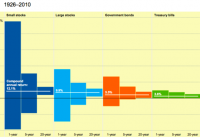
The length of time investors have to plan for is the single most powerful factor in their investment process. If time is short, investments with the highest potential return are the least desirable, because they entail the greatest risk. But given enough time, assets that appear risky become desirable. Time transforms investments from least attractive to most attractive – and vice versa. Our time horizon has a major impact on our investment strategy. This is true in the natural world as well. I’ve been to the coastal redwoods in California, and they’re awesome. John Steinbeck called them “ambassadors from another time.” In many ways, they are. They regularly reach ages of 600 years or more, and some are over 2000 years old. Their natural resistance to disease and insects allows them to grow slowly and gradually. But they have to. The high rainfall in their coastal habitat leaves the soil with few nutrients. By contrast, stumbling into a thicket of pin cherries in the Northeast woods can leave you breathless, but in a different way. The undergrowth can be so thick it’s easy to get disoriented. Pin cherry trees sprout and grow quickly, taking advantage of any disturbance in the forest canopy. But they only live 20 to 40 years, and they’re an important source of food for many types of animals. It would be foolish to say that either tree is more successful. Each has adapted to its environment. What works in one context doesn’t work in another. That’s why, for investors, the typical time period we use to calculate returns – one year – may be misleading. A single year simply doesn’t match the time available to different investors with their differing objectives and constraints. Different assets – and asset mixes – are appropriate in different circumstances. (click to enlarge) Average return and dispersion of return for various asset classes over different time periods, 1926-2010. Source: Jay Sanders, CPA So if you’re worried about the market, be sure to ask yourself how much time you have until you need the money. Because the quickest way to turn a temporary fluctuation into a permanent loss is to sell the asset. Share this article with a colleague

Risk? What Risk?

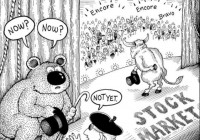
By Dominique Dassault Equity Risk Is Increasingly Non-Existent… By The Numbers The concept of risk for hedge fund managers is a constant concern. The internal monologue goes something like this…”what’s my downside if I initiate this position… how much can I lose if I am not right?” The real answer is that you really have no idea… despite best efforts… even with stop losses [which I abhor]. The true, measurable risk of any position is only exactly known after you liquidate the position. Plus, risk management is more capital management than single stock management. Little did he know how it would all end… Cartoon via wallstreetsurvivor.com How much capital are you assigning to each position in the context of the entire portfolio capital? And are your different positions correlated or not? Even if they are [not], historically, there is no guarantee that correlation [or not] will continue. Anyway… back to risk. Every day my prime broker blasts me with a report loaded with scores of trading metrics calculated over many time frames [mostly the last twelve months]. It is all very interesting but the only real metrics I care to focus on are total returns and risk-adjusted returns. Most clients could not care less about risk-adjusted returns… but I sure do. And, as many are aware, the holy grail of risk metrics is the Sharpe Ratio [as calculated according to the title of this post]. The most interesting precept of the Sharpe Ratio, in my opinion, is that it treats volatility as random… both upside and downside volatility. No way to predict it in either direction so both directions are assigned the same discounting value. Basically, according to Bill Sharpe, all volatility is a penalty against your performance. I get it. Still, in a perfect world, what if most of the volatility experienced by a portfolio of equities was actually favorable? So rare… if not impossible… but still at least worthy of consideration. And so the Sortino Ratio [or as I refer to it as the Gain/Pain Ratio] was born… essentially, it is exactly as the Sharpe Ratio but stratifies favored and unfavored volatility. Favorable volatility is not penalized. Unfavorable volatility is scored as a legitimate demerit. It has always seemed fairer to me. (click to enlarge) The difference between the Sharpe and Sortino ratios Naturally, both ratios are relevant and higher values for both measurements reflect better risk-adjusted returns. And portfolio managers realize that, no matter the ratio, both need to be positive…or you are losing money. However, given full investment of capital, the Sharpe Ratio can be strongly positive yet still not offer high absolute returns. Conversely, if your Sortino Ratio is high, you are probably delivering very strong absolute returns… again, assuming full investment of capital. An Era of Painless Gains Given all of this… What is a good numerical value for both ratios? Generally, over time, any value > 1.5 is pretty good and numbers > 2.0 are stellar. Be advised the data may vacillate, a little bit, based on the time frame used in your calculation i.e. weekly or monthly. Recently, I constructed a model that required one, three and five-year Sharpe Ratios for the S&P 500. I also decided to include the Sortino Ratio. Prior to the results, I hypothesized that the numbers ought to be pretty impressive given the endless equity “bull” since March 2009, but I was still curious to get the exact data. Plus, a weekly price chart of the S&P 500, since 2009, visually reflects the anomaly of very limited drawdowns in the context of extremely strong returns. The calculations are as follows and as Mrs. Doubtfire once said…”Effie… Brace Yourself.” Sharpe Ratio 1-Year = 1.37 3-Year = 1.86 5-Year =1.0 Sortino Ratio 1-Year = 2.65 3-Year = 3.41 5-Year = 1.69 Collectively, these numbers are clearly impressive but even more so in that they are calculated from a passive, long only strategy. This is a hedge fund manager’s worst nightmare as, for five years, most “hedging” has proved to be only performance degrading. (click to enlarge) S&P 500 index – since the 2009 low, hedging has essentially just been a performance drag, with the possible exception of the 2011 correction. Furthermore, the Sortino Ratio data are nothing short of staggering. What they really say = Plenty of Gain with Very Little Pain … and it really is unsustainable if only because it has become much too easy to generate positive returns with very little effort, pain or savvy. To the Ignorant the Spoils It actually seems, at times, as though there is this mysteriously large buyer that suddenly appears whenever the equity market most “needs it”… and the subsequent buying is so aggressive and so desperate… not the style of the mostly steady “hands” I personally know. It just seems too good to be true and the Sortino Ratio numerically reflects that belief. Plus, we all know that the economic fundamentals are not as smooth as the weekly or monthly charts of the S&P 500 would suggest. Remember that equities typically offer the most risk of any asset class… not the lowest risk as the above data set suggests. Nevertheless, Yellen and Bernanke must be “psyched” as their “wealth effect” model has been so effective… actually too effective as the market distortions grow ever larger… and more market bears become contorted “road-kill.” To be sure these distorting effects may be entirely assigned to The Fed… the debt monetizing, interest rate suppressing “Masters of the Universe” who always get what they want while answering to nobody. They’ve literally trounced and expectorated on the concept of “moral hazard” and, it seems, purposely reconfigured and redefined its meaning into: We have no economic morals and this poses an enormous hazard to the performance of hedged money managers. The spoils go to the ignorant only – the Fed’s true heroes. Charts by: Advisor Central, BigCharts
Pick A Valid Strategy, Stick With It

I’m not going to argue for any particular strategy here. My main point is this: every valid strategy is going to have some periods of underperformance. Don’t give up on your strategy because of that; you are likely to give up near the point of maximum pain, and miss the great returns in the bull phase of the strategy. Here are three simple bits of advice that I hand out to average people regarding asset allocation: Figure out what the maximum loss is that you are willing to take in a year, and then size your allocation to risky assets such that the likelihood of exceeding that loss level is remote. If you have any doubts on bit of advice #1, reduce the amount of risky assets a bit more. You’d be surprised how little you give up in performance from doing so. The loss from not allocating to risky assets that return better on average is partly mitigated by a bigger payoff from rebalancing from risky assets to safe, and back again. Use additional money slated for investing to rebalance the portfolio. Feed your losers. The first rule is most important, because the most important thing here is avoiding panic, leading to selling risky assets when prices are depressed. That is the number one cause of underperformance for average investors. The second rule is important, because it is better to earn less and be able to avoid panic than to risk losing your nerve. Rule three just makes it easier to maintain your portfolio; it may not be applicable if you follow a momentum strategy. Now, about momentum strategies – if you’re going to pursue strategies where you are always buying the assets that are presently behaving strong, well, keep doing it. Don’t give up during the periods where it doesn’t seem to work, or when it occasionally blows up. The best time for any strategy typically come after a lot of marginal players give up because losses exceed their pain point. That brings me back to rule #1 above – even for a momentum strategy, maybe it would be nice to have some safe assets on the side to turn down the total level of risk. It would also give you some money to toss into the strategy after the bad times. If you want to try a new strategy, consider doing it when your present strategy has been doing well for a while, and you see new players entering the strategy who think it is magic. No strategy is magic; none work all the time. But if you “harvest” your strategy when it is mature, that would be the time to do it. It would be similar to a bond manager reducing exposure to risky bonds when the additional yield over safe bonds is thin, and waiting for a better opportunity to take risk. But if you do things like that, be disciplined in how you do it. I’ve seen people violate their strategies, and reinvest in the hot asset when the bull phase lasts too long, just in time for the cycle to turn. Greed got the better of them. Markets are perverse. They deliver surprises to all, and you can be prepared to react to volatility by having some safe assets to tone things down, or, you can roll with the volatility fully invested and hopefully not panic. When too many unprepared people are fully invested in risky assets, there’s a nasty tendency for the market to have a significant decline. Similarly, when people swear off investing in risky assets, markets tend to perform really well. It all looks like a conspiracy, and so you get a variety of wags in comment streams alleging that the markets are rigged. The markets aren’t rigged. If you are a soldier heading off for war, you have to mentally prepare for it. The same applies to investors, because investing isn’t perfectly easy, but a lot of players say that it is easy. We can make investing easier by restricting the choices that you have to make to a few key ones. Index funds. Allocation funds that use index funds that give people a single fund to buy that are continually rebalanced. But you would still have to exercise discipline to avoid fear and greed – and thus my three example rules above. If you need more confirmation on this, re-read my articles on dollar-weighted returns versus time-weighted returns . Most trading that average people do loses money versus buying and holding. As a result, the best thing to do with any strategy is to structure it so that you never take actions out of a sense of regret for past performance. That’s easy to say, but hard to do. I’m subject to the same difficulties that everyone else is, but I worked to create rules to limit my behavior during times of investment pain. Your personality, your strategy may differ from mine, but the successful meta-strategy is that you should be disciplined in your investing, and not give into greed or panic. Pursue that, whether you invest like me or not. Disclosure: None