Tag Archives: earnings-center

Trading Against Your Bias: How And Why
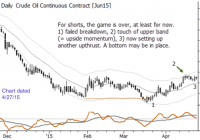
I initiated a short in crude oil back in July, and an astute reader sent me a good question. For many weeks/months, I had been operating with the assumption that crude oil was probably putting in a long-term bottom based on the action back in March/April of 2015; his question was how and why did I take a short against that bias. It’s a good and instructive question, so I thought I’d share the answer with you here. One of the advantages of writing about financial markets and publishing that work every day is that I have a record of what I was thinking and saying at any point in time. As I’ve written many times, I think journaling is one of the key skills of professional trading – this is a form of that. Let me set the background with some charts from a few months ago. A good place to start is in the aftermath of the 2014-2015 sell-off in crude oil. The market bounced in February 2015, set up another short attempt that more or less ran out of steam around the previous lows, and then rallied strongly off those March lows. In early April, I began to work with the idea that crude may have just put in a bottom. A chart says it better: (click to enlarge) Back in April, the case for a bottom in crude oil. Over the next few months, this thesis appeared to be playing out, but it’s important to remember that a bottom is a process. We don’t (usually) identify the absolute extreme of a move and then expect the market never to return. No, it’s far more likely that the market will go flat a while (check), and perhaps even re-test the previous extreme. This is normal, and it may even be those retests that really hammer the bottom in place. It’s easy to imagine hordes of traders thinking that crude oil is going to $20, entering short on a breakdown, and then watching in dismay as the market explodes to new highs after barely taking out the previous lows. A market will do whatever it can, at any time, to hurt the largest number of traders This, in fact, is nearly a principle of market behavior: A market will do whatever it can, at any time, to hurt the largest number of traders. That’s not just cynicism, I think it’s a legitimate consequence of the true nature of the market . Now, we certainly don’t want to be one of those gullible traders who gets tricked into shorting at exactly the wrong time, do we? So what do we do when the market gives us a nice, fat pitch right over the center of the plate, like this? A nice setup for a short, but what about the higher time frame conflict? And just to complete (or, perhaps, to further complicate) the picture, here’s the weekly chart from the same day: Thoughts on that higher time frame. So, just to clarify the situation here, in some bullet points, are the most important elements of market structure at the time we might have been thinking about a short entry: Within the past year, this market had a historic decline. Many people are inclined to think “Too far, too fast,” and that the move will reverse. On the other hand, maybe something fundamentally has changed. At the very least, we need to be aware that these might not be “normal” market conditions. After that historic decline, oil put in what looked like the first part of a bottom: A retest of lows, strong upside momentum off those lows, and then, daily consolidation patterns breaking to the upside. Following that step, the market went flat and dull, perhaps setting up a breakout trade. That breakout was to the downside, and a clear daily bear flag formed after the breakdown. Taking a short could mean going against the longer-term bottom (if it is forming), so what do we do? Many traders end up paralyzed with multiple time frames, as it’s easy to get overwhelmed with information. This is obviously a mistake, but there are also gurus who oversimplify the subject, saying, for instance, to only take a trade when it lines up with the higher-time frame trend. Though this idea is elegant and appealing, it falls short on several counts. For one, the best trades often come at turns, and if you wait to see an established trend, you’ll miss those trades; and even more importantly, the moving average-based trend indicators people use do not work like they think. (In fact, when a moving average trend indicator tells you a market is in an uptrend, at least for stocks, the stock is more likely go down !) Managing the conflicts How do we resolve all of this? I think this is a question that every trader must answer as part of his or her own trading plan. The one thing you probably cannot do is take each case as a new thing and try to make up rules for each situation. It’s far better to have a plan, and to then to follow that plan with discipline. For me, the answer is that a trade is just a trade. I have never been able to prove that having multiple time frames aligned actually increases the probability of those trades. (Though, those examples do sell books!) The way I think about it, if I have a higher-time frame trade that points up and a lower-time frame trade that points down, one of those trades will likely fail. I don’t know which, and I can’t know which in advance. If I knew the higher-time frame trend was more likely to work, I’d just trade that one, but in all intellectual honesty, I don’t know that. No one does. It’s possible that higher-time frame trend will fail because of the meltdown on the lower time frame, and if I’m positioned with that lower time frame, then I will be happy. It’s also possible I will get my first profit target even if the higher-time frame pattern “wins”, so I may be able to make money on both sides of the trade. Perhaps I want to skip the lower-time frame trade and just look for a higher-time frame trade around the previous low – that’s also a viable strategy. What matters is that I know what I will do in advance, and that I am honest about the limitations and constraints. We can only work within the laws of probability, and there are certainly limits to what can be known. It’s not a question of my competence as a trader, but of molding the methodology to fit the realities of the market. A trade is just a trade – avoid complications, and simplify.

Pioneer Municipal High Income Looks Attractive Here

Summary High tax exempt yield of nearly 7%. Very low leverage cost using auction rate preferreds. 7% discount to NAV for a fund that often trades at a premium. It looks like the Federal Reserve is getting ready to raise the short-term Fed Funds rates before the end of this year. Currently the Fed keeps the target rate in a range from zero to 25 basis points, or an average of 0.125%. Most likely the initial rate increase will be quite modest. There are several ways the Fed can increase the rate. Some possible options are: – Eliminate the range concept and set the new target interest rate at 0.25%. (average increase of 0.125%) -Bump up the range slightly to 0.125%-0.375%. (average increase of 0.125%) -Bump up in the range by 25 basis points to 0.25%-0.50%. I don’t think any of these rate increase options would surprise the market, and it is quite likely that the more important longer-term rates (like the 10-year Treasury rate) have already discounted any Fed rate increase. It wouldn’t surprise me to see a drop in longer-term rates once the uncertainty about the first Fed rate hike has passed. The 10-year yield in the US is now about 40 basis points higher than the 10-year yields in Spain and Italy, so there is plenty of room for a drop here. In years since 2008, there have been major changes in the financing of muni bond CEFs. The CEF auction rate preferred (e.g., ARP) market basically froze up in early 2008. There has been no new ARP financing since then. There was about $60 in billion in ARP financing outstanding in 2008, but most of this has been redeemed since then. A number of new leveraging options to replace ARP financing have been developed for muni bond CEFs, but these newer financing tools are currently more expensive than ARP financing by 50 basis points or more. The muni CEFs that have replaced ARP financing with these newer forms of leverage have lower earnings than before, which leads to lower sustainable dividends. Funds that have kept their ARP financing deserve to sell at a premium, or at least a lower discount to NAV. The Pioneer Municipal High Income Fund (NYSE: MHI ) is a leveraged national municipal bond fund. It seeks high current income exempt from regular Federal income tax with capital appreciation through investment in investment grade US tax exempt municipal securities. I have discussed various factors below, which I use to evaluate municipal bond closed-end funds. Note: Data below is sourced from the Pioneer Investments web site unless otherwise stated. Factor #1: What is the distribution rate? MHI currently has a high distribution yield of 6.91%. It pays a regular monthly dividend of $0.07 per share or an annual distribution of $0.84. Factor #2: What is the likelihood the fund can raise its monthly dividend? To determine this, I look at the Average Earnings/Current Dividend Ratio. This ratio tells you whether or not a fund is earning its current dividend. If the value is well above 100%, it means the fund can easily afford to raise its distribution rate. For MHI, the average earnings for April, 2015 was $0.0712, so the latest Average Earnings/Current Dividend ratio = 101.7%. This factor is a slight positive, since MHI over-earned its last distribution. There is a large positive value for “Undistributed Net Investment Income” or UNII Balance of +0.1622, which means that MHI has over two months of interest in reserve, which can cover future monthly shortfalls that may develop for quite some time. Factor #3: What is the Expense Ratio? I look at the Baseline expense ratio, which does not include leverage costs. MHI has a baseline expense ratio of 1.03%, which is reasonable for a fund with attractive low cost leverage. Factor #4: What is the discount to NAV? MHI is currently selling at a -7.46% discount to NAV. The 6-month average premium is 1.75%. The one year Z statistic is -1.94. So on a one-year basis, the discount is nearly two standard deviations below average. Overall, this factor is a big positive for MHI. Source: cefanalyzer Factor #5: How much leverage is used, and what is the borrowing cost? In the last annual report, the fund reported that 25% of the total managed assets were financed by leverage obtained through ARP financing. The maximum rate for each series is 125% of the 7 day commercial paper rate or adjusted Kenny rate. Dividend rates on APS ranged from 0.088% to 0.261% during the year ended April 30, 2015. This leverage is highly favorable and is a major positive factor for MHI. Factor #6: What is the AMT exposure? The fund did not provide recent AMT data, but up to 25% of the fund may be invested in securities subject to AMT. For this reason, this fund may not be ideal for investors with heavy AMT exposure. Factor #7: What is the credit quality? This is the S&P ratings quality breakdown for MHI as of 6/30/2015: AAA 6.82% AA 21.22% A 5.85% BBB 18.88% BB 8.51% B 8.32% CCC 2.35% Not Rated 26.52% MHI has medium to high credit risk with an average credit rating around BB+. Factor #8: What is the interest rate exposure? MHI has a weighted average life of 7.85 years and a duration of 9.17 years (leverage adjusted = 12.28). This is a little above average. I prefer funds with an average adjusted duration of 10.0 or less. Factor #9: What is the call exposure? Here is a table with the call exposure as of June 30, 2015: Under 5 years 48.8% 5-9.99 years 30.7% Over 10 years 1.0% Other 4.2%% Non-Callable 15.3% MHI has moderate call risk over the next few years if interest rates fall. For most investors, this is not a major concern, since they are worried more about higher interest rates than lower interest rates. Morningstar computes the average coupon rate of its bonds at 6% with an average price of 106. Given the high level of the UNII balance, there is only limited short-term risk to the monthly dividend even if interest rates fall more than expected. Factor #10: For a national fund, what is the breakdown by state? Top 5 States Texas 11.59% Illinois 11.40% New York 8.08% California 6.61% Washington 6.01% There is currently no exposure to Puerto Rico. Source: Morningstar Factor #11: How good is the trading liquidity? MHI has an average daily volume of 102,000 shares, and an average dollar volume of $1.25 million. Factor #12: What percent of the portfolio is in Housing-Multifamily bonds? I like to avoid funds where the Housing Multi-Family sector is above 10%. MHI has no exposure to housing bonds. Factor #13: Fund Management MHI is managed by David J. Eurkus and Jonathan Chirunga. Mr. Eurkus has more than 40 years of investment experience and has been the portfolio manager of the fund since inception. Mr. Chirunga joined Pioneer in 2011 and has been an investment professional since 1996. Based on the above 13 factors, I am currently quite positive on MHI. It is an attractive fund because of its high relative discount to NAV, very low leverage costs and reasonable expense ratio. Disclosure: I am/we are long MHI. (More…) I wrote this article myself, and it expresses my own opinions. I am not receiving compensation for it (other than from Seeking Alpha). I have no business relationship with any company whose stock is mentioned in this article.