Tag Archives: earnings-center

Best And Worst Q3’15: Information Technology ETFs, Mutual Funds And Key Holdings
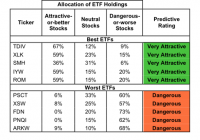
Summary Information Technology sector ranks second in Q3’15. Based on an aggregation of ratings of 28 ETFs and 129 mutual funds. TDIV is our top-rated Information Technology ETF and ROGSX is our top-rated Information Technology mutual fund. The Information Technology sector ranks second out of the 10 sectors as detailed in our Q3’15 Sector Ratings for ETFs and Mutual Funds report. It gets our Neutral rating, which is based on an aggregation of ratings of 28 ETFs and 129 mutual funds in the Information Technology sector as of July 9, 2015. See a recap of our Q2’15 Sector Ratings here . Figures 1 and 2 show the five best and worst-rated ETFs and mutual funds in the sector. Not all Information Technology sector ETFs and mutual funds are created the same. The number of holdings varies widely (from 23 to 397). This variation creates drastically different investment implications and, therefore, ratings. Investors seeking exposure to the Information Technology sector should buy one of the Attractive-or-better rated ETFs or mutual funds from Figures 1 and 2. Figure 1: ETFs with the Best & Worst Ratings – Top 5 (click to enlarge) * Best ETFs exclude ETFs with TNAs less than $100 million for inadequate liquidity. Sources: New Constructs, LLC and company filings Figure 2: Mutual Funds with the Best & Worst Ratings – Top 5 (click to enlarge) * Best mutual funds exclude funds with TNAs less than $100 million for inadequate liquidity. Sources: New Constructs, LLC and company filings The First Trust NASDAQ Technology Dividend Index ETF (NASDAQ: TDIV ) is the top-rated Information Technology ETF and the Red Oak Technology Select Fund (MUTF: ROGSX ) is the top-rated Information Technology mutual fund. Both earn a Very Attractive rating. The ARK Web x.0 ETF (NYSEARCA: ARKW ) is the worst-rated Information Technology ETF and The Rydex Internet Fund (MUTF: RYINX ) is the worst-rated Information Technology mutual fund. ARKW earns a Dangerous rating and RYINX earns a Very Dangerous rating. 527 stocks of the 3000+ we cover are classified as Information Technology stocks. Cisco Systems, Inc. (NASDAQ: CSCO ), a previous Stock Pick of the Week, is one of our favorite stocks held by TDIV and earns our Very Attractive rating. Since 2005, Cisco has grown after-tax profit ( NOPAT ) by 6% compounded annually. Cisco earns a top-quintile return on invested capital ( ROIC ) of 16% and has steadily become a free cash flow machine, generating $9.5 billion on a trailing-twelve month (TTM) basis. Fears of Cisco’s demise in a new age of technology have long kept the stock undervalued. At its current price of ~$28/share, Cisco has a price to economic book value ( PEBV ) of 0.9. This ratio implies the market expects Cisco’s profits to permanently decline by 10%. However, if Cisco can grow NOPAT by 5% compounded annually over the next decade , the stock is worth $36/share – a 28% upside. Proofpoint Inc. (NASDAQ: PFPT ) is one of our least favorite stocks held by ARKW and earns our Dangerous rating. Proofpoint is similar to many of our recent Danger Zone picks in that it touts high revenue growth but negative profits. From 2012-2014, Proofpoint grew revenue by 23% compounded annually. On the other hand, NOPAT declined from -$19 million to -$47 million. On a TTM basis, which includes 1Q15 results, NOPAT has fallen to -$52 million. Proofpoint’s pre-tax (NOPBT) margins are -26% and the company currently earns a bottom-quintile ROIC of -53%. The stock price has benefited from the hype surrounding cyber security companies and is now significantly overvalued. To justify its current price of $63/share, Proofpoint must immediately achieve 6% NOPBT margins (similar to peer Fortinet (NASDAQ: FTNT )) and grow revenues by 30% compounded annually for the next 16 years . If you want to be in a stock that benefits from the growth in cyber security, we recommend this recent stock pick of the week. Figures 3 and 4 show the rating landscape of all Information Technology ETFs and mutual funds. Figure 3: Separating the Best ETFs From the Worst ETFs (click to enlarge) Sources: New Constructs, LLC and company filings Figure 4: Separating the Best Mutual Funds From the Worst Mutual Funds (click to enlarge) Sources: New Constructs, LLC and company filings D isclosure: David Trainer and Max Lee receive no compensation to write about any specific stock, sector or theme. Disclosure: I/we have no positions in any stocks mentioned, and no plans to initiate any positions within the next 72 hours. (More…) I wrote this article myself, and it expresses my own opinions. I am not receiving compensation for it. I have no business relationship with any company whose stock is mentioned in this article.

To Rebalance Or Not To Rebalance

By Larry Cao, CFA Rebalancing is a topic that most professional money managers are familiar with and yet it is hardly clear to many whether this is a practice that actually adds value. I recently spoke with Jason Hsu , co-founder and vice chairman of Research Affiliates, on the subject while he was visiting in Hong Kong. If you follow our conversation, it seems like there is ample room for improvement. For example, are the people who have the most to gain from rebalancing actively engaged in the practice? Equally important, are those who are actively rebalancing actually benefiting from the exercise? These are questions to which all professional money managers should have crystal clear answers formulated in their minds. Enterprising Investor: Rebalancing is a somewhat mundane topic but it is extremely relevant for practitioners. You have done research on the subject and you are also an investor. Do you think investors should rebalance? Jason Hsu: Statistically, there is documented intermediate-horizon mean reversion in equity returns and long-term mean reversion in asset class returns. A naïve but effective way to benefit from mean reversion is to make sure that you regularly rebalance against past price movements. A lot of people call this contrarian trading. The magnitude of this rebalancing benefit is directly related to the magnitude of mean reversion. Where there might be potential disagreement about the benefit of rebalancing, it is due in part to language and definition. Some people define the benefit of rebalancing more narrowly. So there are two levels of rebalancing. One is at the asset class level for multi-asset strategies: you rebalance an asset class to its target weight. The other one is within each individual asset class: you rebalance each holding to its target weight. Which is generally more beneficial? In terms of the benefit from rebalancing, it is larger when applied within an asset class. Two features work in your favor when applying contrarian rebalancing within asset classes: (1) shorter mean-reversion horizon and (2) a larger cross-section. Mean reversion is a very noisy signal, thus you really need a lot of securities to make the effect work reliably. When you aggregate the effect across hundreds of securities within an asset class, the law of large numbers kicks in to wash out the noise and accentuate the mean-reversion effect. When applying contrarian rebalancing across asset classes, if you don’t have many distinct asset classes, the benefit would be more lumpy. Additionally, since the asset class mean-reversion horizon is a bit longer, you might have to wait a bit for the effect to really kick in and work for you. I think the number of securities plays an important role, correct? Quant models may do a terrific job at picking stocks – for example, a model’s top five picks does better than the top 10, the top 50 does better than the top 100, etc. But if you look at individual buy and sell transactions, it’s harder to show that they actually add value. This is also why investors often question whether rebalancing adds value. That’s a point oftentimes lost to more casual investors, in part because they are used to more traditional concentrated stock-picking managers, who supposedly have deep insights on every stock. But when it’s more quantitative in nature, the manager’s edge for each stock is actually relatively small. Most quant strategies attempt to exploit return patterns related to some assumed behavioral biases. However, these statistical patterns apply only on average; you are never quite sure how it will work for a particular stock at a particular point in time. This is why quant portfolios need a large number of securities. Rebalancing is a simple quant strategy aimed at taking advantage of price mean reversion; as such it needs a large cross-section of securities or as Richard C. Grinold and Ronald N. Kahn refer to – breadth . The classic argument of rebalancing to, say, a 60/40 portfolio, is more troublesome. You only have two asset classes, so you don’t have the law of large numbers on your side. The asset class mean reversion also takes place over a much longer horizon. We are talking about a minimum of five years. So at that level, if you try to measure the rebalancing benefit, I’m not surprised that most wouldn’t find satisfying evidence. This is also related to the empirical observation that the Shiller CAPE ratio, which is a popular quantitative signal for implementing contrarian rebalancing, has worked better for rebalancing among a number of equity indices than for timing rebalancing from stocks to bonds. The case for rebalancing, especially in the multi-asset context, is often made with the assumption that you have complete foresight. Obviously, these return (and risk) forecasts are often very far off. I think the average user grossly overestimates the benefit of estimating the optimal portfolio weight. What they don’t realize is the dispersion of expected returns for stocks and asset classes is very small. So we frankly couldn’t tell whether a 5% weight to Apple (NASDAQ: AAPL ) is more optimal than a 1% weight with any degree of confidence. This enormous uncertainty suggests that the notion of “optimal portfolio weights” is not at all realistic and trading aggressively based on presumed optimal weights is probably not advisable. So you think investors can compensate for the fact that optimal weights are sensitive to return and risk facts by not taking these weights too seriously? How do investors rebalance in practice? I think a lot of investors employ the following approach: Every year or two, you reformulate your capital market assumptions to determine the right weights to rebalance to. Like we discussed before, the challenge is that if your expected returns are set incorrectly, you could be rebalancing to very bad target weights. It is almost worse than not rebalancing. This often involves using a portfolio optimizer to set the optimal weights. Case in point, if you thought the expected returns for equities and credits were going to be -10% for 2009 in response to the negative shocks from the global financial crisis, the portfolio optimizer would most certainly set 0% weights for these two asset classes. That wouldn’t have worked very well. Let me share with you a really interesting finding on naïve versus sophisticated asset allocation. Victor De Miguel, Lorenzo Garlappi, and Raman Uppal ran a horse race between naïve equal weighting and optimization-based investment strategies, where portfolio weights were optimized using a variety of models for expected returns. Note that the equally weighted portfolio essentially professes no understanding of expected returns and covariance for securities – it only captures mean-reversion. Surprisingly nothing beats equal weighting. So it really drives home the point that oftentimes people’s dissatisfaction with regularly rebalancing to target weights isn’t that somehow rebalancing your portfolio is a bad concept. The poor experience is largely driven by the fact that your desired target weights coming out of an optimizer were not very good to start with. In some ways, fear and greed (and perhaps hubris) can cause us to focus too much on shifting the portfolio weights (often counterproductively) and thus forgo or diminish the benefit of contrarian rebalancing to capture mean reversion. If most people can’t do it right, then isn’t rebalancing less interesting? There is another approach to rebalancing, what I like to call the lazy approach. It doesn’t really use advanced theory to forecast returns and then optimize. Essentially, investors start with a policy portfolio that isn’t concentrated in a handful of securities or asset classes. If you then regularly rebalance back to this starting static weight, you should do alright over time in terms of capturing the mean-reversion effect. I think for the average investor without special forecasting skill or who is more prone to overconfidence in her return estimates, this lazy approach to rebalancing probably works best. The lazy camp rules. Is there an optimal frequency for rebalancing? You really don’t want to overfit the data and say, “Okay, for large-cap US stocks, I rebalance every 11 months because it gives the best looking backtest.” Determining the optimal rebalancing frequency is most likely a data mining exercise that won’t produce useful out-of-sample performance. Heuristically, I think rebalancing once a year seems quite dependable; this helps you avoid a lot of the short-term momentum effect. Sounds like a good rule of thumb. After taking into account all these challenges investors face, what are some of the strategies that most benefited from rebalancing? I think it is useful to think of contrarian rebalancing as buying cheap after prices have fallen and then selling high after prices have rallied. In a way, it is a flavor of value investing. For markets where value investing has historically worked well, contrarian rebalancing also works well. For example, contrarian rebalancing works really well for Japanese stocks, small-cap stocks, and emerging market stocks, on average. Disclaimer: Please note that the content of this site should not be construed as investment advice, nor do the opinions expressed necessarily reflect the views of CFA Institute.