Tag Archives: earnings-center

Reality Shares’ DIVS ETF: A Really Complex Dividend Tracker

Summary DIVY is Reality Shares’ primary ETF offering. DIVY is an interesting ETF that is based on dividend growth. DIVY, however, isn’t about income. If you love dividends, wouldn’t an exchange traded fund, or ETF, that ties itself to the growth of dividends be an ideal investment? The answer depends on what you want from your investments. This isn’t about income To get this out of the way up front, the Reality Shares DIVS ETF (NYSEARCA: DIVY ) isn’t looking to produce income for investors. So, if you like dividends for the income they provide, this ETF is not for you. However, if you like the fact that broader market dividends have a history of increasing over time and buy dividend stocks because you expect them to increase in value (capital appreciation) as their dividends increase, then, well, you might be interested… maybe. A little confused? You should be. DIVY is a very complicated ETF. For example, according to the sponsor, DIVY uses, “An investment strategy seeking to deliver the dividend growth of Large Cap Securities independent of stock price.” So, looking at this from a big-picture perspective, DIVY’s value is intended to increase by the amount that dividends grow. It is all about capital appreciation. But DIVY’s value won’t change based on the stock price movements of dividend paying stocks. Or at least that’s the goal, anyway. Why would you want that? Because dividends have historically grown in most years (though not every year). For example , the S&P 500 Index has seen dividends grow in 40 of the last 43 years. We all know painfully well that stocks have a habit of going up and down in often violent fashion. So dividend growth, while slow and steady, is really not well correlated with stock price movements. That offers diversification and, potentially, safety in broad stock market downdrafts. OK, that’s interesting. But remember, this is about capital appreciation, not dividends. So if you want income, you won’t find it here. An “option” to watch The thing is, DIVY can’t just buy dividend growth. It has to use an options strategy to mimic dividend growth: The Fund may purchase a series of listed index option contracts that, when combined together, are designed to eliminate the effect of changes in the trading prices of the Large Cap Securities and the effect of interest rate changes on the prices of the option contracts. As a result, the value of the Fund’s option portfolio is designed to change based primarily on changes in the expected dividend values reflected in the option prices. These option combinations are designed to reflect expected dividend values and eliminate the Fund’s exposure to changes in the trading prices of the Large Cap Securities. There’s a lot of math involved in figuring out how to turn that mouthful into actual investments. And, to be sure, it’s an impressive feat that DIVY even exists. But all that math leads to an expense ratio of around 0.85%, so in ETF land this is a pricy product. And then there’s the not-so-small fact that this is a relatively new product that hasn’t lived through a market downturn. The idea sounds really great, but that doesn’t mean it will stand the tests of a bear market. After all, DIVY is an ETF that trades based on supply and demand. True, it should trade fairly close to its net asset value, or NAV, because of the ETF structure, but it might not, too. Why do I say that? Because ETFs trade close to their net asset values because of the arbitrage available to large traders who take make payment in kind redemptions. For an S&P 500 Index that means getting all the stocks in the index. So, if an S&P 500 Index ETF is trading below its NAV a large investor will simply redeem via payment in kind and sell the securities it receives at a profit. But DIVY is a complex collection of options contracts. If it trades below its NAV, who’s going to want to own all those options contracts? In reality, it’s more likely that redemptions will be paid in cash , but DIVY has fees in place to discourage frequent creation and redemption activities. And what if everyone rushes to redeem at once? This process hasn’t been stress tested by a bear market and the fund’s complexity could mean it implodes at exactly the time when you are expecting it to hold steady. Wait for the next downturn At the end of the day, DIVY is an interesting concept that hasn’t proven itself. I’d suggest waiting and watching, for now. The idea sounds great, but then so did the idea of portfolio insurance, bonds backed by mortgages, and any number of other investment ideas that blew up in the face of adversity (tulip bulbs anyone?). If DIVY does what it’s supposed to, it could be a good addition to a diversified portfolio. If it doesn’t, you’ll be glad you waited before jumping aboard a complicated new product. Disclosure: The author has no positions in any stocks mentioned, and no plans to initiate any positions within the next 72 hours. (More…) The author wrote this article themselves, and it expresses their own opinions. The author is not receiving compensation for it (other than from Seeking Alpha). The author has no business relationship with any company whose stock is mentioned in this article.
Best And Worst: All Cap Value ETFs, Mutual Funds, And Key Holdings

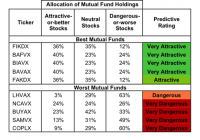
Summary All Cap Value ranks sixth in 2Q15. Based on an aggregation of ratings of 256 mutual funds. FIKDX is our top rated All Cap Value mutual fund and COPLX is our worst rated All Cap Value mutual fund. The All Cap Value style ranks sixth out of the 12 fund styles as detailed in our 2Q15 Style Rankings report . It gets our Neutral rating, which is based on an aggregation of ratings of 256 mutual funds in the All Cap Value style. There are no All Cap Value ETFs under coverage. Figure 1 shows the five best rated and five worst rated All Cap Value mutual funds. Not all mutual funds are created the same. The number of holdings varies widely (from 22 to 1148). This variation creates drastically different investment implications and therefore, ratings. Investors seeking exposure to the All Cap Value style should buy one of the Attractive-or-better rated mutual funds from Figures 1 and 2. Figure 1: Mutual Funds with the Best & Worst Ratings – Top 5 (click to enlarge) * Best mutual funds exclude funds with TNAs less than $100 million for inadequate liquidity. LSV U.S. Managed Volatility Fund (LSVMX, LVAMX) is excluded from Figure 1 because its total net assets are below $100 million and do not meet our liquidity minimums. Advisors’ Inner Circle Frost Kempner Multi-Cap Deep Value Equity Fund (MUTF: FIKDX ) is our top rated All Cap Value mutual fund. One of our favorite stocks held by All Cap Value funds is Qualcomm (NASDAQ: QCOM ). Over the past decade, Qualcomm has grown after-tax operating profit ( NOPAT ) by 18% compounded annually. Every year since 2003, with the exception of 2008, Qualcomm has generated positive free cash flow , with a cumulative $27 billion in free cash flow over this timeframe. Economic earnings have also grown at a compounded annual rate of 20% and been positive in 15 of the past 17 years. Despite the excellent growth in the underlying business operations, the market has failed to properly value Qualcomm, creating a great investment opportunity. At its current price of ~$67/share, QCOM has a price to economic book value ( PEBV ) ratio of only 0.9. This ratio implies the market expects Qualcomm’s NOPAT to permanently decline by 10%. This seems unlikely given the strength of Qualcomm’s business. If Qualcomm can grow NOPAT by 10% compounded annually for the next six years , the stock is worth $108/share today – a 61% upside. Copley Fund, Inc. (MUTF: COPLX ) is our worst rated All Cap Value mutual fund One of the worst stocks currently in the All Cap Value style funds is Intersil Corporation (NASDAQ: ISIL ). We recently put ISIL in the Danger Zone , citing many of the problems below. Since 2006, Intersil’s NOPAT has declined by 24% compounded annually. Along with its declining NOPAT, the company’s margins have declined dramatically from a high of 19% in 2006 to their current level of 2%. Intersil’s ROIC has also declined to 0%, down from 8% in 2006. As a result, the company is extremely overvalued, with a PEBV ratio of 7.3. To justify its current valuation of $13/share, ISIL would need to grow NOPAT at 41% compounded annually for the next 13 years . This appears to very optimistic considering that ISIL has realized declining revenues since 2006. Figure 2 shows the rating landscape of all All Cap Value mutual funds. Figure 2: Separating the Best Mutual Funds From the Worst Funds (click to enlarge) Sources Figures 1-2: New Constructs, LLC and company filings D isclosure: David Trainer owns QCOM. David Trainer and Allen L. Jackson receive no compensation to write about any specific stock, style, style or theme. Disclosure: The author is long QCOM. (More…) The author wrote this article themselves, and it expresses their own opinions. The author is not receiving compensation for it. The author has no business relationship with any company whose stock is mentioned in this article.

Momentum And Stop Losses

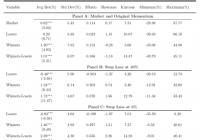
Stop losses are a form of trend following in which you switch from risky assets, such as stocks, to a risk-free or fixed income asset after there are pre-determined cumulative losses. The random walk hypothesis (RWH) was widely accepted in the 1960s and 1970s. It was synonymous with market efficiency. It effectively eliminated any academic interest in stop loss rules. Under RWH, with stock returns being independent, stop losses would decrease a strategy’s expected return. There remains a cultural affinity to RWH despite strong contrary evidence now. This may explain why there is still considerable indifference to stop loss policies and trend following in general among institutional investors, who were schooled in old academic ideas. In their paper, ” When Do Stop-Loss Rules Stop Losses? “, Kaminski and Lo (2013) show both theoretically and empirically that if stock returns have positive serial correlation (there is overwhelming evidence that they do), then stops can add value. Over monthly intervals of daily stock futures data from 1993 through 2011, the authors found that volatility-based stop loss rules could increase monthly returns 1.5% while substantially decreasing volatility. When stopped out of stocks, long-term bond futures are used as a safe harbor asset. In ” Taming Momentum Crashes: A Simple Stop-Loss Strategy “, Han, Zhou, and Zhu (2014) showed the effectiveness of a stop loss overlay applied to a momentum-based strategy. The authors examined the top decile of U.S. stocks from 1926 through 2011 based on relative strength momentum over the preceding 6 months (the authors showed similar results using 12-month momentum). They sold any stock if it dropped 10% below the beginning price of the month. They followed the same procedure for short positions. Portfolios were rebalanced monthly. This stop loss strategy raised the average monthly return from 1.01% to 1.73% (buy and hold was 0.62%) and reduced the monthly standard deviation from 6.07% to 4.67%. [1] Momentum crash risk (from short positions) was completely eliminated. The worst monthly return for buy and hold was -28.98%, while the worst monthly return for an equally weighted momentum strategy was -49.79%, showing the increased risk of applying momentum to individual stocks. The stop loss overlay improved the worst monthly return to only -11.34%. For value weighted portfolios, the maximum monthly loss for momentum and stop loss portfolios were greater at -65.34% and -23.69%, respectively. Average returns and Sharpe ratios doubled by using stops. This stop loss strategy had a positive skewness of 1.86, versus a negative skewness of -1.18 for the original momentum strategy, indicating a dramatic reduction in left tail risk when using stops. Both these papers show theoretically and empirically that risk control overlays, such as stop loss rules, can have dramatically positive effects on momentum-based strategies. This applies also to other trend following forms of risk control, such as moving average filters and absolute momentum, that may work as well or better than stops (the subject of a future post). Stop losses and other trend following methods are a way to head off some of the usual pitfalls of human judgement, such as the disposition effect, loss aversion, ambiguity aversion, and flight to safety. There is no reason why they should not be used by all momentum investors. [1] Stop loss strategies increased trading activity by 40%, but increases in return of about 70% helped overcome these high transaction costs.