Tag Archives: earnings-center

New ETFs Offer Alternative Approaches To Income And European Equity Markets

By DailyAlts Staff Bond prices have been falling over the past several months as investors are becoming increasingly convinced that the Federal Reserve will hike short-term interest rates in the U.S. later this year for the first time since 2006. Higher short-term borrowing rates will increase the rates of return demanded by investors, and newly issued bonds with higher interest rates will make existing bonds at fixed yields less attractive by comparison – this will be bearish for the bond market. Higher rates are also likely to give the dollar strength, relative to foreign currencies, since higher-yielding currencies are more attractive to foreign investors. These factors make for a challenging environment for investors, but fortunately, new liquid alternative products have been designed to address the challenges of higher interest rates and a volatile foreign exchange market. Two such products – the Global X YieldCo Index ETF (NASDAQ: YLCO ) , offering non-bond investment income; and the PowerShares Europe Currency Hedged Low Volatility Portfolio ETF (NYSEARCA: FXEU ) , providing European equity exposure without the currency risk – both launched in May. YieldCo Index ETF YieldCos are an “emerging asset class of income-generated assets,” according to a statement announcing the launch of the Global X YieldCo Index ETF. Most YieldCos, which are often compared to Master Limited Partnerships (MLPs), are in the renewable energy sector. “YieldCos exhibit three key investment characteristics many investors have been looking for: high current income, lower volatility, and the potential for dividend growth,” according to Jay Jacobs, a research analyst at Global X Funds. YieldCos are typically formed when existing energy companies spin off assets such as wind or solar farms, with long-term contracts designed to return cash to shareholders. Unlike MLPs, YieldCos are set up as traditional corporations and therefore don’t require K-1 tax forms. “We are excited to provide investors with access to a new source of potential alternative income, which has traditionally been limited to MLPs and REITs,” said Mr. Jacobs. “YLCO allows investors to participate in this growing field of yield-generating renewable energy projects.” The expense ratio for YLCO is 0.65%. For more information, visit the ETF’s fund page at globalxfunds.com . Currency-Hedged Low Volatility The PowerShares Europe Currency Hedged Low Volatility Portfolio ETF is based on the S&P Eurozone Low Volatility USD Hedged Index, and aims to provide investors with exposure to European stocks without the currency risk and with dampened volatility. The index is based on a simple methodology: The 80 stocks from the S&P Eurozone BMI Index with the lowest realized volatility over the past 12 months are selected and then weighted inversely according to volatility. The portfolio is then 100% currency-hedged to the U.S. dollar using rolling one-month forward contracts that are adjusted monthly. “International investing is often accompanied by the risks of uncertain stock selection and foreign exchange fluctuations,” said Dan Draper, Managing Director and Head of Invesco PowerShares, in a recent statement. “FXEU allows participation in the European equity market’s potential upside while aiming to protect portfolios from potential market downturns.” The expense ratio for FXEU is 0.25%. For more information, visit the fund’s product page .
Avoiding The Pitfalls Of Factor-Based Investing

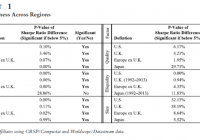
By DailyAlts Staff The proliferation of smart beta ETFs may be a relatively recent phenomenon, but the risk factors used to construct smart-beta indexes – most notably value, momentum, low beta, quality, illiquidity, and size – have been a popular topic for financial researchers for nearly three decades. Building off the early handful of factors, factor-based investing has since been expanded to as many as 250 distinct factors that have allegedly generated historical outperformance, but Research Affiliates’ Jason Hsu, Vitali Kalesnik, and Vivek Viswanathan argue that the supposed outperformance of most (if not all) of these new factors is illusory, based on cherry-picking by researchers and “artifacts” of the data. In fact, Mr. Hsu and his colleagues believe at least one of the traditional factors may be unlikely to generate superior risk-adjusted returns going forward. The researchers make their case in the Summer 2015 edition of The Journal of Index Investing , in an article titled “A Framework for Assessing Factors and Implementing Smart Beta Strategies.” Factor Robustness Hsu, et al. allege that economists, financial researchers, and other quantitative analysts are constantly trying to determine new factors, and that only their positive results are likely to get published. New research undermining an existing and semi-popular factor is unlikely to make it to the stage of peer review, according to Research Affiliates. This means that investors, advisors, and other decision-makers must test would-be factors for robustness themselves. Behind the quantitative data, Hsu, et al. insist that factors must be based on economic intuition and make sense within a theoretical framework – otherwise, they’re likely to be statistical noise. Factor premiums can be based on risk or behavioral issues, but in either case, they should span across geographic markets. If back-testing reveals a factor premium for U.S. stocks, that same premium should be evident in Japan and elsewhere. But when analyzed across geographic regions, only the value and low-beta factors consistently hold up; while momentum, quality, and illiquidity are mixed; and size shows no consistency whatsoever. (click to enlarge) Factor Perturbations Since legitimate factors must make intuitive sense, it stands to reason that they should hold up under “perturbations” of their definitions. For example, the value factor is typically defined with book-to-price ratio, but dividend yield and earnings yield (earnings-to-price) also make sense. Therefore, if the value premium were only evident when measured according to book-to-price, the theoretical framework would crumble. Fortunately for value investors, Research Affiliates’ research indicates that value holds up well under a variety of definitions – as do the momentum, low-beta, and illiquidity factors – but quality and size do not. (click to enlarge) Size Doesn’t Matter? According to Hsu, et al., the small-size factor premium is based on back-testing that includes several months of major small-cap outperformance back in the 1930s, and the factor has not generated alpha since its discovery in the early 1980s. Of course, the 1930s were a time of deflation (strengthening dollar) and the 1980s kicked off a 30-year bull market in bonds (weakening the dollar), which could play a significant role in the data. Today, it is generally assumed that small-cap stocks – with a higher degree of U.S. dollar exposure – benefit from a strong currency. Implementation and Allocation Hsu, et al.’s paper looks into implementation and allocation issues, as well, and notes that transaction costs are rarely taken into account by factor-based investors – and this is a mistake. To maximize risk-adjusted returns, factor-based investors should rotate their portfolios only as often as is necessary to capture the factor premium, and no more. The authors say that factor allocation faces many of the same challenges as asset allocation, and that smart-beta solutions should be customized to meet individual investors’ unique risk tolerances. For more information, visit researchaffiliates.com to download a pdf copy of the paper .

Equal Weight Energy ETF: A Better Way To Tap Oil Rebound?

The energy sector has been gaining ground in recent months after the U.S. oil price rebounded strongly, gaining over 33% from a six-year low of around $45 per barrel hit in January. This is primarily thanks to the billions of dollars in spending cuts, shrinking U.S. oil rigs counts, higher crude oil processing by the U.S. refiners, and consolidation. Will the bullish trend continue in the coming months too? If we look at the demand/supply trends, demand is definitely on the rise but not enough to meet the growing global supply gut, suggesting range-bound trading for the oil and energy stocks. Additionally, strong dollar has been a major headwind for the oil prices. Mixed Trends The peak summer season will drive up the demand for the oil products, in particular gasoline, pushing the energy prices higher. As a result, the International Energy Agency (IEA) raised the global demand growth outlook by 280,000 barrels a day to 1.40 million barrels, bringing total daily demand to almost 94 million barrels for this year. While the agency projects a rise in global demand, oil supplies continue to exceed demand this year. This is because the Organization of Petroleum Exporting Countries (OPEC) is pumping up maximum oil in more than two-and-a-half years buoyed up by higher output from Iraq and Iran. It is currently producing about a million barrels a day against its target of 30 million barrels a day to protect market share and meet growing demand. Notably, the top oil exporter – Saudi Arabia – has boosted its production to at least a three-decade high. Further, oil production in the U.S. has been on the rise and reached another record high of 9.6 million barrels per day last week, in more than 40 years. However, it is expected to show some signs of slowdown in June through early 2016. This is especially true as oil production from the seven major U.S. shale plays will likely fall by 1.3% in June and further by 1.6% in July. The latest positive inventory data report from the U.S. Energy Information Administration (EIA) also showed that crude supplies fell for the sixth straight week (ending June 5). Given mixed fundamentals, investors are definitely looking for a safe and quality choice in this rebounding sector. While there are several energy ETFs available in the market, the Guggenheim S&P 500 Equal Weight Energy ETF (NYSEARCA: RYE ) could be an excellent play. RYE in Focus The fund offers equal weight exposure to 41 stocks in the basket by tracking the S&P 500 Equal Weight Index Energy. None of the firm holds more than 3.03% of the total assets. In terms of industries, oil, gas and consumable fuels takes the top spot at 70.5% while energy equipment and services account for the remaining portion. The product gained nearly 6.6% over the past three months, easily outpacing the broad sector fund – the Energy Select Sector SPDR ETF (NYSEARCA: XLE ) – by over 200 bps. Further, RYE is also leading the way higher from the year-to-date look, with gains of 0.06% against the loss of 1.03% for XLE. Why RYE is Beating XLE The outperformance was mainly driven by its equal allocation across various securities, which prevents heavy concentration and provides a nice balance across various securities. With quarterly rebalancing, the product tends to cash in on the overvalued stocks and reinvest in the underperforming ones, potentially allowing outperformance on solid fundamentals. RYE is also nicely spread out across the two spectrums of market capitalization levels with 52% in large caps and 40% in mid caps. Further, about three-fifths of the portfolio is tilted toward value stocks that appear safe and appealing for investors in a volatile market. Value investing strategy includes stocks with strong fundamentals – earnings, dividends, book value and cash flow – that trade below their intrinsic value and are undervalued by the market. As a result, value stocks often overreact to both positive and negative news, resulting in movement in the share prices that do not reflect the company’s true long-term fundamentals. This creates buying opportunities in such stocks at depressed prices and offers the potential for capital appreciation when the stock finally reflects its true market price. As a result, the combination of large or mid-caps and value stocks help to provide stability in the portfolio in an uncertain environment while also offer a significant upside potential when the trend reverses. While the fund goes a long way in reducing overall risk, investors should note that it is a relatively high cost choice in the space. It charges a bit higher fee of 40 bps compared with the expense ratio of 0.15% for XLE. Further, RYE is illiquid, exchanging just 43,000 shares a day in hand on average suggesting additional cost in the form of bid/ask spread, though it has a decent level of $173.8 million in AUM. Bottom Line Given its equal weighted strategy and diversification benefits, this energy ETF could prove more beneficial to investors compared to the other products in the space. The solid run in the product is expected to continue in coming months even amid volatile oil trading. Link to the original post on Zack.com