Tag Archives: author

Bill Gross Has Started To Sell His Pimco Closed-End Funds

Summary This week there have been a few SEC Filings with Pimco Fund Sales. Thus far only three funds have been partially sold. The selling may provide a good buying opportunity at some point. I have previously written some articles describing Bill Gross purchases or sales of Pimco closed-end funds. While he worked at Pimco, Mr. Gross often supported Pimco’s CEFs with his personal money. There was also “copycat” buyers who often followed Mr. Gross into some of these issues. Bill Gross resigned from Pimco on September 26. Since then, closed-end fund investors have been wondering whether or not Mr. Gross would sell some or all of his Pimco CEF holdings. This week we finally started to see some SEC filings with sales of Pimco CEFs from Mr. Gross. These are the first trades since Mr. Gross resigned from Pimco in September. There is normally a two day filing delay, so the filings for February 5 show the trades done on February 3. It remains to be seen whether the selling is completed, but in the past, buying or selling often continued for a week or longer. Shares Tkr Sell Date Average Price $ Realized Discount/Premium (Feb. 5) 50,000 PDI 3-Feb 30.2641 $1,513,205 -0.8% 32,733 PDI 2-Feb 30.304 $991,941 6,630 PTY 2-Feb 16.7823 $111,267 +19.2% 22,649 PCN 3-Feb 15.3397 $347,429 +4.2% 29,200 PCN 2-Feb 15.3856 $449,260 Bill Gross owns several Pimco closed-end funds that hold tax free municipal bonds. PCQ and PZC hold tax free bonds from the state of California. Even though his new employer, Janus Capital Group, has headquarters based in Colorado, Mr. Gross has arranged to work out of an office in California. For this reason, I expect he will likely hold onto his California muni bond funds. Some of his other national muni bond fund positions may be sold depending on their cost basis to be replaced with similar funds from Janus. One fund that Mr. Gross has not sold yet that still looks fairly attractive is PCI. I’ve included some summary data for PCI below. But keep in mind that Mr. Gross currently owns about 2.4 million shares of PCI, so if he ever did decide to sell PCI, there could be quite an overhang. Pimco Dynamic Credit Income (NYSE: PCI ) -pays monthly Total Assets= 5,717 MM Total Common Assets= 3,096 MM Annual Distribution (Market) Rate= 9.12% Latest Monthly Distribution= 0.1563 (annual= $1.8756) Average Monthly Earnings per Share= $0.1804 (as of 06/30/2014) Fund Baseline Expense ratio= 1.30% Discount to NAV= -8.9% Average Six Month Discount= -8.8%% Effective Leverage: 46% Average Daily Volume: 712,000 Average $ Volume: 14.6MM Manager: Dan Ivascyn + team Disclosure: The author is long PCI. (More…) The author wrote this article themselves, and it expresses their own opinions. The author is not receiving compensation for it (other than from Seeking Alpha). The author has no business relationship with any company whose stock is mentioned in this article. Are you Bullish or Bearish on ? Bullish Bearish Neutral Results for ( ) Thanks for sharing your thoughts. Submit & View Results Skip to results » Share this article with a colleague
Update: Southern Company – Construction Stays An Overhang

Company undertaking growth investments to expand and improve regulated operations. Healthy capital outlook indicates that future growth will stay healthy. Company generates almost 90% of its consolidated earnings from regulated operations. Southern Company (NYSE: SO ) continues to stay a good investment prospect for income-seeking investors, as it offers a solid yield of 4.1% . The company has been undertaking growth investments to expand and improve its regulated operations, which will augur well for its long-term earnings growth. The company’s healthy capital outlook indicates that its future growth will stay healthy. Also, as the company generates almost 90% of its consolidated earnings from regulated operations, its future earnings visibility stays high. However, as the company has been constructing new power generating plants, there is a risk of delays and cost overruns. The construction of plants will weigh on the stock price in the near term and will limit any stock price upside. The company’s operational performance stays satisfactory. The company reported an operating EPS of $0.38 for 4Q’14, in line with analyst expectations. Also, the reported operating EPS of $2.80 for full year 2014 was in line with the consensus of $2.80. The company reported quarterly revenues of $4.01 billion for 4Q’14, representing an increase of 3% year-on-year. Revenue growth for the quarter was driven by healthy industrial sales growth of 2.3%. Moreover, the company reported strong full year 2014 revenue growth of 8.3% year-on-year. Also, the company is expecting total retail sales growth of 1.3% in 2015, which will be driven by 1.7% industrial sales growth. And the company provided the 2015 EPS guidance of $2.76-$2.88, representing an increase of 3-4% year-on-year. A key growth catalyst for Southern Company stays its healthy capital spending outlook . The company has planned to incur capital spending of $16.6 billion from 2015 through 2017, which will drive its future growth. The following table shows future capital spending. 2015 2016 2017 Capital Spending ($-billion) $6.8 billion $5.5 billion $4.3 billion Source: Investors Presentation The company’s operating performance stays satisfactory; however, the construction of ongoing power generating projects remains a risk to its future earnings, as I stated in my previous article. The company registered an incremental after tax charge of $43 million because of cost overruns and a delay in its Kemper project. The project is now scheduled to be in service in the first half of 2016. The company also announced an 18-month delay and an expected cost increase of $720 million for its Vogtle project. The construction of ongoing projects will weigh on the stock price. The company’s operating performance stays satisfactory. The impressive capital spending outlook will drive its future earnings growth, and the stock stays a good investment prospect for income-seeking investors. However, cost overruns and delays of ongoing construction projects will stay a risk for the stock price in the near term, and will limit any stock price upside. Also, the stock’s return in 2015 will be mainly dividend driven. Disclosure: The author has no positions in any stocks mentioned, and no plans to initiate any positions within the next 72 hours. (More…) The author wrote this article themselves, and it expresses their own opinions. The author is not receiving compensation for it (other than from Seeking Alpha). The author has no business relationship with any company whose stock is mentioned in this article.

11 Stocks Plus Cash Saw $24,000 Grow To Over $1 Million

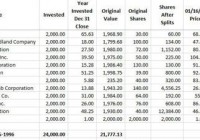
Summary Start in 1985 with a $2,000 investment in cash. Make one $2,000 investment at the end of the year from 1986 through 1996. Investments are assumed to be made in an IRA to shelter from taxes. The first $2,000 was invested in cash to pay for commissions and other fees. The average investor can save a tidy sum for retirement. It takes some luck, perseverance, and a buy and hold approach. The portfolio constructed would generate $22,400 in dividends for 2015. The portfolio was constructed by entering stock symbols into a spreadsheet in random order. The model assumed a $2,000 a year investment from 1985 through 1996 or 12 years. The first – year investment of $2,000 was invested in cash to account for commissions and other fees. The results are not actual results, but hypothetical results. Dividends that would have been earned on investments have been ignored or assumed to have been invested in stocks that blew up and went to zero ($0.00). The results generated most likely are influenced by a survivor basis. Nevertheless, the exercise proved useful. Data was obtained from company websites and or Yahoo Finance. The performance results are handicapped by not accounting for dividends paid since purchase nor assuming they are reinvested. The portfolio results presented are conservative to consider a worst case rather than an unrealistic best case. This is part one. The second part will cover the years 1998 through 2014. The model portfolio is shown below. (click to enlarge) Chart of the stock performance since inclusion into the model portfolio is shown below. Kellogg (NYSE: K ) K data by YCharts Archer Daniels Midland (NYSE: ADM ) ADM data by YCharts Starbucks (NASDAQ: SBUX ) SBUX data by YCharts The Home Depot (NYSE: HD ) HD data by YCharts Exxon Mobil (NYSE: XOM ) XOM data by YCharts Stryker (NYSE: SYK ) SYK data by YCharts Caterpillar (NYSE: CAT ) CAT data by YCharts Charles Schwab (NYSE: SCHW ) SCHW data by YCharts JPMorgan (NYSE: JPM ) JPM data by YCharts Wal-Mart (NYSE: WMT ) WMT data by YCharts Microsoft (NASDAQ: MSFT ) MSFT data by YCharts Bottom line: With a little luck and experience, it is possible for a modest investment to grow into a nice nest egg. What do you think? Disclosure: The author is long ADM, SYK, SCHW, JPM, MSFT. (More…) The author wrote this article themselves, and it expresses their own opinions. The author is not receiving compensation for it (other than from Seeking Alpha). The author has no business relationship with any company whose stock is mentioned in this article. Are you Bullish or Bearish on ? Bullish Bearish Neutral Results for ( ) Thanks for sharing your thoughts. Submit & View Results Skip to results » Share this article with a colleague