Tag Archives: alternative

Attractive Valuations And Potential To Outperform Peers Are Highlights Of American Electric Power
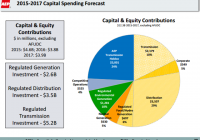
Summary Stock should trade at a 5%-10% premium to its peers’ average forward P/E. Company’s business fundamentals remain strong and efforts to strengthen regulated operations will bode well for stock price. As AEP increases regulated operations, its cash flows will become more certain, which will support dividend growth. American Electric Power (NYSE: AEP ) has strong business fundamentals and its future financial performance is expected to be solid. The stock stays an attractive investment prospect for income-seeking investors, as it offers a solid yield of 3.9% . Moreover, the company’s future growth is expected to stay strong, which will be mainly driven by its capital spending, directed at strengthening and expanding its regulated business operations. The company’s focus on regulated business operations is gaining significant traction, and it expects to achieve long-term growth of 4%-6%. Moreover, an important decision American Electric has to make in the next 3-6 months is regarding the faith of its merchant assets; either the company will sell the assets or continue to operate them. Furthermore, the stock’s current valuations are attractive. Strong Performance and Growth Catalysts American Electric has been delivering a strong financial performance, which is expected to continue in future, mainly driven by its increased focus on regulated operations. The company reported EPS of $0.88 for 2Q2015, beating consensus of $0.81. Also, rate increases and cost control initiatives positively affected American Electric’s performance for the quarter. In 2Q2015, the company secured a $123.5 million annual revenue increase and ROE of 9.75% in West Virginia, along with a $45.4 million annual revenue increase and ROE of 10.25% in Kentucky. Given the strong performance in the first half of 2015, the company increased its mid-point of 2015 EPS guidance by 2%; increased 2015 EPS guidance from $3.4-$3.6 to $3.5-$3.65 . In recent times, the company increased its focus on regulated operations, as the performance of unregulated/merchant operations has stayed weak and volatile because of low forward power prices. The company has a robust capital spending outlook, which will fuel its revenues and earnings growth in future years; American Electric plans to incur capital spending of $12.3 billion from 2015-2017. As the company has increased its focus on strengthening its regulated operations, 96% of the planned capital spending will be allocated to regulated business. Also, the company increased its 2015 capital spending guidance from $4.4 billion to $4.6 billion ; as the company continues to make progress with its cost control measures under its continuous improvement program, it freed up an additional $200 million for capital investment for 2015. The following chart shows the breakdown of the company’s planned capital spending. (click to enlarge) Source: Investors Presentation As forward power prices remain weak and volatile, utility companies in the U.S. are taking initiatives to reduce their merchant power operations. American Electric is also considering different strategic options for its 7,900MW of competitive fleet. I think that in the next 3-6 months, the company will make a decision regarding the future of its merchant assets, as currently it waits for the PJM auction results and for the pending Ohio PPA proposal. I think the best option for the company is to sell its merchant assets, as it will allow it to completely focus on regulated operations, which will improve its revenues and cash flow stability, and will augur well for the stock valuation. Moreover, I believe the company’s merchant assets sale value could range from $2 billion to $3.2 billion, depending on the outcome of the PJM auction prices, which are expected to settle by mid-August. Also, if the company chose to sell its merchant assets, it can direct the sale proceeds to increase its planned capital spending for future years, which will have a positive impact on the stock price. Other than the robust capital spending profile, the company has been making consistent efforts to improve its credit outlook. The company has successfully managed to reduce its total debt to total capitalization ratio from 57% in 2010 to 54.3% in 2Q2015. Also, the company’s qualified pension funding stands at 101% in 2Q2015, up from 96% in 1Q2015 and 97% in 2014, as displayed below in the figures. (click to enlarge) Source: Investors Presentation Valuation and Summation The stock’s current valuation stays attractive, as it is trading at a forward P/E of 15.08x , in contrast to its peers’ average forward P/E of 15.5x. Given, the company’s solid financial performance and robust capital spending profile, which will fuel its future growth, I think the stock should trade at a 5%-10% premium to its peers’ average forward P/E. Also, the company’s business fundamentals remain strong and the company’s efforts to strengthen its regulated operation will bode well for the stock price. And if the company chose to sell its merchant assets, its business risk profile will improve, as revenues and earnings will become more stable. Moreover, as the company is increasing its regulated operations, its cash flows will become more certain, which will support its dividend growth. Disclosure: I/we have no positions in any stocks mentioned, and no plans to initiate any positions within the next 72 hours. (More…) I wrote this article myself, and it expresses my own opinions. I am not receiving compensation for it (other than from Seeking Alpha). I have no business relationship with any company whose stock is mentioned in this article.

Asia Pacific Fund: A Conservative And Extremely Undervalued Option

Summary The Asia Pacific Fund currently has extremely low valuation and is trading at a discount of 12.28%. The fund’s investment approach is extremely diversified, making it a conservative means to profit from economic growth in the Asia Pacific Region. The fund’s valuation is more attractive than other exchange traded funds that invest into high growth Asian countries. The Asia Pacific Fund (NYS APB ) is current a very attractive buy, and perhaps one of the best opportunities for investors seeking to take advantage of opportunities offered from discounted closed end funds. The fund invest in listed equity in the Asia Pacific region and is managed by Value Partners Hong Kong Limited. Historical performance of the fund has been positive, and the liquidity risk is negligent; the fund has an average trading volume of 18,562. One current unique opportunity that this fund presents is that it is currently trading at a discount of 12.28% , providing opportunity for those willing to take a long term investment approach. For a fund that invests into Asia, the valuation is extremely low at the moment; the fund currently has a P/E of 7.5. This is exceptionally lower than other exchange traded funds that invest in high growth countries in Asia, such as the Philippines , Vietnam , and Indonesia . The fund takes a very diversified approach to Asia, as the top 10 holdings for the fund only make up 34.1% of the fund. Moreover, geographical diversification within the Asia Pacific region is very strong; the fund invests in China, Hong Kong, South Korea, Taiwan, Singapore, Thailand, Indonesia, The Philippines, and Malaysia. High geographical diversification in a region that is on track to prosper in the future, further attributes to the logic of investing in this fund. These facts, coupled with the fund having low valuation and trading at a discount, provides a conservative and ideal investment opportunity. Fund Performance The fund seeks to track the performance of the MSCI All Countries Asia Ex. Japan Index, and was able to outperform the MSCI Europe and the S&P 500 Composite this year. Performance this year has been substantial, and is on track to continue based on growth projections for the Asia Pacific region. Investors who are willing to take a long term bullish view of Asia can benefit from investment in this fund. 1 Year % 3 Year % 5 Year % 10 Year % Asia Pacific Fund 12.4% 9.9% 16.37% 131.1% MSCI AC Asia Ex Japan 11% 22.9% 37.2% 161.2% S&P 500 Composite 10.4% 46.8% 76.8% 75.2% MSCI Europe -4.4% 33.2% 40.4% 70.1% Source: The Asia Pacific Fund March 31, 2015 Industry Approach The fund invests its assets into a variety of industries, and the majority of its assets are invested in the following industries: Real Estate: 17.6% Banking: 16.8% Consumer Discretionary: 16.1% Industrials 10.1% Consumer Staples: 7.4% Telecommunication Services: 6.2% The industry approach is very diversified, provide a conservative means to access growth in the Asia Pacific region. Holistically, growth in the Asia Pacific region is set to outperform the rest of the world, with 5.5% Per Annum GDP Growth projected for 2015-2016. Specific opportunities can be found in the consumer products industry, as consumption will inevitably increased with the increased economic growth in this region. Moreover, increased economic activity will also be a major catalyst for the real estate industry, particularly in the increased demand for office rentals. Conclusion This fund provides a unique and simplistic opportunity for investors to leverage off of growth in the Asia Pacific Region. The following factors make this fund relatively favorable to other investment approaches in Asia. The fund is trading at a 12.28% discount and has a P/E of 7.54, which is much more attractive than other alternatives in Asia. The only area of concern is the timeframe required to reconcile the fund’s trading price. The fund’s investment approach is extremely diversified, based on the variety of holdings and industries it invests into, as well as its high geographical diversification. Based on my observation of closed end funds and exchange traded funds that invest in Asia, closed end funds often provide more opportunity for investors. A similar case can be found in a previous article mentioning the benefits of the Aberdeen Indonesia Fund (NYSEMKT: IF ), which is trading at a discount of 10.05% . While both funds present ample opportunity, a diversified investment approach may be more suitable, as Indonesia’s growth is also met with inflation and exchange rate movement risks. Disclosure: I/we have no positions in any stocks mentioned, and no plans to initiate any positions within the next 72 hours. (More…) I wrote this article myself, and it expresses my own opinions. I am not receiving compensation for it (other than from Seeking Alpha). I have no business relationship with any company whose stock is mentioned in this article.

EDF – Cover Your Short For Now On Areva Deal, But Long Term Prefer Engie

EDF has outlined the terms of its acquisition of Areva’s nuclear reactor business. There will be relief on confirmation that EDF is sheltered from legal risk on legacy projects and on confirmation the deal will be cash flow neutral. Investors should consider covering shorts on EDF for the short term, but for long term exposure to the nuclear theme, I prefer Engie. There will be relief on the news: EDF (OTC: OTC:ECIFF ) has sheltered itself from the major risks related to Areva’s reactor business. Strong nuclear performance in H1, in line results and reiterated guidance will also contribute to some improvement in sentiment. One of my big concerns, overhang from the Areva (OTCPK: OTCPK:ARVCY ) deal, is removed. Still, execution risk has increased without a doubt. Some short covering may be advisable, but for long exposure under the nuclear theme I prefer Engie (OTCPK: GDFZY ). In a politically orchestrated transaction, EDF is stepping in to rescue Areva, the loss making integrated French nuclear company. Areva is active in mining, nuclear fuels and nuclear engineering. Amongst other issues, delays and execution issues on new build projects have led to a situation where Areva needed re-capitalisation. EDF’s offer was announced some weeks ago. EDF’s core business is power generation and supply. It runs France’s nuclear power generation. The two companies have been in an uneasy partnership for new nuclear development for a long time. I have previously argued that the EDF’s acquisition of Areva’s reactor business substantiates the market’s perception of government intervention in EDF’s strategy, strains the company’s finances and does not provide synergies but rather risk to the core business. I stand by all of these points, albeit there is some relief on the financial issues from the detail of the terms of the deal (see below). EDF has now outlined the terms of the Areva deal . It will acquire 75% of Areva’s reactor business for Eur 2.7bn (USD 2.96bn). As per the previous numbers, this implies a take-out multiple of 0.75x sales. EDF will submit a binding offer in Q4 15 and is looking to close the deal in H1 2016. According to EDF, the deal will be cash flow neutral in 2018. A new dedicated joint venture to be held 80% by EDF and 20% by Areva will be set up for new reactor exports. I see that as a positive for streamlining and efficiency of the international business. EDF is looking to bring in partners so that eventually it may own 51% of the business. Note, however, that there will be a three way management situation. EDF’s majority ownership gives some comfort in terms of efficiency as far as control goes. Management has said it has already received indications of interest . We would not be surprised for such interest to come from potential Chinese partners. The big relief is that EDF is completely immune from all risk relating to the Finnish project. It is also a positive that it will be in full control of the Flammantville and Chinese projects. That should help with execution, which I see as the key element for success in new nuclear. Along with results in line with guidance (net income Eur 2.5bn (USD 2.7bn), flat y/y) and reiterated guidance (nuclear output 410-415TWh), all of the above should lead to a relief reaction on the share price. If indeed Chinese partners were to enter the EDF/Areva venture this could bring the global nuclear sector down a path that I have anticipated for a while: Chinese project execution skills could reduce risk and with it the cost of new nuclear. Chinese managers and developers would become more important in the nuclear sector globally. New nuclear might become more viable from a cost perspective. Investors might be well advised to consider some short covering over the short term. I do not see the fundamentals strong enough for long exposure, though. For those looking for a true beneficiary of the theme of Chinese involvement in nuclear and long term cost reduction, I prefer Engie (see my previous article, ” Long Engie/Short GDF On More Fundamentals Of Engie “). Engie, the integrated gas and power company, has a very strong engineering arm and a proven track record of large scale power plant development of all fuels. Editor’s Note: This article covers one or more stocks trading at less than $1 per share and/or with less than a $100 million market cap. Please be aware of the risks associated with these stocks. Disclosure: I/we have no positions in any stocks mentioned, and no plans to initiate any positions within the next 72 hours. (More…) I wrote this article myself, and it expresses my own opinions. I am not receiving compensation for it (other than from Seeking Alpha). I have no business relationship with any company whose stock is mentioned in this article.