Tag Archives: undefined

The Refined ETF Approach To Emerging Markets Consumers
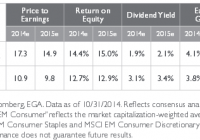
Summary More investors are diversifying with overseas exposure. Why investors should take a look at consumer sectors in emerging markets. Emerging market consumer sector ETF options. Investors have heard plenty about the rise of the emerging markets consumer in recent times, a theme easily accessed by a growing number of exchange-traded funds. Emerging markets investing, including doing so with ETFs, is changing, presenting investors with opportunities to take more tactical, thematic approaches to tap into the rise of developing world consumers. With many traditional emerging markets ETFs either too concentrated in the BRIC nations, excessively exposed to state-run enterprises or both, investors should rethink how they access emerging markets consumer trends. That includes making bets on some of the least developed developing markets. “Investors should focus on buying EM consumer companies in the least developed economies, as well as those EM companies geared towards domestic demand, rather than external demand through exports. Investors should look for stocks in the discretionary sector in countries where the consumption of staples has been satisfied, but consumption of durable goods has not,” according to Emerging Global Advisors , the company behind the EGShares family of ETFs. EGShares’ ETFs include consumer-focused offerings such as the EGShares India Consumer ETF (NYSEArca: INCO ) , the EGShares Emerging Markets Consumer ETF (NYSEArca: ECON ) and the EGShares Emerging Markets Domestic Demand ETF (NYSEArca: EMDD ). ECON, which carries a four-star rating from Morningstar, is up 15.4% over the past three years, enough to easily outpace the Vanguard FTSE Emerging Markets ETF (NYSEArca: VWO ) and the iShares MSCI Emerging Markets ETF (NYSEArca: EEM ) . The allure of ECON, one of the original dedicated emerging markets consumer ETFs, comes from its large combined weight to reform minded countries. For example, China, Mexico and India combine for over 41% of the ETF’s weight. “The new Indian government, led by Prime Minister Narendra Modi, intends to privatize state assets, increase foreign direct investment and reduce the fiscal deficit by cutting subsidies. There are also plans to deregulate the labor market and upgrade infrastructure. These improvements should unleash investment, increase efficiency, raise productivity and boost growth,” said EGShares in a whitepaper . If Modi delivers on the expected reforms, that could power INCO even higher. Often overlooked compared to other India ETFs , INCO also carries a Morningstar four-star rating. More important than that accolade is INCO’s performance. For much of the past year, India ETFs have been BRIC leaders, but INCO has shined especially bright with a gain of almost 77%. EMDD tracks the S&P Emerging Markets Domestic Demand Index, and draws from a country universe of Brazil, Chile, China, Colombia, Czech Republic, Egypt, Hungary, India, Indonesia, Malaysia, Mexico, Morocco, Peru, Philippines, Poland, Russia, South Africa, Thailand, and Turkey. Though not a pure consumer ETF, EMDD does allocate a combined 56.6% of its weight to staples and discretionary sectors. The weight to those sectors is important because consumer sectors have been key contributors to emerging markets earnings growth in recent years. “Emerging market consumer sectors have delivered higher earnings growth in four of the last seven years when compared to the broader emerging market equity index. Although earnings have disappointed over the last two years, we believe this should be a temporary relapse since consensus earnings are forecast to rebound in 2014 and 2015. Based on these estimates, EGA calculates that the EM consumer sectors would deliver earnings growth of 4.1% in 2014 and 16.2% in 2015, respectively, surpassing the rates of growth offered by the overall emerging markets index (3.8% in 2014 and 9.0% in 2015),” according to EGShares. South Africa, China and Mexico combine for over 55% of EMDD’s country weight. The ETF’s index has an impressive dividend yield of almost 3.4%. EM Consumer Fundamentals Table Courtesy: Emerging Global Advisors Tom Lydon’s clients own shares of EEM.
Low Volatility ETFs Delivering Again In 2015

Summary The equities market is experiencing another bout of volatility. Low-volatility stock ETFs are outperforming the broader market. A closer look at low-volatility ETF strategies and sector tilts. The new year is still young, but investors have already been subjected to wild rides by major equity benchmarks. For example, the S&P 500 started 2015 on a downbeat note only to see all of those losses and then some erased by the end of last week, but a dismal showing this week has the benchmark U.S. index down nearly 3% year-to-date. Low volatility exchange-traded funds, including the PowerShares S&P 500 Low Volatility Portfolio ETF (NYSEARCA: SPLV ) and the iShares MSCI USA Minimum Volatility ETF (NYSEARCA: USMV ) are doing what they are supposed: outperform traditional benchmarks during times of market angst. The average year-to-date for SPLV and USMV is less than a half a percent, but that is clearly better than the 2.8% shed by the S&P 500. Notably, SPLV’s and USMV’s outperformance of the S&P 500 comes after the low volatility duo produced an average return of 18.7% last year, about 550 basis points better than the S&P 500 . “Within SPLV, seven of the ten largest holdings have an S&P Capital IQ Quality Ranking of B+ or above, with one with no ranking,” said S&P Capital IQ in a new research note. Dow components Wal-Mart (NYSE: WMT ) and Procter & Gamble (NYSE: PG ) are SPLV’s two largest consumer staples holdings. With an allocation of 16.5%, consumer staples is the third-largest sector weight in the ETF behind financials and utilities. P&G and Wal-Mart are also of the most reliable dividend growers among U.S. companies and although SPLV is not a dedicated dividend ETF, the fund has a trailing 12-month yield of almost 2.2%. That is 50 basis points above 10-year Treasuries, and SPLV pays its dividend monthly. “Though a company’s strong earnings and dividend record are not necessarily indicative of it having below-average volatility, our research has found many such companies have modest risk profiles,” said S&P Capital IQ. The research firm notes that SPLV’s exposure to financial services names is, not surprisingly, confined to lower beta fare such as insurance providers and real estate investment trusts (REITs). “In 2014, we saw defensive consumer staples, REITs, and utilities stocks perform relatively well as interest rates have declined and international economies such as Europe and Japan fall into recession. These stocks typically offer above-average dividend yields and are focused more on the U.S. where economic growth has been relatively impressive,” said S&P Capital IQ. As is often the case, there is a price to pay for playing defensive and it comes in the form of the higher valuations often ascribed to defensive sectors. Consumer staples and utilities are two of the most expensive sectors compared to the S&P 500. Add to that, S&P Capital IQ sees the bulk of SPLV’s 99 holdings as fairly valued, but the research maintains an overweight rating on the ETF. PowerShares S&P 500 Low Volatility Portfolio (click to enlarge)

ETF Securities Expands Equity ETF Lineup With Two More New Funds

ETF Securities is expanding its line of factor-based equity ETFs. A closer look at the two new smart-beta, index-based ETFs. Based off ERI Scientific Beta indexing methodologies. ETF Securities, the London-based exchange-traded funds issuer known primarily for its lineup of commodities funds, is again adding to its lineup of U.S.-listed equity-based offering with the debuts of the ETFS Diversified-Factor U.S. Large Cap Index Fund (NYSEARCA: SBUS ) and the ETFS Diversified-Factor Developed Europe Index Fund (NYSEARCA: SBEU ) . ETF Securities is partnering with ERI Scientific Beta on the new ETFs. Scientific Beta is an index provider specializing in smart beta solutions and is part of the EDHEC-Risk Institute, an entity that works closely with institutions to implement academic research and improve their investment and risk management process, according to a statement . Scientific Beta’s stock selection process includes emphasizing investment factors, such as volatility, valuation, momentum and size. Factor-based funds are one of the fastest-growing segments of the ETF universe. The quality factor alone is the cornerstone of nearly 30 ETFs and issuers continue to bring an array of factor-driven ETFs to market. Since the start of 2015, JPMorgan introduced the JPMorgan Diversified Return Emerging Markets Equity ETF (NYSEARCA: JPEM ) , a multi-factor emerging markets ETF while iShares added two international ETFs to its factor-based suite. The ETFS Diversified-Factor U.S. Large Cap Index Fund tracks the Scientific Beta United States Multi-Beta Multi-Strategy Equal Weight Index, which “uses a proprietary weighting strategy to provide well diversified exposure, by combining 5 models: Maximum Deconcentration, Maximum Decorrelation, Efficient Minimum Volatility, Efficient Maximum Sharpe Ratio, and Diversified Risk Weighted,” according to ETF Securities . Financial services is the largest sector weight in SBUS at 19.2% followed by consumer cyclicals at 13.9%. No stock accounts for more than 0.72% of the new ETF’s weight. Top 10 holdings include CareFusion (NYSE: CFN ), Annaly Capital (NYSE: NLY ) and Dow component Merck (NYSE: MRK ). The ETFS Diversified-Factor Developed Europe Index Fund tracks the Scientific Beta Developed Europe Multi-Beta Multi-Strategy Equal Weight Index, which “is composed of the 700 largest and most liquid stocks listed in the following countries: Austria, Belgium, Denmark, Finland, France, Germany, Greece, Ireland, Italy, The Netherlands, Norway, Portugal, Spain, Sweden, Switzerland and the United Kingdom,” according to ETF Securities . The ETF currently holds 476 stocks, nearly a third of which are U.K. companies. France and Germany combine for over 23% of the new ETF’s weight. Top sector weights include 22.6% to financial services, 17% to industrials and 13.3% to consumer cyclicals. Both new ETFs charge 0.4% per year. SBUS and SBEU debuted on the heels of ETF Securities’ initial forays into U.S.-listed equity ETFs. Those ETFs, the ETFS Zacks Earnings Large-Cap U.S. Index Fund (NYSEARCA: ZLRG ) and the ETFS Zacks Earnings Small-Cap U.S. Index Fund (NYSEARCA: ZSML ) launched last week. ETF Trends editorial team contributed to this post.