Tag Archives: undefined

Solid Growth Outlook Is One Reason Among Many To Buy PPL Corp.
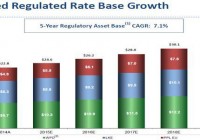
Summary Growth investments directed at becoming a regulated utility company and recent competitive business spin-off will ensure earnings growth in the years ahead. Transformation into 100% regulated utility will ensure cash flow stability and strengthen EPS. PPL currently offers an attractive dividend yield of 4.90%, and remains on track to consistently increase dividends in years ahead. I reiterate my bullish stance on PPL Corporation (NYSE: PPL ); the company is moving ahead with its long-term growth generating investments in order to better its operational performance and keep its financial growth momentum healthy. Moreover, with the completion of its competitive business unit spin off, PPL has increased its focus on regulated utilities, which will mean more upside for its future earnings growth. Considering the fact that the company has been improving its regulated operations and is continuing with growth investments to expand them further, I believe PPL’s cash flows will remain strong in the years ahead, which will ensure the sustainability of its future dividend payments. Furthermore, the company’s future dividend growth is expected to improve. Growth Initiatives Remain On Track In the recent past, utility companies have been making infrastructure development spending to expand their operational bases. As per EIA reports, utility companies’ growth investments will help increase electricity generation in the U.S. by 1.1% and 0.9% in 2015 and 2016, respectively. Moreover, EIA reports have predicted that the increased generation capacity will help utilities raise retail residential prices in 2015 by 1.1% and in 2016 by 1.8%. Given this constructive utility sector’s rate outlook, I believe that utility companies will continue with their infrastructure development projects, which will portend well for earnings and cash flow growth of the industry in the years ahead. As far as PPL is concerned, under its robust strategic growth efforts, the company has been making growth investments towards the development of its transmission and distribution networks in order to capitalize on the available growth potentials. In the past decade, PPL had invested almost $4.7 billion for network rebuilding and up-gradation and it expects to make an additional $5.7 billion of investment over the next five years. As part of its growth investment plan, the company had previously invested in the Susquehanna-Roseland power project, which will strengthen its regulated transmission operations in the region. Moreover, the $1.4 billion power-line construction project will benefit the customers by delivering them power without putting an extra burden on other regional power lines. Moreover, PPL’s $563 million worth Kentucky-based combined natural gas cycle plant Cane Run 7 will be operational soon. These ongoing investments in construction projects will serve as an important means of regulated rate base growth in the years ahead, which will benefit the company’s top-line and will strengthen its cash flows. The following chart shows that PPL’s management expects healthy, regulated rate base growth over the next five years. Source: Company’s Earnings Presentation Making its moves towards generating regulated rate base growth, PPL has filed a rate base increase case with the Pennsylvania Utility Commission (PUC) on an estimated ROE of 10.95%; if approved, the rate hike will add revenues of almost $167.5 million per year, after coming into effect on 1st January 2016. I believe that the rate increase will in fact improve its cash flows, which will back its ongoing growth investments. Moreover, the company, combined with other parties of LG&E and KU generation stations, has reached a settlement agreement of raising electric and gas rates by $132 million. Effective from 1st July 2015, the new rate hike will help it recover the cost of constructing Cane Run natural gas plant and will better its long-term earnings growth prospects. Furthermore, as part of its plan to focus on a broader regulated asset base, PPL recently completed the spinoff of its competitive energy business by combining with River Stone Holdings, and formed a separate entity named Talen Energy Corporation. I believe that after the spinoff, PPL being solely focused on regulated asset base, will strengthen its top-line and bottom-line numbers, and its cash flow certainty will improve, which will support its dividend growth. Safe & Sustainable Dividends PPL has been making attractive cash returns to its shareholders by regularly returning cash flows in the form of dividends. During 1Q’15, dividend payments made by the company were $250 million, up 6.8%, year-over-year. Moreover, PPL had recently announced its quarterly dividend payment of $0.3725 per share , which translates into a healthy dividend yield of 4.90% . Moving ahead, AEP’s cash flow will improve, which will help PPL make regular dividend payments. Owing to the company’s correct growth measures, I believe the company’s future cash flows will remain strong, which will allow the company to consistently increase dividends. Guidance Due to the company’s strong financial performance and due to its attractive, planned infrastructure development projects, the management’s confidence in PPL’s earnings growth prospects have been restored, due to which they have reiterated their previously earnings guidance. The company continues to believe that its EPS for full year 2015 will remain in a range of $2.05-to-$2.25 . Moreover, PPL’s management remains confident about achieving its long-term annual earnings growth rate 4%-to-6%. Risks The company’s future financial performance remains exposed to a risk of increase in regulatory restrictions. Moreover, any laxness shown by the management during the execution of its well thought-out capital expenditure plan will hurt PPL’s long-term earnings growth potentials. In addition, unforeseen negative economic changes, currency headwinds and unfavorable weather changes are key risks that might hamper the company’s future stock price performance. Conclusion I am bullish on PPL; the company has an attractive growth outlook. PPL’s growth investments directed at becoming a regulated utility company, and the recent competitive business spin-off have directed it in the direction of earning better revenues and experiencing earnings growth in the years ahead. In fact, transformation into a 100% regulated utility will ensure cash flow stability and strengthen its EPS, which makes it attractive for dividend-seeking investors. The company currently offers an attractive dividend yield of 4.90%, and remains on track to consistently increase dividends in the years ahead. Disclosure: I/we have no positions in any stocks mentioned, and no plans to initiate any positions within the next 72 hours. (More…) I wrote this article myself, and it expresses my own opinions. I am not receiving compensation for it (other than from Seeking Alpha). I have no business relationship with any company whose stock is mentioned in this article.
3 ETF Winners And A Loser Post Fed Meeting

The latest Fed meeting was arguably the most closely eyed one in quite some time, as investors highly wagered on a September timeline liftoff for the first rate hike in nine years. Expectations of strong cues on the looming policy normalization were not washed away as the meeting was pretty meaningful and informative for the global asset classes. First of all, the Fed appeared pleased with the pickup in the U.S. economic growth in the second quarter of 2015, but not overenthusiastic. The Fed sees the current momentum as ‘ moderate ‘. Job growth numbers and an uptick in housing data were reasonably satisfactory but sluggish business fixed investment and net exports were the causes of concerns for the Fed. Inflation is still short of the Fed’s longer-term target due to the free fall in energy prices last year and declining prices of non-energy related imports, per the Fed minutes. The Fed expects the price index to remain under pressure in the near term, though it will perk up in the medium term. The Fed made it clear that it is well on its way to tighten the policy some time this year, but to reciprocate to this lukewarm economic recovery, it indicated a slower pace of rate hike when the step is actually taken. Added to this, the Fed slashed its projection for the benchmark interest rate for 2016 and 2017, though the guidance for the ongoing year was kept unchanged. The median estimate for 2016 was cut to 1.625% from 1.875% guided in March, and for 2017, it was reduced to 2.875% from 3.125% projected in March. If this was not enough, the Fed lowered the expectation for real GDP for 2015 to 1.8-2.0% from 2.3-2.7% guided in March. Market Impact The reductions combined prompted some big moves in various markets and asset classes as traders started to adjust their positions according to the Fed’s actions. The U.S. dollar was among the big movers as it slipped to a three-week low following the cut in longer-term U.S. interest rates forecast, per Bloomberg. Yield on the benchmark 10-Year U.S. Treasury note remained 2.32% for the last two days (ended June 17, 2015) mostly due to ‘Grexit’ worries which suddenly bolstered the appeal for the safe haven assets despite rate hike concerns in the U.S. In the fixed income market, short-term bonds were among the gainers. Below we discuss a few ETFs which were among the biggest movers after the Fed minutes and could remain in focus as there appears no maddening rush to normalize interest rates. Dollar – The Loser PowerShares DB USD Bull ETF (NYSEARCA: UUP ) This fund is the prime beneficiary of the rising dollar as it offers exposure against a basket of world currencies. These include the euro, Japanese yen, British pound, Canadian dollar, Swedish krona and Swiss franc. This is done by tracking the Deutsche Bank Long US Dollar Index Futures Index Excess Return plus the interest income from the fund’s holdings in U.S. Treasury securities. Needless to say, the fund underperforms in a falling dollar scenario. In terms of holdings, UUP allocates nearly 58% in euro and 25% together in Japanese yen and British pound. The fund has managed an asset base of $1.42 billion so far and it sees an average daily volume of 3 million shares. It charges 75 bps in total fees and expenses. Due to intense selling pressure, this dollar ETF was down about 0.9% at the close of trading on June 17, 2015 and lost over 1% after hours. The Gainers Gold Mining – Market Vectors Gold Miners ETF (NYSEARCA: GDX ) As soon as the greenback dips, commodity prices rise. Gold, one of the key precious metals, has emerged from the slump. SPDR Gold Shares (NYSEARCA: GLD ) tracking the gold bullion added about 0.5% (as of June 17, 2015), while the largest big-cap gold mining ETF, GDX , added about 2.9% on the same day. The latter saw more gains as it often trades as a leveraged play on gold. However, investors should note that the gains were short-lived as both ETFs were down after hours. GDX fell 0.4% while GLD lost 0.1% after the market closed. GDX is one of the popular gold mining ETFs in the market today with assets of $6.04 billion and a trading volume of roughly 35 million shares a day. The fund charges an expense ratio of 53 basis points a year. GDX is heavy on Canada with more than 50% focus. Short-term Treasury – iShares 1-3 Year Treasury Bond ETF (NYSEARCA: SHY ) The reduction in rate projections and a somewhat soft tone of the Fed regarding the rate hike made short-term Treasury ETFs a winner. This fund tracks the Barclays U.S. 1-3 Year Treasury Bond Index and holds 98 securities in its basket. The fund has an average maturity of 1.84 years and effective duration of 1.82 years. SHY is the most popular and most liquid ETF in the short-term bond space with AUM of $8.74 billion and average daily volume of more than 1.4 million shares. Expense ratio came in at 0.44% and its yield stands at 0.44%. The fund was up 0.02%. Emerging Market Dividend – ALPS Emerging Sector Dividend Dogs ETF (NYSEARCA: EDOG ) An indication of a sluggish trail of rate hike made emerging markets ETFs strong performers, while the dovish policy (presumably) brightened the dividend investing theme. This fund applies the ‘Dogs of the Dow Theory’ on a sector-by-sector basis. It reflects the performance of the emerging market equities with above-average dividend yields. The fund gives investors roughly equal exposure to all the sectors. This approach results in a portfolio of about 50 stocks with each security accounting for less than 2.79% of total assets. EDOG has accumulated $12 million in AUM. It charges 60 bps in annual fees and has an annual dividend yield of 3.79%. The fund was up 1.17% on June 17, 2015. Original Post

Hedging The 10-Year? Consider DTYS

Summary DTYS provides a well correlated hedge for 10-year treasury bonds. DTYS, like most alternative investments, is associated with significant risks and is intended for achieving short term goals. Recommended for investors who believe interest rates will rise dramatically over an intermediate time frame. Basic Information The iPath U.S. Treasury 10-year Bear ETN (NASDAQ: DTYS ) is an exchange traded note (ETN). ETNs are unsecured, unsubordinated debt securities. This type of debt security differs from other types of bonds and notes because ETN returns are based upon the performance of a market index minus applicable fees, no period coupon payments are distributed and no principal protections exist. DTYS is intended to move inversely (-1x) to The Barclays Capital 10Y U.S. Treasury Futures Targeted Exposure index. The Barclay’s index is tied to U.S. treasury yields. DTYS seeks investment results for a single day only, not for longer periods. A “single day” is measured from the time the Fund calculates its net asset value (“NAV”) to the time of the Fund’s next NAV calculation. The return of the Fund for periods longer than a single day will be the result of each day’s returns compounded over the period, which will very likely differ from the inverse (-1x) of the return of The Barclays Capital 10Y U.S. Treasury Futures Targeted Exposure index for that period. For periods longer than a single day, the Fund will lose money when the level of the Index is flat, and it is possible that the Fund will lose money even if the level of the Index falls. Longer holding periods, higher index volatility, and inverse exposure each exacerbate the impact of compounding on an investor’s returns. During periods of higher Index volatility, the volatility of the Index may affect the Fund’s return as much as or more than the return of the Index. Expense Ratio: .75% + Portfolio turnover (currently 0% because cash instrument and derivative transactions are not included). How Could it be used? If you are looking for a 10-year hedge, DTYS could be a very beneficial to your portfolio. It is highly correlated to the market, and it is a useful tool any skilled investor should consider. In this article, I’ll attempt to illuminate the risks of investing in an ETN, but with adequate forethought DTYS is not a bad strategy, especially with the threat of rising interest rates. Principal Investment Strategy All investment strategies are used in combination to achieve similar daily return characteristics as -1x of the index: Derivatives – financial instruments whose value is derived from the value of an underlying asset or assets, such as stocks, bond, funds, interest rates, or indexes. Swap agreements – Contracts entered into primarily with major global financial institutions for a specified period ranging from a day to more than one year. In a standard “swap” transaction, two parties agree to exchange the return (or differentials in rates of return) earned or realized on particular predetermined investments or instruments. The gross return to be exchanged or “swapped” between the parties is calculated with respect to a “notional amount,” e.g., the return on or change in value of a particular dollar amount invested in a “basket” of securities or an ETF representing a particular index. Futures Contracts – Standardized contracts traded on, or subject to the rules of, an exchange that call for the future delivery of a specified quantity and type of asset at a specified time and place or, alternatively, may call for cash settlement. Money Market Instruments U.S. Treasury Bills – that have maturities of one year or less and supported by full faith and credit of the U.S. government. Repurchase Agreements – Contracts in which a seller of securities, usually U.S. government securities or other money market instruments, agrees to buy them back at a specified time and price. Repurchase agreements are primarily used by the Fund as a short-term investment vehicle for cash positions. These are the Principal Risks associated with TBX Risks Associated with the Use of Derivatives Compounding Risk Correlation Risk Fixed Income and Market Risk Counterparty Risk Debt Instrument Risk Interest Rate Risk Intraday Price Performance Risk Inverse Correlation Risk Liquidity Risk Early Close/Late Close/Trading Halt Risk Market Price Variance Risk Valuation Risk Non-Diversification Risk Portfolio Turnover Risk Short Sale Exposure Risk As you can see below, estimated returns are volatile, and the funds actual results may be significantly better or worse than the underlying index. Bolded values, not including the x and y axis percentages, are where the fund performed worse than expected. This is meant to illuminate the possibility of under or over performance. Theoretical Fund Returns Index Performance One Year Volatility Rate One Year Index Inverse (-1x) of the One Year Index 10% 25% 50% 75% 100% -60% 60% 147.50% 134.90 94.70 42.40 (8.00) -50% 50% 98.00 87.90 55.80 14.00 (26.40) -40% 40% 65.00 56.60 29.80 (5.00) (38.70) -30% 30% 41.40 34.20 11.30 (18.60) (47.40) -20% 20% 23.80 17.40 (2.60) (28.80) (54.00) -10% 10% 10.00 4.40 (13.50) (36.70) (59.10) 0% 0% (1.00) (6.10) (22.10) (43.00) (63.20) 10% -10% (10.00) (14.60) (29.20) (48.20) (66.60) 20% -20% (17.50) (21.70) (35.10) (52.50) (69.30) 30% -30% (13.80) (27.70) (10.10) (56.20) (71.70) 40% -40% (29.30) (32.90) (44.40) (59.30) (73.70) 50% -50% (34.00) (37.40) (48.10) (62.00) (75.50) 60% -60% (38.10) (41.30) (51.30) (64.40) (77.00) Correlation to 10-year yields I aligned DTYS with 10-year treasury yields. Essentially, DTYS is perfectly correlated to yields. Since bond prices react inversely to yields, it is easy to see why DTYS would be a good choice for hedging rising interest rates. Their are other alternative investment tools like the ProShares Short 7-10 Year Treasury ETF (NYSEARCA: TBX ) . DTYS, in my opinion. is the best direct tool for hedging rates. When rates spike, however, their are a number of other options to consider . My advice for any investor is to expose yourself only to risk you feel comfortable with. Conservative plays often pan out better than risky ones in the long run. DTYS is certainly a risky investment with potential for mediocre to negative returns. Conclusion If you are trying to hedge your investment on 10-Year Treasury yields, then DTYS is probably an ETN you ought to consider. However, it is important for any smart investor to weigh the risks associated with any ETN before jumping into any investment long or short. Disclosure: I/we have no positions in any stocks mentioned, and no plans to initiate any positions within the next 72 hours. (More…) I wrote this article myself, and it expresses my own opinions. I am not receiving compensation for it (other than from Seeking Alpha). I have no business relationship with any company whose stock is mentioned in this article.