Tag Archives: undefined

Income And Caution With This Dividend ETF
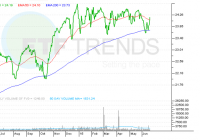
Summary Dividend ETFs may generate attractive yields, but they are exposed to rate-sensitive sectors. Highlight of the First Trust Value Line Dividend Index Fund. Significant utilities sector position is weighing in on performance. By Todd Shriber & Tom Lydon With Treasury yields rising and concerns that the Federal Reserve will boost interest rates in the coming months doing the same, some dividend exchange traded funds are lagging broader benchmarks. That is true of the First Trust Value Line Dividend Index ETF (NYSEARCA: FVD ) , which has traded modestly lower this year while the S&P 500 has gained 2.5%. FVD follows the Value Line Dividend Index, which equally weights components and utilizes the proprietary Value Line research to select components. Specifically, stocks are ranked by the Value Line Safety Ranking of 1 or 2 out of 5, which are based on price stability and financial strength. Additionally, the index excludes stocks with a dividend yield lower than the S&P 500. “Over the last 10 years, FVD produced an annual average 10.4% gain vs. 7.9% for the S&P 500,” according to Investor’s Business Daily . “Their difference in their current dividend yield is modest. FVD yields 2.2% and SPY 1.9%.” Though its yield is attractive relative to the S&P 500, it is the source of that yield that could be a strike against FVD in a rising rate environment. Specifically, the ETF allocates 22.6% of its weight to utilities stocks, the most vulnerable group to rising interest rates . FVD devotes another 13.5% of its weight to consumer staples stocks, another sector that historically lags when interest rates climb. FVD’s utilities and staples exposure is somewhat offset by a combined 32.3% weight to financial services and industrials names, groups that often perform as Fed policy turns hawkish. Rising Treasury yields and slumping utilities stocks have not been enough to sour investors on FVD. The ETF is home to nearly $1.21 billion in assets under management up from $955 million in October. The ETF’s technology weight of 8.1% is fair among dividend funds, but FVD allocates less than 2% to telecom, another highly rate-sensitive sector. FVD’s holdings are also equally weighted. FVD currently shows 187 holdings and its largest component stocks only make up 0.65% of the underlying portfolio. However, this strategic beta index-based ETF is more costly than the average dividend ETF. FVD shows a 0.70% expense ratio, compared to the average 0.58% expense ratio for dividend yield weighted ETFs and 0.5% expense ratio for the average dividend weighted ETF, according to XTF data. At 0.7%, FVD is twice as expensive as the SPDR S&P Dividend ETF (NYSEARCA: SDY ) and seven times as expensive as the Vanguard Dividend Appreciation ETF (NYSEARCA: VIG ) . First Trust Value Line Dividend Index Fund (click to enlarge) Disclosure: I/we have no positions in any stocks mentioned, and no plans to initiate any positions within the next 72 hours. (More…) I wrote this article myself, and it expresses my own opinions. I am not receiving compensation for it. I have no business relationship with any company whose stock is mentioned in this article.
More Triple-Leveraged Biotech ETFs Come To Town

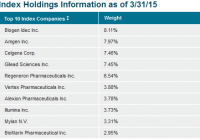
Summary New leveraged biotechnology ETFs to hedge or capitalize on market moves. Focus on ProShares’s new leveraged/inverse NASDAQ Biotechnology ETFs. Additionally, ProShares added leveraged/inverse Oil & Gas and homebuilder funds as well. By Todd Shriber & Tom Lydon For over five years, the ProShares Ultrashort Nasdaq Biotechnology (NasdaqGM: BIS ) and the ProShares Ultra Nasdaq Biotechnology (NasdaqGM: BIB ) cornered the market for leveraged biotechnology exchange traded funds. In the span of three weeks, the number of leveraged biotech ETFs has tripled. In late May, Direxion introduced the Direxion Daily S&P Biotech Bull Shares (NYSEArca: LABU ) and the Direxion Daily S&P Biotech Bear Shares (NYSEArca: LABD ) . Today, ProShares, the largest issuer of inverse and leveraged ETFs, launched the UltraPro NASDAQ Biotechnology (NasdaqGM: UBIO) and the UltraPro Short NASDAQ Biotechnology (NasdaqGM: ZBIO) . The UltraPro NASDAQ Biotechnology will attempt to deliver three times the daily performance of the NASDAQ Biotechnology Index while the UltraPro Short NASDAQ Biotechnology will seek to deliver three times the daily inverse performance of that index. The NASDAQ Biotechnology Index is the underlying benchmark for the iShares Nasdaq Biotechnology ETF (NasdaqGS: IBB ) , the largest biotech ETF by assets. Maryland-based ProShares introduced four leveraged ETFs today, including a pair of leveraged homebuilders funds, a niche rival Direxion is also eyeing . The Ultra Homebuilders & Supplies (NYSEArca: HBU) and the UltraShort Homebuilders & Supplies (NYSEArca: HBZ) will offer double leverage on the Dow Jones U.S. Select Home Construction Index. That is the underlying benchmark for the $2.1 billion iShares U.S. Home Construction ETF (NYSEArca: ITB ) . ProShares also introduced two double-leveraged equity-based energy ETFs today. Those new funds are the Ultra Oil & Gas Exploration & Production (NYSEArca: UOP) and the UltraShort Oil & Gas Exploration & Production (NYSEArca: SOP) . UOP will seek to deliver double the daily returns of the S&P Oil & Gas Exploration & Production Select Industry Index while SOP will attempt to deliver double the daily inverse returns of that index. That index is the underlying benchmark for the $1.6 billion SPDR S&P Oil & Gas Exploration & Production ETF (NYSEArca: XOP ) . On May 29, Direxion introduced triple-leveraged answers to XOP , the Direxion Daily S&P Oil & Gas Exploration & Production Bull Shares (NYSEArca: GUSH ) and the Direxion Daily S&P Oil & Gas Exploration & Production Bear Shares (NYSEArca: DRIP ) . NASDAQ Biotech Index Top Holdings as of March 31, 2015 Table Courtesy: ProShares Disclosure: I/we have no positions in any stocks mentioned, and no plans to initiate any positions within the next 72 hours. (More…) I wrote this article myself, and it expresses my own opinions. I am not receiving compensation for it. I have no business relationship with any company whose stock is mentioned in this article.

Health Care Provider ETF In Focus On M&A Talks

The merger mania is not showing any sign of slowdown in the health care space. Now, health care insurers, which are facing the double whammy of margin erosion and increased regulatory oversight due to Health Care Reform Act or Obamacare, have stepped up consolidation activities. In fact, the five big managed health care insurers are seeking a series of potential mega-mergers that could change the landscape of the whole managed care industry. M&A Talks in Focus Health insurers – UnitedHealth Group (NYSE: UNH ), Anthem (NYSE: ANTM ), Aetna (NYSE: AET ), Humana (NYSE: HUM ) and Cigna Corp (NYSE: CI ) – have been in some kind of merger talks with each other over the last couple of weeks. The coldest match-up war is between Aetna-Humana and Aetna-UnitedHealth. This is especially true as Aetna made a takeover proposal to Humana last weekend, as per the Wall Street Journal, while on the other hand, UnitedHealth made a preliminary takeover approach to Aetna last week. Meanwhile, Anthem renewed a sweetened offer to acquire Cigna for $54 billion, including debt. The deal includes $184 per share in cash and stock. About 31% would be paid in Anthem shares, which represents 29% premium to Cigna’s average closing price in the past 20 trading sessions, and the rest in cash. The combination could be the industry’s biggest takeover in history and could make Anthem bigger than the industry leader UnitedHealth – and thus the largest U.S. insurer in terms of membership. However, Cigna rejected the proposal citing the bid as “inadequate” and not in the best interests of its shareholders. Both companies have been in talks for months and the latest bid is the second in the last 10 days. The mergers – if these come through – could dampen competition in the managed care industry leading to heavy concentration in the hands of a few. This is because a merger could shrink the top insurers names from five to just three with revenues of over $100 billion each. However, it could enhance operational efficiencies with more revenue opportunities from Obamacare and privatization of Medicare and Medicaid at an adequate margin and return on capital. Given the series of M&A talks in the health insurer corner of the broad health care space, the iShares U.S. Healthcare Providers ETF (NYSEARCA: IHF ) could be worth a look for investors seeking to ride out the surge on the merger wave. IHF in Focus This ETF follows the Dow Jones U.S. Select Healthcare Providers Index with exposure to companies that provide health insurance, diagnostics and specialized treatment. In total, the fund holds 51 securities in its basket. UnitedHealth takes the top spot in the basket with 11.98% share while the other in-focus four firms – AET, ANTM, CI and HUM – are also among the top 10 holdings making up for a combined 24.2% of assets. The fund has amassed $958.6 million in its asset base while volume is moderate at about 81,000 shares per day on average. It charges 43 bps in annual fees from investors and added 4.9% over the past couple of weeks. The product has a Zacks ETF Rank of 1 or ‘Strong Buy’ rating with a Medium risk outlook. Originally published on Zacks.com