Tag Archives: undefined

Country CAPE Ratios: Wizard In 2013, Dunce In 2014?
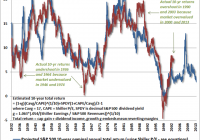
Summary The CAPE ratio was a fantastic predictor of country returns in 2013. In March 2014, Mebane Faber and Cambria Investments launched GVAL, which uses CAPE-like methodologies to buy the cheapest global markets. How did CAPE and GVAL do in 2014? Introduction As followers of my Buy-the-Dip High-Yield portfolio would know, I am a value investor at heart. The fact that value stocks outperform growth stocks has been proven by ample academic research, and is also attested to by the legendary value investor Warren Buffett’s remarkable track record over the years. One commonly used measure to determine market valuation is the cyclically-adjusted price-earnings [CAPE] ratio, also known as the Shiller P/E ratio. This metric was developed by U.S. economist and Nobel laureate Robert Shiller, and is defined as price over 10-year average earnings adjusted for inflation. By using 10-year average earnings rather than one-year trailing (or forward) earnings, fluctuations in net income caused by variations in profit margins over a typical business cycle can be reduced. The use of CAPE as a valuation indicator does have its limitations. While high CAPE values have been associated with lower future long-term returns, and lower CAPE values with higher future long-term returns, the CAPE ratio does not reliably predict near-term tops and bottoms. In a chart from a December 2013 article by Hussman Funds entitled ” Does the CAPE still work? “, the projected 10-year returns predicted by CAPE was found to correlate nicely (> 90%) with actual 10-year returns, except when markets became very overvalued or very undervalued . (click to enlarge) (Image from Hussman Funds) The current CAPE ratio of the U.S. market (27.33) is significantly higher than both its historical average (16.58) and median (15.95), suggesting moderate overvaluation of the market, and thus, low future returns. However, the above commentary from Hussman Funds states that actual returns can exceed CAPE forecasts when stocks become overvalued (“Actual 10-yr. returns overshoot in 1990 and 2003 because market overvalued in 2000 and 2013”). My own interpretation of this is that if the U.S. market were to remain overvalued for the next couple of years, then the subsequent returns could be greater than what is currently predicted by CAPE. However, Hussman Funds is seemingly confident that would not be the case: The CAPE Ratio is doing exactly what it has always done, which is to help investors anticipate the investment returns they should expect over the next decade. Those returns will very likely be in the low, single digits. Country CAPE Does value investing work for countries? According to Mebane Faber, co-founder and Chief Investment Officer at Cambria Investments, the answer is a resounding “yes”. In a January 2, 2014 posting on his “Meb Faber Research” website, Faber points out that the countries with the cheapest CAPE ratios massively outperformed those with the highest CAPE ratios in 2013. The bottom-5 and bottom-10 CAPE countries averaged 20.74% and 21.11% returns, respectively, in 2013, while the top-5 and top-10 CAPE countries averaged -17.81% and -5.39%, respectively. This represents a differential of 38.59% for the top-5 versus bottom-5, and 26.5% for the top-10 versus bottom-10, a remarkable outperformance. (Image from Meb Faber Research ) I compiled the total return performances into a bar chart. Blue bars represent the cheapest countries, red bars represent expensive countries. Countries are sorted from left to right, in order of increasing CAPE values. I have also compiled the data into a scatterplot, to show the relationship between CAPE on the December 31, 2012 and 2013 returns. On the face of it, the divergence between the most expensive and the cheapest stocks in 2013 was pretty dramatic. Even with the outliers (Russia and USA) present, a statistical test conducted on this data revealed that the negative correlation was highly significant (p-value = 0.00018). In other words, countries with high CAPE values showed lower 2013 returns, while countries with low CAPE values showed higher 2013 returns. These results, therefore, suggested that CAPE was an excellent metric for identifying cheap markets to obtain outsized returns. Three months later, Cambria debuted the Cambria Global Value ETF (NYSEARCA: GVAL ), an ETF fund (with a relatively high 0.69% expense ratio for a passive fund) that uses CAPE-like methodologies to invest in the cheapest markets globally. Coincidence? Maybe. How good was CAPE as a valuation measure in 2014? Last year, Faber had actually pre-empted his new year’s article with a December 5, 2013 posting that showed the impressive performance of the CAPE indicator through the first 11 months of 2013. Unfortunately, he had chosen not to do so again this year. Therefore, I took it upon myself to obtain data for CAPE ratios for countries from the start of the year and compare those with their YTD performances. 2014 Country CAPE Evaluation Meb Faber updated his CAPE ratios at the start of the year. As reported by Seeking Alpha : Mebane Faber updates countries’ cyclically-adjusted price-earnings ratios for the start of the year, and Greece, Russia, Ireland, Argentina, Hungary, Jordan, Austria, and Lebanon make the list of the cheapest – all under 10. How did the CAPE do in 2013? If you bought the 5 highest-priced countries – Peru, Colombia, Indonesia, Mexico, and Chile – you would have lost 17.8%. If you bought the 5 cheapest – Greece, Ireland, Argentina, Russia, and Italy – you would have gained 20.7%. Unfortunately, I do not have a subscription to The Idea Farm, Faber’s subscription service, and so could not access Faber’s updated list of CAPE ratios. Therefore, bits and pieces of data were instead obtained from StreetAuthority and from StarCapital . In the table below, CAPE ratios for countries marked with (^) are from StreetAuthority, and are from 12/11/2013. CAPE ratios for the remaining countries are from StarCapital, and are from 1/31/2014. Although the two sets of CAPE data originate from time points nearly two months apart, I reasoned that it should not have a large effect on the analysis, because CAPE is a long-term measure of valuation. 2014 YTD return data are from Morningstar . Country ETF CAPE 2014 YTD % Greece (NYSEARCA: GREK ) 4.03 -36.35 Argentina^ (NYSEARCA: ARGT ) 6.91 -3.12 Ireland^ (NYSEARCA: EIRL ) 6.94 0.67 Russia^ (NYSEARCA: RSX ) 7.11 -42.54 Jordan^ 8.64 Italy (NYSEARCA: EWI ) 8.8 -7.98 Austria^ (NYSEARCA: EWO ) 9.16 -19.47 Hungary^ 9.46 Croatia^ 9.81 Lebanon^ 9.97 Israel^ (NYSEARCA: EIS ) 9.98 -1.39 Spain (NYSEARCA: EWP ) 10.3 -2.22 Belgium (NYSEARCA: EWK ) 12.2 4.81 Norway (NYSEARCA: NORW ) 12.3 -21.68 United Kingdom (NYSEARCA: EWU ) 12.6 -5.77 Singapore (NYSEARCA: EWS ) 12.9 2.6 France (NYSEARCA: EWQ ) 13.8 -7.97 Netherlands (NYSEARCA: EWN ) 14.5 -3.53 Australia (NYSEARCA: EWA ) 16.2 -4.73 Germany (NYSEARCA: EWG ) 17.3 -9.51 Hong Kong (NYSEARCA: EWH ) 18.2 3.15 Canada (NYSEARCA: EWC ) 18.6 1.57 Switzerland (NYSEARCA: EWL ) 21.6 0.28 Japan (NYSEARCA: EWJ ) 23.9 -4.22 USA (NYSEARCA: SPY ) 24.6 14.68 The 2014 YTD total return performances have also been compiled into a bar chart. Blue bars represent the cheapest countries (CAPE

Top Nontraditional Bond Fund Celebrates First Anniversary

The Cedar Ridge Unconstrained Credit Fund (MUTF: CRUPX ) launched on December 12, 2013, and recently celebrated its first anniversary. Ten thousand dollars invested at the fund’s inception would be worth more than $11,092 as of December 22, according to data from Morningstar. This compares very favorably to the non-traditional bond fund category average, which would have seen a $10,000 investment grow to just $10,130 over that same time. Over the past year, the Cedar Ridge Unconstrained Credit Fund’s 11.58% annualized return through December 22 ranks it at the very top of Morningstar’s Nontraditional Bond category, above 319 other funds, including all share classes. The Legg Mason BW Alternative Credit Fund (MUTF: LMANX ) is the only other fund in the category with double-digit returns over the past year, and only one of its five share-classes has that distinction. “With this Fund we have created the opportunity for us to reach a vast audience of investors who are looking for exactly what we have done; deliver superior and uncorrelated investment returns,” said Alan Hart, Cedar Ridge’s CIO and the fund’s portfolio manager, in a December 21 press release . Mr. Hart wanted to thank the fund’s investors for making it a success, but noted that the best way Cedar Ridge can thank its investors is by continuing to deliver superior performance. In addition to Mr. Hart, the Cedar Ridge Unconstrained Credit Fund benefits from the portfolio-management expertise of Jeffrey Rosenkrantz, David Falk, Guy Benstead, and Jeffrey Hudson. The fund’s objective is to provide capital appreciation and current income by employing a credit long/short strategy. As of November 30, the fund was 69% long municipal bonds, 23% long corporate bonds, 23% short U.S. Treasurys, and 11% short corporate bonds, according to its fact sheet . The Cedar Ridge Unconstrained Credit Fund’s shares are available in investor-class (CRUPX) and institutional-class (MUTF: CRUMX ) shares; with net-expense ratios of 2.18% and 1.93%, respectively. The minimum initial investment for the investor-class shares is $4,000; while the minimum for institutional-class shares is $50,000. The 11.37% one-year performance of the investor-class shares trails the 11.58% gains of the institutional shares, but still outdoes all other nontraditional bond funds, regardless of share class. For more information, view the fund’s website .

Buy Europe Without Euro Risk With This New ETF

Euro zone’s celebration of the end of a prolonged recession last year was really short-lived as the region again got itself entrapped in a slowdown and deflation worries from mid 2014. Most of the foremost nations of the continent are presently dragging their feet in terms of economic growth, with some slipping into another recession. To fight these issues, the European Central Bank (ECB) is resorting to every possible step including ultra-low policy rates, negative deposit rates and launch of a program to buy back asset-backed securities and covered bonds. If this was not enough, the ECB indicated that it would implement a broad-based QE measure should the region need it (read: Euro Zone Gets QE Hints, 3 ETFs to Buy on Stimulus Hopes ). While these measures should boost the stock market rally, a flush of liquidity is having an adverse impact on the currency, the Euro. The currency lost about 8% (as of December 12, 2014) against the greenback in the last six months. The plunge was more prevalent given the dollar’s strength during the said phase. Thanks to the Euro slide and the possibility of a strong dollar following the probable hike in interest rates next year, investors are starting to embrace currency-hedged ETFs in droves. There isn’t anything more unfortunate than seeing one’s otherwise impressive portfolio choices fail because of soft foreign currency (read: Hedged European ETFs in Focus: Best Choice for Europe Now? ). Bearing this sentiment, Deutsche Asset & Wealth Management recently rolled out a hedged version focused on Europe recently, DBEZ . Let’s discuss the fund in greater detail below: DBEZ in Detail The fund looks to follow the MSCI EMU IMI U.S. Dollar Hedged Index to provide exposure to more than 600 of the largest European companies. As of November 5, 2014, the index includes 682 securities with an average market cap ranging from about $6.09 billion to about $23.96 million. The product is highly diversified with no stock accounting for more than 2.78% of the portfolio. Among individual holdings, Bayer AG-Reg takes the top spot, followed by Total SA and Sanofi with, respectively, 2.62% and 2.56% exposure. Sector wise, Financials gets the highest exposure with 22.8% of the portfolio. Consumer Discretionary, Industrials, Materials and Consumer Staples also get double-digit investments, while Health Care gets the least exposure with only 4.8% of the basket. As far as country exposure is concerned, Germany (29.55%) gets the top priority while France (29.65%), Spain (11.57%) and Italy (7.86%) take up the next three positions. The fund charges 45 bps in fees. How Does it Fit in a Portfolio? The fund is a good choice for investors seeking exposure to the Euro zone. At the same time, it is a tool to safeguard investors from negative currency translations. Health of the Euro zone companies also appears stable as evident by impressive corporate earnings in Q3. As per Reuters , net earnings for 36% of total market capitalization reported so far are up 7.1% on almost flat revenues with beat ratios of 67% and 59%, respectively. If this was not enough, about 80% of ECB banks cleared the latest stress test. This, coupled with an accommodative central bank, undoubtedly warrants a look at the Euro zone to earn some quick gains. However, this return can be curtailed on repatriation as the U.S. dollar is hovering at multi-year highs on QE taper and rising rate risk for next year. In such a scenario, possessing DBEZ, which is protected from currency translation, in one’s portfolio might be a wise decision (read: 3 European ETFs Worth Considering on ECB Measures ). Competition The European ETF space is pretty competitive, so it could be slightly tough for the new entrant to build up assets. However, we are hopeful as the hedged ETFs space still has room to grow. The issuer itself has a product in the name of Deutsche X-trackers MSCI Europe Hedged Equity ETF (NYSEARCA: DBEU ) which offers exposure to more than 400 European stocks in developed markets while at the same time providing a hedge against any fall in a number of currencies in the region including the Euro, the British pound, and the Swiss franc to name a few. Making a debut last year, DBEU has become a $680 million fund. However, the topper among the hedged ETFs list is WisdomTree Europe Hedged Equity Index Fund (NYSEARCA: HEDJ ) which has generated about $5.2 billion in assets so far. Moreover, there is a flurry of single-country hedged ETFs in this space including ones targeting Germany, which could offer up some competition. However, investors should note that Deutsche Bank has proven its skills in offering successful hedged ETFs lately in different markets. So, the profound knowledge of the issuer on this subject might help the new entrant to garner considerable investor assets.