Tag Archives: undefined

Relative Rotation Shows U.S. Equities Are The Place To Be
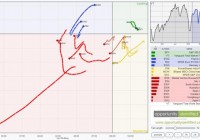
RRG charts help us focus on those areas of the investment universe that deserve it. This article looks at the relative strength of the world’s largest markets, using the total world ETF from Vanguard as our benchmark. If you are looking to invest in stocks, the U.S. is still the best place (at this time) to be. We live in the golden age of investing. Never before have individual investors had so much available to them for gaining investment knowledge, finding great investment opportunities, and the ability to take advantage of them at such a low cost. Our parents could only dream of having investment communities like Seeking Alpha, investment blogs like ours , almost limitless fundamental information online, and technical analysis tools only one click of a mouse (“what’s that?” says your grandpa) away. And with the advent of ETFs, common investors can invest in pretty much whatever and wherever they want. Want to buy timber? Go for it. There’s an ETF for that, the iShares S&P Global Timber & Forestry Index ETF ( WOOD). How about palladium? Got you covered with the ETFS Physical Palladium Shares ETF ( PALL). Want to invest in foreign markets like South Korea? Be my guest, the iShares MSCI South Korea Capped ETF ( EWY). Do you really like coffee? Try the iPath Dow Jones-UBS Coffee ETN ( JO). With sugar? Sure, the Path Dow Jones-UBS Sugar Total Return Sub-Index ETN (NYSEARCA: SGG )! Investors today have the investment world at their fingertips. In this week’s RRG™ analysis, we’re going to look at the relative strength of the world’s largest markets, using the Vanguard Total World Stock ETF (NYSEARCA: VT ) as our benchmark. Basically, we want to see where in the world we should be focusing our attention. Accordingly, the following ETFs representing most of the world’s largest stock markets will be compared against VT: SPDR S&P 500 Trust ETF ( SPY) Vanguard Total Stock Market ETF ( VTI) iShares MSCI Canada ETF ( EWC) iShares MSCI France ETF ( EWQ) iShares MSCI Germany ETF ( EWG) iShares MSCI Italy Capped ETF ( EWI) iShares MSCI Spain Capped ETF ( EWP) SPDR EURO STOXX 50 ETF ( FEZ) PowerShares India Portfolio ETF ( PIN) S PDR S&P China ETF ( GXC) iShares MSCI China ETF ( MCHI) iShares MSCI South Korea Capped ETF ( EWY) iShares MSCI Hong Kong ETF ( EWH) iShares MSCI Japan ETF ( EWJ) iShares MSCI Australia ETF ( EWA) Market Vectors Russia ETF ( RSX) Generally speaking, when looking at the ETFs above in the RRG™ below, those in the green leading quadrant are what you want to own; those within the yellow weakening quadrant should be on your watch-list (as they might be deteriorating), those within the red lagging quadrant should be avoided and those in the blue improving quadrant should be on your shopping list. In the RRG™ below, the long tails represent the movement of each country’s ETF over the past 10 weeks in comparison to the world ETF, VT. So what do we see? The first thing to notice is the chart of VT in the upper right corner. Global stocks as a whole are down since July. Accordingly, when we analyze this chart, we want to be cognizant of the fact that maybe stocks as a whole are not where we want to be. That being said, if we are looking for stock opportunities, we see that we should be in the U.S. (SPY and VTI have been leading the last 10 weeks) and looking for potential opportunities in Germany, France, and Europe as they have moved from lagging to improving over the past 10 weeks. And finally, we should also look to China as they are subtly rotating from weakness towards leading. In conclusion, if we have to be in stocks, we should be in the United States and looking for potential opportunities in Germany, France, Europe, and China. [1] Note: The terms “Relative Rotation Graph” and “RRG” are registered trademarks of RRG Research . (click to enlarge)

GAMCO Natural Resources, Gold & Income Trust: Similar But Different Discounted CEF Opportunity

Summary GNT invests in hard assets and trades at a discount to NAV, like its sibling GGN. GNT, however, has a more diversified portfolio and doesn’t use leverage. Although GNT has a lower yield than GGN, it may be a better option for some investors. GAMCO Natural Resources, Gold & Income Trust (NYSE: GNT ) is a sister fund to GAMCO Global Gold, Natural Resources & Income Trust (NYSEMKT: GGN ), another closed-end fund, or CEF, that I recently wrote about . GNT shares many similarities with its older sibling, but the differences could make it more appropriate for some investors looking for a combination of hard asset exposure, income, and “outsourcing.” The same but different Like GGN, GNT is heavily invested in the precious metals, mining, energy, and energy services sectors (this quartet makes up around 80% of its portfolio). That fits tightly with its name and is roughly similar to GGN’s allocation. GNT, however, has more leeway in its security selection, putting another 15% of assets in the specialty chemicals, agriculture, and machinery sectors. This is likely the reason for the very slight difference in the naming of these two closed-end funds. (Note the switched places of natural resources and gold in the two names.) What it means for investors is that GNT is a bit more diversified. That can be a good thing on one hand, but also tells you that this CEF isn’t a pure play precious metals and energy fund. If that’s what you are looking for, you’re better off with GGN or some other option. Another big difference between the two is the use of leverage. GGN uses leverage, GNT does not. That could limit performance at GNT in an up market, but won’t exacerbate losses in a down market. And since weak gold prices and recently plummeting oil prices have been a big issue for the fund, that’s not such a bad thing right now. GNT, however, does make use of options, like its sibling, to meet its primary goal of income generation. That’s why income investors should like this CEF and its monthly dividend. Currently it’s paying $0.07 a share, a reduction from $0.09 a share paid in December. The yield based on the lowered dividend is a touch over 10%. Although that’s nothing to sneer at, GGN’s yield is closer to 12%. But that higher yield comes with the added risk of leverage and with a less diversified portfolio mandate. A trade off worth spending some time considering. But don’t forget the dividend cut, because such dividend changes are a risk inherent to both CEFs. On sale Last year wasn’t any kinder to GNT than it was to GGN (down nearly 24%), with GNT shares falling around 22% (total return, which includes dividends was a loss of around 13%). That’s largely because commodities of all sorts were out of favor. Gold, for example, has been a laggard for some time and oil’s quick fall is filling the headlines right now. However, such hard assets, including other commodities like food, can be a haven in a storm. Gold, for example, is an inflation hedge and a safety vest when the market gets stormy. It’s why asset allocation models include such securities, they provide diversification. That doesn’t mean load up on either GGN or GNT, but it does mean that adding a little of either to an otherwise diversified portfolio could be a good long-term decision. And now is a good time to consider it if you haven’t already. First off, the fund had a bad year last year because the sectors on which it focuses underperformed. There are various reasons for that, and fear of further downside risk could keep you away, but it also means that these sectors are on sale. If you wanted to own them, but haven’t pulled the trigger, they’re cheap right now. But that’s not the only sale going on. GNT is a closed-end fund, which means its market price often deviates from its net asset value, or NAV. NAV is the actual value of what GNT owns on a per share basis. Over the last couple of years, GNT has traded at a discount to its NAV in late December and early January, with the gap narrowing as the new year progresses. Investors selling shares that have gone down in value to lock in losses for tax purposes is a part of this. The discount is currently nearly 9%, larger than sibling GGN’s 5% or so. And while GNT doesn’t have as long a history, the trends for the two are roughly similar. So you could view GNT as being on double mark down. That allows you to pick up a high yield, the chance for the discount to narrow, and exposure to out of favor hard assets. Very similar to what GGN offers, but without the leverage and with a bit more portfolio level diversification. Author’s Note: The comments on the GGN article referenced above brought up some valid points that will be similar for GNT for long-term investors. They are worth a read if you haven’t seen them. This article, like the one about GGN, speaks more to new investors. I plan to address some of the thoughts presented by long-term investors in a future article. It’s number four or five in the cue of ideas brought out by recent comments on articles I’ve written. And I want to thank those who have respectfully disagreed with me. Respectful discussion makes this community better and more fun.

Update: Paladin Energy Denies Accusation Of Environmental Damage In Malawi

Kayelekera mine targeted again by environmental activists. A storm has caused minor damage to the water management system, and small amounts of storm water have been released from the mine site. Our view of the company remains unchanged. Paladin Energy ( OTCPK:PALAF ) has issued two press releases regarding its Kayelekera mine in Malawi, which the company has put on care and maintenance as discussed in our most recent article on the Australian-listed uranium producer. The first press release comes in response to accusations and media reports regarding the alleged illegal discharge of contaminated sludge from the tailings dam into the water system. Paladin Energy strongly denies these allegations, and reasserts its intentions to begin discharge of purified surplus water in the upcoming wet season in early 2015. The company maintains that the water quality of this released surplus water will ” meet Malawi and internationally recognised discharge standards, including the World Health Organisation (WHO) drinking water guideline for uranium content. ” The second press release reports on minor storm damage at the Kayelekera mine caused by a severe downpour on January 5, 2015. The liner in one of the run-off tanks was ruptured due to the surge of rain water ” releasing up to 500m 3 of material to the bunded areas of the site .” The company reports approximately 50 liters of run-off water have over-topped the bunds. Protection and remediation action has been taken and a sampling programme to analyze water from within the local stream system has been initiated. The Kayelekera mine remains on care and maintenance and therefore does not provide much benefits for the host country at present. NGOs and individual activists have targeted this operation in the past, and the combination of the mentioned media reports with the storm damage does not exactly improve the company’s standing in the country. The described events do not change our view of Paladin Resources, but developments in Malawi need to be watched since this mine will provide important leverage once uranium prices pick up again. Editor’s Note: This article covers one or more stocks trading at less than $1 per share and/or with less than a $100 million market cap. Please be aware of the risks associated with these stocks. Now that you’ve read this, are you Bullish or Bearish on ? Bullish Bearish Sentiment on ( ) Thanks for sharing your thoughts. Why are you ? Submit & View Results Skip to results » Share this article with a colleague