Tag Archives: undefined

Smart-Beta, Small-Cap ETFs Could Outperform

Small caps have been underperforming large caps. New research paper suggests investors should compare like with like, and small caps would outperform when controlling for quality. Focus on alternative index-based small-cap ETFs. When picking out small-capitalization stock exposure, exchange-traded fund investors may be better of with funds based on alternative indices that weed out weaker companies. For instance, small-cap ETFs like the WisdomTree SmallCap Dividend Fund (NYSEARCA: DES ) , PowerShares Fundamental Pure Small Cap Core Portfolio (NYSEARCA: PXSC ) and First Trust Small Cap Core AlphaDEX Fund (NYSEARCA: FYX ) track alternative or smart-beta indices that don’t follow traditional market-capitalization weighted methodologies, as opposed to the widely monitored iShares Russell 2000 ETF (NYSEARCA: IWM ) , which is based of the Russell 2000 benchmark. According to a recent research note, ” Size matters, if You Control Your Junk ,” conducted by US hedge fund AQR, along with Tobias Moskowitz, a finance professor at Chicago Booth, small-cap stocks outperform large caps when quality of the companies is taken into account, reports James Mackintosh for Financial Times . “Controlling for quality/junk also explains interactions between size and other return characteristics such as value and momentum,” according to the research paper. Many small-cap stock investors have been disappointed by last year’s nine percentage point underperformance to large-cap stocks. However, the research paper explains that investors should compare like with like. For instance, small high-quality companies outperformed larger high-quality companies while small junk beat out large junk stocks. Consequently, funds and ETFs based off of benchmark indices like the Russell 2000 or the FTSE Small Cap, which carry more junky stocks at the bottom end of the market, would offset potential benefits of quality small-cap stocks. However, when controlling for quality, small caps have generated decent returns. For example, DES weights holdings based on the aggregate cash dividends that companies are projected to pay in the coming year. PXSC is based on a RAFI Fundamental Index, which selects components based on fundamental factors like sales, cash flow, dividends and book value. FYX ranks stocks from the S&P SmallCap 600 Index on growth factors including three, six and 12-month price appreciation, sales to price and one-year sales growth, and separately on value factors including book value to price, cash flow to price and return on assets. Over the past year, DES has increased 7.3% and PXSC gained 8.4%. In contrast, IWM rose 2.8% over the past year. Nevertheless, over the short term, “beta
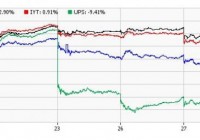
Transport ETFs Jolted By Weak UPS Earnings Forecast

With the economy growing at the fastest clip in over a decade and the oil price at a five-year low, transportation was one of the best performing sectors of 2014. This trend continued in 2015 driven by solid retail, manufacturing, and labor data that created strong demand for the movement of goods across many economic sectors. Additionally, strong earnings from major players in the industry are fueling growth in the sector. However, the space was badly hit by the recent profit warning and sluggish outlook from the bellwether United Parcel Service (NYSE: UPS ) on January 23 that dampened investors’ mood making them cautious on the stock and the broad sector. UPS Warns of Soft Q4 Earnings The world’s largest package delivery company said that higher operating expenses and temporary hiring for the peak holiday season might take a toll on the earnings for the fourth quarter and full-year 2014. It is slated to release its fourth quarter earnings on February 3. The company now projects earnings for Q4 to come in at $1.25 per share, missing the Wall Street’s expectations of $1.47. Accordingly, the Zacks Consensus Estimate moved down to $1.25 from $1.47 over a period of seven days. United Parcel also slashed its full-year guidance to $4.75 per share, much below the previous expectation of $4.90-$5.00 a share and the current Zacks Consensus Estimate of $4.77. The Zacks Consensus Estimate has declined 21 cents over the past 7 days. Weak 2015 Guidance Further, the company expects 2015 earnings to grow slightly less than its long-term growth target of 9-13% due to increased pension costs and currency headwinds. The Zacks Consensus Estimate currently represents growth of 7.85% for this year. Market Impact The news has spread bearishness not only on this package delivery giant but also on the broad space. UPS shares dropped as much as 10% on Friday after this bearish announcement and are down nearly 11.7% over the past three days. Its major rival FedEx (NYSE: FDX ) fell 4.1% over the past three sessions. The sluggish trading has also been felt in the ETF world as both the transport ETFs – the iShares Dow Jones Transportation Average Fund (NYSEARCA: IYT ) and the SPDR S&P Transportation ETF (NYSEARCA: XTN ) – lost 2.3% and 1.2%, respectively, in the same period. What Lies Ahead? Despite the slide and UPS’ sluggish outlook, investors shouldn’t completely write off transportation ETFs from their holdings. This is because the funds have spread out exposure to a number of firms in various types of industries like railroads, airline and low cost trucking suggesting that the space can easily counter shocks from some of the industry’s biggest components. In fact, IYT puts about 47% in railroads while airfreight & logistics makes up for nearly 27% share. Meanwhile, XTN is heavily exposed to trucking and airlines as these make up roughly 62% of the total while air freight & logistics accounts for 21% share. In terms of individual holdings, the iShares product is heavily concentrated on the top firm – FedEx – at 11.65% while UPS takes the fourth spot at 6.71%. On the other hand, State Street fund uses an equal weight methodology for each security. While IYT is more popular and liquid among the two, XTN is cheap by 8 bps. Further, FedEx reaffirmed its EPS guidance of $8.50-$9.00 for fiscal 2015 on the heels of UPS’ warnings. The midpoint is well above the Zacks Consensus Estimate of $8.94, indicating sound business for the transport ETFs. If these were not enough, cheap fuel will provide a big-time boost to transport earnings growth. This has already started to reflect in the latest earnings results as earnings for the transport sector reported so far is up 20.6% with a beat ratio of 57.1% and median surprise of 3.3%.

ALPS Plans A Put Write ETF To Play Market Volatility

The U.S. markets have seen a volatile start to the year, thanks to the relentless slide in crude oil prices, worries about a possible exit of Greece from the Euro zone, global economic growth concerns and slumping commodity prices. Rising market volatility has led some issuers to plan for funds based on put write strategy. WisdomTree has lately filed for a fund – WisdomTree CBOE S&P 500 Put Write Strategy Fund – to generate returns by writing put options on the S&P index. Most recently, ALPS has filed for a fund based on a similar strategy. The proposed fund will go under the name of ALPS Enhanced Put Write Strategy ETF (Pending: PUTX ). Below, we have highlighted some of the key details of the recently filed fund. PUTX in Focus As per the SEC filing , the proposed actively managed product looks to maximize total return by selling put options on the SPDR S&P 500 Trust ETF (NYSEARCA: SPY ). SPY tracks the S&P 500 index measuring the performance of large-cap U.S. stocks. The premium received will then be invested in an actively managed portfolio of investment grade debt securities. The portfolio will include Treasury bills, corporate bonds, commercial paper and mortgage- and asset-backed securities, having an average duration of less than 6 months and maturity of less than one year. How might it fit in a portfolio? The fund is a good choice for investors who wish to add income and thereby boost risk-adjusted returns. Investors who believe that the U.S. equity market will trade in a narrow range next year can look to invest in the fund. A put write strategy usually outperforms the index in a down trending market and significantly outperforms the S&P 500 index in a sideways market. Moreover, put write strategies have historically outperformed buy strategies. However, investors should keep in mind that the fund’s potential return is limited to the amount of option premium it receives and that the proposed fund might underperform during strong bull markets. ETF Competition The recently filed product is quite similar in strategy to the WisdomTree CBOE S&P 500 Put Write Strategy Fund. However, unlike PUTX. which sells options on SPY ETF, WisdomTree’s product looks to sell options on the S&P 500 index itself. Moreover, while PUTX looks to invest the premium received in an actively managed portfolio of investment grade debt securities with less than one year maturity, the CBOE S&P 500 Put Write Strategy Fund will invest the premium received in one-to-three month U.S. Treasury securities. As such, both the funds might be good competitors if launched. Apart from this we also have another put-write fund in the market from ALPS itself. The fund in question – US Equity High Volatility Put Write Index ETF (NYSEARCA: HVPW ) – tracks the NYSE Arca U.S. Equity High Volatility Put Write Index. The index sells put options on the largest capitalized stocks having the highest volatility. The index uses the sales proceeds to invest in short-term U.S. Treasury securities. The fund manages an asset base of $50.8 million and trades in low volumes of roughly 23,000 shares a day. The ETF charges 95 basis points as fees and has delivered flat returns in the year-to-date frame. So, there is hardly any competition for the newly proposed fund. If launched, the fund has a fair chance of making a name for itself. However, let’s not forget that success over the longer run is ultimately a huge factor of the fund’s performance.