Tag Archives: setpageviewname

Income And Caution With This Dividend ETF
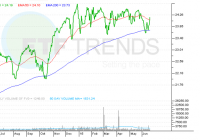
Summary Dividend ETFs may generate attractive yields, but they are exposed to rate-sensitive sectors. Highlight of the First Trust Value Line Dividend Index Fund. Significant utilities sector position is weighing in on performance. By Todd Shriber & Tom Lydon With Treasury yields rising and concerns that the Federal Reserve will boost interest rates in the coming months doing the same, some dividend exchange traded funds are lagging broader benchmarks. That is true of the First Trust Value Line Dividend Index ETF (NYSEARCA: FVD ) , which has traded modestly lower this year while the S&P 500 has gained 2.5%. FVD follows the Value Line Dividend Index, which equally weights components and utilizes the proprietary Value Line research to select components. Specifically, stocks are ranked by the Value Line Safety Ranking of 1 or 2 out of 5, which are based on price stability and financial strength. Additionally, the index excludes stocks with a dividend yield lower than the S&P 500. “Over the last 10 years, FVD produced an annual average 10.4% gain vs. 7.9% for the S&P 500,” according to Investor’s Business Daily . “Their difference in their current dividend yield is modest. FVD yields 2.2% and SPY 1.9%.” Though its yield is attractive relative to the S&P 500, it is the source of that yield that could be a strike against FVD in a rising rate environment. Specifically, the ETF allocates 22.6% of its weight to utilities stocks, the most vulnerable group to rising interest rates . FVD devotes another 13.5% of its weight to consumer staples stocks, another sector that historically lags when interest rates climb. FVD’s utilities and staples exposure is somewhat offset by a combined 32.3% weight to financial services and industrials names, groups that often perform as Fed policy turns hawkish. Rising Treasury yields and slumping utilities stocks have not been enough to sour investors on FVD. The ETF is home to nearly $1.21 billion in assets under management up from $955 million in October. The ETF’s technology weight of 8.1% is fair among dividend funds, but FVD allocates less than 2% to telecom, another highly rate-sensitive sector. FVD’s holdings are also equally weighted. FVD currently shows 187 holdings and its largest component stocks only make up 0.65% of the underlying portfolio. However, this strategic beta index-based ETF is more costly than the average dividend ETF. FVD shows a 0.70% expense ratio, compared to the average 0.58% expense ratio for dividend yield weighted ETFs and 0.5% expense ratio for the average dividend weighted ETF, according to XTF data. At 0.7%, FVD is twice as expensive as the SPDR S&P Dividend ETF (NYSEARCA: SDY ) and seven times as expensive as the Vanguard Dividend Appreciation ETF (NYSEARCA: VIG ) . First Trust Value Line Dividend Index Fund (click to enlarge) Disclosure: I/we have no positions in any stocks mentioned, and no plans to initiate any positions within the next 72 hours. (More…) I wrote this article myself, and it expresses my own opinions. I am not receiving compensation for it. I have no business relationship with any company whose stock is mentioned in this article.
More Triple-Leveraged Biotech ETFs Come To Town

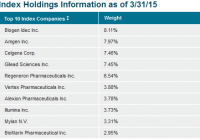
Summary New leveraged biotechnology ETFs to hedge or capitalize on market moves. Focus on ProShares’s new leveraged/inverse NASDAQ Biotechnology ETFs. Additionally, ProShares added leveraged/inverse Oil & Gas and homebuilder funds as well. By Todd Shriber & Tom Lydon For over five years, the ProShares Ultrashort Nasdaq Biotechnology (NasdaqGM: BIS ) and the ProShares Ultra Nasdaq Biotechnology (NasdaqGM: BIB ) cornered the market for leveraged biotechnology exchange traded funds. In the span of three weeks, the number of leveraged biotech ETFs has tripled. In late May, Direxion introduced the Direxion Daily S&P Biotech Bull Shares (NYSEArca: LABU ) and the Direxion Daily S&P Biotech Bear Shares (NYSEArca: LABD ) . Today, ProShares, the largest issuer of inverse and leveraged ETFs, launched the UltraPro NASDAQ Biotechnology (NasdaqGM: UBIO) and the UltraPro Short NASDAQ Biotechnology (NasdaqGM: ZBIO) . The UltraPro NASDAQ Biotechnology will attempt to deliver three times the daily performance of the NASDAQ Biotechnology Index while the UltraPro Short NASDAQ Biotechnology will seek to deliver three times the daily inverse performance of that index. The NASDAQ Biotechnology Index is the underlying benchmark for the iShares Nasdaq Biotechnology ETF (NasdaqGS: IBB ) , the largest biotech ETF by assets. Maryland-based ProShares introduced four leveraged ETFs today, including a pair of leveraged homebuilders funds, a niche rival Direxion is also eyeing . The Ultra Homebuilders & Supplies (NYSEArca: HBU) and the UltraShort Homebuilders & Supplies (NYSEArca: HBZ) will offer double leverage on the Dow Jones U.S. Select Home Construction Index. That is the underlying benchmark for the $2.1 billion iShares U.S. Home Construction ETF (NYSEArca: ITB ) . ProShares also introduced two double-leveraged equity-based energy ETFs today. Those new funds are the Ultra Oil & Gas Exploration & Production (NYSEArca: UOP) and the UltraShort Oil & Gas Exploration & Production (NYSEArca: SOP) . UOP will seek to deliver double the daily returns of the S&P Oil & Gas Exploration & Production Select Industry Index while SOP will attempt to deliver double the daily inverse returns of that index. That index is the underlying benchmark for the $1.6 billion SPDR S&P Oil & Gas Exploration & Production ETF (NYSEArca: XOP ) . On May 29, Direxion introduced triple-leveraged answers to XOP , the Direxion Daily S&P Oil & Gas Exploration & Production Bull Shares (NYSEArca: GUSH ) and the Direxion Daily S&P Oil & Gas Exploration & Production Bear Shares (NYSEArca: DRIP ) . NASDAQ Biotech Index Top Holdings as of March 31, 2015 Table Courtesy: ProShares Disclosure: I/we have no positions in any stocks mentioned, and no plans to initiate any positions within the next 72 hours. (More…) I wrote this article myself, and it expresses my own opinions. I am not receiving compensation for it. I have no business relationship with any company whose stock is mentioned in this article.

Preferred Stock ETFs For Retirement

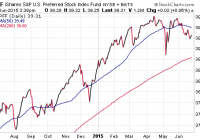
Summary The income investing landscape has certainly shifted in 2015, with many dividend fixtures trading well below their starting point for the year. The backup in interest rates this year has been the primary culprit responsible for rebalancing the scale away from these equity income assets. PFF has managed to remain on a relatively steady course so far this year when compared to other areas of the income-generating universe. The income investing landscape has certainly shifted in 2015, with many dividend fixtures trading well below their starting point for the year. Stalwart asset classes such as REITs, utilities, MLPs, and even dividend paying common stocks have struggled to make positive headway and in some cases are more than 10% off their recent highs. The backup in interest rates this year has been the primary culprit responsible for rebalancing the scale away from these equity income assets. The 10-Year Treasury Note Yield has moved over 40% higher since hitting a low in January and is now firmly situated near 2.40%. Income investors are likely feeling a level of frustration with the lack of progress year-to-date and oversensitivity to interest rates may fuel additional anxiety as they contemplate the looming threat of a Fed rate hike. Nevertheless, one alternative asset class has continued to persevere despite the overarching malaise. The iShares U.S. Preferred Stock ETF (NYSEARCA: PFF ) is a fund I have owned for some time now for my income-seeking clients . PFF has over $13 billion dedicated to over 300 preferred stock holdings and charges an expense ratio of 0.47%. One of the most attractive features of this fund is its current 30-day SEC yield of 5.40%. Income is paid on a monthly basis to shareholders and has historically been very consistent. In addition, PFF has managed to remain on a relatively steady course so far this year when compared to other areas of the income-generating universe. Preferred stocks carry characteristics of both equity and debt, which allow for very low correlations with either asset class. Typically these securities are issued by banks, financial institutions, and real estate companies with long maturity dates. While PFF has been able to escape the wrath of interest rate volatility this year, that doesn’t mean it will hold up under every appreciable change in credit or Treasury-linked securities. This fund experienced a 10% drop in 2013 as changes to quantitative easing programs by the Fed sent shockwaves through the financial markets. The portfolio manager for PFF did an excellent review of its potential weaknesses with respect to interest rates that is worth a read as well. Another ETF in this space that promises a unique dynamic is the PowerShares Variable Rate Preferred Portfolio ETF (NYSEARCA: VRP ). This fund primarily invests in preferred stocks with floating rate or variable coupon components. VRP has an effective duration of 3.86 years and a 30-day SEC yield of 4.92%. In theory, floating rate securities are deemed to be more effecting during periods of rising interest rates because their income component adjusts higher along the way and they typically have shorter durations. Nevertheless, with the relatively short trading history, this strategy has yet to be tested under the rigors of an outsized move in rates. The Bottom Line Preferred stock ETFs can be used for yield enhancement and diversification in the context of a well-balanced income portfolio. However, investors should be aware that as a non-traditional asset class, they may be susceptible to unique risks and price drivers. Keep in mind that the higher yields of preferred stocks should correlate with smaller overall position sizes to avoid becoming overly focused on just one component of these securities. Disclosure: I am/we are long PFF. (More…) I wrote this article myself, and it expresses my own opinions. I am not receiving compensation for it. I have no business relationship with any company whose stock is mentioned in this article. Additional disclosure: David Fabian, FMD Capital Management, and/or clients may hold positions in the ETFs and mutual funds mentioned above. The commentary does not constitute individualized investment advice. The opinions offered herein are not personalized recommendations to buy, sell, or hold securities.