Tag Archives: seeking-alpha

Risk-Neutral Vs. The Real World: Wall Street Traders Really Are From A Different Planet

Risk-neutral versus real-world pricing and valuations matter. Risk-neutral traders are less active, leading to trading and investment opportunities. Interest rates drive growth and inflation expectations, not the other way around. Traders at the big Wall Street banks have their own culture, language, idioms and superstitions. They have a peculiar code of ethics, ideals and standards of behavior. Indeed, they even have unique and privileged access to markets and information that both ordinary and sophisticated investors are envious of. It is like they come from and inhabit a different planet from the rest of us. It turns out the traders at the big banks do, in fact, belong to another world. Readers of a quantitative inclination will recall that sell side traders operate in what is called the Q, or “risk-neutral” world, whereas the buy side – that means the rest of us – function in the P, or “real world.” The distinction between the two worlds – the P and Q – is profound, and is also gaining increased importance. That is because the Q World, occupied by the traders at the sell-side banks, is under intense pressure to reduce risk taking activities. There is also a culling of Malthusian proportions going on at Wall Street trading desks, in effect depopulating the Q World. The table below describes the differences between the two worlds: The P World The Q World Goal Predict the future Extrapolate the past Environment Real world probability Risk Neutral probability Process Discrete time series Continuous time martingales Dimension Infinite Finite Tools Econometrics, statistics Ito calculus, SDEs Challenges Parameter estimation Calibration Business Buy Side Sell side Density ratio or ∏ =q/p should be a monotonically decreasing function of market returns. Source: Meucci 2011, CGA Research. The key point to note here is that sell-side traders, or the Q-World, do not really need to worry about future market returns. The sell-side model is based upon a cost-plus replication strategy that simply buys and sells securities at prices where risk is neutralized by various hedging strategies. As long as markets are reasonably complete and liquid, the sell side can isolate itself against future price developments. The sell side only gets into trouble when it moves away from the Q-World and risks its own capital speculating in the P-World. Now that we understand the two worlds, the question becomes what happens when Q-World goes away or its market power is greatly diminished? We have already seen and heard about disruptions and lack of liquidity in various bond markets since Q-World retrenched in the aftermath of the 2008 financial crisis. More recently, we see the effects in the oil markets where an unprecedented exodus from commodity markets by the big banks has contributed to the drastic fall in oil prices. Is it simply a coincidence that headline oil prices have declined by upwards of 50% during the same time that Morgan Stanley (NYSE: MS ), JPMorgan Chase (NYSE: JPM ), Credit Suisse (NYSE: CS ), Goldman Sachs (NYSE: GS ) and others have or are planning to exit the commodity trading business? Maybe, but it is more likely that a reduced number of Q-World commodity traders has facilitated the decline. In years past, large market declines were typically met by sell side traders bundling distressed assets into packages of securitized products that were ultimately on sold to buy side investors. The banks once had a stabilizing influence upon volatile markets. Such activity is no longer profitable for the banks due to stringent capital requirements and some outright prohibitions against warehousing the risk. Unwittingly or not, the world’s central banks, led, of course, by the U.S. Federal Reserve, have supplanted the diminished role of Q-World traders by providing an ample dose of extraordinary monetary accommodation. In other words, secular volatility is set to rise and will be further exacerbated once the world’s central banks move to the side-lines. Few people, including myself, expect the days of hyper activist central banking to end anytime soon. Nonetheless, at the margin, even the U.S. Federal Reserve is a little less active then last year. So what are the implications? Secular volatility will rise in most assets classes, particularly those that trade over the counter e.g. government and corporate bonds Market corrections will be more violent, happen quicker and take longer to reverse than in years past Intrinsic value does not change, although cash flow value may- which will ultimately lead to an abundance of market opportunities Specifically, there are now opportunities to buy the SPDR S&P Oil & Gas Explore & Production ETF (NYSEARCA: XOP ) after it fell 30% in 2014. The PowerShares DB Com Index Tracking ETF (NYSEARCA: DBC ), also off close to 30% in 2014, offers investors greater exposure to a basket of commodities, although the ETF maintains significant exposure to oil. Timing such purchases is always difficult, and the risk of being too early is real. My point here is that such declines have as much to do Q- World inactivity as they do with fundamental changes to the supply demand equilibrium. Hence, a good portion of the recent drop should prove to be transitory. Investment success rests with those that can best understand the phenomenon of markets explained by basic economic mechanisms such as supply and demand and, which can also incorporate agent based models of behavior. There is little doubt that such agent based models such as the need to save for retirement, risk aversion or the savings and consumption patterns of millennials to name just a few, account for a large portion of the variance of asset returns. What has changed recently is the agent based conduct of the Q-World traders rather than any fundamental principle of economics. That leads to opportunities for P-World investors like you and me. The trick is to balance your assessment of both Type I errors – investing in an unprofitable strategy and Type II errors – missing a truly profitable trading opportunity. The likelihood of making a Type II error has increased simply because there are fewer Q-World traders willing and able to take the other side of market overreactions such as the mid October 2014 equity selloff, materially wider U.S. High Yield spreads and the ever lower Euro currency. Looking ahead to 2015, I think it is important to note just how important it is to get your interest rate call right. Last year, Utilities (SPDR ETF, XLU ), REITs (iShares Dow Jones US Real Estate ETF, IYR ), and high-quality, long-duration government bonds (iShares Barclays 20+ Yr Treasury Bond ETF, TLT ) had total returns close to 25% to 30%. These three asset classes benefited enormously from lower nominal and real U.S. interest rates. With interest rates in play again in 2015 (higher or lower), the difference between Q and P world pricing and valuation becomes even more important. It used to be that investors just had to get the growth and inflation call right, and the interest rate view would simply follow. That no longer seems to be the case. It’s a big deal, and it’s a theme that I plan to develop further in a future newsletter. Look at it this way. U.S. growth and inflation readings in 2015 are likely to be quiet supportive of risky assets. Yet the market’s attention is almost wholly captured by a potential rise, however modest, of the Federal Funds rate.
Investors Are Scared – Getting Long Volatility Again

Last week I offered up a playbook for volatility for this year. Since that time I’ve shorted volatility and subsequently gotten long. I’ll continue to use a hedged position selling calls against the VXX until the volatility outlook changes. Last week I wrote a piece regarding volatility in the new year and my playbook for how to survive the strong moves up and down in volatility as measure by the short term VIX ETF (NYSEARCA: VXX ). At the time I had no positions as I was waiting for a more definitive move up or down in order to stake my claim on the VXX. I wrote I wanted to see a bigger move up before shorting and since the time the article was published, VXX has moved sharply to the upside to trade near $35 as I write this. So what have I done since the last article and what am I doing going forward? After being out of the VXX for a couple of weeks I actually decided to get short volatility after another move up following my article. I used the inverse short term VIX (NASDAQ: XIV ) ETF to do so to try and capture a move down in the VXX. I went long XIV on the 7th and captured a very nice move down in volatility only to have it reversed on Monday the 12th. After seeing the move down in volatility was short lived I closed my XIV position for a very small gain (after riding the XIV up and back down) and went long VXX again. Why did I go long? There is a lot of stuff going on in the financial world. Oil and other commodities continue to signal that a recession is coming, Greece is once again on the verge of breaking up the Euro and here at home, the market hangs on the Fed’s every word in terms of any potential volatility that could be introduced from the central bank raising rates and pulling stimulus. These factors make me think the likely move in volatility is up in the short term, not down. I’m currently long VXX while selling calls against my position. I did this for two reasons. First, in case I’m wrong, VXX can move down in a hurry and crush you. This is the same problem the short volatility ETFs have and that’s why I trade in and out so much and why you’ve got to be careful. The calls give me some cushion on the downside in exchange for taking away my upside in case volatility collapses. Second, I sold the calls simply because premiums are huge. Slightly out of the money calls can be sold for 5% of the ETFs price – for an option that expires in a week. Think about that one; that kind of yield for five or six trading days is unbelievable and it provides not only huge amounts of cash for your portfolio but a nice bit of protection to the downside. I went long VXX at $33.30 and sold weekly 33 calls against my position for $1.46, expiring four days after I sold them. Given the move up in the VXX to $34.40, I’ve given some upside away but I’m still collecting the huge premium in the meantime, offering 3.5% yield and some downside protection as I sold in the money calls. Given the outlook for continued volatility I think the best course of action going forward is hedged bets in the VXX. Last October and again in December of last year I went long the inverse VXX ETF (NYSEARCA: SVXY ) or the VXX itself with no protection as the situation warranted because I felt strongly I could predict what volatility was doing. But given all of the places we can expect news from in the short term, I don’t feel confident enough to just buy VXX or XIV. I like the covered call play on VXX right now but if VXX spikes to the high $30s, as I said in my last article, I’ll look at doing the same think with XIV. But for now, I’m long VXX until something changes and when it does, I’ll be sure to let you know. Additional disclosure: I’m long VXX hedged with short calls but may trade out of this position at any time.

Time In, Not Timing, Is Everything

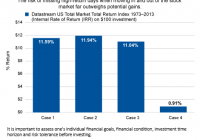
Editor’s note: Originally published on December 22, 2014 Market timing can be a perilous game that long-term investors should avoid playing. It’s difficult to get it right. And the time spent on the sidelines waiting for “the right moment” presents big risks to your portfolio. Last week proved to be a roller-coaster ride for investors and an important reminder for investors to stay the course in the face of short-term market gyrations. Stocks dropped dramatically in the first half of the week, as the price of oil continued to fall and Russia raised interest rates in a desperate attempt to defend the ruble. That all changed on Wednesday afternoon, when the FOMC announcement halted the selloff. The announcement and accompanying projections appeared to soothe markets and actually change the mindset of investors, sending stocks sharply higher. Heading for the Exits Unfortunately, many investors had sold out of stock funds by then and missed that rebound. In fact, according to EPFR Global data, the week ending Wednesday saw the biggest outflows from equity funds since 2005. This is troubling because it shows that investors continue to let their emotions get the better of them. Moving in and out of the stock market based on the headlines is hazardous to the health of investors’ long-term portfolios, and puts financial goals at risk. In light of last week’s market tumult and the response from investors, I feel compelled to repeat the findings of a study published in early 2014 by my colleagues on the Economics & Strategy team at Allianz Global Investors. Their research shows the dangers of market timing. Specifically, the study looked at the performance of the Datastream US Total Market Total Return Index from 1973 through the end of 2013, comparing four different investment approaches: 1. Investing $100 at the start of the first year and adding an additional $100 at the start of each subsequent year. 2. Investing $100 on the day of the lowest index level of the year and adding an additional $100 each year on the day of the lowest index level of that year—the best day of the year to invest. 3. Investing $100 on the day of the highest index level of the year and adding an additional $100 each year on the day of the highest index level of that year—the worst day of the year to invest. 4. Investing $100 each year at the start of the year as in the first approach, but assuming one misses the returns of the best three trading days in each year. The results provide a strong cautionary tale: Time in the market beats timing the market. The returns are actually quite similar in the first three hypothetical scenarios, ranging from 11% to 11.9% in annualized terms. However, the fourth hypothetical produces dramatically lower performance: an annualized return of just under 1%. In other words, it doesn’t matter when you get in, it matters that you stay in for the long haul. Equally compelling are the results of Morningstar’s research on the disparity between mutual fund returns and mutual-fund shareholder returns. Over the 10 years ending Dec. 31, 2013, Morningstar found a widening performance gap between investors and the funds themselves. That makes sense given that investors became extremely risk averse in the wake of the global financial crisis, shunning stocks even as they rebounded. The scars from the crisis clearly run deep and have exacerbated investors’ emotional responses to market events. Breaking down the numbers, Morningstar shows that the typical investor gained 4.8% on an annualized basis over that 10-year period versus 7.3% annualized for the typical mutual fund. The gap is caused by the investor’s time (or lack thereof) in the stock market. In fact, market timing takes a bigger bite out of investor returns than fees for active management. Poor Timing Mutual fund flows in 2012 reveal the perils of market timing. Flows in 2012 Show Poor Timing 2012 Flows ($ Billion) Subsequent Return 2013 (%) U.S. Equity -93,677 35.04 Sector Equity 3,264 18.90 International Equity 13,604 13.19 Allocation 20,399 15.40 Taxable Bond 269,760 0.15 Municipal Bond 50,313 -3.40 Alternative 14,781 -4.85 Commodities 1,365 -9.10 Source: Morningstar. Looking ahead to 2015, we expect more market turbulence and rotation among different styles and asset classes. In this type of environment, it’s critical that investors remember the importance of developing a long-term plan in an emotional vacuum—and adhering to it even when the world around us seems to be panicking. In short, investors don’t plan to fail, but they often fail to plan. The key is to have a plan—and then stick with it. These are words to invest by as we prepare for 2015 and beyond.