Tag Archives: seeking-alpha

Exelon Set To Grow And Reward Investors In The Long Run
Summary EXC’s strategic investments in regulated operations and recent acquisitions will trigger decent growth and stability in revenue, earnings and cash flows. EXC will better support its dividend payments to remain an attractive pick for dividend-seeking investors. Stock offers attractive dividend yield of 3.3%. Owing to volatility in natural gas and power prices, Exelon Corporation’s (NYSE: EXC ) competitive business operations have been hurting its earnings growth prospects. In its efforts to fight back the challenges in its competitive power operations, the company has started pursuing an intelligent strategic growth formula that focuses on strengthening its regulated operations. As a matter of fact, these strategic initiatives, focused on diversifying its power generation portfolio through strategic acquisitions and through the sale of its competitive assets, will strengthen its long-term growth prospects. I believe that by increasing regulated operations, the company will create stable earnings and a secure cash flow base, which will ensure the security of its attractive dividend payment policy in the long term. EXC Making Right Moves to Grow In Long Run The company has a large operational base with both competitive and regulated operations. Competitive business operations contribute more than 40% towards its total earnings. Weakness in the company’s competitive business operations in recent years due to low and volatile power prices has hurt EXC’s consolidated earnings growth prospects. In its efforts to overcome the backdrops of its competitive operations, the company has carved out an intelligent strategic growth plan to divest most of its competitive assets and grow its power generation portfolio through acquisitions. The company has signed definitive contracts to sell the non-core assets of its generation segment for $1.4 billion . And out of these $1.4 billion proceeds, approximately $1 billion will be used to fund the acquisition of Pepco Holdings Inc. (NYSE: POM ). The POM-EXC merger agreement, which recently reached a settlement in a hearing before NJ BPU (New Jersey Board of Public utilities), is expected to close in the second or third quarter of 2015. Upon its completion, the merger will increase the scale of EXC’s regulated operations. An increase in regulated operations and completion of the merger will bring stability to its cash flow base. Along with that, the combined utility business is expected to have a rate base of approximately $26 billion , which will portend well for its future sales growth. Also, I believe the $6.8 billion POM-EXC merger will positively affect its earnings growth rate, and EXC is expected to enjoy an earnings growth rate of 4%-6% in the long term. Moreover, EXC is working to improve its electricity generation portfolio and reduce its operational risks. The company completed the acquisition of Integrys Energy, which will strengthen its operations. Since many of Intergrys’ customers are in the same regions where EXC has significant power generation operations, the acquisition will benefit the company by matching generation with load capacity. Talking about the significance of the acquisition, Kenneth Cornew, the president and CEO of Exelon Generation, said : “The combination creates a stronger, more diverse business that is well positioned to compete for customers in retail electricity and gas markets across the country. It vastly expands our gas portfolio increasing our load by 150 BCF annually.” Owing to the potentials of the company’s strategic growth efforts, I believe the management’s expected rate base growth of $24.7 billion by the end of 2017 is achievable, which will add well towards its sales and earnings numbers in the long-run. The following chart shows the company’s expected rate base growth from 2014 to 2017. Source: Company’s Earnings presentation In addition to the successful acquisitions, EXC is considering options to close its nuclear power operations. Although the company has a widely extended nuclear power generating portfolio, but owing to their cost-competitive nature, its nuclear facilities are putting EXC at a disadvantage as compared to its peers. The company has highlighted the need for government support on nuclear plants in its recent statement on a power plant closure in Illinois. Although the government hasn’t responded to this statement yet, I believe that if the state doesn’t pursue the Regional Green House Gas Initiative (RGGI) or comparable market based programs to support carbon-free nuclear energy in Illinois, EXC should shut three out of its eleven nuclear plants in the state. Potential rewards for Income-Seeking Investors EXC has returned a significant proportion of its annual cash flows to its shareholders through healthy dividend payments. The company currently offers an attractive dividend yield of 3.30% . Given the fact that the POM acquisition will soon raise its level of regulated operations, EXC will remain attractive for its dividend-seeking investors due to the attainment of a stable cash flow base. As a matter of fact, a stable cash flow base will provide sustainability and security to the company’s long term dividends. The following chart shows EXC’s dividend per share payments in the last two years and for future years, based on my estimates. Source: Company’s Yearly Earnings Reports & Equity Watch Estimates Risks With an increase in the level of regulated operations, the company will be exposed to the risk of increases in regulatory restrictions by federal and state regulators. Moreover, EXC’s competitive assets will continue to face the risk of volatility in power prices. In addition to that, failure to integrate new acquisitions may undermine the company’s expected earnings growth potentials. Conclusion Owing to the company’s strategic investments in regulated operations and recent acquisitions, I believe EXC will witness decent growth and stability in its revenue, earnings and cash flows. Moreover, the company will be able to better support its dividend payments to remain an attractive pick for dividend-seeking investors. The stock currently offers an attractive dividend yield of 3.3%. Also, analysts have anticipated a decent next five-year earnings growth rate of 4.40% for the company.
Why Dave Ramsey Is Wrong

There is no denying that Dave Ramsey has done a commendable job of bringing back our grandparents’ financial values into popular culture. Many Americans have been poor stewards of their finances and have been saddled with avoidable debt. Ramsey’s advice has helped thousands get back on the right financial track. Even at my own company, we use the debt snowball of Financial Peace University to help right the finances of our pro-bono planning clients. Ramsey has become a multimillionaire by simply telling people to live within their means by creating and maintaining their household budget. Certainly, in today’s society of zero interest and only three easy payments of $19.99, this is no simple task. However, once a person overcomes modern-day financial temptation and begins investing in his or her future, Ramsey drops the ball and becomes a spokesperson for one of the most confusing industries in America, financial product sales. Ramsey recommends his followers work with brokers who are paid high commissions for investing in mutual funds. Ramsey, as popular as he is – and no one disputes that – has missed the boat on one thing – dismissing the credibility and sensibility of a fiduciary and fee-only financial advisor. That may not sound like a big deal, until you understand that picking the right financial advisor can lead to an overall stronger financial foundation for your family, your future and your state of mind. Let’s look at this a bit closer. The Fee-Only Advantage Fiduciary (your best interest) fee-only advisors take a different approach to investing. There are no selling products; fee-only advisors are not paid a commission from a product. This removes the conflict of interest that brokers carry in their relationships with their clients. This also causes the advisor to look differently at the product that he or she recommends to the client, which is why we see a much higher usage of index funds from the fee-only community. These highly diversified funds carry very low fees, because they don’t pay any advisor any commission, and historically have beat actively managed, commission mutual funds over long periods of time. A well-diversified index fund portfolio should cost no more that 0.25% a year, with most of the funds trading at no charge. Fee-only advisors are compensated as a percentage of assets they manage, by a flat monthly retainer, or bill hourly for financial planning. Each of these options are free from any conflict that the advisor gives to the client. Most fee-only firms also include financial planning in their asset management fees. A financial plan sets how the portfolio should be allocated. Proper asset allocation is a large ingredient to successful long-term investing. A mutual mess Ramsey, on the other hand, encourages his followers to contact a broker within his referral network when they are ready to start investing. In the interest of full disclosure, his network rejected my firm telling me that being a fiduciary fee-only financial services firm we did not qualify because his network is made up of only commission brokers. Ramsey recommends that his flock work with a broker and invest in a mutual fund that has a long track record of good results vs. the S&P 500. He then adds that the investor should purchase and stay put, meaning don’t sell when the market falls, be a buy and hold investor. The broker will collect a 5% +- commission from the sale and will receive a smaller percentage on a quarterly basis, assuming the investor does not sell the fund. Additional investments into the fund, whether it is annually or monthly, will also be charged the large upfront fee. Ramsey supports this model because he believes this to be the cheapest form of investing compared to fee-based firms that would be charging 1.2% a year to give advice and provide planning services. In the 80’s and early 90’s this may have been the correct advice, but unfortunately the US brokerage business has taken a turn for the worst, in that products are not built to benefit the client, they are built to make money for the firm and the broker. A retired executive from a large brokerage company recently told me he got out because his firm no longer focused on the client, they focused on what they could get away with selling to the client. Even if Ramey’s referral network has the best intentions, history is against them. There have been very few mutual funds that actually beat the S&P 500 net of fees over long periods of time. Some get lucky over a 10 year stretch, but after 15 years the list is very short. Historically we see less than 1% of funds beat the S&P 500 (after fees) over 30 years. This might be a long time, but how long are you going to be invested? If you live to age 95 and are in your 40’s or 50’s, 30 years is not that long. Another issue is Ramsey’s buy and hold philosophy. The idea is great on the surface, but when a year like 2008 strikes many individual investors, without a good financial support system, are going to sell. If you get burnt, you first want to stop the pain (sell low) and when you go back, if at all, it will be when you feel ready (buy high). Buy and hold is the correct advice, but when you call the broker for reassurance there is always the potential of him or her selling you another fund at 5% commission to help “make you feel better,” while padding his or her pockets with more of your money. This is where a fee-only advisor earns their fee. By keeping the client focused long term, buy high and sell low tendencies can be eliminated, increasing the client’s rate of return. Ramsey also recommends that you not own bonds. He states “bonds are mistakenly believed to be safe.” While it is true – not all bonds are safe – there is a good case to be made for adding the right bonds to a portfolio to lower volatility. Bonds in a portfolio help keep you from hitting the panic button when it feels like the stock market is falling into oblivion. A fee-only advisor can help choose the right bonds for the portfolio. Ramsey also wants his followers to stay away from Exchange Traded Funds (ETFs). ETFs, if used properly are more tax efficient than any mutual fund, held outside retirement accounts, are more liquid and offer cheaper fees. There are good ETFs and bad ETFs, and I think Ramsey has thrown the baby out with the bath water with this advice. Perhaps it is because his network of advisors would not receive a commission or trailing fee if ETFs were used. What should Ramsey do? If Ramsey and his network of brokers wanted to truly work in the best interest of his radio and print flock, I propose that he endorse a network of fee-only advisors, simply being paid by the hour. These advisors would help create portfolios for the Ramsey following at a fraction of the cost of his commission advisors, all while giving unbiased investment advice. In the end, Ramsey’s math does not add up and the investor loses. Ramsey, who tweeted that he was the “big dog on the porch” in a recent tweet with fee-only advisor Carl Richards, could use his status to help make all advisors work in the best interest of their clients, as is being discussed at the SEC in 2015. Instead, he sits in the pockets or every big insurance company on Wall Street who wants to maintain the current system of taking from Main Street to pad the profits of Wall Street.

Learning From Children About Investing

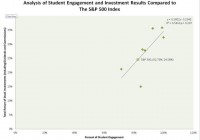
From the mouths of babes. Students show that one can beat the market, if s/he is interested. If you are passive, then invest in passive funds. If you are engaged, do it yourself or invest in managed funds. It was a simple enough project; teaching students to find a stock in which they might invest real money. That was the objective I had set when I was teaching at a high school in southwest Florida in 2013. I was assigned a class called, “Advanced Algebra with Financial Applications,” for seven periods. My goal? To teach high school seniors applied algebra for financial applications. I am on hiatus from the financial world, and wanted to return to teaching. With that, the school’s administration felt that having someone with a Series 7 and Series 66 talking to the kids on a daily basis about financial matters was an opportunity. Given that I am a stock jockey at heart, I was eager to show the students some basic stock analysis. I told them to invest in companies they knew. I showed them basic fundamental screening, so they could limit their choices to financially sound companies, actually had profits, and that those profits were likely to increase over time. Out of the approximately 190 students, 81 stocks were chosen. It was clear the students focused on products they bought or retailers where they shopped. The top five companies where the students wanted to invest were: Apple (NASDAQ: AAPL ), Disney (NYSE: DIS ), Coca-Cola (NYSE: KO ), Nike (NYSE: NKE ), and Procter & Gamble (NYSE: PG ). There were some surprising selections, and that was good, because I wanted the students to be creative, and try to find hidden gems. Companies such as Allegiant Travel (NASDAQ: ALGT ), Randgold (NASDAQ: GOLD ), L Brands (NYSE: LB ), Toyota Motors (NASDAQ: TM ), and V.F. Corp (NYSE: VFC ) made it to the ledger. We would monitor the progress of the stocks, and use current events to discuss any sharp moves in the stock prices throughout the year. Of course, this was a great opportunity to learn mathematics. Sadly, the Florida Department of Education daggered the program, and I had to transfer to another school. During the interim, I never gave the project much thought. Recently though, and ironically on the 500th day after we started, I went back to see how the portfolios were performing, and I found something very interesting. The classes that were fully engaged in the process, and who seemed to take the project seriously outperformed the S&P 500 market index. Most outperformed by a mile. It is worth describing what one means by “fully engaged.” High school students, being that they are still children, do not always do what they are supposed to do. Some of the classes had students simply not participate, and sadly, those students did not pass the class. I was not surprised by this, because this class of was being used for those students who historically struggled with mathematics, and had a history of failure. Keeping that in mind, I noticed that the classes where they fully invested their portfolios saw their stock positions outperform the market. I have a chart here to show what I mean. (click to enlarge) Essentially what happened was this: the classes with highest levels of participation saw their stock selections outperform the market. The correlation between participation and market performance was r = .7357 ( ρ = 0.0297). All of the classes where at least 85% of the students actively participated in the project outperformed the market index. The data showed that the bright line between outperformance and underperformance was an 82.75% level of participation. The data also showed when there was at least a 90% level of participation; the classes outperformed the market by at least 7.86%. Why did this happen? I did not count the students who refused to invest, so I only looked at those students who were participating. The non participating students had no effect on the outcomes directly. I guess I will say the usual disclaimer that more research will need to occur, but I am willing to make some educated guesses as to what happened. Given that this only studies seven classes, and 190 students, that is a fair conclusion to make. First, in the classes where there was full participation, there was a healthy competitive environment. One of the outperforming classes had a lot of football players in it, and they wanted to beat each other. Second, the outperforming classes had a higher level of collaboration, where the students would help each other in making decisions, and calculations for their stock selections. Of course, these observations are anecdotal, and will need to be measured in the future to determine whether anything significant exists. What this does tell me, is there might be some useful data for mutual fund companies to note. Mutual funds should have a team of analysts that have an environment of collaboration where the team members can support each other. Additionally, though, there should be a competitive environment where the stakeholders not just try to outperform the market, but try to outperform each other. For the individual investor, there are two clear conclusions. First, if one is willing to be fully engaged and active in their stock selections, then it is possible to outperform the market. There is a whole roster of superstar portfolio managers who can prove this point. If the individual investor does not have the time to dedicate to the process of finding fundamentally sound companies that will outperform over time, then hire a professional who will. Second, if one simply has a passive interest in investing, and merely does so to save for retirement or another goal, then passive indexing is just the thing to do. I hope this is useful for someone, and I will wish you happy investing. Additional disclosure: While I still have a Series 7 and Series 66, I am in no way publishing this as financial advice. If you need advice, I suggest you hire a professional. If you invest on your own, the decisions you make are yours, and so are the results.