Tag Archives: seeking-alpha

Top-Ranked ETF Wealth-Builders Now
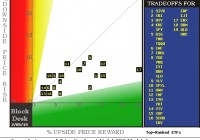
Summary ETFs provide diversification defenses against specific-issue calamity, while providing thematic focus on general investment opportunity notions – maybe good reward~risk tradeoff. Same argument for leveraged long broad-market ETFs. Using wealth-building objective strategy to rank ETFs provides ability to compare attractiveness of many, varied investing themes at one point in time. Here are 30+ ETFs at present price-based Market-Maker expectations for coming prices put to such a comparison. What is the wealth-building strategy? An active-investment one, minimizing required capital holding periods while seeking high odds for profitable outcomes. It is based on prior experience of applying the strategy, which pits Market-Maker [MM] upside price change prospects, derived from their specific issue hedging actions, against worst-case price drawdown encounters. All prior forecasts with price upside to downside outlooks like the present are subjected to a regimen of buy at the next market day close and sell upon reaching the forecast upside price, or no later than 3 months after the forecast day, regardless of gain or loss. The ranking requires at least a two to five year daily history of forecast price ranges and observes the frequency of profitable results of the regimen described above on all forecasts like today’s. The win-loss ratio proportions are applied to the upside price change forecast and the average worst-case price drawdowns encountered during prior holding periods. That net reward-minus-risk result is multiplied by the number of prior forecasts to get a figure of merit for ranking purposes. This proof-of-the-pudding approach keeps our taste restricted strictly to the objective of accumulating capital in the most time-efficient way. The following picture shows how the upside forecast rewards (horizontal green scale) compare to the historical risk exposures (vertical red scale) for over 30 best-ranked ETFs at last night’s close. Figure 1 (used with permission) The R~R map’s identity numbering has no particular significance. The presence of leveraged long market indexes is notable. Among ETFs their leverage is clearly a plus. The diversity of focus among the top ETFs is instructive: But there are other dimensions that matter. Here in ranked order are their details: Figure 2 (click to enlarge) The table of Figure 2 takes on the format of our daily “topTen” ranking of all 2500 or so stocks, indexes and ETFs that provide sufficient hedging data to reasonably imply the price ranges justifying the price protection being bought by market-makers. The averages rows in blue at the bottom of Figure 2 are to offer perspective of how these 30 “best” ETFs compare with other market investment alternatives at present. Of the daily overall rankings, today’s other 20 best have substantially stronger upside prospects (6) of 11 1/2%, compared to the ETFs +7.2%. But the ETFs demonstrate shorter average holding times (10) needed to reach sell targets, about 6 weeks, compared to 7 weeks for the best single-company securities, and 9+ weeks for the entire population and the usual market-metric of the S&P 500, the SPDR S&P 500 Trust ETF (NYSEARCA: SPY ). But both “best” lists average wins in 9 out of ten prior commitments following prior forecasts like today’s. Please remember that this is not a durable appraisal of long-term prospects for these securities. Instead, it is a scorecard, of the moment, of the likelihood of market-price movements in coming days, weeks and a few months, as seen by investment professionals with fairly short time horizons. The rankings can be impacted heavily by current market price changes, and will certainly be different a week from now. By design of strategy, none of these ETFs purchased tomorrow should still be still among holdings the first week of May, and many will have had two closeouts of the employed capital in that period. The price range forecasts in the first two data columns (2) and (3) of Figure 2 set the balance of upside to downside price change prospects shown in (7). The selection of prior forecasts with similar balance (12) is where the historic norms in (8) through (11) come from. The ranking is scored in (15), with other qualitative measures in (13) and (14). Conclusion All 30 of these ETFs have good wealth-building promise at this point, with strengths in different dimensions which may have particular preferencing appeal for different investors. But for all those with a wealth-building objective, the strategy is continuing, repetitive, active investing attention, in a series of small bites with a high percentage of profitable transactions to a small proportion of unsatisfactory ones. Careful management of time invested, along with capital, is what produces growth at rates often regarded by the less careful as impossible to achieve without taking dangerous risks. Quite the contrary, the growth comes from having an informed perspective and a solid, active discipline within which to monitor and continually renew accomplishments. Disclosure: The author has no positions in any stocks mentioned, and no plans to initiate any positions within the next 72 hours. (More…) The author wrote this article themselves, and it expresses their own opinions. The author is not receiving compensation for it (other than from Seeking Alpha). The author has no business relationship with any company whose stock is mentioned in this article.
UGAZ Capitulates On ‘The Bloodbath’ – It’s Time To Get Long

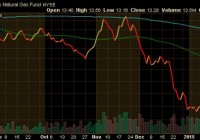
Summary UGAZ, as expected, capitulated into “The Bloodbath” that was inventory on another miss. UGAZ held $2.50 strong and I believe is a nice round number that energy desks will build positions around. BUY UGAZ or DCA into a lower cost basis if you’re already long – “The Turn” has happened. With the EIA Natural Gas Inventory report coming in at -115 BCF against expectations of -121 BCF and the subsequent drop in natural gas pricing, which is most popularly played using The United States Natural Gas ETF, LP (NYSEARCA: UNG ), I believe post- Blood Bath the bottom for natural gas is in. I’ll explain further. (click to enlarge) After outlining the longer term natural gas bull thesis (click “Blood Bath” above) I believe “The Turn” for natural gas pricing has happened. Now, what does that mean? I can’t possibly outline my positions in real time to readers outside of guiding that I own VelocityShares 3x Long Natural Gas ETN (NYSEARCA: UGAZ ) at $2.90 and will add to my position tomorrow in the early AM to average down my cost basis. Over the next 9 months I’ll be offloading and adding to my net natural gas exposure, inclusive of selling and buying UGAZ and inclusive of selling and buying hedges via UNG options, in an effort to maximize the longer term bullish trend. I’ve ridden trends using this strategy the last two years with great success both on the long and short side. (click to enlarge) So, I’ll outline my thoughts on immediate term, mid-term, and longer term trends with following recommendations – this will become a regular section of these weekly updates, make sure to # FOLLOW me and subscribe to real time alerts for the UGAZ ticker: Immediate Term (next 7 days): bullish, BUY. This is going to be against consensus as weather is expected to be in the mid-70’s for HOD’s for the middle part of the country with LOD’s coming in at just over 50 degrees. Normally, this would be bearish and it just might be during the next 7 days leading into inventory. IF UGAZ is hit – BUY (see Long Term bullet) as we are at what should be generational lows. I’m going against consensus in estimating that UGAZ is higher than its most recent close of $2.48 but 1) I just can’t imagine cooling demand not upticking in the middle part of the country (namely Texas) as this will be the first time in a long time that folks have felt anything resembling heat, I’m betting folks overreact in that it will “feel” hotter than it is and that cooling demand comes on strong and 2) I can’t imagine big energy desks not beginning to build longer term positions right here, that should provide some volume on any drops to pricing. Mid Term (next 30 days): Mixed to flat as of right now, BUY in the immediate term and wait on further buys. Guys, I had watch the inventory report post greater than 90 BCF reports 8 consecutive weeks in the middle of summer (including builds of 91BCF, 87BCF, 94BCF, 105BCF, 112BCF, 97BCF, 90BCF, 92BCF), the middle of what was supposed to be the bull thesis, before the market gave me some credit and ran natural gas pricing down. I was looking VERY foolish for about two months as the price of natural gas was denying all fundamentals. Eventually, everything has to be priced efficiently and thank goodness I had conviction in my short position. That said, I’m never willing to say that my thesis will play out exactly on time or exactly in lock step with developments. Wait on further buys in the mid-term once you get some position on the board at these lows. Long Term (longer than 30 days): bullish, BUY on dips as far as $2.00. I have no question natural gas is higher than its current close in 30 days. If you plan on buying for the long term and not trading around you should build positions on dips down to $2.00. No questions natural gas is at the lows. We’ll see over the next few weeks how many institutional holders have to be wrong (by selling or shorting natural gas) but just like always eventually they’ll come around. If you’re in this name for a once a month buy/sell the decision to buy is easy. Just do it. I understand I can post one update article per regular long article so if a major weather change develops or something else comes along that would change my immediate term opinion I’ll post an update article. Check back daily to make sure no updates have been posted. Remember, mid-term and longer-term reco’s aren’t effected by week to week developments. Also remember, the current bull thesis is as follows: Falling rig counts hurt overall production – that’s good for the supply side of the equation as production is slowed overall. Less oil E&P to come on lower CAPEX across the board for oil and natural gas E&Ps – that’s also good for the supply side of the equation (Source: Bloomberg.com). I’m betting on the fact that spring will start early and summer will be, well, it’ll be hot – that’s good for the demand side of the equation – for clarity these projections are based on longer term weather models from Weather.com which may be unreliable. I believe at poor hedging or at lower than ideal aggregate hedging that natural gas E&P names won’t “pump baby pump” as hard into what has been excellent hedging in size the last few years – that’s also good for the supply side. Examples of companies I’ve reviewed that have 1) less than ideal pricing hedging or 2) less than ideal aggregate hedging coverage are Chesapeake Energy Corporation (NYSE: CHK ), Antero Resources Corporation (NYSE: AR ), Ultra Petroleum Corp. (NYSE: UPL ), Halcon Resources Corporation (NYSE: HK ), SandRidge Energy, Inc. (NYSE: SD ), Quicksilver Resources Inc. (NYSE: KWK ), etc. This list could have been 50 names deep. Finally, please read the disclosure section of this article as playing leveraged commodity ETN’s is dangerous and requires a constant monitoring of positions. Good luck everybody, I’ll see you next week in The Lounge. Disclosure The risks of investing in a 3X leveraged commodity trading vehicle like UGAZ/DGAZ are much greater than those of other vehicles. These risks include (Source: Velocitysharesetns.com/ugaz): ETNs are only suitable for knowledgeable investors seeking daily exposure (including inverse or leveraged exposure) to the underlying index. ETNs are intended for short-term trading, therefore investors with a horizon longer than one day trading should carefully consider whether the ETNs are appropriate for their investment portfolio. Because the inverse leveraged ETNs and leveraged long ETNs are linked to the daily performance of the applicable underlying Index and include either inverse and/or leveraged exposure, changes in the market price of the underlying futures will have a greater likelihood of causing such ETNs to be worth zero than if such ETNs were not linked to the inverse or leveraged return of the applicable underlying Index. The ETNs do not guarantee any return of principal at maturity and do not pay any interest during their term. At higher levels of volatility, and since the ETNs are not principal protected, there is a significant chance of a complete loss of ETN value even if the performance of the index is flat. The closing indicative value on each valuation date is determined in part by reference to the daily percentage change in the level of the underlying index. As a result, to the extent the closing indicative value of the ETNs is greater than or less than the initial indicative value, subsequent changes in the level of the index may have a bigger or smaller impact on the closing indicative value of the ETNs than if the closing indicative value remained constant at the initial indicative value. For example, assuming an initial indicative value of $100, if the closing indicative value of the ETNs increases above $100, a subsequent 1% daily change in the level of the index will result in more than a $1 decrease in the closing indicative value of the ETNs. Likewise, if the closing indicative value of the ETNs is less than $100, a 1% increase in the level of the index will result in less than a $1 increase in the closing indicative value of the ETNs. If the level of the underlying index decreases or does not increase sufficiently (or if it increases or does not decrease sufficiently in the case of the inverse ETNs), to offset the effect of the Daily Investor Fee over the term of the ETNs, the investor will receive less than the principal amount of his investment upon early redemption, acceleration or maturity of the Notes. This particular ETN also runs the risk of being decayed by contango which is defined by Investopedia as: A situation where the future price of a commodity is above the expected future spot price. Contango refers to a situation where the future spot price is below the current price, and people are willing to pay more for a commodity at some point in the future than the actual expected price of the commodity. This may be due to people’s desire to pay a premium to have the commodity in the future rather than paying the costs of storage and carry costs of buying the commodity today. Finally, there are general risks that should also be considered such as liquidity risk (Source: Investopedia.com): The risk stemming from the lack of marketability of an investment that cannot be bought or sold quickly enough to prevent or minimize a loss. Liquidity risk is typically reflected in unusually wide bid-ask spreads or large price movements (especially to the downside – which are magnified in leveraged ETNs) . The rule of thumb is that the smaller the size of the security or its issuer, the larger the liquidity risk. Disclosure: The author is long UGAZ. (More…) The author wrote this article themselves, and it expresses their own opinions. The author is not receiving compensation for it (other than from Seeking Alpha). The author has no business relationship with any company whose stock is mentioned in this article. Additional disclosure: The author is long UGAZ at equal sizes at $2.90 and $2.48. The author has a cost basis of $2.69

Should You Buy Social Media ETF On Solid LinkedIn, Twitter Earnings?

The social media space, once a sharp pain for investors, is likely seeing a reversal. High beta issues and a massive sell-off the year before had made the space decently valued. Then, impressive corporate earnings from many of the companies started brightening the space and the related ETF last quarter. This quarter too seems to have sustained the wining trend. On February 5, Twitter (NYSE: TWTR ) and LinkedIn (NYSE: LNKD ), two extremely well known social media stocks, reported earnings after the bell and both excelled on both lines. Stocks of the Internet giants soared after hours. Their fourth quarter performances are detailed below (read: 3 Internet ETFs Leading the Tech World Higher ): Twitter’s Q4 in Detail Initially, Twitter stock was hit by disappointing user growth despite improved top and bottom lines. But the stock shot up as the company threw light on the one-time reason behind sluggish user growth. Per Twitter, Apple’s (NASDAQ: AAPL ) iOS 8 software upgrade encountered an “unforeseen bug,” causing a loss of 4 million active users. Otherwise, Twitter would have been able to report 292 million users instead of 288 in the quarter, though the reported figure was up 20% y/y. Non-GAAP earnings were 12 cents per share (per the company ), easily beating the year-ago earnings of 2 cents per share. Revenues of $479 million in the quarter were up 97% year over year and ahead of the Zacks Consensus Estimate of $451 million. Shares were up 9.1% after hours. LinkedIn’s Q4 in Detail LinkedIn’s fourth quarter revenues increased 44% year over year to $643.4 million, surpassing the Zacks Consensus Estimate of $618 million bolstered by its hiring business. The online job services media site posted non-GAAP earnings of 61 cents per share (reported by the company ), up from 39 cents in the year-ago quarter. Shares were up 7.7% in the aftermarket session. If this was not enough, Facebook (NASDAQ: FB ) also came up with top and bottom line beats for Q4 in late January. Its adjusted earnings per share came in at 54 cents, ahead of the Zacks Consensus Estimate of 33 cents and up 69% from the year-ago earnings of 32 cents. Revenues climbed 49% year over year to $3.85 billion and surpassed our estimate of $3.79 billion (read: ETFs in Focus on Facebook Earnings Beat & Rising Cost ). Market Impact The reaction of such stellar results also drove Global X Social Media Index ETF (NASDAQ: SOCL ) – a pure play on social media space – higher. The fund, which was up 1.1% on February 5, added about 0.2% after hours, reflecting LNKD and TWTR’s performances. Investors can easily use the recent ascent in the above-mentioned stocks as a buying opportunity of SOCL. Through SOCL, investors can simultaneously be in touch with the most sought after social media companies. SOCL in Focus SOCL focuses on companies across the world engaged in some aspect of the social media industry. The fund tracks the Solactive Social Media Index and invests $102.5 million of assets in about 30 holdings. The in-focus LinkedIn takes the second spot in the fund accounting for about 11.85% in the portfolio while Facebook takes the third spot with 9.96% weight and Twitter occupies the tenth spot with 3.96% exposure (read: 3 IBM Proof Tech ETFs for 2015 ). SOCL has company-specific concentration risk putting more than 60% of investments in its top 10 holdings. The product charges 65 bps in annual fees. SOCL has added about 3% year to date (as of February 5, 2015). Though volatility is imminent in this high-tech space thanks to valuation and global growth concerns, there are plenty of sound companies in the space, suggesting that an ETF approach might now be a better way to play the segment. After all, Twitter and LinkedIn hold a solid industry rank (in the top 38%) at the time of writing as per the Zacks Industry Rank, suggesting upside potential for the stock in the coming days.