Tag Archives: seeking-alpha

BlackRock Utility And Infrastructure Trust: An Option Player In The ETF Utility Space

I recently looked at UTG and UTF, leading readers to ask about BUI. BUI is BlackRock’s entrant into the infrastructure space. The biggest difference it offers is the use of options. I recently wrote an article reviewing two relatively long-standing infrastructure closed-end funds , or CEFs. My conclusion being that Reaves Utility Income Fund (NYSEMKT: UTG ) and Cohen & Steers Infrastructure Fund (NYSE: UTF ) are both good products, though UTF is trading at a wider discount at the moment. Readers of that article asked my take on BlackRock Utility and Infrastructure Trust (NYSE: BUI ), another option (that’s a pun, actually) in the space. What is BUI? BUI opened its doors in late 2011, meaning that it doesn’t have the longevity of UTG or UTF. In fact, it hasn’t really witnessed a major market correction yet, like the pain we all suffered at the turn of the century and more recently during the 2007 to 2009 recession. This is less of a knock than a piece of information to keep in mind. BUI isn’t doing anything outlandish, so it’s unlikely it would “blow up” in a downturn. Actually, just the opposite is likely to be the case, but that expectation is untested. That said, what does it do? As the name implies, like UTG and UTF, BUI invests in things like electric utilities, water utilities, pipelines, bridges, and other similar hard assets. These are the types of things we take for granted, but without which life simply wouldn’t go on as it had before. On that score, it does, indeed, deserve to be looked at with UTG and UTF. However, there’s a not too subtle difference here. UTG and UTF both make use of leverage. BUI does not. It enhances returns, specifically income, through the use of an option overlay strategy . This means two things: return of capital will always be an issue and the options it writes could provide downside protection in a bear market. One of UTG’s big bragging rights is that it has never used return of capital to support its distributions. They have always come out of income and capital gains. You can argue this doesn’t matter much so long as a fund isn’t using destructive return of capital over extended periods. For example, UTF has used return of capital in the past and in one recent year it was destructive (the net asset value went down at the same time as return of capital was being used to support the dividend). However, that was one year and UTF hasn’t used return of capital recently. But some investors are highly suspicious of return of capital distributions. And BUI has made use of return of capital every single year. Why? Because it writes options. Dividends and interest on debt fall into investment income. Capital gains fall into, well, capital gains. Option income isn’t either of those things and winds up getting shoved into return of capital. It hasn’t proven to be a bad thing at BUI, with the net asset value, or NAV, increasing from $19.10 a share at its initial public offering to $21.50 or so more recently. So, at this point, the issue of return of capital hasn’t been a big one and likely only matters if you have a personal issue with that type of distribution. Looking at options from a different angle, the premiums received can provide return during down markets. This protects an option writing fund’s returns to some extent from the full effects of a market decline. In the case of BUI, however, that’s more of an academic issue because the fund has yet to deal with a truly severe downdraft. So, in theory, BUI should hold up better than UTG or UTF in a downturn. But it’s worth noting that the use of leverage at these two funds is likely to result in notable underperformance during a bear market. Both funds, for example, lost more than 40% of their NAV value in 2008. A fact to keep in mind when you consider that options can also limit BUI’s upside because positions will get called away. So BUI should lag in good markets and shine in bad ones compared to UTG and UTF. How has it done? Looking at performance numbers, BUI has underperformed relative to UTG and UTF on an NAV total return basis over the trailing three-year period through May (BUI’s short history means that’s the furthest back this trio can be compared). Interestingly, however, over the trailing six months period, UTG is down 2.7%, UTF is up a scant 0.4%, and BUI is up roughly 1.8%. Although hardly a bear market, while UTG and UTF have struggled, BUI is beating them. BUI’s standard deviation goes right along with that. UTG and UTF have three year standard deviations, a measure of volatility, of 13.5 and 11.4, respectively. BUI’s standard deviation is a far more subdued 8.5% over that span. Looking at cost, UTG is trading at a small discount to its NAV and roughly in line with its historical price trends. UTF, meanwhile, is trading far more cheaply at an around 14% discount. BUI is trading at a discount of around 12%, nearly three percentage points more than its trailing three-year average discount. Investors looking for bargains should be interested in UTF and BUI. That said, if you are concerned about risk, BUI should have the edge (despite the fact that it hasn’t been stress tested by a deep downturn). Yield wise, BUI’s distribution is around 7.5%. That’s in the same area as UTF, but notably above UTG’s 6.3% yield. That said, it’s worth repeating that UTF and UTG use leverage to enhance yield, hopefully earning more in dividends than they pay in interest. BUI, on the other hand, generates income by selling options on its holdings, which generates return of capital, can limit upside potential, yet also helps to reduce volatility. And options are also cheaper to deal with, which is why BUI’s expense ratio is around 1.1%. Both UTG and UTF have to contend with interest costs, which push their expense ratios up to 1.7% and 2.2%, respectively. Who’s BUI for? Whether or not you want to purchase BUI really boils down to your concern about market volatility. If you think the markets are trading at premium levels and could be due for a correction, theoretically, BUI is probably the best choice out of these three funds. It also has the allure of trading at a noticeable discount, like UTF, if you prefer to buy on the cheap. And it’s the least expensive to own based on fees. All of that said, I still like UTG because of its longevity and the fact that it has never cut its distribution. But for risk-averse investors who don’t have an issue with return of capital, BUI is truly worthy of consideration. Disclosure: The author has no positions in any stocks mentioned, and no plans to initiate any positions within the next 72 hours. (More…) The author wrote this article themselves, and it expresses their own opinions. The author is not receiving compensation for it (other than from Seeking Alpha). The author has no business relationship with any company whose stock is mentioned in this article.

Applying A Dual Momentum Model To The IVY 10 Portfolio

Long only, ETF investing, portfolio strategy, momentum “}); $$(‘#article_top_info .info_content div’)[0].insert({bottom: $(‘mover’)}); } $(‘article_top_info’).addClassName(test_version); } SeekingAlpha.Initializer.onDOMLoad(function(){ setEvents();}); How to enhancing a Buy and Hold strategy with Dual Momentum Model. Reduce volatility and portfolio draw-down with an ETF cutoff model. How to apply both absolute and relative momentum to portfolio management. How to triple portfolio returns over a stock-bond index fund. Beginning with the ten (10) ETFs identified in Mebane T. Faber and Eric W. Richardson’s book, The Ivy Portfolio , the following analysis shows how the IVY portfolio would have performed from June 30, 2006 through 6/11/2015 when a momentum model is applied to these ETFs. The ETFs using in this analysis are the IVY 10 plus SHY , our cutoff or “circuit breaker” ETF. Here is the portfolio strategy used with the IVY 10. Rank the ETFs as shown in the following table. Review period is every 33 days. This moves the review or update throughout the month, thus avoiding short-term trading fees, wash rule, and end of month mutual fund window dressing. Look-back periods are 87 days with a 30% weight, 145 days with a 50% weight, and 20% assigned to a 14-day mean-variance volatility setting. ETFs performing below SHY using this ranking system are sold out of the portfolio. Select the top two performing ETFs and invest equal percentages in each. If there is a tie, invest in equal amounts in the three or four top performing ETFs. The absolute momentum model identifies ETFs that are ranked above SHY. The ranking model identifies the relative momentum between the various ETFs. IVY 10 ETF Rankings: The following table (generated from spreadsheet) shows both the absolute and relative momentum for the 10 IVY ETFs. The following table includes 6/11/2015 data. GSG and VB are the top two performing ETFs based on the three metrics used to come up with these rankings. If one were to follow this model today, we would invest equal dollars in GSG and VB. (click to enlarge) IVY 10 Back-Test Results: How has this investing model worked since June 2006? The following graph shows a Monte Carlo calculation where the dark black line is the average performance of the IVY 10. The red line is the performance of our stock-bond benchmark, VTTVX . Note the light gray lines as they show other probabilities or noise around the review days. In reality, investors are likely to make trades from 2 days before the review period to as many as 5 days after the review period. Call this trading noise. Even the worst light gray line outperforms the VTTVX benchmark. Here are a few salient points when Dual Momentum is applied to the IVY or Faber 10. Portfolio return = 240% vs. 77% for the VTTVX index fund. Maximum draw-down (DD) for portfolio is 27% vs. 45% for VTTVX. Average annual DD for portfolio is 14% or under 15%, what might be considered an acceptable level. Average Compound Annual Growth Rate (CAGR) = 14.7%. Trades per review period = 1.7. Tax considerations may dictate one use this model only with tax-deferred accounts. (click to enlarge) Disclaimer: After running hundreds of back-tests using similar models to what is described above, there is still a considerable amount of luck when it comes to the day in which a particular ETF is purchased. The “trading noise” analysis helps to temper this problem, but it is still there. Also, the above model does not account for remaining cash that is left lying around due to dividends and money not invested due to share rounding. Taxes are also an issue as mentioned above. Investors in the 28% tax bracket need to add something close to 2% annually to overcome the difference between short and long-term capital gain taxes. Each investor should take their own tax situation into consideration. Disclosure: The author is long VTI,VEA. (More…) The author wrote this article themselves, and it expresses their own opinions. The author is not receiving compensation for it (other than from Seeking Alpha). The author has no business relationship with any company whose stock is mentioned in this article. Additional disclosure: Back-testing analysis was run by interested investor. Share this article with a colleague

Best And Worst: All Cap Growth ETFs, Mutual Funds, And Key Holdings

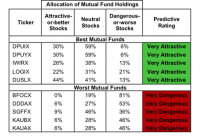
Summary All Cap Growth style ranks fifth in 2Q15. Based on an aggregation of ratings of 517 mutual funds. DPUIX is our top rated All Cap Growth mutual fund and KAUAX is our worst rated All Cap Growth mutual fund. The All Cap Growth style ranks fifth out of the 12 fund styles as detailed in our 2Q15 Style Ratings report . It gets our Neutral rating, which is based on an aggregation of ratings of zero ETFs and 517 mutual funds in the All Cap Growth style. Figure 1 shows the five best rated and the five worst rated All Cap Growth mutual funds. Not all mutual funds are created the same. The number of holdings varies widely (from 20 to 2140). This variation creates drastically different investment implications and, therefore, ratings. Investors seeking exposure to the All Cap Growth style should buy one of the Attractive-or-better rated mutual funds from Figure 1. Figure 1: Mutual Funds with the Best & Worst Ratings – Top 5 (click to enlarge) * Best mutual funds exclude mutual funds with TNAs less than $100 million for inadequate liquidity. Strategic Funds Dreyfus U.S. Equity (MUTF: DPUIX ) is our top-rated All Cap Growth mutual fund, and gets our Very Attractive rating. Over 30% of the stocks within this fund are rated Attractive or better. Even more impressive, 0% of the fund’s assets are allocated to Very-Dangerous-rated stocks. One of our favorite stocks in this fund is Target (NYSE: TGT ). Target has long been a staple of American consumer retail. It operates as a general merchandise retailer, selling everything from grocery goods to furniture to electronics and clothing. In fiscal 2015, Target saw strong growth in both revenues and after tax profits ( NOPAT ). Total sales grew 2% in 2014 and comparable store sales grew over 1%, showcasing strength in Target’s existing stores. Target also increased its return on invested capital ( ROIC ) to 9% in 2015, up from 8% the prior year. Best of all is the fact that Target has generated positive economic earnings every year for the past 17 years, showcasing its ability to consistently earn a return greater than its cost of doing business and to generate value for shareholders. At its current price of $80/share, Target has a price to economic book value ( PEBV ) ratio of only 1.1. This ratio implies that the market expects Target’s NOPAT to grow by only 10% from current levels. Meanwhile, if Target can grow NOPAT by only 4% compounded annually for the next eight years , the stock is worth $92/share today – a 15% upside. Federated Kaufmann Fund (MUTF: KAUAX ) is our worst rated All Cap Growth mutual Fund. It earns a Very Dangerous rating. One of the worst stocks in the fund is Actavis plc (NYSE: ACT ). In 2014, Actavis saw disappointing results in regards to ROIC and NOPAT growth. Actavis’ ROIC declined from 4% in 2013 to just 1% in 2014. NOPAT also declined 28% in 2014. The long-term trends for the company do not look promising either. Over the past decade, the company has never earned a ROIC above 7%. In 2004, NOPAT margin was 11% but has declined to just 3% in 2014. Due to the deteriorating fundamentals of the business, we believe the stock is overpriced. To justify its current price of ~$301/share, the company would need to grow NOPAT at a compounded annual rate of 36% for the next 13 years . This seems unreasonable given that the company has grown NOPAT by only 8% compounded annually over the past decade. Figure 2 shows the rating landscape of all All Cap Growth mutual funds. Figure 2: Separating the Best Mutual Funds From the Worst Funds (click to enlarge) Sources Figure 1-2: New Constructs, LLC and company filings D isclosure: David Trainer and Allen L. Jackson receive no compensation to write about any specific stock, style, style or theme. Disclosure: The author has no positions in any stocks mentioned, and no plans to initiate any positions within the next 72 hours. (More…) The author wrote this article themselves, and it expresses their own opinions. The author is not receiving compensation for it. The author has no business relationship with any company whose stock is mentioned in this article.