Tag Archives: seeking-alpha

HACK Surges With Rise In Cyber Crime

Though more than 15 dozen products were launched last year, one that surely deserves a special mention in the ETF world is the ISE Cyber Security ETF (NYSEARCA: HACK ). The fund has been a darling among investors thanks to a recent slew of cyber security breaches that have prompted companies to step up security spending. Cyber security breaches have been witnessed in almost every industry, with some of the big shot companies such as JPMorgan Chase (NYSE: JPM ), eBay (NASDAQ: EBAY ), Apple (NASDAQ: AAPL ), Starbucks (NASDAQ: SBUX ) and Adobe (NASDAQ: ADBE ) been among the victims this year. In fact, the U.S. government’s Office of Personnel Management, which stores data for more than 30 million people, witnessed a breach in April 2015, which itself explains the severity and extent of cyber crime. According to a report by McAfee, cyber crime cost the world economy $400 billion in 2014. Per KPMG, a professional services firm, cyber crime is expected to cost the world an enormous $560 billion per year . “In addition to financial losses, cyber attacks have the ability to shut down or manipulate energy infrastructure, weapons defense systems, medical devices, financial markets, transportation networks/vehicles, or harvest highly personal or secret information and a constantly growing amount of other potential threats,” as explained by Pure Funds . This menace has prompted companies to commit billions of dollars annually in hopes of preventing future attacks which in turn is acting as a major tailwind for the U.S. cybersecurity industry. Rampant cybersecurity breaches and the success of cybersecurity stocks have led to a massive inflow of assets into HACK, with the product having recently crossed the $1 billion threshold. In fact, the success of HACK has prompted other issuers to come out with funds focusing on this niche space. Below, we have lighted HACK in detail for investors willing to try their hands in this ultra popular ETF. Launched last November, the fund tracks the ISE Cyber Security Index. The index tracks the performance of companies actively engaged in providing services for the cybersecurity industry. These cybersecurity services are designed to protect computer hardware, software, networks and data from unauthorized access, vulnerabilities, attacks and other security breaches. The equal weighted fund presently holds a basket of 31 stocks, with Intralinks Holding (NYSE: IL ), Vasco Data (NASDAQ: VDSI ) and Proofpoint Inc. (NASDAQ: PFPT ) being the top three holdings, each holding a little more than 4% of total fund assets. As far as the sub-industry breakdown is concerned, the fund allocates nearly 60% of its assets in Systems Software, 16% in Communications Equipment, followed by 8.4% in Internet Software & Services. Also, more than two-thirds of the fund’s holdings belong to U.S. companies, followed by 13% from Israel, 5% from the Netherlands and 4.7% from South Korea. The fund charges 75 bps in fees. It trades in solid volumes of more than 800,000 shares a day resulting in a narrow bid/ask spread. HACK has returned a solid 24% this year and roughly 30% since its inception. Originally published on Zacks.com .

TYO: The Worst Inverse Bond ETF

Summary TYO has a high expense ratio. It is illiquid. The ETF is too volatile and does not adequately cover its underlying market. Introduction I have written a number of articles about my favorite inverse bond ETFs. I have also compiled a comprehensive list of the inverse bond ETFs I hate the most. I have discussed these securities extensively over the past few weeks, because I believe we are in an economic environment unavoidably poised to experience rising interest rates. Inverse bond ETFs can be used shrewdly to capitalize on this market inevitability, and they are valuable hedging tools for bond-heavy portfolios. However, there is long list of risks associated with investing in an inverse bond ETF, and it is prudent to research and analyze each security before investing. For this reason, I decided to write an article about the single worst inverse bond ETF on the market, the Direxion Daily 10-Year Treasury Bear 3X Shares ETF (NYSEARCA: TYO ). What Makes an Inverse Bond ETF Bad? When evaluating an inverse bond ETF, it is important for an investor to find a security that has a low expense ratio and correlates well to its underlying index. The three most important metrics for determining the quality of an inverse bond ETF are liquidity, expense, and coverage. A good inverse bond ETF has a low expense ratio, is highly traded, and maintains assets with wide coverage. A bad inverse bond ETF does just the opposite. Another metric that ought to be considered is the strength of the underlying institution that issues the inverse bond ETF. If the institution cannot honor an investment, an investor stands to lose everything. Another factor that ought to be considered is the inverse bond ETFs’ leverage multiple. Inverse Bond ETFs come in three sizes: 1X, 2X and 3X . 2X and 3X ETFs are designed to multiply the returns (or inverse returns) of the daily performance of an underlying index. 1X ETFs follow the daily returns of its underlying index one for one. Since 3X inverse bond ETFs track daily returns by three times, the risks already associated with inverse bond ETFs are exacerbated exponentially. Compounding risk greatly affects the returns of 3X ETFs particularly when tracking range-bound indexes. To read more about the risks of 2X and 3X leveraged ETFs, read my article here . TYO Analysis TYO is the worst inverse bond ETF because its expense ratio is high, it is not highly traded, it does not have wide coverage, and it is triple leveraged (which magnifies the risks associated with investing in it particularly for periods longer than one day). TYO is really the only option for 3X exposure to intermediate-term US Treasury bonds, however, just because it is the only option, does not mean it is a good option. It is the responsibility of issuing institutions to produce a good product that creates its own demand. TYO simply fails in all regards. I included a graph as more of a visual aid to show how TYO works. TYO Performance I included a graph mainly to show how TYO performs relative to its underlying index. The Direxion Daily 10-Year Treasury Bull 3X Shares ETF (NYSEARCA: TYD ) (green) is the 3X bull for 7-10 year Treasury bonds and TYO (orange) is the bear. I also included 10-year Treasury yields to show the correlation between bonds, yields and inverse bond ETFs. From a broad perspective, TYO is well correlated to 10-year yields and provides the results an investor would hope and expect from its underlying index TYD (about .99% correlation). TYO Analysis Continued On the surface, TYO seems to perform the job it is meant to perform. To see how TYO fails, one must examine the security closely. First, TYO’s net expense ratio is very high. The industry average for much more respected and liquid inverse bond ETFs is about 0.9%. Based on TYO’s total assets however, its average competitor has a net expense ratio of about 0.7%. TYO itself boasts one of the highest net expense ratios at 0.95% . What this means is, the investor must pay 0.95% just to hold TYO. The biggest risk of holding TYO, however, is its liquidity risk. It has an average volume of 10,228. TYO’s price is 18.15*10,228=$189,320. Basically, the ETF is off limits to any wealthier investors or money managing firms. Those who hold TYO run the risk of not being able to sell when they want, or causing a drop off in price when attempting to sell large volumes. Either way it’s a huge risk that can be avoided by investing in a more liquid inverse bond ETF. Lastly, TYO only has 49 million in total assets. It does not have an adequate amount of market exposure to fully correlate to changing market conditions. Conclusion The market speaks loudly and prices drive demand. An overpriced inversely leveraged ETF like TYO is going to have very little volume because investors do not want the risk. It is 3X leveraged, so it is designed to be inherently volatile. I can only imagine a poor investor losing money and being unable to sell their shares because no one is buying (or selling). Pick a better, more liquid ETF like the ProShares UltraShort 20+ Year Treasury ETF (NYSEARCA: TBT ) if you are trying to utilize an inversely leveraged ETF. Disclosure: I/we have no positions in any stocks mentioned, and no plans to initiate any positions within the next 72 hours. (More…) I wrote this article myself, and it expresses my own opinions. I am not receiving compensation for it (other than from Seeking Alpha). I have no business relationship with any company whose stock is mentioned in this article.

PureFunds Cyber Security ETF: Troubling Inconsistencies And Specific-Holding Concerns Should Make Investors Think Twice

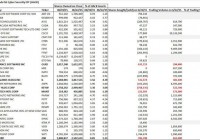
Summary Due to increased investor interest in the cyber security space, the PureFunds Cyber Security ETF has grown rapidly since its launch in November 2014, with assets now exceeding $1.2B. Its track record has been impressive, returning nearly 22% since inception. Our tracking of the recent semi-annual reconstitution, however, raises some troubling questions about the validity of the data that this ETF is reporting. Specifically, reported changes in positions on reconstitution that occurred this past Monday, in several instances, seem to be impossible to have been executed based on that day’s trading volume data. Finally, we are concerned about the high level of ownership the ETF now has in several small cap names, and would caution investors regarding risks in owning these names. Background The PureFunds Cyber Security ETF (NYSEARCA: HACK ) was launched in November 2014 to track the ISE Cyber Security Index, and seeks to provide investors with exposure to the hot cyber security technology sector. The index (and ETF) provide exposure to large, well-known cyber security plays, such as Palo Alto Networks (NYSE: PANW ) and FireEye (NASDAQ: FEYE ), in addition to other large cap technology companies such as Cisco (NASDAQ: CSCO ) and Juniper Networks (NYSE: JNPR ) that, while not pure plays, are deemed to be relevant to cyber security. At a high level, the index owns companies that fall into either the cyber security infrastructure, or cyber security services sub-categories, with the infrastructure group making up the overwhelming majority of the index. One of the lesser understood features of the index, however, is that it seeks to equal weight its components within the infrastructure and services sub-categories. A complete explanation of the index’s construction methodology can be found here . This unique index construction means that small-cap (and even micro-cap) stocks are weighted similarly in many cases to large-cap stocks. Herein lies some issues that we recently came across when analyzing this past Monday’s index/ETF reconstitution. Recent Index/ETF Reconstitution According to ISE index methodology and the HACK ETF methodology , components are re-weighted twice annually, on market close on the third Friday in December and June (and become effective the following Monday), the most recent reconstitution of ISE Cyber Security index having occured on this past Friday’s market close, June 19. The index weighting changes were announced after the close on that date. The HACK ETF, in order to track the underlying index, must then adjust their holdings, i.e. buy/sell the individual stocks held, in this most recent case on Monday, June 22 to realign themselves with the index. PureFunds posts its daily holdings in HACK as of the close each day, along with the ETF’s underlying Net Asset Value (or NAV), total assets, etc. Thus holdings can be tracked on a daily basis. As expected, there were large changes in the end of day holdings reported in HACK between Friday, June 19 and Monday, June 22, with the changes being inline with the newly announced stock weightings of the underlying ISE index. Below we show the reported holdings as of each close on these two dates in HACK, as obtained directly from their site (linked above) along with analysis of shares bought/sold on June 22 (note that we only did the analysis for US-listed stocks): (click to enlarge) (Source: PureFunds site for daily share ownership, Yahoo for June 22 trading volume) As can be seen from the data above, there are several stocks for which the supposed buy/sell volume from HACK exceeded 100% of the June 22 total trading volume in that stock. We have highlighted in bold in the table above the stocks we are referring to. Clearly, this raises some troubling questions as clearly HACK could not have traded more than 100% of the day’s total volume: Is HACK accurately reporting their end of day holdings in the ETF? Is the end of day reported NAV therefore accurate? If these shares were in fact traded on either 1) different days than June 22, 2) across multiple trading days, or 3) yet to be fully traded, then why were the end of day share holdings reported as the above by PureFunds? We do not profess to know the answers to these questions, despite our attempts to understand their trading/reporting methodology through reading their prospectus linked above. We, nonetheless, find the inconsistency of their reported data to be troubling and thus would be cautious in relying on both claimed share holdings AND reported NAV, which investors in HACK rely on to assess the fair market value of the ETF. Note that we have contacted PureFunds, sent them this data, and asked for an explanation, but have received no response . If we do get a response from them, we will certainly share it with our readers. Ownership concentration in small cap names As noted above, the HACK ETF (and underlying index) have an unusual equal-weighting (rather than market cap weighting) structure that causes the ETF to have outsized ownership of certain small cap names. The two that we’d highlight specifically, for which the ETF has the highest percentage ownership of shares outstanding are below: Company Ticker HACK shares owned 6/23 S/O from latest 10-Q HACK % ownership Widepoint Corp WYY 7,532,622 82,135,803 9.2% KEYW Holding Corp KEYW 3,463,191 38,222,484 9.1% We highlight Widepoint (NYSEMKT: WYY ) and KEYW Holding (NASDAQ: KEYW ) specifically because they are the two stocks that HACK has the highest percentage ownership (both now approaching 10%), though there are other small-cap names for which HACK ownership is now 5.0% or greater, namely Intralinks (NYSE: IL ), Guidance Software (NASDAQ: GUID ), and Zix Corp (NASDAQ: ZIXI ). We specifically are concerned about these stocks because 1) they have all seen significant share price increases recently, we believe, driven primarily by fund flows into HACK, which disproportionately are allocated into these small cap names per the index methodology, 2) we question whether, even if HACK fund inflows remain robust, the ETF will be comfortable owning 10% or more of any individual stock (which would then require filings with the SEC as a ‘beneficial owner’ in the stock and Form 4 reporting within 2 business days of any buy/sell transaction, and perhaps, most importantly, potentially make the ETF subject to “Short-Swing” liabilities). For those not familiar with beneficial ownership reporting requirements, Short-Swing rules, etc, here is a useful summary presentation . We severely doubt that the HACK ETF would wish to exceed 10% ownership in any of these names. Therefore, we believe the recent appreciation in the names, driven primarily by HACK ETF buying, is likely nearing an end, thus leaving a sudden dearth of buying to support these names and making them very susceptible to pullbacks in the absence of the somewhat artificial buying from HACK. Conclusion We are troubled by the seeming inconsistency of the data reported by HACK and thus question both the accuracy of its reported share holdings on a day-to-day basis, and the reported NAV. We would thus avoid owning HACK as a means for gaining exposure to cyber security. Alternatively, we would suggest that an investor instead own individual cyber security stocks which they know and are comfortable with (we are long PANW, and have been for some time, as an example). We would also highly caution against owning and even encourage selling the small cap names which we highlighted above, that we believe have been temporarily, and somewhat artificially, bid up by the HACK ETF. We believe all could be subject to (potentially substantial) pullbacks before too long. We would be especially cautious in WYY and KEYW, where HACK ownership is already nearing the key 10% threshold. Disclosure: I am/we are long PANW. (More…) I wrote this article myself, and it expresses my own opinions. I am not receiving compensation for it (other than from Seeking Alpha). I have no business relationship with any company whose stock is mentioned in this article. Additional disclosure: We may initiate long or short positions in any of the named securities at any point.