Tag Archives: seeking-alpha

Goldman Sachs’s Conviction Stock List For Mutual Funds
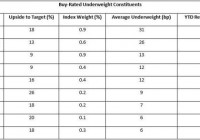
According to analysts at Goldman Sachs, Large cap mutual fund managers have had a successful start to this year. In 2014, 11% of large cap value mutual funds had outperformed the Russell 1000 large cap index. In 2015, so far, this number has soared to 76% of large cap value mutual funds beating the index. However, the equation changes when comparing with the S&P 500 performance. After fees, 43% of the funds could beat the S&P 500 year to date. So, 57% of funds are underperforming considering fees, when reviewing 248 large cap equity mutual funds. Goldman Sachs analysts have also released a conviction buy and sell lists. Interestingly, these lists are to help managers pick stocks that are underweight in the value mutual fund sector. Underweight Stocks Large cap mutual funds have been underweight on stocks such as Netflix (NASDAQ: NFLX ), Amazon.com (NASDAQ: AMZN ) and Yum! Brands (NYSE: YUM ). Year to date, these stocks have astounding returns of 89%, 38% and 23%, respectively. On the other hand, funds were overweight on Comcast Corporation (NASDAQ: CMCSA ) (NASDAQ: CMCSK ), Lowe’s Companies (NYSE: LOW ) and Time Warner Inc. (NYSE: TWX ) But these stocks have performed poorly. While Comcast and Time Warner are up 3.4% and 1.3%, Lowe’s is down 1.8% year to date. The point here is, Goldman Sachs analysts are recommending large cap fund managers to hold stocks, which have a predominantly underweight view. Below we present Goldman Sachs’s conviction lists. The first one lists buy-rated stocks on which the average large-cap core fund is most underweight and the second list shows sell-rated stocks on which the average large-cap core fund is most overweight (as of Jun 2): (click to enlarge) (click to enlarge) Source: Lionshares, FactSet and Goldman Sachs Our Take If we calculate the average return of buy-rated underweight constituents, it is a healthy 11.4%. On the other hand, the average return of the sell-rated overweight constituent is a negative -0.9%. Though the average return speaks in favor of the buy-rated underweight constituents, we believe holding specifically these stocks is not the only necessary step. The New York Times Company reported in April that Morningstar data revealed that only 12% of Goldman Sachs’s mutual funds had beat their analyst-assigned benchmarks over the last 10 years. What is more important is to pick stocks, sectors or industries that are fundamentally strong and offer great growth potential. Potential winners with positive historical performance should also be a good indicator. For example, the healthcare sector has been a strong performer. Incidentally, to prove this true, the top 20 US stock holdings for the Goldman Sachs fund family only featured one of the sell-rated overweight constituents. It was just W.W. Grainger (NYSE: GWW ) who made it to the top 20 holdings, while Navient Corp., (NASDAQ: NAVI ) Apple (NASDAQ: AAPL ) and Cardinal Health (NYSE: CAH ) were at the top of the holdings list (as of Jun 26). Goldman Sachs’s year-to-date total return of 2.2% lagged the category average of 2.9% (as of May 31). However, it has consistently outperformed the category average in 2014, 2013 and 2012. To pick the potential gainers, we will consider the Zacks Mutual Fund Rank. Remember, the goal of the Zacks Mutual Fund Rank is to guide investors to identify potential winners and losers. Unlike most of the fund-rating systems, the Zacks Mutual Fund Rank is not just focused on past performance, but the likely future success of the fund. Below we present 3 mutual funds from the Goldman Sachs fund family that either carry a Zacks Mutual Fund Rank #1 (Strong Buy) or a Zacks Mutual Fund Rank #2 (Buy). These funds have a low expense ratio and carry no sales load. The minimum initial investment is within $5000. These funds are not only in the green so far this year, but have positive total return over the last 1, 3 and 5-year periods. They also have encouraging average EPS growth. Goldman Sachs Strategic Growth Fund Retirement (MUTF: GSTTX ) seeks capital growth over the long term. A minimum of 90% of total assets are invested in publicly traded domestic securities. A maximum of 25% of assets may also be invested in non-US securities. GSTTX currently carries a Zacks Mutual Fund Rank #2. Goldman Sachs Strategic Growth IR has gained 4.4% and 13.7% year to date and over the last 1-year period, respectively. The 3 and 5-year annualized returns stand at 20.1% and 16.3%. Expense ratio of 0.91% is lower than the category average of 1.19%. The average EPS growth is 14.5%. Goldman Sachs Large Cap Growth Insights Fund Retirement (MUTF: GLCTX ) seeks capital appreciation with dividend income being the secondary objective. GLCTX invests a minimum of 80% of its assets in a diversified portfolio of equity investments of large-cap US issuers. Investments are also made in non-US issuers, but which are domestic in the US. GLCTX currently carries a Zacks Mutual Fund Rank #1. Goldman Sachs Large Cap Growth Insights IR has gained 3.9% and 12.9% year to date and over the last 1-year period, respectively. The 3 and 5-year annualized returns stand at 21.6% and 18.8%. Expense ratio of 0.71% is lower than the category average of 1.19%. The average EPS growth is 11.8%. Goldman Sachs Concentrated Growth Fund Retirement (MUTF: GGCTX ) invests, under normal circumstances, at least 90% of its total assets in equity investments selected for their potential to achieve capital appreciation over the long term. The fund may invest up to 10% of its total assets in fixed-income securities, such as government, corporate and bank debt obligations. GGCTX currently carries a Zacks Mutual Fund Rank #2. Goldman Sachs Concentrated Growth IR has gained 4.2% and 13.3% year to date and over the last 1-year period, respectively. The 3 and 5-year annualized returns stand at 18.9% and 15.6%. Expense ratio of 1.02% is lower than the category average of 1.19%. The average EPS growth is 13.4%. Original Post
Grexit Or Not, Buy These 3 European ETFs

The Greece predicament was at its worst last weekend, leading many to believe that its debt drama has climaxed. As the deal talk collapsed, prime minister Alexis Tsipras was forced to close the country’s banks for this entire week and impose capital controls. Daily withdrawals from automated teller machines was limited at 60 euros in an all-out attempt to prevent catastrophe. The breakdown has put Greece on the brink of a default, as the $1.8-billion payment to the International Monetary Fund (IMF) that was scheduled for June 30 will finally not be made. The fate of Greece’s eurozone membership now depends on Tsipras and his last-ditch efforts. A New Twist in the Greek Crisis The crisis took a dramatic turn when Tsipras called a snap referendum on July 5, wherein Greek citizens will have to vote for or against the terms of a bailout deal proposed by the country’s creditors – IMF, European Union and the European Central Bank (ECB). The prime minister called the referendum because the creditors are demanding tough economic policies, such as drastic tax hikes and sharp cuts to government spending, including pension cuts, in exchange for rescue funds. The government found the deal “humiliating”, and is urging all Greek citizens to vote against the proposal in the referendum so that it could open the doors for desirable bailout negotiations. Tens of thousands of protesters are out on the streets to back the government’s rejection of a tough international bailout. The latest news from the Greek front is that its finance minister Yanis Varoufakis has ruled out any possibility of paying an IMF installment, while Tsipras is trying again to work out a last-minute deal with the creditors. Even if Tsipras’ efforts in the eleventh-hour fail and Greece is compelled to exit eurozone, there would actually be not much to panic about. This is because the European financial system now has much less exposure to the cash-strapped Greece than it had in 2011 and 2012. Grexit concerns sent the Greek stock market into a free-fall territory on Monday’s trading session. The Global X FTSE Greece 20 ETF (NYSEARCA: GREK ), the only ETF targeting the Greek stock markets, fell 19.4% on a single trading day. The contagion has also spread worldwide. While Asia and the U.S. felt a ripple effect, the European stocks were the hardest hit (see: all the European ETFs here ). The blue-chip Euro STOXX 50 Index dropped as much as 5% on the day, representing the biggest one-day drop since 2011, led by countries having high debt and austerity policies. Investors could wait on the sidelines until the crisis drags the stocks. And when the cloud clears, the beaten-down prices might point to solid buying opportunities for many stocks and ETFs, irrespective of Greece’s withdrawal from or place in the eurozone. Further, the ECB is still pumping billions of dollars into the economy. And if this continues, the stocks might get a huge boost in the coming months. We can’t foretell whether Greece will win this debt battle like its heroic ancestors in the nick of time, but we do predict three European ETFs as having huge upside potential at the end of this drama. These funds have a top Zacks ETF Rank of 2 or a “Buy” rating, suggesting their outperformance over the coming months: First Trust Eurozone AlphaDEX ETF (NASDAQ: FEUZ ) This fund provides exposure to the eurozone stocks by tracking the NASDAQ AlphaDEX Eurozone Index, and employs an AlphaDEX methodology. It ranks stocks in the space by various growth and value factors, eliminating the bottom-ranked 25% of the stocks. This approach results in a basket of 150 stocks that are widely spread out across various components, with none holding more than 1.37% of assets. The fund is also spread out across sectors, with consumer discretionary, industrials, financials, utilities and materials taking the top five spots with double-digit exposure each. In terms of country allocations, Germany and France are leading with 23.3% and 22% share, respectively, followed by Italy (11.2%) and Spain (10.3%). FEUZ is unpopular and less liquid in the broad European space, with AUM of $15.3 million and average daily volume of around 141,000 shares. The expense ratio came in at 0.80%. The fund was down 3.1% in Monday’s trading session. iShares MSCI Italy Capped ETF (NYSEARCA: EWI ) This ETF tracks the MSCI Italy 25-50 index holding 26 Italian firms in its basket. It is heavily concentrated on the top two firms, Eni and Intesa Sanpaolo, with a combined 23.5% share, while other securities hold less than 8% of the total assets. Further, about 40% of the fund’s portfolio is allotted to financials from a sector look, while energy, utilities, industrials and consumer discretionary round off the top five with double-digit exposure each. The fund has amassed $1.1 billion in its asset base, and trades in heavy volume of more than 7.5 million shares a day, on average. It charges 48 bps in annual fees and lost 5.6% on Monday trading, making it attractively valued at the current levels. iShares MSCI Germany ETF (NYSEARCA: EWG ) This fund targets the German equity market and tracks the MSCI Germany Index. It is by far the largest and most popular German ETF, with AUM of over $7.5 billion and average daily volume of 5.5 million shares. The fund has an expense ratio of 0.48%. Holding 55 stocks in its basket, EWG is skewed toward the top firm – Bayer ( OTCPK:BAYZF ) – at 10%, while other firms hold no more than 7.58% of the assets. From a sector look, industrial takes the top spot at 22%, while financials, healthcare, materials and industrials make for double-digit allocation each. The ETF lost about 4% on the day. Original Post

Examining Your Fund’s Puerto Rico Exposure

Summary Puerto Rico is scaring investors on fresh default concerns. High-yield municipal bonds are fluctuating on the heightened risks. Focus on three high-yield muni ETFs. By Todd Shriber & Tom Lydon Greece or Puerto Rico, investors have their pick of default poison, but investors in fixed-income, exchange-traded and mutual funds would do well to monitor goings-on in Puerto Rico because the U.S. territory’s imminent default could affect some well-known municipal bond funds. So dire is the situation in Puerto Rico, Gov. Alejandro García Padilla told the New York Times over the weekend that government finances there are “in a death spiral.” And $72 billion is not chump change. To put $72 billion into context with a catchy anecdote, that is more than twice the market capitalization of General Mills (NYSE: GIS ). Puerto Rico’s debt woes are important to fund investors because an “estimated in 2013 that as much of 80% of Puerto Rico’s debt has found its way into muni-bond funds, and 180 mutual funds in the United States and elsewhere have at least 5% of their portfolios in Puerto Rican bonds,” Alan Gomez reports for USA Today , citing Morningstar data. “Last week, the general obligation (GO) debt had plumbed new depths, helping to record a negative 5% month-to-date return for the S&P Municipal Bond Puerto Rico General Obligation Index. According to JR Rieger, global head of fixed income for S&P Dow Jones Indices, the facts are the situation isn’t looking good: the pending Puerto Rico Electric Power Authority July 1st default looms on the market, the possible restructuring of the Government Development Bank debt and the possible postponement of G.O. set – asides have sent alarms to G.O. bond holders,” said S&P Capital IQ in a new research note. The $1.6 billion Market Vectors High-Yield Municipal Index ETF (NYSEARCA: HYD ) lost 1.4% Monday . That ETF has a Puerto Rico weight of just 3.2%, making the territory the fund’s tenth-largest geographic weight. The $396.8 million SPDR Nuveen S&P High Yield Municipal Bond ETF (NYSEARCA: HYMB ) lost just 0.8% yesterday despite a Puerto Rico weight of over 13%, making the territory HYMB’s largest geographic weight. The shorter-duration Market Vectors Short High-Yield Municipal Index ETF (NYSEARCA: SHYD ) was unchanged Monday even with a 4.5% weight Puerto Rican munis. Some actively-managed mutual funds have significantly larger Puerto Rico exposure than the ETF rivals. “Oppenheimer Rochester Fund Municipals (MUTF: RMUNX ), an actively managed mutual fund has 77% of its assets in NY state bonds, but most of the rest of the assets is in Puerto Rico bonds. Similarly Oppenheimer Rochester New Jersey Municipal Fund (MUTF: ONJAX ) has 29% of assets in bonds issued by Puerto Rico, despite what some New Jersey residents might expect,” according to S&P Capital IQ. SPDR Nuveen S&P High-Yield Municipal Bond ETF (click to enlarge) Tom Lydon’s clients own shares of HYD. Disclosure: I am/we are long HYD. (More…) I wrote this article myself, and it expresses my own opinions. I am not receiving compensation for it. I have no business relationship with any company whose stock is mentioned in this article.