Tag Archives: seeking-alpha

YLCO – Leveraging On The Growth Of The YieldCo Investment Class
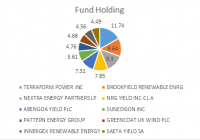
Summary YieldCos are an emerging asset class of yield vehicles, providing stable and growing dividend income from renewable energy assets. The ETF portfolio consists of high quality yieldco securities. The Global X YieldCo Index ETF is a low risk way to play the high growth renewable energy. The Global X YieldCo Index ETF (NASDAQ: YLCO ) is a new ETF investing in yieldcos as the underlying asset. It was formed by the Global X Funds, one of the largest issuers of ETFs providing investment opportunities across the global markets. This ETF provides a good opportunity for investors looking to invest in the renewable energy sector including solar and wind companies. YieldCos are becoming important especially in the solar industry. Many big solar companies have made plans to form a yieldco. YieldCos are dividend growth oriented public companies, providing stable cash flows and distributing the cash amongst its shareholders as dividends. YLCO will be the first YieldCo ETF available to U.S. investors. ETF Details The fund started on May 27, 2015 and has an expense ratio of 0.65%. The ETF follows the Indxx Global YieldCo Index, which is the underlying index. It will have to invest at least 80% of its total assets in the securities of the underlying index. It follows a replication strategy, where investment in securities will be done in the same proportion as the underlying asset; not trying to outperform or underperform. Since the Global YieldCo Index focuses on the energy sector, the new ETF will also concentrate on the energy sector. The Global YieldCo Index currently has a yield of over 3%. This fund is different from the rest as it seeks to invest in yieldcos. Why should you invest in a Renewable Energy YieldCo 1) Renewable Energy is growing rapidly Renewable energy usage has been scaling up in recent times. With solar energy reaching grid parity in a number of places, it is now becoming more economical to use solar power rather fossil fuels. Countries are focusing on reducing their carbon footprint by using more renewable energy. Developing countries like China and India have made aggressive plans to shift their energy mix from coal to more cleaner and efficient energy sources like wind and solar. Energy companies are bound to benefit in the future from these long term trends. According to Solar PV roadmap by IEA, solar energy capacity will grow to 3000 GW by 2050 up from 184 GW now. 2) YieldCos are becoming popular YieldCos are fast gaining traction in the renewable energy space. It is created by a parent company to lower the cost of capital, as renewable energy projects are capital intensive. Green energy does not require fuel and most of the cost is front loaded. The capital cost is the most crucial variable in determining the levelized cost of electricity (LCOE). The income from these yieldcos is considered reliable and some of the yieldcos are also growing rapidly e.g. Terraform Power (NASDAQ: TERP ). YieldCos distribute the cash amongst investors in the form of dividends. YieldCos have become extremely popular in this industry today. They enter into long term contracts and thus provide stable cash flows. This industry currently has a combined market capitalization value of $39 billion currently and 11 more IPOs are in the pipeline. 3) Top 10 Fund Holding The fund holds 20 securities with the top holding Terraform Power Inc. accounting for as much as 12%. TERP was the first yieldco formed by SunEdison (NYSE: SUNE ) in the solar energy space, which revolutionized the whole industry. The company’s portfolio has grown from 808 MW since its IPO in July 2014 to 1,675 MW. It has plans to diversify into natural gas, geothermal and hydro power. The CAFD guidance more than doubled to $225 million for 2015 . Another big holding is Brookfield Renewable Energy Partners which owns $20 billion in renewable power assets and is a leading operator of renewable projects across North America, Latin America and Europe. It has installed more than 7GW capacity predominantly in the hydroelectric space. The 3rd largest holding is NextEra Energy Partners (NYSE: NEP ) which owns clean energy projects particularly wind and solar energy in North America with stable, long-term cash flows. It declared $100-120 million as its CAFD guidance for 2015 and is expecting a 12-15% annual growth in dividend distribution over the next five years. Data from Global X Funds 4) Geographic Diversification Though the fund has a global footprint, the focus in mainly on the developed countries. The main reason for this concentration is the fact that yieldcos have been launched mainly in these regions. Emerging markets do not have major yieldcos as of now. As time passes, I expect yieldcos to emerge in the developing markets as well. Data from Global X Funds Index Characteristics (click to enlarge) Source: Indxx Risks One of the concerns of investing in this ETF could be the fact that the underlying assets are not fully under the control of its management. They are dependent on their sponsors. For example, if the sponsors do not have a healthy project pipeline, they will be unable to transfer the assets to their underlying yieldco which may adversely affect the yieldco’s performance and in turn the ETF’s. Other than this, it is a relatively new concept in the industry and like any other new venture there is this risk of whether it will be a success or a failure. But given the high quality stocks in the Global X YieldCo portfolio, I do not think it should be a major concern. Stock performance The Global X YieldCo Index ETF was launched on May 27, 2015 at $15.35 and is currently trading at ~$15. Conclusion Investing in renewable energy stocks is sometimes regarded as risky given the volatile nature of the sector. ETFs are a good way to diversify individual stock risks and are regarded as less risky. The Global X YieldCo Index ETF is a good and balanced way to stay invested in the green space, giving exposure to the growing yieldco market. It is a relatively new concept in the market now and has been launched by one of the fastest growing issuers of ETFs. I think it’s a smart way of investing in the renewable energy space as it is less risky and involves a portfolio of growing stocks. Disclosure: I/we have no positions in any stocks mentioned, and no plans to initiate any positions within the next 72 hours. (More…) I wrote this article myself, and it expresses my own opinions. I am not receiving compensation for it (other than from Seeking Alpha). I have no business relationship with any company whose stock is mentioned in this article.

CIBR Gives Investors Another Chance To Profit From Hot Growth Market

First Trust brings a new cybersecurity ETF to market to serve underserved sector. The First Trust Nasdaq CEA Cybersecurity ETF has a cheaper expense ratio and more frequent re-balancing, providing key differences to the PureFunds ISE Cyber Security ETF. The PureFunds Cybersecurity ETF is up more than 15% in 2015 and has shown the strength and growth of the sector. First Trust, a top ten fund management company, recently introduced the First Trust Nasdaq CEA Cybersecurity ETF (NASDAQ: CIBR ) to the public. The ETF gives investors a new way to invest in a basket of stocks in the hot growth cybersecurity market. After watching the strong growth of the PureFunds ISE Cybersecurity ETF (NYSEARCA: HACK ), which I profiled in December, investors will want to take a look at this new name. The new First Trust ETF will invest in stocks deemed to fit into the cybersecurity class by the Consumer Electronics Association. Other rules for inclusion are a minimum market capitalization of $250 million, average volume of $1 million over last 3 months, and a minimum free float of 20%. The First Trust fund holds 33 stocks. The companies selected range in market capitalization from $322 million to $139 billion. The average capitalization is $6.8 billion. Here is the current (7/7) top ten holdings for the First Trust ETF: Company Symbol Market Capitalization Weighting Qihoo 360 Tech QIHU $6.9 billion 6.8% FireEye FEYE $7.4 billion 6.2% Palo Alto Networks PANW $14.4 billion 6.1% Cisco Systems CSCO $137.3 billion 5.7% NXP Semiconductors NXPI $21.5 billion 5.2% Imperva IMPV $2.0 billion 3.2% Proofpoint PFPT $2.5 billion 3.2% Vasco Data VDSI $1.1 billion 3.1% Fortinet FTNT $6.9 billion 3.1% Splunk SPLK $8.5 billion 3.1% As of July 7th , there was an overlap of six companies between the two ETF’s top ten holdings. The stocks held by both in the top ten are (weighting in HACK): Proofpoint: 4.3% Imperva: 4.3% Fortinet: 4.2% Splunk: 4.2% Palo Alto Networks: 4.1% Cisco: 4.0% Along with the difference in the top ten holdings, a couple other differences are worth pointing out. The first and obvious one is expense ratio. PureFunds charges 0.75% on the ETF and First Trust will be charging 0.6%. While this isn’t a huge difference, it does mean you will pay more for PureFunds to manage your investment. The other big difference is re-balancing. PureFunds re-balances their holdings on a semi-annual basis. First Trust is planning on quarterly re-balancing. I have to side with First Trust on this one as it is the more active management and allows the company to make necessary changes more often. Since going public, shares of the PureFunds ETF have traded between $24.44 and $33.91. As of Wednesday, they were trading for $30.48 per share. The ETF is up 15.1% in 2015 to date. Shares have increased 17.9% over the last six months. Since my December article recommending the ETF, shares are up more than 11%. The ETF has also seen a large number of inflows since the start of 2015 as the sector heats up and the fact that investors had only one option. The ETF passed the $1 billion mark and as of June had more than $1.2 billion assets under management. Cybersecurity continues to be a hot growth market. Anytime there is a major security breach, the whole sector rises. Companies and major agencies continue to spend large amounts of money to protect themselves from future attacks. According to the First Trust prospectus , cybersecurity is expected to see compound annual growth of 10.3% to hit $155.7 billion by the year 2019. I pointed out the opportunity in cybersecurity back in December. At that time the hacks on Sony (NYSE: SNE ), Target (NYSE: TGT ), and Home Depot (NYSE: HD ), were still fresh in people’s minds. In June, the whole sector rose on the heels of a major government hack. The companies in this category get money when things go bad or for cleaning up messes, but ultimately get the majority of their revenue from prevention. The White House is also proposing to spend more than $14 billion in fiscal 2016 to help support cybersecurity measures. The market for cybersecurity is heating up and likely will see the projected double digit annual growth. Investors have the option to hand pick one or two stocks in the sector or buy one of these two ETFs to get invested in the sector. As far as a recommendation, I think both ETFs will outperform the market as this sector should stay hot for at least the next five year cycle. I think it would be wise to consider the new First Trust ETF with the lower expense ratio, and more frequent re-balancing. It’ll be interesting to see if First Trust gets new investor money or the assets under management on HACK takes a small hit from investors looking for greater newer investment options. Disclosure: I/we have no positions in any stocks mentioned, but may initiate a long position in CIBR over the next 72 hours. (More…) I wrote this article myself, and it expresses my own opinions. I am not receiving compensation for it (other than from Seeking Alpha). I have no business relationship with any company whose stock is mentioned in this article.

The Right Municipal Bond ETF Right Now

Summary Puerto Rico problems raises concerns in municipal bond space. Take a look at a more conservative muni ETF that targets debt from dedicated revenue streams. Highlight of the Deutsche X-trackers Municipal Infrastructure Revenue Bond ETF. By Todd Shriber & Tom Lydon Chicago. Detroit. Puerto Rico. Increasingly precarious financial positions in those cities and territories and others across the U.S. have cast a pall over the municipal bond market. The cases of Chicago, Detroit and other cities across the U.S., including several mid-sized cities in California, underscore the pressure public pensions and post-employment benefits, such as healthcare for public workers, are putting on state and municipal finances. Those weakening financial positions are prompting advisors and investors to consider alternatives to general obligation bonds when building out the municipal section of fixed income portfolios. There is an exchange traded fund for that and that fund is the Deutsche X-Trackers Municipal Infrastructure Revenue Bond Fund (NYSEArca: RVNU ) . RVNU seeks to limit or reduce exposure to public pension risk, not avoid or eliminate it, by focusing solely on bonds that fund, state and local infrastructure projects such as water and sewer systems, public power systems, toll roads, bridges, tunnels, and many other public use projects where the interest and principal repayments are generated from dedicated revenue sources. Toll roads, tunnels and water systems may not sound like the sexiest investment themes, but with public pension issues afflicting states from New Jersey to Pennsylvania to California, revenue bonds, including those held by RVNU, can be seen as the “new black” of the municipal bond market. “RVNU allows us to offer a product that focuses on investment-grade revenue bonds,” said Deutsche Asset & Wealth Management (Deutsche AWM) Portfolio Manager Blair Ridley in an interview with ETF Trends. “We focus on revenue issuers that by that heir nature usually carry less pension risk as compared to general obligation issuers. We’re trying to follow those issues with dedicated revenue streams, or ‘essential purpose bonds. In any economic environment, people will pay their electric bill and their water bill.” RVNU’s index is intended to track federal tax-exempt municipal bonds that have been issued with the intention of funding, state and local infrastructure projects such as water and sewer systems, public power systems, toll roads, bridges, tunnels, and many other public use projects. The index will attempt to only hold those bonds issued by state and local municipalities where the interest and principal repayments are generated from dedicated revenue sources. A succinct way of highlighting RVNU’s utility in the current municipal bond market environment comes courtesy of Deutsche AWM portfolio manager Ashton Goodfield. She said, “RVNU has less exposure to headline risk. The revenue streams are more stable in up and down economic environments. These revenue streams are what pays back principal and interest on the bonds.” RVNU is just over two years old holds 44 bonds. The ETF’s underlying index, the DBIQ Municipal Infrastructure Revenue Bond Index, holds over 800 bonds. As Ridley notes, RVNU has “a lot of room to add holdings.” RVNU employs a representative sampling methodology in order to match the traits and returns of its underlying index. RVNU has the flexibility to go as far down the ratings spectrum as BBB, but bonds rated either AA or A currently comprise over 86% of RVNU’s index, according to issuer data. At a time of heightened concerns regarding bond liquidity, RVNU ensures liquidity by tilting more than 75% of the fund’s lineup to issues with $100 million or more outstanding. Another obvious concern is rising interest rates and how higher rates will affect longer duration bond funds. RVNU’s index has a modified duration of 6.53 years. That longer duration has been something of a hurdle for RVNU, but one the ETF can easily overcome. “Our focus is on finding the most attractive part of the yield curve,” adds Ridley. “RVNU finds bonds with 10-year calls because those have the same sensitivity as bonds with 10-year maturities.” Since coming to market, RVNU has taken its lumps. The ETF debuted in the midst of the 2013 taper tantrum and the Detroit bankruptcy, but at a time when some of the largest U.S. states, including California and Illinois, are awash in massively under-funded public employee pension obligations, some investors are looking to diversify away from GO bonds while still keeping exposure to munis. “Clients are asking about GOs and pensions,” said Goodfield. “There are some municipalities that aren’t managing these issues well. While true, we think it’s important to say many general obligation issuers are managing these issues well Some investors have a negative outlook and want to be solely in revenue bonds.” As Goodfield notes, awareness of public pension issues is on the rise. That could prove to be good for RVNU over the long-term. Deutsche X-Trackers Municipal Infrastructure Revenue Bond Fund (click to enlarge) Tom Lydon’s clients own shares of RVNU. Disclosure: I/we have no positions in any stocks mentioned, and no plans to initiate any positions within the next 72 hours. (More…) I wrote this article myself, and it expresses my own opinions. I am not receiving compensation for it. I have no business relationship with any company whose stock is mentioned in this article.