Tag Archives: seeking-alpha

Top 5 Smart Beta FAQs

In the first half of 2015 we’ve seen many of our smart beta predictions fulfilled. In particular I’m glad to see that there is more consensus around the definition of smart beta, with investors growing more comfortable with the investment strategy that captures aspects of both traditional passive and active investing. However, we are far from the Smart Beta Promised Land. In the meantime, here are a handful of questions I get most often from investors-so I thought I’d share my answers with you. Why is smart beta the topic du jour? Given the prolific attention on smart beta (in the United States alone, the term “smart beta” was searched an average of 7,500 times per month in the past year on Google), you’d think that smart beta is the shiny new bike on the block. We’re the first to admit that many of the concepts behind smart beta are not new – the idea of seeking inexpensive companies (Value investing) or high quality balance sheets (Quality investing) have been part of the active management toolkit for ages. What’s getting everyone’s attention is the ability to capture these potential sources of return in a low cost and transparent form – and we all like the potential to get more for less. How should I choose a smart beta strategy? There are lots of types of smart beta available these days, so the strategy you choose should be driven by the outcome you are trying to achieve. The best forms of smart beta are deliberate and transparent in the exposures they deliver, making it easy for investors to determine what’s under the hood. However not all smart beta strategies deliver “pure” exposure, so being mindful of any unintended risks lurking in the portfolio is always a good idea. Skilled implementation is also critically important. Most smart beta strategies have a higher level of turnover than traditional market cap-weighted indexes, and a slightly less advantageous liquidity profile. Without a skilled portfolio management team in place, transaction costs and tracking error may quickly begin to erode the potential benefits of a smart beta strategy. Smart beta providers talk a lot about transparency. Why is that important? Transparency is a defining attribute of smart beta strategies. Like traditional index strategies, smart beta strategies follow pre-set rules to determine the process for security selection, portfolio construction and rebalancing. Often those rules are published by a third-party benchmark provider. That means investors should have full knowledge of construction rules and portfolio characteristics, enhancing their ability to make deliberate allocations and build more diversified portfolios. Smart beta ETFs have yet another layer of transparency in that daily holdings are publicly available. One thing to note: Those pre-set rules stay set. Those rules have no knowledge of and make no adjustments for changing market conditions. Where would I implement smart beta into my existing portfolio? Many investors struggle to think about how to add smart beta strategies to their existing portfolios. Conceptually it is really no different than blending traditional passive and active strategies. Many smart beta strategies are designed to seek incremental returns. Others provide the potential for less risk (some do both, but let’s start with the simple case). A return-seeking strategy like the iShares® FactorSelectTM MSCI USA ETF (NYSEARCA: LRGF ) can complement traditional active and passive investments as a potential source of incremental return. In contrast, a risk-mitigating strategy like the iShares MSCI USA Minimum Volitility ETF (NYSEARCA: USMV ) can complement your traditional investments as a way to seek potential downside risk protection. Quantifying your desired outcome, such as an after fee incremental return goal, or a certain decrease in max drawdown, can further refine the asset allocation decision. Is smart beta just equities? There are many forms of equity smart beta, but we can apply this way of thinking to any asset class. One of the things I’m most excited about is the work we are doing in fixed income smart beta. As I wrote in my previous post discussing the iShares U.S. Fixed Income Balanced Risk ETF (BATS: INC ), there are many opportunities for smart beta to re-write the rules of fixed income investing. Original Post
Rothschild Continues To Build Team, Multi-Strategy Fund In Top Decile

By DailyAlts Staff In a flurry of recent activity, Rothschild Asset Management has expanded its presence in the alternative investments business. A pair of hirings since July 21 have bolstered the firm’s capabilities in both the institutional and retail markets, and Rothschild recently celebrated the one-year anniversary of the alternative mutual fund it co-runs with Larch Lane . These moves come on the heels of CEO Michael Woods’s March appointment, and the April hiring ( announced in January ) of Shakil Riaz as Global CIO and Head of U.S. Alternative Portfolio Management. Fund Anniversary The $61 million Rothschild Larch Lane Alternatives Fund (MUTF: RLLIX ) celebrated its one-year anniversary on July 27, outperforming the HFRX Global Hedge Fund Index, the MSCI World TR Index, and Morningstar’s Multialternative category in its first year. Through July 31, the fund’s Institutional share class had one-year returns of 7.09%, which ranked in the top 9% of funds in its category. The fund, which is the product of a joint venture between Rothschild and Larch Lane, is designed to perform well under a variety of market conditions, and to have limited correlation to the broad stock and bond markets. Both Rothschild and Larch Lane have decades-long track records managing hedge-fund portfolios, and the Rothschild Larch Lane Alternatives Fund offers a “proven capacity to source and allocate to emerging hedge fund managers and liquid strategies,” according to a statement issued by Rothschild. The fund currently uses four managers to sub-advise the fund, each implementing a different strategy: Ellington Management Group, L.L.C – Relative Value / Tactical Trading Karya Capital Management LP – Discretionary Global Macro Mizuho Alternative Investments, LLC – Systematic CTA Winton Capital US LLC – Equity Trading “As investors turn to non-traditional strategies to generate returns in varying market environments, the Rothschild Larch Lane Alternatives Fund is proving to be a compelling option,” said Larch Lane COO David Katz in a recent statement. “By utilizing a multi-manager structure that offers diversification across a variety of asset classes, trading time frames, investment styles and strategies, the Fund has a broad opportunity set from which to potentially profit.” Recent Hirings Rothschild’s presence in the alternatives space has been expanding at an accelerating rate. On July 21, the firm announced the hiring of Joseph Gill, formerly of Pentegra Retirement Services, to join the firm’s institutional sales team; and on August 3, Brinker Capital’s Jennifer Kulp joined Rothschild’s retail distribution team. With recent hirings in both the institutional and retail spaces, Rothschild is demonstrating an across-the-board commitment to the emergence of alternative strategies. Commenting on the pair, Rothschild’s CEO Michael Woods said: “Joseph brings over 20 years of institutional sales and relationship management experience in both traditional and alternative investment management to the firm. He will be instrumental in continuing Rothschild’s consistent presence and long-standing relationships with institutional clients;” and “Jennifer’s addition to the firm will help to further deepen our expertise, broaden our reach across the retail marketplace, and widen distribution channels, which is integral to our growth strategy for North America. I am certain Jennifer’s experience and longstanding client relationships will add immediate value to our retail team.” Mr. Gill will play a “key role” in within Rothschild’s New York-based institutional sales team. Previously, he was with BlackRock, Blackstone, JPMorgan, and the Bank of Tokyo-Mitsubishi, in addition to co-founding Thane Capital. In her newly created position, Ms. Kulp will be responsible for leading Rothschild’s retail distribution strategy and working with distribution channels to help financial advisors achieve their goals. Her prior experience includes a 20-year stint with Brinker Capital, where she was most recently a Managing Director in the firm’s Wealth Advisory Sales group. “I am excited to join Rothschild at a time when the firm is expanding its retail presence and increasing its retail client coverage in the region, and I look forward to contributing to its continued success,” said Ms. Kulp.

Best And Worst Q3’15: Utilities ETFs, Mutual Funds And Key Holdings

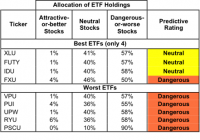
Summary Utilities sector ranks eighth in Q3’15. Based on an aggregation of ratings of nine ETFs and 26 mutual funds. XLU is the top-rated Utilities ETF and EVUYX is the top-rated Utilities mutual fund. The Utilities sector ranks eighth out of the 10 sectors as detailed in our Q3’15 Sector Ratings for ETFs and Mutual Funds report. It gets our Dangerous rating, which is based on an aggregation of ratings of nine ETFs and 26 mutual funds in the Utilities sector. See a recap of our Q2’15 Sector Ratings here. Figure 1 ranks from best to worst all nine Utilities ETFs and Figure 2 shows the five best and worst-rated Utilities mutual funds. Not all Utilities sector ETFs and mutual funds are created the same. The number of holdings varies widely (from 20 to 81). This variation creates drastically different investment implications and, therefore, ratings. Investors should not buy any Utilities ETFs or mutual funds because none get an Attractive-or-better rating. If you must have exposure to this sector, you should buy a basket of Attractive-or-better rated stocks and avoid paying undeserved fund fees. Active management has a long history of not paying off. Figure 1: ETFs with the Best & Worst Ratings – Top 5 (click to enlarge) * Best ETFs exclude ETFs with TNAs less than $100 million for inadequate liquidity. Sources: New Constructs, LLC and company filings Figure 2: Mutual Funds with the Best & Worst Ratings – Top 5 (click to enlarge) * Best mutual funds exclude funds with TNAs less than $100 million for inadequate liquidity. Sources: New Constructs, LLC and company filings The Utilities Select Sector SPDR ETF (NYSEARCA: XLU ) is the top-rated Utilities ETF and the Wells Fargo Advantage Utility & Telecommunications Fund (MUTF: EVUYX ) is the top-rated Utilities mutual fund. Both earn a Neutral rating. The PowerShares S&P SmallCap Utilities Portfolio ETF (NASDAQ: PSCU ) is the worst-rated Utilities ETF and the Rydex Utilities Fund (MUTF: RYUTX ) is the worst-rated Utilities mutual fund. PSCU earns a Dangerous rating and RYUTX earns a Very Dangerous rating. 80 stocks of the 3000+ we cover are classified as Utilities stocks, but due to style drift, Utilities ETFs and mutual funds hold 81 stocks. SCANA Corporation (NYSE: SCG ) is one of our favorite stocks held by Utilities ETF and mutual funds and earns our Attractive rating. Since 2010, the company has grown after-tax profit ( NOPAT ) by 6% compounded annually. This profit growth is supported by SCANA’s 16% NOPAT margin, which is much higher than the 12% achieved in 2010. Despite SCANA’s steady business improvements, the stock price reflects a different picture. At its current price of ~$56/share, SCANA has a price to economic book value ( PEBV ) ratio of 0.9. This ratio implies that the market expects the company’s profits to permanently decline by 10%. If SCANA can grow NOPAT by only 4% compounded annually over the next five years , the stock is worth $72/share today – a 28% upside. Northwest Natural Gas Company (NYSE: NWN ) is one of our least favorite stocks held by Utilities ETF and mutual funds and earns our Dangerous rating. Over the past five years, Northwest’s NOPAT has declined by 3% compounded annually. Northwest currently earns a bottom quintile return on invested capital ( ROIC ) of 3%. Despite the declining profits, investors have stuck with NWN, most likely for its 4% dividend yield. However, dividend aside, Northwest’s stock price is overvalued. To justify its current price of $44/share, Northwest must grow NOPAT by 4% compounded annually for 12 years . 4% NOPAT growth might not seem like much, but for a Utility company that has seen profits decline for years, this growth expectation is rather optimistic. Figures 3 and 4 show the rating landscape of all Utilities ETFs and mutual funds. Figure 3: Separating the Best ETFs From the Worst ETFs (click to enlarge) Sources: New Constructs, LLC and company filings Figure 4: Separating the Best Mutual Funds From the Worst Mutual Funds (click to enlarge) Sources: New Constructs, LLC and company filings D isclosure: David Trainer, Kyle Guske II, and Max Lee receive no compensation to write about any specific stock, sector or theme. Disclosure: I/we have no positions in any stocks mentioned, and no plans to initiate any positions within the next 72 hours. (More…) I wrote this article myself, and it expresses my own opinions. I am not receiving compensation for it. I have no business relationship with any company whose stock is mentioned in this article.