Tag Archives: pro

Loan Fund Primer

Sweden is now the latest country to make headlines about extreme central bank policy to stimulate growth which creates a dilemma for Swedish people trying to save money. This highlights the need to learn about different sectors of the fixed income market and taking a multi-sector approach in your fixed income portfolio. One sector that has attracted attention and assets has been the loan market. By Roger Nusbaum, AdvisorShares Strategist Last week the Riksbank (the Swedish central bank) dropped its benchmark interest rate to -0.10 and as of earlier this week Sweden’s ten year sovereign debt was yielding 0.50%. So Sweden is now the latest country to make headlines about extreme central bank policy to stimulate growth. We will see whether this turns out to be effective policy but it creates a dilemma for Swedish people trying to save money. This is the same or similar dilemma for people in many other countries including the US and while our rates are not as low as many other countries they are low enough to be problematic; two basis points for a money market and 2% for ten year treasuries. We’ve been looking at this issue for years, making the point about the need to learn about different sectors of the fixed income market and taking a multi-sector approach in your fixed income portfolio. We’ve talked about combining sectors with higher yields and so potentially more risk with sectors with lower yields and likely less risk to get an overall yield that hopefully approaches a useful level even if not a normal level; normal based on historical interest rates. One sector that has attracted attention and assets has been the loan market. There have been traditional mutual funds offering access for a fair bit of time and in the last couple of years ETFs have been rolled out that target the sector and the asset flows have been huge, more than $5 billion for the largest fund in the group. The attraction is simple enough; yields can be in the four percent range and because of their reset feature they don’t take interest rate risk. ‘Reset feature’ means that the interest rate paid on the loans adjusts based on prevailing rates on a regular interval, usually every three months. If you look on the info page for a loan fund you’ll see a maturity of several years but you’ll also see something like average days until reset which is when the rate on a given loan will update. From quarter to quarter there may not be much change but occasionally there will. This entire mechanism reduces interest rate risk to being essentially a non-issue. The credit quality of course tends to be lower which accounts for the yields being relatively attractive. Credit risk is generally mitigated, but not completely mitigated, by accessing the space via a fund similar to high yield. I would note that accessing an individual loan is not really a possibility for individuals. The other risk to mention is liquidity risk. Loans don’t trade on a secondary market so during some sort of event that strains liquidity the funds and their holders could have a problem with short term volatility. Most of the funds have the flexibility to hold some bonds that do trade on a secondary market to help in the face of a liquidity event. Anyone interested in the space, and with the yields available it is worth learning about, should take the time to understand what their given fund will do to address this potential issue. Disclosure: The author has no positions in any stocks mentioned, and no plans to initiate any positions within the next 72 hours. (More…) The author wrote this article themselves, and it expresses their own opinions. The author is not receiving compensation for it. The author has no business relationship with any company whose stock is mentioned in this article. Additional disclosure: To the extent that this content includes references to securities, those references do not constitute an offer or solicitation to buy, sell or hold such security. AdvisorShares is a sponsor of actively managed exchange-traded funds (ETFs) and holds positions in all of its ETFs. This document should not be considered investment advice and the information contain within should not be relied upon in assessing whether or not to invest in any products mentioned. Investment in securities carries a high degree of risk which may result in investors losing all of their invested capital. Please keep in mind that a company’s past financial performance, including the performance of its share price, does not guarantee future results. To learn more about the risks with actively managed ETFs visit our website AdvisorShares.com .AdvisorShares is an SEC registered RIA, which advises to actively managed exchange traded funds (Active ETFs). The article has been written by Roger Nusbaum, AdvisorShares ETF Strategist. We are not receiving compensation for this article, and have no business relationship with any company whose stock is mentioned in this article.
My Duke Energy Fourth-Quarter Earnings Prediction

I predict the stock to report a $1.27 earnings number on $6.344 billion in revenue. Analysts are predicting an average of $0.80 and $6.25 billion. Duke is definitely a solid name to hold onto to during difficult times and the 4% dividend yield offers pretty good protection for when the stock price drops. As earnings season continues we’ve seen the utility sector of the market show some chinks in the armor as the ten-year treasury yield has begun to climb. Duke has been the beneficiary stock recently of falling yields and now is becoming a victim of rising yields. I selected this stock for my portfolio of thirty back in May of 2013 because I liked the prospect of having a great dividend and a business which is always going to have a customer. During the past year the stock price has increased 11.74% excluding dividends and only just in the past two weeks has it lost 10% due to rising treasury yields. With that said I’d like to make my prediction for Duke Energy for the fourth quarter of 2014 that the company will be announcing on February 18, 2015 before the market opens. DUKE ENERGY CORPORATION (NYSE: DUK ) INCOME STATEMENT Fiscal year ends in December. USD in millions except per share data. 2014-12 2014-09 2014-06 2014-03 2013-12 2013-09 Revenue $6,344 $6,395 $5,949 $6,624 $6,112 $6,709 Cost of revenue $2,275 $2,307 $2,287 $2,531 $2,281 $2,474 Gross profit $4,069 $4,088 $3,662 $4,093 $3,831 $4,235 Operating expenses Operation and maintenance $1,398 $1,409 $1,467 $1,506 $1,527 $1,458 Depreciation and amortization $810 $788 $761 $790 $763 $707 Other operating expenses $491 $272 $318 $1,739 $338 $327 Total operating expenses $2,699 $2,469 $2,546 $4,035 $2,628 $2,492 Operating income $1,370 $1,619 $1,116 $58 $1,203 $1,743 Interest Expense $412 $405 $413 $406 $419 $379 Other income (expense) $175 $137 $122 $131 $211 $87 Income before income taxes $1,132 $1,351 $825 -$217 $995 $1,451 Provision for income taxes $340 $460 $209 -$127 $309 $457 Net income from continuing operations $793 $891 $616 -$90 $686 $994 Net income from discontinuing ops $100 $378 -$3 -$3 $6 $14 Other $3 $5 -$4 -$4 -$4 -$4 Net income $896 $1,274 $609 -$97 $688 $1,004 Net income available to common shareholders $896 $1,274 $609 -$97 $688 $1,004 Earnings per share Basic $1.27 $1.80 $0.86 -$0.14 $0.97 $1.42 Diluted $1.27 $1.80 $0.86 -$0.14 $0.97 $1.42 Weighted average shares outstanding Basic 707 707 707 706 706 706 Diluted 707 707 707 706 706 706 So you may notice that I have revenue to be about equal to what it was during the past quarter and that’s because I don’t believe the economy has excelled much during the past couple of quarters. The average analyst estimate for the quarter is $6.25 billion with a high of $6.8 billion. So I appear to be a bit optimistic for the quarter on revenue than the average but on a GAAP basis I’m predicting earnings to be $1.27 while the average estimate is $0.80 with a high of $0.98. I’m actually quite a bit higher than the rest of the pack because I’ve assumed best case scenarios for operating expenses as all their commodity prices have dropped significantly during the fourth quarter. We’ll have to wait and see what happens in a few days, but one thing is for sure, I’m not going to be buying any of the stock before the earnings report. However, I purchased a batch last week right before the ex-dividend date so I can increase my dividend a little. Duke is definitely a solid name to hold onto to during difficult times and the 4% dividend yield offers pretty good protection for when the stock price drops. Disclaimer: This article is in no way a recommendation to buy or sell any stock mentioned. This article is meant to serve as a journal for myself as to the rationale of why I bought/sold this stock when I look back on it in the future. These are only my personal opinions and you should do your own homework. Only you are responsible for what you trade and happy investing! Disclosure: The author is long DUK. (More…) The author wrote this article themselves, and it expresses their own opinions. The author is not receiving compensation for it (other than from Seeking Alpha). The author has no business relationship with any company whose stock is mentioned in this article. Are you Bullish or Bearish on ? Bullish Bearish Neutral Results for ( ) Thanks for sharing your thoughts. Submit & View Results Skip to results » Share this article with a colleague

Don’t Feel Bad If You’re Not Making Money In This Market

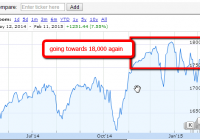
Summary The Dow is clawing back to its all-time high, and how it affects investors. Hedge fund performances suck, but are you getting suckered in to the hype? There is a need to reassess your attitude towards risk during market cycles. The Dow is just below its all-time high again. After all these years of a bull run, Mr. Market is still giddy with excitement and wants you to join the ride. But while Mr. Market puts on his charm during this upward market, I am reminded of Howard Marks’ memo titled “Ditto” which goes over market psychology and investor sentiment. But First… You are Missing Out Feel like everyone else is making money except you? Are you missing out on this market upside? Well, that’s a lie because in 2014, hedge funds performed miserably. The average hedge fund performance was under 3%. 2012 and 2011 weren’t impressive either. If at any point during the past few months or years you thought to yourself “I’m missing out”, then you are not alone. However, you shouldn’t be worried or concerned. If the best investors can’t get anywhere near the indexes, then you have no chance of doing any better, right? Wrong. You and I know that investing should be emotionless, but one of the easiest ways to get emotional is when you feel like you need to act to keep up, or when you start comparing yourself to other investors. The difficult part is ignoring the itch that makes you want to get trigger happy. In fact, we should be focusing on limiting our risk by understanding how market cycles affect us. Over the years, I’ve become convinced that fluctuation in investor attitudes toward risk contributes more to major market movements than anything else. I don’t expect this to ever change. – Howard Marks It’s bull markets like these where it just seems like everything is going up where many people crumble and get suckered in to buying stocks that they otherwise would not buy. Simply because they do not want to get left behind. Herd mentality isn’t just about buying whatever the next person is buying. Herd mentality exists primarily because of human behavior and getting caught up in emotions. So are you really missing out? Not at all. That’s what your emotions are telling you. Not what your logic is telling you. The Cycle in Attitudes towards Risk I’m sure you have seen the image below. And to complement this, here is Howard Marks’ version. 1. When economic growth is slow or negative and markets are weak, most people worry about losing money and disregard the risk of missing opportunities. Only a few stout-hearted contrarians are capable of imagining that improvement is possible. 2. Then the economy shows some signs of life, and corporate earnings begin to move up rather than down. 3. Sooner or later, economic growth takes hold visibly and earnings show surprising gains. 4. This excess of reality over expectations causes security prices to start moving up. 5. Because of those gains – along with the improving economic and corporate news – the average investor realizes that improvement is actually underway. Confidence rises. Investors feel richer and smarter, forget their prior bad experience, and extrapolate the recent progress. 6. Skepticism and caution abate; optimism and aggressiveness take their place. 7. Anyone who’s been sitting out the dance experiences the pain of watching from the sidelines as assets appreciate. The bystanders feel regret and are gradually suckered in. 8. The longer this process goes on, the more enthusiasm for investments rises and resistance subsides. People worry less about losing money and more about missing opportunities. 9. Risk aversion evaporates and investors behave more aggressively. People begin to have difficulty imagining how losses could ever occur. And so goes the path towards a mania or bubble. How to Keep Your Emotions In Check One of the easiest methods of controlling your emotions is to know the value of your companies. I just love how Prof. Damodaran puts it in this previous article I wrote because it’s exactly how I process it. Valuation slows the process down, gives your rational side a chance to mount an argument. Most investors don’t want to hear about valuation because it challenges their desire to hear what they want about their holdings. But valuation is the compass that keeps you on the right path. My valuations are not always correct, but it’s saved my bacon on so many occasions. It’s not just about finding undervalued stocks to buy, it also helps with selling stocks that have become expensive. You don’t know if it’s expensive unless you know what something is worth. That way, you can protect yourself from unnecessary losses. I love valuation and it’s the reason why I’m always using my stock analysis tool and checking my rationale with cold hard facts. Unless I find a legitimate reason for why I have to increase my valuation from $50 to $300 without solid evidence, it’s easy to recognize I’m fooling myself. This is NOT a Market Prediction Even with the Dow just over 18,000, I have no opinion on whether the market is undervalued or overvalued. It’s easier for individual companies, but more difficult for an index. All I know is that there are always pockets of opportunity available. The main idea I want to share is to not fall victim to feeling like you are missing out. Keep your risk assessment in check and let the market do what the market does. Invest independent of the market. In this interview with Mohnish Pabrai , Pabrai talks about how his fund was down 65% from the peak at one point, but his wife had no clue because his behavior pattern did not change. Even in a really bad year, he was sticking with his principles. You do not want to be in a place where you go from worrying about missing opportunities to worrying about losing money. Disclosure: The author has no positions in any stocks mentioned, and no plans to initiate any positions within the next 72 hours. (More…) The author wrote this article themselves, and it expresses their own opinions. The author is not receiving compensation for it. The author has no business relationship with any company whose stock is mentioned in this article.