Tag Archives: portfolio

Shorting China Based On GDP Growth Rate Projections Is Highly Risky
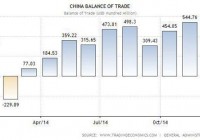
Summary China is looking at record trade surpluses in 2015, which should boost GDP growth. Many China shorts assume GDP growth moves in one direction instead of up and down. Shorting based on projections is risky, especially when there are many factors that can throw off these projections. China’s trade surplus is currently trending up. After a relatively quiet first quarter in 2014, the balance of trade improved drastically throughout the remainder of the year. In fact, the country recorded a record monthly trade surplus of $54.5 billion last November . For the whole of 2014, the trade surplus soared by 47 percent over the previous year and wound up at a record $382.46 billion. (click to enlarge) What’s driving the trade surplus and why they may continue The drastic change in the balance of trade is not all that surprising when the fall in commodity prices is taken into account. Since China is the biggest importer of many commodities, it makes a big difference when it is able to pay less. To illustrate the drop in commodities, the Continuous Commodities Index is down by almost 14 percent over the last 12 months and continues to go down. Crude oil, the most important commodity, is down by more than half. The drop occurred in the second half of the year and accelerated by late November. This will have an impact since China imported 6.17 million barrels per day in 2014, an increase of 9.5 percent over the prior year. With commodities going the way they are, China can expect continued bumper trade surpluses. Trade surpluses should be especially high for at least the next two quarters due to the high base of the preceding year. Barring a drastic rebound in commodity prices, the trade surplus in 2015 is very likely to be substantially higher than the one in 2014, which was already a record setting number. Why China’s trade surplus matters Trade surplus matters because it influences GDP growth. In fact, one of the main components of GDP calculated using the expenditure approach is net exports. The difference between exports and imports, can be a trade surplus or trade deficit. Therefore, a large or increasing trade surplus will boost GDP growth assuming all else remains the same and can help offset weaknesses elsewhere to a certain extent. GDP growth in China is in turn one of the most closely watched metrics by many people. The reason why is simple. As the second largest economy, China is one of the most important markets for many companies around the world. Certain sectors such as commodities are especially sensitive to whatever goes on in China. (click to enlarge) For the fourth quarter of 2014, GDP growth rate came in at 7.3 percent. GDP growth rate for the whole of 2014 was 7.4 percent. The expectation was for 7.2 percent and 7.3 percent respectively. The target set by the Chinese government at the beginning of the year was for “about 7.5 percent” annual GDP growth. China shorts assume that China’s growth rate will go down However, despite GDP growth beating expectations, there are many who remain bearish when it comes to China. For instance, the International Monetary Fund (IMF) projects GDP growth to come in at 6.8 percent for 2015 and 6.3 percent the following year. There are others who are even more bearish. With so much negative sentiment around, it’s no wonder that some may be tempted to short China. The thinking is that a slowing economy will have a negative impact on company earnings, which in turn should affect their valuation. Shorting makes sense in such a situation. However, since there is no one who can accurately predict the future, it’s not possible to say for certain what will happen in the future. It may or may not be true. In other words, expectations that China’s growth rate will continue to go down may be misplaced. (click to enlarge) China shorts will point out that the current growth rate is much less than the double digit growth in previous years. However, contrary to what is often reported, double digit growth in China is actually the exception and not the norm. GDP growth rate does not move in a straight line, but goes up and down along the way. There are many factors that can throw projections off course Record trade surpluses are just one factor that can result in China’s growth rate coming in above expectations. For instance, the IMF originally expected China’s GDP growth for 2014 to come in at 7.2 percent early in the year. They later raised this to match the official government target. In other words, the projections for 2015 could be adjusted upwards in the coming months just like the IMF did the previous year. Furthermore, the Chinese government is a wild card as it has several options available to influence GDP growth. For instance, the one year benchmark lending rate is at 5.6 percent, which is quite high in an era where low interest rates are common. Besides interest rates, reserve requirements for banks is at 20 percent. China also has fiscal reserves that could be used. Depending on what target the Chinese government sets for 2015, it may deploy some or all of the available options. All of which can throw projections way off course, which would have negative implications for shorts that are banking on projections coming true. Shorting China based on GDP growth expectations is therefore highly risky and not recommended.
Tax-Loss Harvest Swap – A Prudent Move For Energy Investors

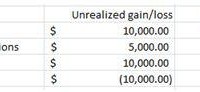
Summary In this article, we will discuss a popular tax strategy called a “loss-harvest swap”. This is effectively a legal version of the SEC-outlawed “wash-sale”. This is particularly relevant for investors with current unrealized losses in energy companies. A tax-loss harvest swap works well in times of indiscriminate selling within a sector, such as the recent selloff in oil. Whenever there are substantially alike securities to “swap” one position for another, this strategy can work well. The strategy also works well (better in fact) with ETFs. Loss-Harvest Swap Example Take this example portfolio. You’ll see we have some unrealized losses in Ultra Petroleum, a small-cap E&P company. Since the broad selloff in energy, many small-cap E&Ps have gone on sale. There are several which have fallen more than UPL and which we wouldn’t mind owning instead of it now. Say our swap of choice is SWN , a larger E&P trading at a similar valuation of 3.5x trailing cash flow, and more stable long-term Marcellus acreage. The stock has fallen 39% over the past year, compared to UPL’s 35%. A loss-harvest swap calls for a sale of UPL and a buy of SWN. From a portfolio standpoint, my risk / reward would be basically unchanged – I am still long a small-cap E&P company that is substanitally correlated to the sector. I might eventually end up with more gains from SWN than UPL, or less – that is a risk. But, I also generate some immediate & guarranteed tax benefits. Tax Savings The exact amount of the tax savings depends on your tax bracket: The savings vary, but the point is that these tax savings were obtained without much risk, and are essentially free money. If you have some short term capital gains, this is pure gold. Also, if your realized losses exceed your realized gains for the year, one can use $3000 of the losses to reduce one’s taxable income, and carry over the rest to next year. How Often to Harvest Losses Tax-loss harvesting is a strategy that can be used fairly often. Taking trading commissions into account as a cost, and leaving some margin for error for divergence between your swapped securities’ returns (don’t want inadvertently destroy alpha by buying an inferior name), you could easily make the case for an automatic swap at set thresholds (for example- harvest at every 5% loss). As such, you could benefit from even minor market volatility after you buy– and lock in a lower cost basis. However, swapping more often will generate trading costs, so I recommend using a discounted broker such as Interactive Brokers or Optionshouse (these are two I have used in the past). Also, keep in mind tax strategy is not a substitute for a good investment strategy – make sure you have the latter in place first. For a stock or sector that keeps falling, using 2 substantially-alike securites, one can swap one for the other once every 31 days and still remain in the clear with respect to the SEC’s wash sale rules. Using 3 alike securities, such as 3 ETFs which track the same index (yes, that is still allowable under SEC wash sale rules), one could swap more often than that, one just cannot swap the same security in 31 days.

What To Hold In The Face Of Deflation

Deflation is turning into a global threat. Falling prices are bad for the economy, not good. Until government becomes willing to spend buy gold, buy bonds and buy defense stocks just in case. Today’s Great Deflation is creating a lot of casualties. Among the most interesting are big banks’ trading desks and hedge funds. Inconceivable does not mean what they think it does. Goldman Sachs (NYSE: GS ) blamed “volatility” for a bad trading quarter. (Why isn’t it volatility when prices go up?) JPMorgan Chase (NYSE: JPM ) talked up legal costs and nasty regulators rather than admit that their traders got things horribly wrong. Despite all this, the bank’s shares fell below book value , what I like to call the “Mendoza Line” of banking. JPMorgan Chase CEO Jamie Dimon is desperate to keep his bank together because, in the face of ruinous trading losses, many hedge funds are facing, well, ruin. John Paulsen and Carl Icahn got killed by the deflation in oil. Everest Capital saw its main fund wiped out by the Swiss Franc’s sudden revaluation, done in the face of continuing European deflation, and it cost West Ham the shirt off their backs . FXCM (NYSE: FXCM ) was forced into an emergency rescue due its customers’ losses in currencies. Funds have been forced to cut their losses on soybeans. Even the computers are getting killed. Deflation means a shortage of buyers in the face of abundant supply. It is precisely what the world faced in the early 1930s. Unfortunately both policymakers and traders are acting as they did then. They refuse to acknowledge the reality that, without buyers, markets can’t clear, and they’re doing everything they can to discourage buyers as a matter of policy. John Mason is right. The business model of the big banks is flawed . So are their political models. The world is threatened by squeezed margins, cuts in production, business contraction, falling wages – the same negative spiral that Japan has suffered from for two decades. The most dangerous delusion is that the problem will take care of itself and that demand will magically “materialize” because there are so many bargains out there. It didn’t in the 1930s, and it won’t in the 2010s. What the hedge funds and the big banks should be doing is getting on the phone to policymakers and telling them to buy, buy, buy, to spend, spend, spend. Maybe send Elizabeth Warren’s PAC a check. Streetwise Research’s call to buy gold is, unfortunately, good short-term advice. So is the call to hold strong bonds, especially U.S. government bonds, which despite their tiny yields have kept going up in price, delivering big capital gains over the last six months. But that’s short-term advice. At some point governments will realize they need to spend big to stimulate domestic demand and whip deflation. I hope they do it before public demand switches to guns from butter but, just in case, you might want to keep some Boeing (NYSE: BA ) in your portfolio.