Tag Archives: portfolio

Alternate Current: The Power Of Diverse Return Sources
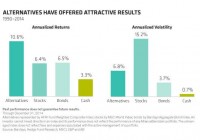
By Christine Johnson After a long period of calm, global markets now face tumbling oil prices, geopolitical risks and monetary policy changes. Investors looking for new ways to diversify in this uncertain environment should take a long look at investments that don’t take their cues from stock or bond market movements. The Key: Un-Stock-Like Return Patterns Alternative investments have that name for a reason: they don’t act like traditional investments. Adding alternatives thoughtfully to a portfolio may lower its sensitivity to the stock market and interest-rate fluctuations. Alternatives also have the potential to enhance long-term returns and reduce risk. Investors may be surprised to learn that over the last 25 years, alternatives have produced higher returns than stocks, bonds or cash – with less than half the volatility of stocks (Display). A big part of the equation? Managers’ use of flexible investment approaches, and their ability to act opportunistically to exploit mispricings within and across asset classes. How Do Alternatives Handle Stress? On average, alternative investments haven’t been up as much as stocks in bull markets, but they also haven’t been down as much as stocks in bear markets. By losing less than traditional equity strategies during times of market stress, alternative strategies have historically preserved investors’ capital. In 2001 and 2002, as markets struggled to recover from the dot-com bust, alternatives provided more downside protection than stocks. In 2008, alternatives also lost less than stocks. Alternatives in the Portfolio Context Investors want more diversification in their portfolios; we think investments that don’t track stock and bond markets as closely as traditional investments offer that potential. Many alternative strategies provide returns driven more by a manager’s skill in decision making than by broad market movements. And there’s a lot of variety among alternatives. Investors can choose narrowly-focused alternative strategies – nontraditional bond or long/short equity, for example. Or they can opt for a more diversified strategy like multi-manager. This offers exposure to diverse approaches – and even diverse managers. A manager’s investing skill is integral to alternative investing, and the returns of individual strategies can vary greatly. A diversified strategy may prove valuable. Challenging market periods turn up unexpectedly, and a diversified investing approach that incorporates alternatives may help portfolios’ performance across diverse market conditions. Not all strategies will be in or out of favor at a given time. This point is particularly relevant in terms of US stocks. The lofty returns of the last couple of years won’t last indefinitely – so it makes sense to look for strategies whose return patterns offer something different from those of the broad market. The views expressed herein do not constitute research, investment advice or trade recommendations and do not necessarily represent the views of all AB portfolio-management teams. MSCI makes no express or implied warranties or representations, and shall have no liability whatsoever with respect to any MSCI data contained herein. The MSCI data may not be further redistributed or used as a basis for other indices or any securities or financial products. This report is not approved, reviewed or produced by MSCI. Christine Johnson is Managing Director of Alternative Investments at AB (NYSE: AB ).
The Big Lesson From A Bet With Warren Buffett

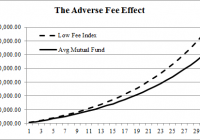
Seven years ago Ted Seides made a bet with Warren Buffett that a fund of hedge funds could outperform the S&P 500 over a ten-year period. As of today, that bet is looking very bad, with the S&P 500 beating the fund of funds by over 40% (63.5% vs. 19.6%). Seides wrote a piece for CFA Institute explaining why the bet has been wrong and some lessons from it. While Seides makes many good points, there’s one lesson that is particularly important in all of this: Seides explains that half of the underperformance is from fees: Just over half (24.4% ÷ 43.9% = 55.6%) of the underperformance by hedge funds can be attributed to fees. A full 19.5% of cumulative underperformance, or approximately 2.6% per annum, must have been caused by something else. That’s not exactly a glowing endorsement for high fee funds. Why would anyone pay more for less? The fact is, the investment world has become dirt cheap. You can get good financial advice for a fraction of the fee that you once had to pay. The entire hedge fund industry is living in the past, hoping to continue to suck 2&20 out of their unwitting clients for as long as they can. The reality is that you don’t have to pay high fees for smart advice any longer. Heck, I offer my asset management service for a measly 0.35% and I’d say I am a pretty “sophisticated” thinker. That’s what my mother tells me anyhow and I believe everything she says. More importantly, we’re entering a world where future returns are likely to be lower in the future. With bonds generating low yields, a balanced portfolio is either going to produce lower returns in the future or higher volatility returns as more of the gain is made up by stocks. This creates a problem for investors. If you’re paying high fees, you’re either paying more for lower risk adjusted returns OR your fees are eating into your returns by an increasingly large margin. If you’re looking at a real return (after inflation) of 6%-7% in stocks, then we have every reason to be mindful of any other frictions like taxes and fees that might reduce that return even further. But what is the average fee effect? To put things in perspective, consider that the average mutual fund charges 0.9% relative to the average low fee index which charges 0.1%. That’s a 0.8% difference. It doesn’t sound like much, but take a 7% compound annual growth rate on $100,000 and extend that over 30 years. Just how much of an impact does it make? The mutual fund ends up with a balance that is 23% lower than the index. In other words, the mutual fund could just mimic the return of the index and reduce your return by $150,000! Either way, the solution is simple. Stop paying high fees. My general rule of thumb is that you should almost never pay more than 0.5% for portfolio management. If you’re paying more than that, then I highly doubt you’re getting your money’s worth. Are you Bullish or Bearish on ? Bullish Bearish Neutral Results for ( ) Thanks for sharing your thoughts. Submit & View Results Skip to results » Share this article with a colleague

Healthcare ETFs Have More Room To Run

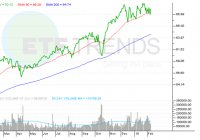
Summary The Healthcare sector could continue to perform this year. Fundamental factors continue to contribute to growth. Biotech is the leading sub-sector in the healthcare industry. The Healthcare sector exchange traded funds have been outpacing the broader markets and could remain healthy as rising profits diminish concerns over frothy valuations. Over the past year, the Health Care Select Sector SPDR ETF (NYSEARCA: XLV ) rose 25.2%, while the SPDR S&P 500 Trust ETF (NYSEARCA: SPY ) gained 17.1%. Year-to-date, XLV is up 2.5% and SPY is 0.6% higher. Specialized drug treatments, an aging population and industry-wide consolidation, among other factors, will continue to help healthcare stocks, reports Eric Platt for Financial Times . “More than any other sector, healthcare is benefiting from strong demographic and secular trends: aging population, expanding insurance coverage, growing middle-class around the world, new product launches,” Dubravko Lakos-Bujas, equity strategist with J.P. Morgan, said in the Financial Times article. Strong earnings results will support the healthcare sector ‘s rising prices. Healthcare companies reported organic growth of all sectors, including 11% revenue growth and 22% earnings growth over the fourth quarter. Looking ahead, S&P Capital IQ projects S&P 500 healthcare earnings per share to rise 8.9% in 2015 year-over-year, compared to a 1.7% gain in the broader blue-chip index. Barclays strategists also point out that the biotech sub-sector has been a significant contributing factor to earnings growth within the healthcare industry. Over the past year, the iShares Nasdaq Biotechnology ETF (NASDAQ: IBB ) rose 27.2% and the Market Vectors Biotech ETF (NYSEARCA: BBH ) increased 21.9%. The biotech sub-sector makes up 20.3% of XLV’s holdings. “Our conviction level is high on the industry given what we believe will be another strong year for biotech innovation and a differentiated earnings growth profile versus the broader markets,” Geoffrey Meacham, an analyst with Barclays, said in the Financial Times article. Moreover, merger and acquisition (M&A) activity will strengthen valuations. As the market anticipates more deals ahead , consolidations have provided a floor on share prices. Fueling further M&A activity, Marshall Gordon, senior healthcare analyst at ClearBridge Investments, argues that large companies still need to acquire more products, especially as large blockbuster drug patents expire, and financing remains inexpensive. Health Care Select Sector SPDR ETF (click to enlarge) Max Chen contributed to this article . Disclosure: The author is long SPY. (More…) The author wrote this article themselves, and it expresses their own opinions. The author is not receiving compensation for it. The author has no business relationship with any company whose stock is mentioned in this article.