Tag Archives: nreum

China’s A Shares: My Biggest Bet In 67 Years Of Investing

I’m divesting myself of 50% of my U.S. holdings (stocks and bonds) and gently investing it all in China A shares (ASHR) in anticipation of an October 2015 upsurge. I anticipate billions of dollars flowing into China A shares in response to the IMF’s expected decision to make the Reminbi (Yuan) an official reserve currency in October. The operative words are “anticipate” and “expect”. This is NOT a slam-dunk; it’s a high-risk guesstimate. A year ago the IMF came within a whisker of approving the Reminbi to join the basket of official settlement currencies for worldwide debt settlement, bank retention, bond issuance, and credibility. In October of this year, I expect the organization to approve. Already major banks are issuing bonds and settling debts in Reminbi in anticipation. Major indexes and investment funds will pore billions into the China A shares market once the Yuan becomes internationally and easily and credibly convertible. This will occur for two reasons: first, because investors want exposure to the Reminbi in the foreign exchange market; and second, because China is liberalizing its rules to permit foreign investors to own these A shares, i.e. shares denominated in Reminibi. Asia, China, small-cap and development funds have been waiting years for this opportunity to buy the shares of Chinese companies in the currency of the country. And the funds that will be used to make all these new Reminbi investments in China will in large part come out of U.S. dollar investments, just as mine are. Meanwhile, the A share market itself has become particularly enticing of late. The off-putting “bubble” so bemoaned by the talking heads and the financial press has burst, with China’s indexes falling more than 10% since the start of June. That’s officially a correction. Last Friday the Shanghai Composite ended down 6.4% for a single week, with the Shenzhen close behind with a drop of 6%. This week there appears to be a stop to the falling knife: it appears to me the point to gently begin to buy A shares. As a consequence, I expect the China A share market to stabilize between now and October, at which point I anticipate the Reminbi (the Yuan) to rise significantly against the U.S. Dollar, and the A shares market to make real headway. But, as I pointed out, all of this is predicated upon “anticipate”, “expect”….and, I would add, “hope”. Follow my line of thinking at your own risk! But I must say I’ve never bet half the farm before on a single position in my 67 years of investing. I plan to hold this position until January, when I will begin transitioning back into the U.S. market, retaking the same positions I now hold (hopefully in larger measure) as I expect a strong 2016 for the U.S and U.S. stocks. I shall avoid U.S. bonds altogether, as a slough of despond. I doubt that I will hold any of my A shares beyond the October of 2016. Divesting myself of 50% of my U.S. liquid assets is a rash move, clearly not for the faint of heart. At the age of 75 I’m bored with the micromanagement of incrementalist investing. To me, this move looks like a one-time shot at an interesting risk with a limited downside. I simply do not foresee the implosion of the Chinese economy coming about in the next 18 months. After all, we trained their economists! But to say that this trade is not for the faint of heart is inadequate. Don’t put a dime into it that you are not willing — and comfortable — to lose. It’s just that straight forward. And just that much fun. Disclosure: I am/we are long ASHR. (More…) I wrote this article myself, and it expresses my own opinions. I am not receiving compensation for it (other than from Seeking Alpha). I have no business relationship with any company whose stock is mentioned in this article. Additional disclosure: I am unable to activate the SEEKING ALPHA template to accept ASHR as a ticker.

Best And Worst: Mid Cap Value ETFs, Mutual Funds And Key Holdings

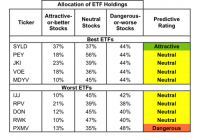
Summary Mid Cap Value style ranks seventh in Q2’15. Based on an aggregation of ratings of 16 ETFs and 166 mutual funds. SYLD is our top rated Mid Cap Value ETF and HAMVX is our top rated Mid Cap Value mutual fund. The Mid Cap Value style ranks seventh out of the 12 fund styles as detailed in our Q2’15 Style Ratings report . It gets our Dangerous rating, which is based on an aggregation of ratings of 16 ETFs and 166 mutual funds in the Mid Cap Value style. Figures 1 and 2 show the five best and worst rated ETFs and mutual funds in the style. Not all Mid Cap Value style ETFs and mutual funds are created the same. The number of holdings varies widely (from 23 to 570). This variation creates drastically different investment implications and, therefore, ratings. Investors seeking exposure to the Mid Cap Value style should buy one of the Attractive-or-better rated ETFs or mutual funds from Figures 1 and 2. Figure 1: ETFs with the Best & Worst Ratings – Top 5 (click to enlarge) * Best ETFs exclude ETFs with TNAs less than $100 million for inadequate liquidity. The First Trust RBA Quality Income ETF (NASDAQ: QINC ) and the Direxion Value Line Mid & Long Cap High Dividend ETF (NYSEARCA: VLML ) are excluded from Figure 1 because their total net assets are below $100 million and do not meet our liquidity minimums. Figure 2: Mutual Funds with the Best & Worst Ratings – Top 5 (click to enlarge) * Best mutual funds exclude funds with TNAs less than $100 million for inadequate liquidity. Nationwide Herndon Mid Cap Value Fund (Investor shares (MUTF: NWWQX ), S shares (MUTF: NWWPX ), C shares (MUTF: NWWNX ), A shares (MUTF: NWWMX )) is excluded from Figure 2 because its total net assets are below $100 million and do not meet our liquidity minimums. The Cambria Shareholder Yield ETF (NYSEARCA: SYLD ) is our top-rated Mid Cap Value ETF and the Harbor Mid Cap Value Fund (MUTF: HAMVX ) is our top-rated Mid Cap Value mutual fund. Both earn our Attractive rating. One of our favorite stocks in SYLD is Chemed Corp (NYSE: CHE ). This healthcare company provides hospice services throughout the United States. Chemed has exhibited strong and resilient operating performance. Over the past decade the company has consistently grown after-tax operating profit ( NOPAT ) by 13% compounded annually. The company currently earns a return on invested capital ( ROIC ) of 14%, up from 6% in 2004. Chemed has also generated positive economic earnings for nine consecutive years. Despite the consistent fundamental growth exhibited by Chemed, the company is undervalued at its current price of ~$131/share. If the company is able to grow NOPAT by just 9% compounded annually for the next 10 years the company is worth $156/share today – a 19% upside. The PowerShares Fundamental Pure Mid Value Portfolio ETF (NYSEARCA: PXMV ) is our worst rated the Mid Cap Value ETF and Mid-Cap Value ProFund (MUTF: MLPSX ) is our worst rated Mid Cap Value mutual fund. PXMV earns our Dangerous rating and MLPSX earns our Very Dangerous rating. One of our worst rated stocks held by Mid Cap Value ETFs and mutual funds is Alliant Energy Corp (NYSE: LNT ). LNT is a utility holding company that provides electricity and natural gas to customers in the Midwestern United States. Over the last 10 years Alliant’s ROIC has never exceeded 6% yet the company’s cost of capital ( WACC ) has exceeded its ROIC. This has resulted in negative economic earnings in 16 of the last 17 years. Over the last four years, the company’s NOPAT growth has been equally as disappointing, growing by only 2% compounded annually. However, LNT is highly overvalued at $59/share. In order to justify this price, LNT would have to grow NOPAT by 5% compounded annually for the next 11 years . While 5% NOPAT growth might not seem high, given the company has achieved less than half this growth over the past four years, this scenario seems unlikely. Figures 3 and 4 show the rating landscape of all Mid Cap Value ETFs and mutual funds. Figure 3: Separating the Best ETFs From the Worst ETFs (click to enlarge) Figure 4: Separating the Best Mutual Funds From the Worst Funds (click to enlarge) Sources Figures 1-4: New Constructs, LLC and company filings D isclosure: David Trainer and Allen L. Jackson receive no compensation to write about any specific stock, style, style or theme Disclosure: I/we have no positions in any stocks mentioned, and no plans to initiate any positions within the next 72 hours. (More…) I wrote this article myself, and it expresses my own opinions. I am not receiving compensation for it. I have no business relationship with any company whose stock is mentioned in this article.

Building The Core With Vanguard: Foreign Stocks

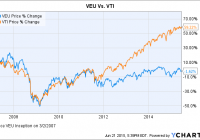
Summary Every ETF investor needs to consider what holdings will form the very core of their portfolio. For the portion relating to foreign stocks, the Vanguard FTSE All-World ex-US ETF is a compelling choice. Also discussed are reasons every investor should consider holding foreign stocks in their portfolio, along with links to additional background reading for those who desire such. For my first articles for Seeking Alpha, I decided to start simple: tackling the question of building a solid core portfolio using ETFs offered by Vanguard Funds. I started with domestic stocks featuring the Vanguard Total Stock Market ETF (NYSEARCA: VTI ), followed by domestic bonds featuring the Vanguard Total Bond Market ETF (NYSEARCA: BND ). As can quickly be discerned, however, both of the above options relate to U.S.-centric investments. For their portfolio to be complete, investors should also seriously consider going beyond the borders of the U.S. and into the world of foreign equities. For your first venture into this brave world, the Vanguard FTSE All-World ex-US ETF (NYSEARCA: VEU ) makes an excellent choice. Why Foreign? Why Now? For an overview of the risks and benefits of investing in foreign stocks, I offer this article from my personal blog. It offers a relatively brief, yet comprehensive overview, supported by links to further reading if desired. Essentially, what you will read there is that foreign stocks offer two potential benefits, growth and diversification . Hopefully, this material will answer that first question, Why Foreign? But what about that second question, Why Now? I hope to write about the concept of rebalancing one’s portfolio in a future article. But for now, let me just say that a key to good portfolio management is to “sell high and buy low;” in other words, to take a certain portion of your investments out of asset classes that have outperformed and put them to work in asset classes that have underperformed. With that in mind, have a look at the graph below. It compares Vanguard’s VTI (Domestic Stocks) with the ETF featured in this article, VEU, since VEU’s inception on March 2, 2007: VEU data by YCharts Do you notice anything interesting about that chart? I thought you might. After a period of relatively similar performance between roughly 2007 and 2012, U.S. stocks have outperformed their foreign brethren by a fairly significant margin. Further, foreign stocks have been roughly flat over the roughly 8-year span covered by the chart, while U.S. stocks have risen almost 60%. Let me be clear, there have doubtless been good reasons for this. While the U.S. economy has struggled, in particular since 2008, other countries have done even worse. Further, I am in no way predicting that foreign stocks will outperform their U.S. brethren moving forward. I don’t have a crystal ball. However, based on an analysis similar to this that I performed approximately two months ago, I decided to lower my personal weighting in U.S. stocks by 2.5% and shift those funds to foreign stocks. Certainly, this is no dramatic move. I simply decided that I wished to take a little from the asset class that had experienced significant gains and move it to the class that had been flat. With that big picture background, let’s now turn to the composition of VEU, as well as the expense ratio. Composition VEU is named well (Vanguard FTSE All-World ex-US ) because, as it happens, that is the name of the index it tracks. As such, VEU offers incredibly broad and diversified foreign exposure. As of the latest factsheet , we find that VEU actually contains a slightly greater number of securities than the index, 2,492 vs. 2,377. Let’s look a little closer. First, here is the fund’s geographic allocation: As you can see, the fund leans heavily toward developed markets such as Europe and the Pacific (Asia). At the same time, it offers reasonable exposure to emerging markets; those whose economies are not as fully developed and therefore offer greater potential for growth, albeit with a greater level of risk. If you back out the 18.8% in emerging markets, you quickly realize that 81.2% of the fund is invested in what are generally considered developed markets. Diving in a little more specifically, here are the Top 10 countries represented in the fund. If you add up the numbers, you will see that these countries comprise 73.4% of the total. Of these, China is the only country included in the Vanguard FTSE Emerging Markets ETF (NYSEARCA: VWO ). Let’s now take a look at one last perspective, the Top 10 holdings: To give you some small sense of the sorts of companies that constitute the largest portions of the fund, here are extremely brief synopses of the Top two; Nestle SA ( OTCPK:NSRGY ) and Novartis AG (NYSE: NVS ): Nestle SA – Nestle is the largest food company in the world , measured by revenues. Encompassing baby food, bottled water, coffee & tea, dairy products, frozen food, pet food, snacks and more. The list of brands is made up of legendary names that you will instantly recognize, and Wikipedia states that 29 of these brands each have annual sales of over $1 billion. The company operates in 197 countries, with factories in 86 countries. Novartis AG – Novartis is the largest pharmaceutical company in the world , measured by revenues. According to its latest annual report , Novartis’ products are available in more than 180 countries worldwide. Its pharmaceuticals arm has 135 projects in development, its subsidiary Alcon is the #1 eye care company worldwide, and its subsidiary Sandoz is the #2 global provider of generic medicines. Looked at from any of these vantage points, I submit that VEU is a wonderful core holding for the foreign, or international, component of your portfolio. Costs and Expenses At 0.14%, VEU’s expense ratio is somewhat higher than that of either VTI or BND, the other two ETFs I have featured. And yet, it too is one of the lowest in the industry. Bear in mind, this is an ETF that is dealing with assets all over the world, across different stock exchanges and the like. To that, of course, you have to add your trading commissions. Vanguard offers its own ETFs commission-free, and TD Ameritrade offers a decent selection of commission-free Vanguard ETFs. Suitability As a core holding, VEU is suitable for all portfolios. While I do believe that all investors should hold at least some portion of their portfolio in foreign stocks, I understand that you must do so at a level at which you are comfortable. Alternatives Another ETF worth considering, particularly if your brokerage offers it commission-free, is the iShares Core MCSI Total International Stock ETF (NYSEARCA: IXUS ). It too sports a very competitive 0.14% expense ratio, and covers basically the same range of countries, including emerging markets, as does VEU. The ETF’s size, as well as its average trading volume, is substantially smaller than VEU, but I do not believe this should be any impediment. As a Fidelity client, I use VEU for my core position and IXUS, which I can trade commission-free, for small incremental investments and/or to adjust portfolio weightings. Editor’s Note: This article discusses one or more securities that do not trade on a major U.S. exchange. Please be aware of the risks associated with these stocks. Disclosure: I am/we are long BND, IXUS, VEU, VTI, VWO. (More…) I wrote this article myself, and it expresses my own opinions. I am not receiving compensation for it (other than from Seeking Alpha). I have no business relationship with any company whose stock is mentioned in this article. Additional disclosure: I am not a registered investment advisor or broker/dealer. Readers are advised that the material contained herein should be used solely for informational purposes, and to consult with their personal tax or financial advisors as to its applicability to their circumstances. Investing involves risk, including the loss of principal.