Tag Archives: nreum

Relative Rotation Shows U.S. Equities Are The Place To Be
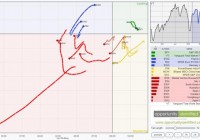
RRG charts help us focus on those areas of the investment universe that deserve it. This article looks at the relative strength of the world’s largest markets, using the total world ETF from Vanguard as our benchmark. If you are looking to invest in stocks, the U.S. is still the best place (at this time) to be. We live in the golden age of investing. Never before have individual investors had so much available to them for gaining investment knowledge, finding great investment opportunities, and the ability to take advantage of them at such a low cost. Our parents could only dream of having investment communities like Seeking Alpha, investment blogs like ours , almost limitless fundamental information online, and technical analysis tools only one click of a mouse (“what’s that?” says your grandpa) away. And with the advent of ETFs, common investors can invest in pretty much whatever and wherever they want. Want to buy timber? Go for it. There’s an ETF for that, the iShares S&P Global Timber & Forestry Index ETF ( WOOD). How about palladium? Got you covered with the ETFS Physical Palladium Shares ETF ( PALL). Want to invest in foreign markets like South Korea? Be my guest, the iShares MSCI South Korea Capped ETF ( EWY). Do you really like coffee? Try the iPath Dow Jones-UBS Coffee ETN ( JO). With sugar? Sure, the Path Dow Jones-UBS Sugar Total Return Sub-Index ETN (NYSEARCA: SGG )! Investors today have the investment world at their fingertips. In this week’s RRG™ analysis, we’re going to look at the relative strength of the world’s largest markets, using the Vanguard Total World Stock ETF (NYSEARCA: VT ) as our benchmark. Basically, we want to see where in the world we should be focusing our attention. Accordingly, the following ETFs representing most of the world’s largest stock markets will be compared against VT: SPDR S&P 500 Trust ETF ( SPY) Vanguard Total Stock Market ETF ( VTI) iShares MSCI Canada ETF ( EWC) iShares MSCI France ETF ( EWQ) iShares MSCI Germany ETF ( EWG) iShares MSCI Italy Capped ETF ( EWI) iShares MSCI Spain Capped ETF ( EWP) SPDR EURO STOXX 50 ETF ( FEZ) PowerShares India Portfolio ETF ( PIN) S PDR S&P China ETF ( GXC) iShares MSCI China ETF ( MCHI) iShares MSCI South Korea Capped ETF ( EWY) iShares MSCI Hong Kong ETF ( EWH) iShares MSCI Japan ETF ( EWJ) iShares MSCI Australia ETF ( EWA) Market Vectors Russia ETF ( RSX) Generally speaking, when looking at the ETFs above in the RRG™ below, those in the green leading quadrant are what you want to own; those within the yellow weakening quadrant should be on your watch-list (as they might be deteriorating), those within the red lagging quadrant should be avoided and those in the blue improving quadrant should be on your shopping list. In the RRG™ below, the long tails represent the movement of each country’s ETF over the past 10 weeks in comparison to the world ETF, VT. So what do we see? The first thing to notice is the chart of VT in the upper right corner. Global stocks as a whole are down since July. Accordingly, when we analyze this chart, we want to be cognizant of the fact that maybe stocks as a whole are not where we want to be. That being said, if we are looking for stock opportunities, we see that we should be in the U.S. (SPY and VTI have been leading the last 10 weeks) and looking for potential opportunities in Germany, France, and Europe as they have moved from lagging to improving over the past 10 weeks. And finally, we should also look to China as they are subtly rotating from weakness towards leading. In conclusion, if we have to be in stocks, we should be in the United States and looking for potential opportunities in Germany, France, Europe, and China. [1] Note: The terms “Relative Rotation Graph” and “RRG” are registered trademarks of RRG Research . (click to enlarge)
How To Find The Best Sector ETFs

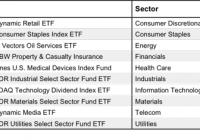
With so many ETFs to choose from, finding the best can be a daunting task. You cannot trust ETF labels, only due diligence on the holdings allows an investor to understand an ETF. Low costs and quality holdings, not past performance, is the best indicator of an ETF’s future success. Why ETF Labels are Confusing There are at least 44 different Financials ETFs and at least 188 ETFs across all sectors. Do you need that many choices? How different can the ETFs be? Those 44 Financials ETFs are very different. With anywhere from 22 to 541 holdings, many of these Financials ETFs have drastically different portfolios, creating drastically different investment implications. The same is true for the ETFs in any other sector, as each offers a very different mix of good and bad stocks. The Consumer Staples sector ranks first. Financials ranks last. How to Properly Assess a Sector ETF I firmly believe ETFs for a given sector should be similar. I think the large number of Financials (or any other) sector of ETFs hurts investors more than it helps because too many options can be paralyzing. It is simply not possible for the majority of investors to properly assess the quality of so many ETFs. Analyzing ETFs, done with the proper diligence, is far more difficult than analyzing stocks because it means analyzing all the stocks within each ETF. To be a smart investor, you understand analyzing the holdings of an ETF is critical to finding the best ETF. Figure 1 displays the best ETF in each sector. Figure 1: The Best ETF in Each Sector (click to enlarge) Sources: New Constructs, LLC and company filings How to Avoid “The Danger Within” Why do you need to know the holdings of ETFs before they buy? You need to know to be sure you do not buy a fund that might blow up. Buying a fund without analyzing its holdings is like buying a stock without analyzing its business and finances. No matter how cheap, if it holds bad stocks, the ETF’s performance will be bad. PERFORMANCE OF FUND’S HOLDINGS = PERFORMANCE OF FUND New Constructs covers over 3000 stocks and is known for the due diligence we do for each stock we cover. Accordingly, our coverage of ETFs leverages the diligence we do on each stock by rating ETFs based on the aggregated ratings of the stocks each ETF holds. The PowerShares KBW Property & Casualty Insurance Portfolio ETF (NYSEARCA: KBWP ) is the top-rated Financials ETF and the overall top ranked fund of the 188 sector ETFs that I cover. The worst ETF in Figure 1 is State Street’s Utilities Select Sector SPDR ETF (NYSEARCA: XLU ), which gets a Neutral (3-star) rating. One would think ETF providers could do better for this sector. Kyle Guske II contributed to this post. Disclosure: David Trainer Kyle Guske II receive no compensation to write about any specific stock, sector, or theme.

SEC Enhancing Regulatory Monitoring Of Asset Managers

by Ron D’Vari The asset management industry is evolving rapidly and so are the regulatory environment and tools that govern and support it. The larger managers had thought they had received a reprieve by the Financial Stability Oversight Council’s decision not to designate individual asset management firms as Systemically Important Financial Institutions (SIFIs), but instead focusing its attention on potential risks within asset managers’ activities and products they offer. As a result, the giant asset managers are spared from Federal Reserve. In an apparent response to that, the SEC is increasing focus on the asset management industry. In a speech on December 11, SEC Chair Mary Jo White referenced new initiatives to address portfolio composition risks and operational risks of asset managers. Portfolio composition risks include liquidity and leverage risks of a fund’s holdings and operational risks encompassing inadequate or failed internal processes and systems. The heightened SEC monitoring will include expanded data reporting and enhanced controls on risks related to portfolio composition and liquidity management. A more comprehensive approach will be taken to monitor the risks associated with the increasingly complex nature of fund holdings and the use of derivatives. Additionally, the SEC will be looking into “transition planning” and stress testing, both market and operationally. Asset managers will be expected to safeguard against the impact on investors of a market stress event or when an investment adviser is no longer able to serve its clients. There has been a significant increase in the use of derivatives by funds in general. More and more, fund managers are using derivatives to adjust or obtain exposure to a market sector more efficiently. However, the risks of implied leveraged exposures and potential illiquidity in derivative instruments can be opaque or underestimated. As a result, management of liquidity and redemption and the use of derivatives in widely distributed mutual funds, ETFs and separately managed accounts are becoming key areas of focus by the SEC. The SEC staff will be watching for significant risks of inadequate controls in those areas, to the funds and their investors, as well as potential impact on the overall financial system. Asset managers will be required to manage risks of not being able to meet redemptions under stressful market scenarios. This means that not only the giant managers have to meet enhanced composition and liquidity regulatory requirements; the entire asset management industry needs to. Now that you’ve read this, are you Bullish or Bearish on ? Bullish Bearish Sentiment on ( ) Thanks for sharing your thoughts. Why are you ? Submit & View Results Skip to results » Share this article with a colleague