Tag Archives: nreum

Gross Shocks Conventional Wisdom

Bill Gross told investors this week to Beware the Ides of March, or the Ides of any month in 2015 for that matter. When the year is done, there will be minus signs in front of returns for many asset classes. The good times are over. Gross is the legendary bond fund manager who left the company he founded, PIMCO, for a job as a portfolio manager at Janus Global Unconstrained Bond Fund, so most people pay attention when he writes. The prediction came inside the January Investment Outlook for investors. But for the mainstream financial media, he might as well have expelled foul smelling gas at a crowded party. The media quickly pointed out how contrarian his forecast is. For example, the Bloomberg reporter wrote: Gross is putting himself way out on a limb: Not one of Wall Street’s professional forecasters predict the S&P 500 will drop in 2015. Their average estimate calls for an 8.1 percent rise. And while the global economy looks weak, the U.S. has been heating up, with GDP up 5 percent in the third quarter. Of course, he forgets that mainstream financial experts and economics have failed to see every recession for the past century, especially the latest. They have failed because their business cycle theory asserts that recessions and the stock market collapses that precede them are random events. In other words, @#$% happens! So while insisting that business cycles are random events and by definition unpredictable, they continue to insist they can predict them! Gross makes one mistake that shows the bad influence behavioral finance has inflicted on him. He wrote, Manias can outlast any forecaster because they are driven not only by rational inputs, but by irrational human expressions of fear and greed. Stock and bond market “bubbles” are not manias; humans are not irrational with their money and the current market levels don’t illustrate greed or fear. As my forecasts show, the stock market reflects historically high profits plus greater tolerance for risk by investors. And the bond market is responding rationally to the Fed’s loose monetary policy. Fortunately, Gross doesn’t follow mainstream economics. His rationale comes from the “debt super cycle.” Gross attributes the theory to the research and investment advisory firm Bank Credit Analyst, but the cycle has been a major theme of the Bank for International Settlements for years. You can find a good intro in Claudio Borio’s The financial cycle and macro economics: What have we learnt? In short, the theory says that debt increases when central banks pump money into the economy through artificially low interest rates and open market operations, that is, buying bonds, also known as quantitative easing. Much of the debt increases the value of capital that has been used as collateral on loans and makes further borrowing on the same collateral possible. Credit continues to expand, asset prices rise and GDP increases as part of the expansion phase until debt service burdens become too great for businesses or households to bear, causing them to cut back on spending. As a result, asset prices fall and banks demand more collateral for outstanding loans. Some companies default and the financial system spirals downward, taking the economy with it. The latest debt super cycle extended almost 20 years peak-to-peak, from about 1989 to 2007. Business cycles last up to 8 years, but when a recession coincides with a peak in the debt cycle, it’s much more severe. There is a lot of truth in the debt super cycle theory. But it doesn’t explain why debt service becomes unbearable. After all, if asset prices are increasing and the economy is growing, debt service should become easier. The debt theory needs the Austrian business-cycle theory to make it whole. Debt service becomes a burden when sales fall in the capital goods sector because sales are soaring in the consumer goods sector. This is Hayek’s Ricardo Effect kicking in. However, the debt theory helps flesh out some of the financial aspects of the ABCT. So what does Gross advise investors to do? He recommends buying Treasuries and high quality corporate bonds. He cautions that rising interest rates could hurt such investments, but if the debt cycle theory is correct, that won’t happen in 2015. Only contrarians like Gross make money when the market morphs from a bull to a bear.
Top Investments For 2015, A Followup – Bank Of America And Citigroup

This is a follow up on my last post Top Investments for 2015 . I was asked the following question in the comment section. This answer is a little more than a comment so I decided to post it here. Anonymous January 10, 2015 at 7:15 AM Hi Kevin, Could you please share with us your thoughts on the current tangible book value of C and BAC and why you still see a discount on their current price? Hi Anonymous. Thanks for your question. The price to tangible book value for C and BAC can be calculated to be 0.9 and 1.2, respectively. Whether or not that is cheap enough for you is something you will need to decide. Let me offer some additional thoughts on BAC first and then on C. BAC has paid out around $100 billion in legal expenses over the past 5 years. Their tangible book value has risen slightly over that same time. Given the fact the company has close to $150 billion in tangible book value, legal expenses of this magnitude are not insignificant. The next fact I would point out is that in Q3 2014, the company earned $5.0 billion in profits excluding the consumer real estate services (CRES) division. Annualized, this works out to just about $20 billion per year or $1.88/share. Let me be clear. Bank of America earns this amount of profit already today. They are earning this amount in a sub-optimal economy, a low interest rate environment, and with many regulatory headwinds. All you have to do is wait for the dust to settle and the earnings power of the company will come shining through. Now this $20 billion in profits works out to be approximately 0.9% return on assets (ROA). On a comparable basis, Wells Fargo (NYSE: WFC ) is earning 1.3% on their assets. I believe that with strong management BAC can earn above 1% on their assets, just like WFC does. The reason for this is that BAC, just like WFC, has a large, low cost deposit base supporting their assets. Including non-interest bearing liabilities, both companies have access to over a trillion dollars in deposits at a cost of 0.1% (10 basis points). Coming back to the returns on tangible common equity, we have established that BAC has a number of businesses that together are already earning 13.4% on tangible common equity (TCE). This is interesting because WFC is earning 13.8% on TCE, and JPM is earning 13.5% on TCE and C is earning 6.5% on TCE. If BAC was valued on the same P/TBV multiple as WFC or JPM, the stock would sell for between $19-25/share. So nothing has to happen and the value of BAC’s stock will rise somewhere between 15% and 50% as the underlying earnings emerge. Any help from a rise in interest rates and it will have real liftoff potential. Oh and perhaps the CRES division will turn a profit and the company will be able to utilize their deferred tax assets (> $30 billion). If the company earns $80 billion over the next 4 year, it isn’t hard to make the case that the common shares will sell for between $35-40/share. Of course a large portion of these returns will likely be dividends and share repurchases but the net result is the same, the common shareholders will realize over 20% annually over that time period. Turning to Citigroup, they are selling at a much lower price to TBV. As noted above that is warranted because of they are earning only 6.5% on TCE. Their ROA is only 0.6%, lower than BAC (ex CRES) and JPM at 0.9% and WFC at 1.3%. Don’t let this fool you; they have higher earnings potential just like BAC. As the real earnings power of the company emerges, they will earn around 1% on assets. If you apply a 1% ROA to C, the net result is an EPS of $6.21/share. First Call analyst estimates are for $5.41/share in 2015 and $6.52 in 2016, so we are right in the ballpark. Citi also has over $50 billion in deferred tax assets. In today’s markets there are few companies that can be purchased at less than 10x normal earnings and C is one of them. In the future the shares will sell more in line with BAC and JPM at 1.3 P/TBV, or around $75/share. So the upside is easily 50% and all shareholders have to do is be patient and watch the earnings rise. Hope this helps. Disclosure: I own BAC common, BAC Class A Warrants, JPM and WFC.

Where To Look For Cheap Stocks In 2015: CAPE Around The World

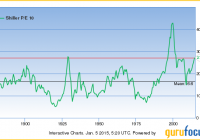
2014 was a lousy year for global value investors. Cheap markets, as measured by the cyclically-adjusted price/earnings ratio (“CAPE”) got even cheaper, while expensive markets got even pricier. (Note: the CAPE takes a ten-year average of earnings as a way of smoothing out the economic cycle and allowing for better comparisons over time.) I expect this to reverse in 2015. At some point – and I’m betting it could be as early as the first quarter – global market valuations should start to revert to their long term averages. That’s fantastic news if you’re invested in cheap foreign markets. It’s not such fantastic news if your portfolio is exclusively invested in high-CAPE American stocks. Let’s take a look at just how skewed the numbers are. The S&P 500 managed to produce total returns of 13.7% in 2014. But as quant guru Meb Faber pointed out in a recent blog post , globally, the median stock market posted a loss of 1.33%. The cheapest 25% of countries saw declines of 12.88%, while the most expensive markets actually gained 1.36%. I should throw out a couple caveats here. These were the returns of U.S.-traded single-country ETFs, which are priced in dollars, and not the national benchmarks. The strength of the U.S. dollar relative to virtually every other world currency last year was a major contributor to the underperformance of the rest of the world. All the same, it’s worth noting that we’re in uncharted territory here. As Faber noted in a recent tweet , U.S. stock valuations relative to foreign stock valuations closed 2014 at the highest spread over the past 30 years. Four out of the five biggest relative valuation gaps resulted in outperformance by foreign stocks the following year. The only exception was 2014. Let’s dig into the numbers. The CAPE for the S&P 500 is now 27.2. That’s a full 63.9% higher than the historical average of 16.6 , more expensive than at the 2007 peak, and close to the 1929 peak. The only time in U.S. history where the S&P 500 was significantly more expensive based on CAPE was during the peak of the 1990s tech bubble. Sure, the “fair” CAPE is going to be a little higher today than in decades past due to record low bond yields (all else equal, lower yields mean higher “correct” valuations). But I should point out that yields are even lower in most of Europe and Japan, yet valuations are significantly cheaper. So while low bond yields might partially explain why U.S. stocks are expensive relative to their own history, it doesn’t explain why the U.S. is expensive relative to the rest of the world. No matter how you slice it, U.S. stocks aren’t the bargain they were a few years ago. Research Affiliates calcuates that U.S. stocks are priced to deliver returns of about 0.7% over the next 10 years. Using a similar methodology, GuruFocus calculates an expected return of about 0.3% . I’ve driven home how expensive U.S. stocks are. Now, let’s take a look at other global markets. Here are the world’s markets as measured by the CAPE and sister valuation metrics cyclically-adjusted price/dividend (“CAPD”) cyclically-adjusted price/cash flow (“CAPCF”) and cyclically-adjusted price/book (“CAPB”). All figures reported in Meb Faber’s Idea Farm using original data from Ned Davis Research. Country CAPE CAPD CAPCF CAPB Average Rank Greece 2.8 6.5 1.5 0.4 1 Austria 7.3 21.6 3.0 0.7 3.75 Portugal 7.7 12.9 3.2 1.0 4.25 Hungary 5.9 23.0 3.0 0.9 4.75 Italy 9.6 16.6 3.7 0.9 5.25 Russia 5.2 29.8 3.5 0.8 7 Czech Republic 10.3 15.3 5.3 1.6 7.75 Poland 10.8 22.9 5.0 1.5 8.75 Brazil 10.0 23.2 6.4 1.5 9.25 Spain 11.6 19.4 5.7 1.6 10.25 Ireland 11.0 24.7 7.7 1.3 11 France 13.8 29.3 7.6 1.5 15 Norway 12.1 29.2 6.6 1.9 15 New Zealand 14.6 18.2 7.5 1.9 15.25 U.K. 12.1 26.9 8.1 1.9 17.25 Egypt 13.2 27.7 7.9 2.1 18.25 Turkey 11.3 39.5 8.0 1.9 19 Korea 12.4 73.3 7.3 1.5 19.25 Finland 14.5 24.3 8.6 2.1 19.75 Singapore 13.8 32.6 10.3 1.7 20 Belgium 14.6 30.3 9.4 1.8 20.25 Germany 15.8 37.8 7.8 1.8 21 Australia 15.7 22.8 11.3 2.1 23 Netherlands 15.5 35.9 10.1 2.1 24.75 Israel 14.8 38.8 11 1.9 25.5 China 14.3 43.3 9.2 2.2 25.75 Chile 17.4 40.9 10.2 1.9 26.25 Hong Kong 18.2 40.1 13.8 1.7 27.5 Peru 14.3 33 12.2 3.5 28.25 Japan 23.4 69 8.8 1.6 28.5 Taiwan 19.7 30.8 9.7 0 30.25 Thailand 17.8 41.6 11.5 2.9 31 Canada 19.2 45 10.5 2.4 31.5 Sweden 19.1 39.8 13.6 2.8 31.75 Malaysia 19 42.7 12.8 2.5 32 Colombia 23.1 43.7 18.8 2.2 36.25 South Africa 20.9 45.3 14.8 3.4 36.5 Switzerland 22.4 47.9 17.4 3.2 37.25 Mexico 22.6 73.6 12.4 3.6 38 Indonesia 20.9 52.6 14.3 5.0 38 U.S. 23.6 69.0 14.7 3.4 38.75 Philippines 26.1 65.9 16.1 3.9 40 Denmark 30 99.4 18.6 3.9 42.25 (Note: The U.S. figures use the MSCI U.S. index rather than the S&P 500, hence the difference in CAPE value.) We see some familar names on the list. Greece remains the world’s cheapest market by a wide margin. Of course, Greece is also in the middle of an election cycle that may well result in the country getting booted out of the eurozone. Interestingly, Russia is cheap following Western sanctions and the collapse in the price of oil, yet there are several far more stable countries that are cheaper, such as Austria, Portugal, Hungary and Italy. Two countries that I’ve liked for years based on valuation – Brazil and Spain – round out the top ten. To put things in perspective, the most expensive market on this list–Spain–trades at nearly a 60% discount to the U.S. market based on CAPE. Yes, Spain has its problems. Its economy is stuck in a slow-growth rut, and unemployment remains over 20%. But Spain is also home to some of the world’s finest multinationals, such as banks BBVA (NYSE: BBVA ) and Banco Santander (NYSE: SAN ), telecom giant Telefonica (NYSE: TEF ) and fashion retailer Inditex ( OTCPK:IDEXY ). There are different ways to use this data. You could buy and hold country ETFs, such as the Global X FTSE Greece 20 ETF (NYSEARCA: GREK ), the Market Vectors Russia ETF (NYSEARCA: RSX ) or the iShares MSCI Spain ETF (NYSEARCA: EWP ). Or you could go with a convenient one-stop shop like Faber’s Cambria Global Value ETF (NYSEARCA: GVAL ). GVAL is nice collection of cheap stocks from around the world. As of last quarter, GVAL’s largest country weightings were to Brazil, Spain and Israel. Disclosures: Long GVAL, EWP, BBVA, SAN, TEF This article first appeared on Sizemore Insights as Where to Look for Cheap Stocks in 2015: CAPE Around the World Disclaimer : This site is for informational purposes only and should not be considered specific investment advice or as a solicitation to buy or sell any securities. Sizemore Capital personnel and clients will often have an interest in the securities mentioned. There is risk in any investment in traded securities, and all Sizemore Capital investment strategies have the possibility of loss. Past performance is no guarantee of future results.