Tag Archives: nreum

Materials ETF: XLB No. 8 Select Sector SPDR In 2014
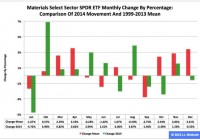
Summary The Materials exchange-traded fund finished eighth by return among the nine Select Sector SPDRs in 2014. The ETF was a winner in the first and second quarters, flattish in the third and a loser in the fourth. Seasonality analysis indicates its downward trajectory could continue in the first quarter. The Materials Select Sector SPDR ETF (NYSEARCA: XLB ) in 2014 ranked No. 8 by return among the Select Sector SPDRs that section the S&P 500 into nine subdivisions. On an adjusted closing daily share-price basis, XLB progressed to $48.58 from $45.33, a yield of $3.25, or 7.17 percent. Accordingly, it lagged its sibling, the Utilities Select Sector SPDR ETF (NYSEARCA: XLU ) and parent proxy, the SPDR S&P 500 Trust ETF (NYSEARCA: SPY ) by -21.57 and -6.29 percentage points, in that order. (XLB closed at $47.19 Wednesday.) XLB also ranked No. 8 among the sector SPDRs in the fourth quarter, when it behaved worse than XLU and SPY by -14.60 and -6.32 percentage points, respectively. And XLB ranked No. 6 among the sector SPDRs in December, when it performed worse than XLU and SPY by -4.13 and -0.30 percentage points, in that order. Figure 1: XLB Monthly Change, 2014 Vs. 1999-2013 Mean (click to enlarge) Source: This J.J.’s Risky Business chart is based on analyses of adjusted closing monthly share prices at Yahoo Finance . XLB behaved worse in 2014 as it did during its initial 15 full years of existence based on the monthly means calculated by employing data associated with that historical time frame (Figure 1). The same data set shows the average year’s weakest quarter was the third, with an absolutely large negative return, and its strongest quarter was the fourth, with an absolutely larger positive return. Inconsistent with this pattern last year, the ETF actually had a loss in Q4. Figure 2: XLB Monthly Change, 2014 Versus 1999-2013 Median (click to enlarge) Source: This J.J.’s Risky Business chart is based on analyses of adjusted closing monthly share prices at Yahoo Finance. XLB performed a little worse in 2014 than it did during its initial 15 full years of existence based on the monthly medians calculated by using data associated with that historical time frame (Figure 2). The same data set shows the average year’s weakest quarter was the third, with an absolutely large negative return, and its strongest quarter was the fourth, with an absolutely larger positive return. It also shows there is no historical statistical tendency for the ETF to explode in Q1. Figure 3: XLB’s Top 10 Holdings and P/E-G Ratios, Jan. 14 (click to enlarge) Note: The XLB holding-weight-by-percentage scale is on the left (green), and the company price/earnings-to-growth ratio scale is on the right (red). Source: This J.J.’s Risky Business chart is based on data at the XLB microsite and Yahoo Finance (both current as of Jan. 14). LyondellBasell Industries NV (NYSE: LYB ) aside, XLB’s top 10 holdings appear to range between fairly valued and overvalued (Figure 3). And these kinds of valuations seem unlikely to function as tailwinds for the ETF this quarter, even though the numbers on the S&P 500 materials sector reported by S&P Senior Index Analyst Howard Silverblatt Dec. 31 indicated the sector’s valuation is not superstretched, with its P/E-G ratio at 1.26. However, I suspect XLB will continue to be a laggard among the Select Sector SPDRs in Q1, mostly because of the bias divergence in monetary policy at major central banks around the world. On the one hand, the U.S. Federal Reserve is oriented toward tightening; on the other hand, the Bank of Japan, European Central Bank and People’s Bank of China are oriented toward loosening. This bias divergence has had important effects on currency-exchange rates, such as the one centered on the euro and U.S. dollar pair: The EUR/USD cross dipped from as high as $1.3992 May 8 to as low as $1.1753 Jan. 8, a drop of -$0.2239, or -16.00 percent. This change in EUR/USD and similar moves in other currency pairs could pressure earnings of U.S. companies in sectors with substantial international businesses. It is noteworthy the Fed announced the conclusion of asset purchases under its latest quantitative-easing program Oct. 29 and may announce the beginning of interest-rate hikes April 29. Its ending of purchases under its first two formal QE programs this century is associated with a correction and a bear market in large-capitalization equities, as evidenced by SPY’s falling -17.19 percent and -21.69 percent in 2010 and 2011, respectively. If one were to argue that this time is different, then I would have to wonder: Why? Disclaimer: The opinions expressed herein by the author do not constitute an investment recommendation, and they are unsuitable for employment in the making of investment decisions. The opinions expressed herein address only certain aspects of potential investment in any securities and cannot substitute for comprehensive investment analysis. The opinions expressed herein are based on an incomplete set of information, illustrative in nature, and limited in scope. In addition, the opinions expressed herein reflect the author’s best judgment as of the date of publication, and they are subject to change without notice.
Get Out Of Swiss Stocks Now: Barclays

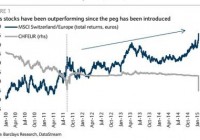
By Michael Ide Swiss stocks took a beating yesterday (and are falling again today) after the Swiss National Bank ’s decision to end the 1.20 cap on the EUR/CHF exchange rate. But if you are a non-CHF investor the exchange rate shift more than made up for falling stock prices, pushing the Swiss Index up in USD even as it fell in CHF. Barclays PLC analysts Dennis Jose and Ian Scott think this is the perfect opportunity for those non-CHF investors to get out (although many would have argued that before the big drop would have been a better time). “The sudden appreciation of the Swiss franc has provided a windfall to non-Swiss denominated investors despite the decline in the stock market in domestic currency terms,” they write. “We advocate switching out of Swiss stocks into Euro Area stocks now… if as per our FX view, the CHF weakens hereon, the benefit to non-CHF returns should no longer be there.” Non-CHF investors should take advantage of temporary exchange rate effects: Barclays The obvious reason to take yesterday’s gains and get out of the Swiss market is that Swiss companies are expected to face earnings pressure now that their currency has gotten stronger. The SNB has said that the strength of the Swiss franc is still a concern, part of the reason Jose and Scott expect it to depreciate by other means, but it probably won’t return to the 1.20 EUR/CHF exchange rate naturally any time soon. Non-Swiss investors who stay invested risk watching the beneficial exchange rate effects wear off while stock prices continue to struggle and dividends probably get reduced. (click to enlarge) European QE could undermine the Swiss stock market The other reason to worry about Swiss stocks is the effect that European QE would have on Switzerland. Swiss stock market gains have been inversely correlated with German Bund yields for more than a decade. If that relationship continues, then when ECB QE pushes yields higher it would also pull Swiss stock prices down. We won’t know officially whether the ECB is going to start buying sovereign bonds until January 22, but all signs point to yes – the SNB decision being the most recent signal. Investors who wait until the end of the month to make their decision by may not be able to exit quite as easily. Jose and Scott removed Credit Suisse Group AG (ADR) (NYSE: CS ) and Adecco ( OTCPK:AHEXY ) from their recommended European portfolio and replaced them with Airbus ( OTCPK:EADSY ) and Publicis ( OTCQX:PUBGY ). (click to enlarge) Disclosure: None Editor’s Note: This article discusses one or more securities that do not trade on a major exchange. Please be aware of the risks associated with these stocks. Now that you’ve read this, are you Bullish or Bearish on ? Bullish Bearish Sentiment on ( ) Thanks for sharing your thoughts. Why are you ? Submit & View Results Skip to results » Share this article with a colleague

3 Investments Jeffrey Gundlach Loves In 2015

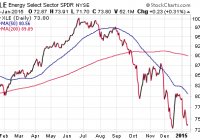
Summary This article summarizes Jeffrey Gundlach’s “2015 Market Outlook” webcast. He spoke favorably about the underlying fundamentals in the strong U.S. dollar despite its rapid ascent last year and how currency trends can be “persistent and long lived”. Gundlach also spoke favorably about gold as a flight to quality instrument. Yesterday I listened to Jeffrey Gundlach’s “2015 Market Outlook” webcast along with much of the financial community. Gundlach has certainly peaked in his notoriety as one of the most prestigious bond fund managers and continues to draw fascination for his timely insights into global economic machinations as well. For full disclosure: I have owned the DoubleLine Total Return Fund (MUTF: DBLTX ) for myself and my clients for many years now as well as various other Doubleline funds along the way. I have found Gundlach’s team focus on security selection, duration exposure, risk management, and overall total return to be a far more attractive value proposition than owning a passive index such as the iShares U.S. Total Bond Market ETF (NYSEARCA: AGG ). One of the themes that Gundlach noted throughout his call is that the U.S. consumer is focused on the positive impact of the oil space, while Wall Street has yet to fully embrace the impending negative aspects. He noted that currently 35% of the S&P 500 capital expenditures are represented in energy companies, of which there is a probability this spending could completely evaporate later this year. That could ultimately lead to employment cuts, potential bankruptcies for leveraged energy companies, and deeper impact across the high yield bond spectrum. The Energy Select Sector SPDR (NYSEARCA: XLE ) has certainly been pricing in some of those eventualities as it continues to decline with crude oil prices. Despite some modest rallies, XLE now stands at more than 25% off its 2014 high and recent probed down to new lows as angst sets in. The one thing I have noted recently is how much buying has been on throughout the energy complex since the decline began. At this juncture you would typically expect widespread distribution rather than accumulation in energy ETFs. He also spoke favorably about the underlying fundamentals in the strong U.S. dollar despite its rapid ascent last year and how currency trends can be “persistent and long lived”. However, he candidly stated that “I know it’s a crowded trade. I’m as uncomfortable as everybody else.” The PowerShares U.S. Dollar Bullish Fund (NYSEARCA: UUP ) has been a big mover as declines in the euro and Japanese yen continue to fuel a flight to the dollar. The overarching themes of lackluster growth and quantitative easing efforts in these foreign developed countries make the U.S. dollar, and concomitantly U.S. treasuries, an attractive trade for overseas dollars. Gundlach also spoke favorably about gold as a flight to quality instrument. He thinks that gold will move higher as the stress to the financial system from the repercussions of oil deflation takes hold. We have already seen an uptick in the SPDR Gold Shares ETF (NYSEARCA: GLD ) since the beginning of 2015 as it comes off multiple years of heavy declines. This sector certainly bears watching as volatility in both stocks and commodities may favor investors seeking out hard assets with non-correlated returns as a hedge against other investments. On interest rates, Gundlach noted how far off economists were in predicting the outcome of the 10-Year Treasury note yield at the end of 2014. He believes that the trend in higher bond prices (lower bond yields) will continue in the first half of this year and will probably overshoot most investors’ expectations. The strong price trend in the iShares 7-10 Year Treasury Bond ETF (NYSEARCA: IEF ) has continued to stretch further than many believed possible, and has gone almost vertical since the beginning of 2015. On a relative basis the U.S. 10-Year Yield near 1.80% is still far more attractive than other developed nations in Europe and Japan. There is obviously no concern right now for a rate hike scenario being priced into the market. Instead, investors are focusing on sheltering their portfolio from low global yields and a volatile stock environment. Other bullets of caution worth mentioning: Gundlach did not speak favorably about bitcoin and noted it was virtually the worst performing asset class of 2014. (See what I did there with “virtually”?) The stock market has been positive for the last 6 years straight (2009-2014). Stocks never been up 7 years in a row since 1871. He still feel that Treasury inflation protected securities ( OTC:TIPS ) are for losers because near-term inflation expectations are actually pointing towards negative trends. He did note that they are cheap on a relative basis, but the overriding argument to own them is flawed in this market. Avoid the iShares TIPS Bond ETF (NYSEARCA: TIP ) for the time being. He is “afraid of mall REITs” due to more retail sales moving online and shrinking need for conventional shopping centers. He noted that “It’s a little late to buy the Shanghai (China)” after last year’s run and that you probably don’t want to own European stocks or bonds right now. Also beware of leveraged ETFs with respect to compounding and tracking error over time. He noted the big decline in the DirexionShares Daily Gold Miners Bear 3x Shares (NYSEARCA: DUST ) for 2014, despite the fact that the Market Vectors Gold Miners ETF (NYSEARCA: GDX ) was down heavily last year as well. The Bottom Line No one man knows the fate of the markets and most will probably take these comments with a grain of salt. However, those that take a wider macro view in their investment analysis may be intrigued by some of the correlations that were noted in this presentation. Many of the observations Gundlach made in his monologue mirror our own thoughts on the market at this juncture. Our most recent January 2015 client memo outlined several salient points on interest rates, volatility, and areas of perceived value as well.