Tag Archives: nreum

Bonds To Bring Stability To Our 1% Portfolio
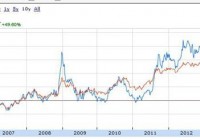
We are taking a bond position (low cost ETF) but not fully using our $180,000 allocated capital as bonds are too overbought right now. Hedging TIPS against US Treasury bonds is an option if you don’t want any to the corporate bond or short term bond sector. We now have $350k invested in our portfolio. Agricultural commodities are next on our radar. We have purposefully not invested in bonds thus far in our portfolio as I have been conducting extensive research into this area. To many, bonds are a boring vehicle as the returns are usually less than other asset classes. However they are vital in any portfolio as they bring stability and expectation as they are far less volatility than stocks. I am a firm believer that if you are approaching retirement, bonds should be a fundamental part of your portfolio and should outweigh your stock holdings. We have $180k to deploy in this asset class in our portfolio but we are not going to deploy all our available capital here just yet. Let’s go through this article and discuss why we are going to invest less and what bond vehicle(s) we are going to use in our portfolio. In a previous article, I spoke about portfolio re-balancing and position sizing in respective asset classes. I outlined that when an asset class becomes “Top Heavy” for us, we usually take some capital off the table and deploy that capital elsewhere in depressed sectors. Bonds have been on a glorious run for the past while with some analysts calling for a top anytime soon. Look at the charts below (10 year and 1 year) for (NYSEARCA: TLT ) and (NYSEARCA: IEF ) which are 20 and 10 year bond ETFs respectively. (click to enlarge) (click to enlarge) The 20 year bond has really outperformed recently with 28% gains in the last year alone which is extremely high for bonds. We do not want to deploy all our capital into this asset class just yet as I’m wary of the downside here. Nevertheless, the US bond bull may have many months and years to go as US dollar denominated funds are still seen as a safe haven by investors all over the world. We are not going to bet against the US government so $100,000 is going to be invested here instead of the allocated $180,000. So which bonds are we going to invest in? Let’s discuss. I looked first at “Treasury bills or T-bills”. These are short term instruments that don’t go beyond 12 months so they are essentially short term bonds. Next we have “Treasury notes” which mature from anything from one to ten years. These are good for income investors as the interest rate is fixed and you get interest payments every six months. Then you have our good old fashioned Treasury bonds, which are mid to long term (10 to 30 years). Finally we have TIPS, which are inflation adjusted. These bonds go up in value if inflation increases or down in value if deflation takes hold. TIPS are used by many professional investors as a hedge against long term treasuries. Long term treasuries usually fall in value (opposite to TIPS) when interest rates rise. This was an option I definitely looked at for our portfolio. However there are also corporate bonds where corporations pay you income in exchange for a fixed interest rate on your bond over a period of time. Blue chip US multinationals corporate bonds yield slightly higher returns than US Treasuries but since these bonds are related to equities, they also are more volatile. Another thing I am conscious of in our 1% portfolio is fees and commissions. Even though we are excellently diversified, we spend our fair share on broker commissions through the buying and selling of our underlyings. We currently have 40 positions in our portfolio and even though we have a very cheap broker, I hate giving money away. Also since bonds are far less volatile instruments than stocks, we will not be selling covered calls in this sector. The reward doesn’t justify the risk. Therefore I have decided to go with the Vanguard Total Bond Market ETF (NYSEARCA: BND ) and not go with multiple positions in this asset class. This asset class is to be our portfolio anchor. This ETF has returned 6% in capital gains over the last 5 years (see chart) and currently has a healthy 2% yield. What attracted me was the diversity (3000 US related bonds) and the expense ratio which is a very low 0.08%. (click to enlarge) So to sum up, we are investing $100k today into and holding for the medium to long term. If bonds start to lose value, then we have an extra $80k ready to deploy into this asset class if needs be. We now as of 20-01-2015 have in the region of $350k invested. (click to enlarge) Now that you’ve read this, are you Bullish or Bearish on ? Bullish Bearish Sentiment on ( ) Thanks for sharing your thoughts. Why are you ? Submit & View Results Skip to results » Share this article with a colleague
A Hedged ETF Strategy For Rising Interest Rates

The 10-year Treasury Yield at 1.8% is 1.2% below where it started 2014. Forecasts that rates would rise in 2014 were very, very wrong. With the 10-year yield now at a record low level, the probability of rising rates from here are better. Outlined below is a hedged strategy using short and long bond ETFs to profit from rising long term interest rates. In one of my accounts I hold about 20% in cash that I did not want to put into the equities market. My plan is to hold that money as available investment capital for the next time the equities market experiences a strong correction. In the current 0% interest on cash environment, I started to think about ways to put that money to work in a relatively low-risk way. I am also concerning about the effects of rising interest rates on the overall value of my income focused equity holdings. With the current level of interest rates paid on bonds, you need to take on quite a bit of duration to earn any meaningful rate of yield and I am unwilling to go 100% into a bond ETF with the prospects of higher interest rates somewhere in the not to distant future. In contrast, an inverse Treasury bond ETF will gain value when interest rates rise, but does not pay any income and will lose value if rates continue to decline. My research led me to try set up a combination investment of a bond ETF and an inverse Treasury bond ETF. The plan is to sell off the inverse ETF in stages as interest rates rise, reinvest the proceeds into the bond fund to generate a growing income stream from the bond ETF. The goal is to end up a few years down the road with the initial investment amount intact and all of the money in the bond ETF earning a higher yield than what is currently available in the market. Half of the cash in the account has been employed into this strategy. To put the strategy in play I initially selected the Schwab U.S. Aggregate Bond ETF (NYSEARCA: SCHZ ) and the ProShares Short 7-10 Year Treasury (NYSEARCA: TBX ) . SCHZ currently yields 2.03% with an average yield-to-maturity of 2.56%. Expenses are 0.06%. TBX is intended to provide a one-times inverse return of the Barclays U.S. 7-10 Year Treasury Bond Index and has expenses of 0.95%. Over the last year, the yield on the 10-year Treasury has declined by about 100 basis points (1.00%). For that period, the SCHZ share price appreciated by 4.50% and the TBX share price declined by 11.35%. With dividends reinvested for SCHZ you have roughly a 2 to 1 inverse return differential between TBX and SCHZ. Since I expect interest rates to increase over the next few years, my initial plan was to split the invested capital 40/60 between SCHZ and TBX. I started to leg into the two ETFs at the beginning of this year. At that time the 10-year Treasury carried a 2.12% yield, down 0.88% from where it started 2014. As the first two weeks of 2015 unfolded, the Treasury yield marched steadily lower. As the price of TBX dropped, I made two buy trades to establish an initial position. A point of interest, TBX is thinly traded and day only limit orders at or near the low end of the bid/ask spread typically get filled. When the 10-year yield dropped below 1.9%, I got more aggressive and I made two purchases of the ProShares UltraShort 20+ Year Treasury ETF (NYSEARCA: TBT ) , spread a week apart. TBT is a longer duration bond, leveraged ETF, so will change value at about 4 times the rate of TBX. With the 10-year yield setting record lows, I decided that there is an opportunity to make a relatively quick profit on an interest rate bounce off the 1.77% T-note yield bottom set on Thursday, January 15. Now with the full planned amount invested in the three ETFs, I am much more aggressively skewed towards rising interest rates than I initially planned. Here are the percentages invested in each ETF: SCHZ: 35% TBX: 48% TBT: 17% Currently, the total value of the three funds down 1.3% from the amounts invested. From this point, the plan is to profit from rising interest rates. As the share price of TBT rises, it will be sold off first with the proceeds invested into SCHZ. Even a modest rate climb back about 2% for the 10-year will turn this into a profitable trade. The SCHZ and TBX positions will be managed based on an expected slow 2-3 year rise in interest rates. Now that you’ve read this, are you Bullish or Bearish on ? Bullish Bearish Sentiment on ( ) Thanks for sharing your thoughts. Why are you ? Submit & View Results Skip to results » Share this article with a colleague

The Permanent Portfolio Fund Looks Weak Long-Term

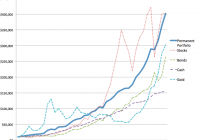
Summary Harry Browne’s simple concept of the permanent portfolio is still valid and is a low volatility method of passive investing. PRPFX does not closely follow the original concept of the PP and the current allocation is closer to stock picking than passive investing. PRPFX has become too volatile to be considered as a safe, long-term investment. Constructing your own PP with ETFs is cheaper than the mutual fund fees and allows you to stick with the original concept. While the concept is still valid today, it needs to be modernized in terms of internationalizing the asset classes and not putting all of the PP into one country. The Permanent Portfolio Concept In the early 80s, the idea of the permanent portfolio was created by Harry Browne and Terry Coxon and was laid out in a series of books written by the two. The whole concept is based upon the idea that nobody knows exactly what will happen in the future, and your investments should reflect this fact. The permanent portfolio calls for splitting the assets equally into 4 parts: 25% stocks, 25% bonds, 25% cash, and 25% gold. The portfolio would be rebalanced once a year, or if any one asset rises too much during the year. The purpose of this allocation is to have at least one portion of your portfolio doing well, regardless of the economic environment at the time. Harry Browne referred to 4 different general economic scenarios that the portfolio would address: inflation, deflation, prosperity, and depression/recession. The world around us is not quite that simple however, and today we see a hodgepodge of these 4 scenarios. There is deflation in things like oil, gold, silver, and smartphone technology, at the same time as inflation in medical care, college tuition, and certain food items. You cannot label today’s economy with only one term such as inflationary or deflationary. As Jim Rickards says , inflation and deflation are now locked into a very equally matched game of tug-of-war, since high amounts of force and tension on both sides will result in the rope being tugged nowhere despite all of the forces at play. Because of this, the permanent portfolio concept is even more relevant today than in the past. The 25% allocation to gold is enough to give most financial advisors the shivers, but when you look at the results of the PP compared to each of its components individually, it makes a lot more sense. (click to enlarge) Basically you end up with conservative gains and a lot less volatility overall. I would compare the PP strategy to riding a bicycle with training wheels on a flat path while wearing a helmet, elbow pads, and knee pads. You could certainly still crash, but you won’t be as scraped and banged-up as if you had gone all in with the stock market, for example, and it won’t be too terribly difficult to pick yourself up and be headed back down the path. So with this in mind, let’s look at the mutual fund that was based on Browne’s concepts and the flaws that it currently has. Permanent Portfolio Fund – PRPFX This is the flagship fund from the Permanent Portfolio Family of Funds. The fund was founded in 1982 by Terry Coxon and John Chandler. The allocation is quite a bit different than the original PP concept. It is only loosely based around the 25% x 4 allocation, as it has 6 asset classes made up of 36% US dollar assets, 20% gold, 15% aggressive growth stocks, 15% real estate and natural resource stocks, and 10% Swiss franc assets and 5% silver. The biggest problem with this allocation is the great over-emphasis on commodities. The purpose of having 1/4 gold in the PP concept is to act as something that will go up in periods of severe inflation and/or economic turmoil. Adding natural resource stocks and physical silver just adds more volatility that isn’t even necessary. Extra volatility is exactly what you don’t want for a long-term, wealth compounding fund. Take a look at the level of volatility since 2011. (click to enlarge) Does this look like a steady, conservative fund that you can dollar-cost average into every month and compound your wealth with? No investor should accept this level of volatility on something that is supposed to be safe and conservative. But let’s not get too caught up in the short-term price, let’s look at how PRPFX did since 2000 compared to the Dow and the S&P 500. (click to enlarge) As you can see, PRPFX beat the two indexes over the long run, so if you bought this fund in the year 2000 then you deserve a pat on the back. However, if you are looking to start a position or continue an existing position in this fund, you are in for a bumpy ride. Instead of safely biking down a straight path with training wheels and pads on, you will be wearing no safety equipment and speeding further across a very hilly/curvy terrain. The distinction always needs to be made between investing and speculating when it comes any particular security, and in the case of PRPFX the inherent problem with the allocation is that commodities and particularly natural resource stocks are speculative in nature. So mixing these things in with bonds and bank deposits creates a problem. Take some of the mining stocks the fund holds for example, BHP , Vale S.A. (NYSE: VALE ) and Peabody Energy (NYSE: BTU ). BHP is the biggest mining company in the world, but even this fact does not stop it from being volatile and thus speculative in nature. It does not belong in a portfolio of money that you can’t afford to lose. In the cases of Vale S.A. and Peabody, the first company went down 40% over the year 2014 and the second went down 62%. (click to enlarge) Again, these are not the kind of companies you want to have in a portfolio that you expect to draw from in retirement or further down the road. The heavy weighting towards commodities does the fund well when the commodities themselves are in the midst of a bull market, but when the commodities are in a long period of decline it’s very detrimental to the long term investing approach. If you want to implement the original concept, you can do so using ETFs that will result in lower expense ratios compared to the expense ratio of .75% for PRPFX. Below is an example of a cheaper method of using the original 4 x 4 concept with ETFs: 25% Vanguard S&P 500 ETF- VOO -Expense ratio .05% 25% Vanguard Long-Term Bonds ETF- BLV -Expense ratio .10% 25% Vanguard Short-Term Bonds ETF- BSV -Expense ratio .10% 25% iShares Gold Trust ETF- IAU -Expense ratio .25% Or simply keep this component in physical gold held directly. Even with low expense ETFs, there is still a problem with this allocation. The problem is that all 4 areas are U.S. based which means you are putting all of your eggs into the American basket. Most people would see no problem with that today, since America is where the action is at. But the point of diversifying is to spread your risk out by not having it all in one place. Never forget the untimely proclamation made by Yale economist Irving Fisher, “Stock prices have reached what looks like a permanent high plateau… I expect to see the stock market a good deal higher than it is today within a few months.” This statement was made on October 19th, 1929, which was a mere 10 days before the infamous Black Friday. Just because things look promising today doesn’t mean that they will stay that way tomorrow. A lot can happen in a short time, and if a crash happens you wouldn’t want all of your portfolio exposed to the country where the crash takes place. The ETF choices for foreign diversification are not as vast as they are for domestic ETFs, but even with limited choices it could be easier than owning something like international bonds directly. Below is an example of such a portfolio: 25% iShares MSCI China ETF- MCHI 25% WisdomTree Asia Local Debt ETF- ALD 25% Australian Dollar Trust ETF- FAX 25% iShares Gold Trust ETF-IAU or physical gold You don’t want to just randomly pick a mix of countries, obviously Greek bonds and Russian rubles are not smart choices right now. Go for countries that have the least amount of economic/political chaos and that have decent reputations for economic freedom. Also, don’t spend the time back testing different ETFs in order to find the optimal allocation for the future. This defeats the whole purpose of admitting that you don’t know exactly how the future will play out. If you are ready to admit this, then the PP concept might be just for you.