Tag Archives: nreum

12% In 12 Years

There are too many articles telling people they cannot beat the market. It can be done, and at only 80% in the market. During his seminars, Dave Ramsey often talks about averaging 12%, and critics say that is not possible. It is possible. With a little leg work, research, mathematical skills, and strategic allocation, there is a method that works, and a track record to prove it. It was a pretty simple idea in 2003, and I wanted to see if it would work. I wanted to see if it was possible to beat the market using some of the basic strategies I had studied. I had committed myself to studying Graham, Buffett, Fisher, Zweig, Dreman, O’Shaughnessy, and Domash, and was ready to get to work. I used some pretty basic concepts to find my stock selections. First, I used the old MSN Money Stock Screener, which no longer exists to screen for Bulletproof stocks as outlined by Harry Domash in his original book, Fire Your Stock Analyst . With that, I determined an intrinsic value of each stock using the techniques from Mary Buffet ‘s book , where she outlines Warren Buffet’s techniques for stock selection. With a list of stocks that had at least a 15% discount to intrinsic value, I allocated my Marketocracy Hybrid Fund portfolio in equal lots based on Large-Cap, Mid-Cap, Small-Cap and International. These were the initial companies I bought on January 30, 2003: Symbol Name Notes AJG GALLAGHER(ARTHUR J.) BFR BBVA BANCO FRANCES SA BPT BP PRUDHOE BAY ROYALTY CRRC COURIER CORP DECA DECOMA INTL ‘A’ Acquired by MG: CN DOM DOMINION RES BLACK WARRIOR TR HRL HORMEL FOODS IMH Invictus MD Strategies Corp Listed only in Canada IMO IMPERIAL OIL LTD ITT ITT Corp KNX KNIGHT TRANSPORTATION MHO M/I Homes Inc MRK MERCK & CO NAT Nordic American Tankers Ltd OTCQB: OTCQB:NOVC Novation Companies Inc OTC NTZ INDUSTRIE NATUZZI ADS PAA PLAINS ALL AMER PIPELINE PEP PEPSICO INC PII POLARIS INDUSTRIES PTSI P.A.M. TRANSPORTATION SVCS QSII QUALITY SYSTEMS OTCQB: OTCQB:RILY B. Riley Financial Inc SGP SCHERING-PLOUGH Acquired by MRK SSL SASOL LTD ADR THO THOR INDUSTRIES TSMA TESMA INTL ‘A’ Acquired by MGA OTCPK: OTCPK:VCYE Velocity Energy Inc OTC WCSTF WESCAST IND INC CL A Acquired by Sichuan I would say I was off to a pretty good start that first year with a 33.3% return, after fees and commissions. This compared favorably with the S&P 500 at 33.25%. By 2005, my strategy changed a bit to include a 20% allocation for the new bond ETFs from iShares . I wanted to mirror what I was doing in real life as much as possible, and I never looked back. Since I started this approach of finding undervalued stocks that are financially safe and undervalued, I have averaged 12.40% over the last 12 years. In the meantime, the S&P 500 averaged 9.54%. Think about that. Including fees, I have a strategy that beats the market by an average of almost 300 basis points over the last 12 years, and that includes a 20% allocation for fixed income. It also includes all fees and commissions that are bane of all managed funds. This is a strategy that has a 5.26 alpha, 0.73 beta, and a 1.58 gain/loss ratio. The data is here for all to see. So why did I bring up Dave Ramsey? When Ramsey speaks at his financial seminars, he always touts 12% as the average annual return for a particular mutual fund since 1934. Professionals in the field recognize the mutual fund he describes as American Funds’ Investment Company of America (MUTF: AIVSX ), and it has returned almost 12% since 1934. I, however, am one of many who have said he needs to stop saying 12%, especially since ICA has only averaged 9.15% since 2003. Since the market has historically returned 9% since 1871, that is a more reasonable target number. This is according to data from Nobel Laureate Robert Shiller. If one is willing to listen, there are strategies that will help one achieve 12%, or at least beat the market; the strategy described here is one of many. Frederik Vanhaverbeke describes how no less than 30 Wall Street Legends consistently beat the market. Again, it is a matter time and effort. Which equities are in the Hybrid portfolio now? Here are the top five: Symbol Name SHOO Steve Madden Ltd GOLD Randgold Resources WDR Waddell & Reed Financial CRUS Cirrus Logic SLW Silver Wheaton Why is this topic important? It’s important because the naysayers contend that one cannot beat the market, and just give up. They acquiesce and only use index funds. One can beat the market, but that only occurs if one is willing to put in the work. Happy investing. Editor’s Note: This article covers one or more stocks trading at less than $1 per share and/or with less than a $100 million market cap. Please be aware of the risks associated with these stocks.
Dividend Growth Stock Overview: Aqua America, Inc.

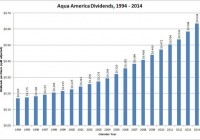
Summary Aqua America provides water and wastewater services to 3 million customers across 8 states. The company seeks to grow through acquisitions; it completed 13 acquisitions in 2014. Aqua America has increased dividends for 22 years, and over the past 5 years, it has grown dividends at an average rate of nearly 7.6%. About Aqua America Aqua America (NYSE: WTR ) is a holding company that, through its subsidiaries, provides water and wastewater utilities to 3 million customers across 8 states. The company owns and operates over 1,440 public water systems, and 187 wastewater treatment plants and collection systems. Aqua America originated as the Springfield Water Company in 1886 when a group of Swarthmore College professors were granted a charter to supply water to residents of Springfield Township, PA. Having started in Pennsylvania, half of Aqua America’s customers are in that state with the remaining customers distributed over Illinois, Indiana, New Jersey, North Carolina, Ohio, Texas and Virginia. Aqua America’s strategic objective is to grow in the fragmented water utility industry through acquisitions. The company completed 13 acquisitions in 2014. The most recent acquisitions were the Caroline Water Company, which serves 3,000 people in Caroline County, VA; Texas H2O which serves 3,300 customers in the suburbs of the Dallas-Fort Worth metropolitan area; and the Spartan Village water and wastewater systems – serving 650 customers – from the New Jersey village government. In 2013, the last year for which full-year figures are currently available, Aqua America’s income was $221.3 million, up 12.6% from 2012; and its income per share was $1.25, up 11.6% from 2012. Aqua America’s customer base was up 1.3% to 941,000 customers. One area of concern is the company’s high level of debt. At the end of 2013, Aqua America had $1.5 billion in long-term, fixed-rate debt with an average interest rate of 5%. Another area of concern is the degree to which Aqua America’s organic income growth is dependent on rate increases granted by local and state regulatory authorities. The company is a member of the S&P Mid Cap 400 index and the S&P’s High Yield Dividend Aristocrats index, and trades under the ticker symbol WTR. Aqua America, Inc.’s Dividend and Stock Split History (click to enlarge) Aqua America has paid quarterly dividends since 1944 and increased dividends annually since 1992. Last year, Aqua America announced a dividend increase of 8.6%, from 15.2 cents to 16.5 cents per share, at the beginning of August. The stock went ex-dividend with the increased dividend in mid-August. I expect Aqua America to announce its next dividend increase in early August 2015. Aqua America has a history of moderate dividend increases, with annual dividend growth in the mid-single digit percentages. From 2009-2014, Aqua America grew its dividend from 44 cents to 63.4 cents per share, for a 5-year compounded annual dividend growth rate (CADGR) of 7.58%. Aqua America’s 10-year and 20-year CADGRs are 7.99% and 6.83%, respectively. Aqua America has split its stock eight times since 1986. In September 1986 and June 1996, Aqua America conducted 3-for-2 stock splits. This was followed by a 4-for-3 stock split in January 1998, and 5-for-4 stock splits in December 2000, December 2001, and December 2003. In December 2005, Aqua America split its stock again, this time 4-for-3. And most recently, the company split its stock 5-for-4 in September 2013. Over the 5 years ending on December 31, 2014, Aqua America stock appreciated at an annualized rate of 16.93%, from $12.22 to $26.70. This beat both the 13.0% annualized return of the S&P 500 and the 14.9% annualized return of the S&P Mid Cap 400 index during this time. Direct Purchase and Dividend Reinvestment Plans Aqua America has both direct purchase and dividend reinvestment plans. The company has created a very favorable pair of plans for investors. The company pays nearly all of the fees associated with purchasing stock, including through dividend reinvestment. There are no fees to setup an account, or to purchase stock – either directly or through dividend reinvestment. The minimum investment for new accounts is $500, either in a single purchase or in 10 monthly installments of at least $50 each. The plan permits both purchases by check or automatic debit. The most attractive feature of Aqua America’s dividend reinvestment plan is the discount. The company currently offers a 5% discount on the purchase price of shares bought through the dividend reinvestment plan. This will reduce your cost basis and is taxable, but is extremely beneficial to you as an investor. Aqua America is one of a very few companies that offers shares purchased through dividend reinvestment at a discount to the market price. Finally, when you go to sell your shares in the plan, you’ll pay a transaction fee of either $15 or $25, depending on the type of sell order you request. You’ll also pay an additional fee of 12 cents per share sold. Furthermore, if you place your sell order through a representative on the phone, you’ll pay an additional fee of $15. Helpful Links Aqua America, Inc.’s Investor Relations Website Current quote and financial summary for Aqua America, Inc. (finviz.com) Information on the direct purchase and dividend reinvestment plans for WTR

Low Volatility ETFs Delivering Again In 2015

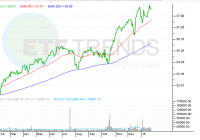
Summary The equities market is experiencing another bout of volatility. Low-volatility stock ETFs are outperforming the broader market. A closer look at low-volatility ETF strategies and sector tilts. The new year is still young, but investors have already been subjected to wild rides by major equity benchmarks. For example, the S&P 500 started 2015 on a downbeat note only to see all of those losses and then some erased by the end of last week, but a dismal showing this week has the benchmark U.S. index down nearly 3% year-to-date. Low volatility exchange-traded funds, including the PowerShares S&P 500 Low Volatility Portfolio ETF (NYSEARCA: SPLV ) and the iShares MSCI USA Minimum Volatility ETF (NYSEARCA: USMV ) are doing what they are supposed: outperform traditional benchmarks during times of market angst. The average year-to-date for SPLV and USMV is less than a half a percent, but that is clearly better than the 2.8% shed by the S&P 500. Notably, SPLV’s and USMV’s outperformance of the S&P 500 comes after the low volatility duo produced an average return of 18.7% last year, about 550 basis points better than the S&P 500 . “Within SPLV, seven of the ten largest holdings have an S&P Capital IQ Quality Ranking of B+ or above, with one with no ranking,” said S&P Capital IQ in a new research note. Dow components Wal-Mart (NYSE: WMT ) and Procter & Gamble (NYSE: PG ) are SPLV’s two largest consumer staples holdings. With an allocation of 16.5%, consumer staples is the third-largest sector weight in the ETF behind financials and utilities. P&G and Wal-Mart are also of the most reliable dividend growers among U.S. companies and although SPLV is not a dedicated dividend ETF, the fund has a trailing 12-month yield of almost 2.2%. That is 50 basis points above 10-year Treasuries, and SPLV pays its dividend monthly. “Though a company’s strong earnings and dividend record are not necessarily indicative of it having below-average volatility, our research has found many such companies have modest risk profiles,” said S&P Capital IQ. The research firm notes that SPLV’s exposure to financial services names is, not surprisingly, confined to lower beta fare such as insurance providers and real estate investment trusts (REITs). “In 2014, we saw defensive consumer staples, REITs, and utilities stocks perform relatively well as interest rates have declined and international economies such as Europe and Japan fall into recession. These stocks typically offer above-average dividend yields and are focused more on the U.S. where economic growth has been relatively impressive,” said S&P Capital IQ. As is often the case, there is a price to pay for playing defensive and it comes in the form of the higher valuations often ascribed to defensive sectors. Consumer staples and utilities are two of the most expensive sectors compared to the S&P 500. Add to that, S&P Capital IQ sees the bulk of SPLV’s 99 holdings as fairly valued, but the research maintains an overweight rating on the ETF. PowerShares S&P 500 Low Volatility Portfolio (click to enlarge)