Tag Archives: nreum

TransCanada Corporation: Long-Term Value From Growth Projects And MLP Drop-Downs

TransCanada has $45 billion of commercially secured projects and $50 billion of projects under evaluation. Drop-downs to TCP represent efficient capital plan. Energy East stakeholder agreement could serve as catalyst. TransCanada Corporation (NYSE: TRP ) owns several key natural gas pipelines, power generation, and natural gas storage assets in North America. The company owns and operates about 42,000 miles of natural gas pipelines and 406 Bcf of storage capacity. In addition, TRP has 11,800 MW of power generation operations in place and under development across hydro, gas, nuclear, and coal. We believe that TRP’s organic developments, aside from Keystone XL, multi-billion portfolio of commercially secured projects, and ability to deploy capital into attractive new projects provide for about 15% upside from current prices. Due to TRP’s large scale and expansive network, the firm has access to some of the most attractive growth projects, which we think are not accounted for in the stock’s current valuation. Currently, TransCanada has $45 billion of commercially secured projects and $50 billion of projects under evaluation. In particular, we think that the new long-term contracts for ANR and higher capacity prices for Ravenswood signal positive developments that would benefit long-term earnings. The ANR Pipeline is one of the largest natural gas pipelines in North America, connecting Wisconsin, Michigan, Illinois, and Ohio with supply in Texas, Oklahoma, and the Gulf of Mexico. We would note that the new contracts demonstrate ANR’s quality even during times of low commodity prices. On the power generation side, Ravenswood Generating Station is a 2,480 MW power plant located in Queens, NY that has the capability to serve 21% of New York City’s peak load. In addition, the plant possesses advanced technology that can be used to reduce nitrogen oxide emissions. We believe that drawn-out Keystone XL process poses headlines risk that is currently depressing TRP’s valuation. On Monday, the Department of State restarted the national interest review on the Keystone XL projects. Despite these efforts, the White House is expected to veto the project and the House and Senate are not expected to reach the two-thirds super-majority needed to override the veto. We feel that current sentiments pose a buying opportunity for longer term investors given the company’s other prospects. We also think stakeholder agreements for Energy East would serve as a catalyst for TRP. In the most recent quarter, TransCanada filed for US government approval for the construction and operation of the Energy East Pipeline and terminal facilities with the National Energy Board. The firm is proposing a marine terminal near Cacouna, Quebec, which could impact the beluga whale population. We believe that a successful agreement regarding the impact on wildlife will likely be reached by quarter-end. In addition, we are pleased that the company completed a successful binding open season for the $600 million Upland Pipeline. The proposed pipeline would begin near the northwestern North Dakota oil hub of Williston and go north into Canada about 200 miles. It would transport up to 300,000 Bpd of oil, connecting with other pipelines including Energy East. We would also highlight TransCanada management’s statement that the decline in commodity prices have not had any impact on TRP’s cash flows. In terms of valuation, we believe that the highlighted growth projects combined with the capacity for over $1 billion in annual drop-downs to TC PipeLines, L.P. (NYSE: TCP ), should allow TRP to be re-rated to a 20x forward multiple, more in-lined with peers, Enbridge (NYSE: ENB ) and Fortis (OTCPK: FRTSF ). In the meantime, investors are paid a 3.6% dividend to wait for the projects to be developed. Disclosure: The author has no positions in any stocks mentioned, and no plans to initiate any positions within the next 72 hours. (More…) The author wrote this article themselves, and it expresses their own opinions. The author is not receiving compensation for it (other than from Seeking Alpha). The author has no business relationship with any company whose stock is mentioned in this article.
The New Enhanced Bond Rotation Strategy With Adaptive Bond Allocation

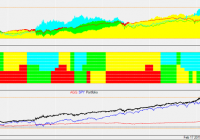
Summary A top 2 ETF (out of 4) bond rotation strategy with adaptive allocation. Switching between treasury bonds and corporate bonds depending to market conditions. Built to perform also in a rising rate environment. On November 2013 I published the first SA article on the BRS ( Bond Rotation Strategy ). Now, 15 months later, I am presenting an important update for this strategy. Even though the old strategy has done well, I think it is very important to constantly validate and improve any investment strategy. Markets change, ETFs change and even we ourselves grow and learn how to increase the returns and limit the risk of our own investments. In November 2014 I presented the Universal Investment Strategy which was based on a variable allocation of the SPDR S&P 500 Trust ETF ( SPY)- iShares 20+ Year Treasury Bond ETF (NYSEARCA: TLT ) funds. This new concept of an ETF rotation with variable allocation is very versatile and can be used on all types of strategies. For the BRS strategy, this new way to calculate allocations results in a considerably improved Sharpe (Return/Risk) ratio of the strategy. Here is the ETF selection for the BRS Old ETF selection New ETF selection SPDR Barclays Capital Convertible Bond ETF (NYSEARCA: CWB ) CWB SPDR Barclays Capital High Yield Bond ETF (NYSEARCA: JNK ) JNK iShares 10-20 Year Treasury Bond ETF (NYSEARCA: TLH ) TLT PowerShares Emerging Markets Sovereign Debt Portfolio ETF (NYSEARCA: PCY ) iShares Core Total U.S. Bond Market ETF (NYSEARCA: AGG ) not necessary anymore PIMCO Total Return ETF (NYSEARCA: BOND ) not necessary anymore iShares 1-3 Year Treasury Bond ETF (NYSEARCA: SHY ) not necessary anymore. The total allocation can go automatically below 100% An advantage of the adaptive allocation is, that we can work with less ETFs. We do not need the total return ETFs and anymore. The old BRS used these ETFs to achieve a blended way of investing in treasuries and corporate bond ETFs. This was needed because normal switching strategies don’t take into account cross-correlation between ETFs. I had to add total return ETFs so that the strategy ‘knew’ about the possible Sharpe ratio of a blended ETF. The new strategy, however, does calculate cross correlations and it will allocate automatically to the top ETFs, so that the Sharpe ratio is maximized. Cross correlation of ETFs is extremely important. If for example the stock market is doing well, then a normal ranking ETF strategy would probably invest in the two highly correlated corporate bonds: and. However a combination of with a negatively correlated treasury would probably have the better Sharpe ratio because of the inverse correlation of the two ETFs. This would reduce volatility and this would result in a higher Sharpe ratio for this ETF pair. For the selection of the 4 ETFs, it was very important to have uncorrelated bonds, so that we would have a successful ETF combinations for any kind of market. ETF Average correlation to the stock market CWB 0.8 JNK 0.7 PCY 0.25 TLT -0.5 (-0.75 during market corrections) PCY is an interesting addition with low correlation to the other ETFs. From a correlation point of view, it sits half-way between stocks and treasuries, and it gives the strategy some additional global diversification. To calculate the strategy we use our QuantTrader software. As this is a top 2 ETF strategy, the algorithm calculates the maximum Sharpe allocation for all 6 possible ETF pairs. We could run allocations from 0% to 100% for each ETF, but for the bond rotation it is better to limit the allocations from a 40% minimum allocation to a maximum of 60%. If we allow bigger variations the risk increases because there would be times where we are invested up to 100% in one single ETF. The return would also increase, but the Sharpe ratio would be lower than with this 40%-60% allocation. One way to further improve risk adjusted returns would be to always invest in all 4 ETFs with adaptive allocation. The algorithm would loop through all allocations like 10%-30%-20%-40% and calculate the max. Sharpe allocation considering the cross correlation of all 4 ETFs. For bigger investments, this would be the best solution with the highest Sharpe ratio and a very low volatility of only 5%. It is also good because the ETF risk is spread among 4 ETFs rather than 2 ETFs. However for the private investor an investment in the best 2 ETFs is absolutely sufficient. The new BRS strategy shares the same tweaked Sharpe formula with the UIS strategy. Normally the Sharpe ratio is calculated by Sharpe=rd/sd with rd=mean daily return and sd= standard deviation of daily returns . I don’t use the risk free rate, as I only use the Sharpe ratio to do the ranking. My algorithm uses the modified Sharpe formula Sharpe=rd/(sd^f) with f=volatility factor . The f factor allows me to change the importance of volatility. If f=0 , then sd^0=1 and the ranking algorithm will choose the composition with the highest performance without considering volatility. If f=1 , then I have the normal Sharpe formula. Using values of f> 1 , I rather want to find ETF combinations with low volatility. With high f values, the algorithm becomes a “minimum variance” or “minimum volatility” algorithm. Here is a comparison between different ways to execute the BRS Comparison of different BRS strategies (5 year) Strategy 5 year CAGR Sharpe ratio Max drawdown 1 Old BRS strategy (top 1 ETFs) 11% annual return 1.13 -12.2% 2 Old BRS strategy (top 2 ETFs) 12.5% annual return 1.44 -9.3% 3 New BRS strategy (2 ETFs) 17% annual return 2.25 -6.5% 4 New BRS strategy (4 ETFs) 13% annual return 2.45 -6.6% 5 benchmark: AGG 4.18% annual return 1.25 -5.1% 6 benchmark: SPY 15.9% annual return 1.01 -18.6% N.B. – no 3 is the strategy used by Logical-Invest The max. drawdown coincides with the end of QE announcement in 2013. Bond strategy drawdowns are mostly driven by FED announcements, but they are about 3x smaller than drawdowns. Here is a screenshot of the 5 year backtest of the new BRS with QuantTrader (click to enlarge) The middle graph shows the allocation of the ETFs and the lower graph shows the strategy compared to two benchmarks: AGG and SPY. Due to the limited history of CWB, which exists only since 2009, this backtest is quite short. However, using mutual fund proxies we can backtest the strategy using a longer historical period. There is a plenitude of different proxies using mutual funds, but none is a 100% match. In particular, emerging market bonds are only available in recent times. Still they add unique diversity. Long term backtests are interesting, but personally I don’t think that you need to look back longer than 10 years. Markets and ETFs evolve so quickly that history that extends back for more than 5 years, is not really useful in fine-tune a strategy which has to successfully trade in current market conditions and whose only goal is to predict the next 20 trading days. So take the results below with a grain of salt. They show that the fundamental principle of the strategy works even before 2008. It does perform even better after 2008 due to increased momentum of stock and bond markets after the 2008 correction. The most important lesson learned from this longer term backtest is that you don’t need to be afraid of big market corrections. Such corrections are even good for strategies with variable allocation, because you can make double the gains. Once using defensive Treasuries during the down going market and then a second time when the markets go up again. Mutual fund proxies used for the longer term backtest ETF Proxy TLT Vanguard Long-Term Treasury Fund Inv (MUTF: VUSTX ) JNK T. Rowe Price High-Yield Fund (MUTF: PRHYX ) PCY T. Rowe Price International Bond Fund (MUTF: RPIBX ) CWB Vanguard Convertible Securities Fund Inv (MUTF: VCVSX ) Benchmark: AGG Benchmark: Vanguard Total Bond Market Index Fund Inv (MUTF: VBMFX ) Here is a screenshot of the 13 year backtest of the mutual fund BRS with QuantTrader (click to enlarge) The charts show that the strategy worked well since 2002. CAGR is 13.2% and Sharpe is 2.02. The max. drawdown was 12.5% in 2008. However one last important question for the future is how the strategy will handle rising rates? I think that the BRS should still do quite well in a rising rate environment, because of the two corporate bonds funds, CWB and JNK. Long duration 15-18 year Treasury bonds and TLT will be affected most by rising rates. But even here I would set a question mark. With Treasury yields near zero in Europe, these U.S. long term bonds are still extremely attractive. Convertible corporate bonds or high yield bonds with short duration and a high coupon are even more attractive and should do quite well in a rising rate environment. Emerging-markets bonds like are quite susceptible to global sentiment, but they should be less affected by rising rates also because of their lower 9 year duration. All I know is, that the banks and Federal Reserve have been constantly wrong about their predictions on rising rates for five years, so be skeptical of any rate predictions. Better let algorithms decide how to change bond allocations. Disclosure: The author has no positions in any stocks mentioned, and no plans to initiate any positions within the next 72 hours. (More…) The author wrote this article themselves, and it expresses their own opinions. The author is not receiving compensation for it. The author has no business relationship with any company whose stock is mentioned in this article.

Cyber Security ETF Fired Up On Blowout Earnings

Cyber security – a need of the hour – has developed into a booming industry on growing awareness due to widespread hacking. With the extensive adoption of Internet usage in enterprises and government agencies, cyber attacks are increasingly difficult to prevent. But this evil of technology is in focus, and governments and businesses are willing to beef up their spending on information security. This young corner of the broad technology space represents one of the few growth opportunities left for developed market investors. Growth will likely come from the rapid adoption of mobile, cloud, social and information technologies. In fact, it seems that the cyber security trend has reached a new level this earnings season, as most of the companies in the space impressed with robust results. For investors seeking to play this trend in a basket form, there are a few options, PureFunds ISE Cyber Security ETF (NYSEARCA: HACK ) being the most notable. Buoyed by the solid earnings, this product has surged 12.5% over the past ten days and about 13% since its debut in November. It has gathered enough interest from investors, accumulating $261 million in AUM in just three months. Average daily volume is also solid as it exchanges around 282,000 shares in hand (read: Inside HACK: The Sought-After Cyber Security ETF ). Given this, it might be worth it to shed some light on this newly introduced ETF and its holdings for investors not familiar with it but thinking about jumping in on the space. Below we highlight some of the key details regarding HACK and how recent earnings have led to this fund’s solid run. HACK in Focus The fund offers exposure to the companies that ensure the safety of computer hardware, software, networks, and fight against any sort of cyber malpractice. It tracks the ISE Cyber Security Index, holding 30 securities in its basket. It is well spread out across components, as each security holds no more than 5.71% of total assets. From an industrial outlook, software and programming accounts for nearly two thirds of the portfolio while communication equipment and Internet mobile applications round off the top three. In terms of country exposure, U.S. firms take the top spot at 71%, followed by Israel (13%), the Netherlands (5%), South Korea (5%), Japan (4%), Finland (3%) and Canada (1%). Cyber Security Earnings in Focus The torrid run in HACK was driven by the stellar Q4 earnings and a bullish outlook on CyberArk Software (NASDAQ: CYBR ) and the subsequent surge in its stock price. CYBR shares soared as much as 40.7% to record high of $64.45 since its earnings announcement on February 12. The stock takes the top spot in the fund’s basket with 5.71% share (read: These New ETFs Could be Big Winners ). CyberArk reported earnings per share of 19 cents, outpacing the Zacks Consensus Estimate of a penny and saw nineteen-fold jump from the year-ago quarter. Revenues surged 81% year over year to $36.3 million and strongly surpassed our estimate of $27 million. The company projects earnings per share in the range of 4-6 cents on revenues of $25.5-$26.5 million for the ongoing first quarter. For 2015, revenues are expected to grow 23-26% to $127-$130 million and earnings per share are projected at 24-27 cents. The earnings guidance for both the quarter and the full year is much higher than the Zacks Consensus Estimate of a loss of 26 cents and earnings of one cent, respectively. The cyber security ETF’s second holding – FireEye (NASDAQ: FEYE ) comprising 5.55% share in the basket – also topped our estimates and guided higher. Net loss of 64 cents was narrower than our expected loss of 83 cents and revenues of $143 million exceeded our estimate of $141 million. FireEye expects revenues in the range of $118-$122 million for the ongoing first quarter and $605-$625 million for the full year. Net loss per share is projected at 49-53 cents for the first quarter and $1.80-$1.90 for the full year. The Zacks Consensus Estimate at the time of earnings release was pegged at a loss of 79 cents and $3.18 cents, respectively. FireEye has jumped over 24% to date post earnings announcement on February 11. Further, Qualys (NASDAQ: QLYS ) also contributed to the upside in HACK. The stock shot up as much as 21% and hit a new all-time high of $49.42 on upbeat earnings and robust guidance. The firm occupies the fourth position in the basket and represents about 4.57% of the fund (see: all the Technology ETFs here ). Earnings per share of 9 cents strongly outpaced the Zacks Consensus Estimate by 7 cents while revenues of $37 million also edged past our estimate of $36 million. For the first quarter, Qualys expects revenues of $37.6-$38.1 million and earnings per share in the range of 10-12 cents, which is much higher than the Zacks Consensus Estimate of 6 cents. It also projects 2015 revenues of $167.3-$169.3 million and earnings per share of 50-55 cents, well above our estimate of 34 cents. Juniper Networks Inc. (NYSE: JNPR ) also contributed to the rally in HACK as it is one of its top 10 holdings, accounting for 4.18% share. It beat on both the bottom and top lines by 9 cents and $0.033 billion, respectively. Further, the forward guidance for the first quarter is also encouraging. The company expects earnings per share in the range of 28-32 cents, the midpoint of which is higher than the Zacks Consensus Estimate of 18 cents at the time of the earnings release. Revenues are expected in the range of $1.02-$1.06 billion. Shares of JNPR rose nearly 9% since its earnings announcement on January 27. Apart from the incredible cyber security earnings, HACK also got a boost from Obama’s initiative taken at the first ever summit on Cybersecurity and Consumer Protection held last week. The president signed an executive order that focuses on consumer protection and private-public partnerships against cyber threats (read: Obama Budget Plan Drives Up These Sector ETFs ). Further, Russia’s Kaspersky Lab, a major cyber security firm, released data on the widespread breach in the financial sector early this week that raises concerns about cyber security, propelling the stocks and the ETF higher. The report showed that a group of hackers have stolen at least $1 billion from over 100 banks in 30 countries since late 2013. Bottom Line The cyber security ETF is showing relative strength and should continue to outperform the broad technology space in the coming months given the impressive earnings and solid guidance from many players. Further, the growing awareness for the protection against the cyber threats will likely take the space to new heights. So, for investors seeking to play the potential rise in cybercrime, HACK could be the ticket in 2015.