Tag Archives: management

Great Plains Energy’s (GXP) CEO Terry Bassham on Q2 2015 Results – Earnings Call Transcript

Great Plains Energy Inc. (NYSE: GXP ) Q2 2015 Earnings Conference Call August 7, 2015 9:00 a.m. ET Executives Lori Wright – VP of IR and Treasurer Terry Bassham – Chairman, President and CEO Jim Shay – SVP, Finance and CFO Analysts Ali Agha – SunTrust Paul Ridzon – KeyBanc Shar Pourreza – Guggenheim Partners Brian Russo – Ladenburg Thalmann David Paz – Wolfe Research Operator Good day, ladies and gentlemen, and welcome to the Great Plains Energy Second Quarter 2015 Earnings Conference Call. At this time, all participants are in a listen-only mode. Later, we will conduct a question-and-answer session, and instructions will follow at that time. [Operator Instructions] As a reminder, this conference may be recorded. I would now like to turn the conference over to our host for today’s conference, Ms. Lori Wright. You may begin. Lori Wright Thank you, operator, and good morning. Welcome to Great Plains Energy’s second quarter 2015 earnings conference call. Today, Terry Bassham, Chairman, President and Chief Executive Officer; and Jim Shay, Senior Vice President, Finance, and Chief Financial Officer will provide an overview of our second quarter results. Scott Heidtbrink, Executive Vice President and Chief Operating Officer of KCP&L and Darrin Ives, Vice President, Regulatory Affairs are also with us this morning, as our other members of our management team who will be available during the question-and-answer portion of today’s call. I must remind you of the inherent uncertainties in any forward-looking statements in our discussion this morning. Slide 2 and the disclosure in our SEC filings contain a list of some of the factors that could cause future results to differ materially from our expectations. I also want to remind everyone that we issued our earnings release and second quarter 2015 10-Q after the market closed yesterday. These items are available, along with today’s webcast slides, and supplemental financial information regarding the quarter on the main page of our website at greatplainsenergy.com. With that, I’ll now hand the call to Terry. Terry Bassham Thanks, Lori. And good morning everybody. As you saw in the 8-K that was filed yesterday, we are announcing a change in our officer team. Jim Shay will be leaving the company effective September 2 to take a new role as CFO at Hallmark Cards here in Kansas City. It’s truly been an honor and pleasure to work with Jim and we appreciate his leadership. Replacing Jim as Senior Vice President Finance, Strategy and Chief Financial Officer will be Kevin Bryant. Many of you know and have already worked with. Kevin is currently our Vice President, Strategy Planning and has been with Great Plains Energy for 12 years. His responsibilities at the company include Vice President of Investor Relations and Treasurer and Vice President of Energy Solutions. He is very eager to assume his new responsibilities and in particular working with each of you. I hope you’d join me to wishing Jim the best in his new opportunity and welcoming Kevin to his new role. On our call this morning, we will discuss our second quarter results and provide an update on KCP&L’s rate cases in Missouri and Kansas. We’ll also give an operations update and an overview of Transource’s new project in West Virginia. I will begin with Slide 4 in the presentation. Yesterday, we announced second quarter 2015 earnings of $44 million or $0.28 per share compared to $52 million or $0.34 per share in 2014. Drivers for the quarter included favorable operations and maintenance expense, positive weather normalized demand growth and milder weather with cooling degree days 15% below the second quarter 2014. We also reaffirmed our 2015 EPS guidance range of $1.35 to $1.60. Jim will discuss more details on the quarter in his comments. On the regulatory front, KCP&L’s rate cases are on schedule to be completed during the third quarter. In Missouri evidentiary hearings were completed in July and founder reply briefs were filed earlier this week. KCP&L’s initial request in revenue increase of $120.9 million was subsequently adjusted to $112.7 million as a result of updates to the case and negotiated partial stipulations and agreements. As a reminder, KCP&L’s request is based on a return of equity of 10.3%. Missouri Public Service Commission staffs recommended revenue increase ranges in the $76.8 million to $87.3 million predicated on our ROE range of 9.0% to 9.5%. The partial stipulations and agreements that have already been approved by MPSC resolved several issues in the case. The remaining unresolved items include ROE as well as the company’s ability to utilize a fuel clause and trackers for property taxes and critical infrastructure protection standards or CIPS cybersecurity expenses. In Kansas, evidentiary hearings concluded in June and reply briefs were filed earlier this week. KCP&L requested a revenue increase of $67.3 million based on a return of equity of 10.3. The Kansas Corporation Commission staff recommended a revenue increase of $44 million based on an ROE of 9.25. Turning to the Missouri case, we were able to resolve a majority of the issues in our Kansas case and partial stipulations and agreements were filed in June. The agreements include the ability for KCP&L to implement a transmission delivery charge rider and a CIPS cybersecurity tracker. Stipulations and agreements have yet to be approved by KCC. With most of these issues settled, ROE remains as one of the few unresolved items in the Kansas case. We anticipate new rates to be effective in both KCP&L’s jurisdictions by the beginning of the fourth quarter of the year. You can find summaries of the rate cases in the appendix of this presentation. We remain confident in our ability to deliver constructive regulatory outcomes in our current proceedings, reinforcing our commitment to deliver 4% to 6% earnings growth from 2014 to 2016. In addition, we remain on target to grow rate base to 6.5 billion by 2016. Turning to operations. Earlier this week, the Environmental Protection Agency issued the final standards for its Clean Power Plan. As we analyze the more than 1500 page document we are getting a better understanding of the plan and its potential impact. Although KCP&L and the electric power industry have spent more than a year working with EPA on a viable solution, the final version of the Clean Power Plan has significantly changed from the draft, we will continue evaluating the new rules. In recent months, our service territory has been impacted by the number of severe weather events, including a storm in late June that led to our largest customer outage since 2002. Storms uprooted or caused significant damage to over 50,000 trees, left over 150,000 customers without power. Our employees and our neighboring utilities worked diligently and safely to restore power to our customers, and I’d like to take this opportunity to thank everyone for their efforts and execution. I will wrap up with a few comments on transmission. We are pleased that Transource, our joint venture with AEP, was selected by PJM to develop the competitive portions of the thoroughfare area project in West Virginia. Construction on the 60 million 138 KV line is expected to begin in 2017 and to be in service in 2019. This win in the emerging competitive transmission market combined with its existing SPP projects reinforces our belief that Transource is well-positioned to successfully compete and deliver innovative solutions. I’ll now turn the call over to Jim to discuss our financial performance. Jim Shay Thank you, Terry and good morning everyone. I will begin with Slide 6 which presents a comparison of the second quarter and year-to-date earnings-per-share results for 2015 compared to 2014. As Terry indicated, our second quarter 2015 earnings was $0.28 per share compared to $0.34 per share last year. Lower operating and maintenance expense, positive weather normalized demand growth and new retail rates in Kansas were positive drivers that were more than offset by milder weather, decrease in AFUDC and increases in depreciation and amortization. For the year-to-date period, earnings were $0.40 per share compared to $0.49 per share last year. Through the first half of 2015, we’ve seen favorable O&M expense driven by diligent cost management and lower cost at Wolf Creek, related to the planned 2014 mid-cycle maintenance outage and lower refueling amortization. For the second half of 2015, we expect our O&M expenses to increase above the 2014 level. Consistent with our 2015 guidance, we expect overall O&M for the full year to increase 3% to 4% which include increases in regulatory amortizations and items which have direct revenue offsets. As a reminder, the O&M items with direct revenue offsets include our Missouri Energy Efficiency Investment Act programs. These investments allow us to invest in our customers by providing long-term energy solutions and ability to generate shareholder returns. We recover program costs and a throughput disincentive for these programs, which is included in our gross margin. Our projected O&M increase for the full-year 2015, exclusive of regulatory amortizations and items which have direct revenue offsets, is 1% to 2%. Turning to Slide 7. As we think about the third quarter compared to a year ago, we will be impacted by a decrease in AFUDC and increasing O&M. We will also expect continued lag from property taxes, transmission costs and depreciation until new rates are in effect. Lower natural gas prices are negatively impacting off-system sales, which have an earnings impact to KCP&L and Missouri, where we do not have a fuel clause. As Terry discussed, KCP&L’s ability to utilize a fuel clause is one of the remaining items to be determined by the commission in the Missouri rate case. A fuel clause would mitigate the exposure to off-system sales going forward. Finally, in the third quarter of 2014 we had unrecognized tax benefits that will have an unfavorable year-over-year comparison. As a result of these drivers, we expect third quarter 2015 earnings will be lower than the same period in 2014. Weather normalized demand, net of the impact of our energy efficiency programs, was up 1.2% for the quarter and up 0.6% year-to-date through June. The results are in line with our full year projection of flat to 1.5% net of energy efficiency. Year-to-date we’ve seen strong residential and commercial demand partially offset by lower industrial demand which has the lowest margin among the sectors. The Kansas City region has experienced 47 consecutive months of seasonally adjusted job growth and in June the unemployment rate of 5.3% was below the national rate of 5.5%. Construction is well underway at Cerner Corporation’s new Trails Campus in South Kansas City. The first two towers which will accommodate more than 3500 employees are under construction and a move-in date likely in early 2017. Over the next 10 years, a total of 16 new buildings containing 4.7 million square feet of office space supporting approximately 16,000 employees are planned, making it the largest economic development project in Missouri’s history. On the industrial front, we were impacted by a customer relocating to a more energy-efficiency facility within our service territory and a general decrease in usage from a handful of customers. Demand at Ford’s Kansas City assembly plant remains strong. Sales of Ford’s F-150 pickup truck had benefitted from gasoline prices that are near a five-year low. The Ford plant is operating with three shifts to keep up with demand for the F-150 America’s best-selling vehicle. On the capital markets front, we expect to issue long-term debt at KCP&L this year with no plans at this time to issue equity. We are reaffirming our 2015 earnings-per-share guidance range of $1.35 to $1.60. We are on plan to deliver on our financial objectives for the year and we remain confident in our ability to deliver 4% to 6% earnings growth from 2014 to 2016. Thanks for your time this morning. We would now be happy to answer any questions you may have. Question-and-Answer Session Operator [Operator Instructions] And our first question comes from Ali Agha of SunTrust. Ali Agha Terry or Jim, in the past, I had a call coming out of the last rate case cycle, you had mentioned that target earnings power for the company, should be between 50 to 100 basis point lag from the authorized ROE. Is that still a good rule to think about as we come out from this better [ph] rate cycle? Terry Bassham Yes, I think that’s what we’ve said all along, as the first year out of the case you should see that kind of range. Obviously what can affect your ability to deliver within that range, so it will be based on the outcomes of these cases. A few issues around riders and trackers and things like that. But certainly coming out as we did in the last cycle, the year after should be better matched to our historical test year. Ali Agha And then on the riders, trackers, fuel adjustment clause, any insights into how the commission may be looking at that, any sense of or conviction level in terms of the ability to get those this time around? Terry Bassham Well obviously we’re still awaiting an order, so probably little premature to have handicapped those. I would say that they remain very important to us. You can see some things that have happened in other cases that could indicate where they ruled on those before. But I will again remind you that we did get the CIPS tracker in Kansas and that’s a positive going forward for sure. We certainly – Commonwealth [ph] is expected to see those orders and rates implemented in this quarter. Ali Agha And assuming you do get those trackers and fuel adjustment clause, is it possible for you to hold on to that earned ROE in the following year like in ‘17 or is that just the natural lag in the way things work that you see some slippage as you go beyond the – on to the next year from the rate case? Terry Bassham Well obviously depend on which of the trackers, obviously we feel confident and think it important that we get the fuel factor itself in Missouri. There is a transmission piece and in the other asks we’ve made. Obviously if we’ve got all of the trackers, riders and asks we’ve made in that front makes it easier the second year, the extent you don’t get on this certainly makes it more difficult. What I would say to you is that if the — we don’t get those riders and trackers because they are considered general rate case type ask we will have to file rate cases on a much more frequent basis and we will do that. That was our response in this case with our prior asks and so what you’ll see from us if we are not allowed to deal with those in that manner is filing general rate cases much quicker. It’s just the nature of what we would assume is an indication from the commission. Ali Agha And lastly can you just remind us when you talked about the ’14 to ‘16 earnings growth outlook, can you just remind us what that base for ’14 is? Jim Shay It’s $1.60, off of the original guidance range. $1.60 was the bottom end of the original guidance range. Operator And our next question comes from Paul Ridzon of KeyBanc. Paul Ridzon Jim, congratulations on your new position and new role. I wish you the best of luck. It’s been a pleasure working with you over the years. Jim Shay Thank you. Paul Ridzon Quick question. How much of a headwind is not having the Missouri fuel clause? Terry Bassham Well, obviously it would be a disappointment and in the way we believe we’re entitled to it, it’d be a great disappointment candidly. In terms of actual financial effect, we already talked about the fact that we would have to file case again pretty quickly and at this point with off-system sales which are embedded in that being a very low level and an update on coal cost at the time it wouldn’t be a bigger drag as it historically has been. But it certainly would be one more challenge we’d have to face but we would again quickly file as appropriate ask for that in the next case. Paul Ridzon So just historically you had a fuel clause but you had to give it up as part of the deal. Is this how you treat, correct? Terry Bassham No, not really. Back in ‘04 when the original comprehensive energy plan was signed, there weren’t fuel clauses in Missouri. There was some discussed legislation that could create that. And so as we finalized the comprehensive energy plan and the deal, if you will, included gives and takes on both sides. It was agreed by the company not to ask for a fuel clause if and when legislation provided for that for our 10 year period. So that brings us to 2015 as our first opportunity to ask for it. Paul Ridzon And just on the transmission and property tax in Missouri, where does that stand as far as legislation or are you seeking more of a regulatory solution at this point? Terry Bassham Well again we’ve asked for both of those in the case. We will know again this quarter the result of that request from a commission standpoint, certainly if we’re not allowed to get those from the commission’s standpoint that would become part of our legislative agenda for the upcoming session. Operator And our next question comes from Brian Chen [ph] of Bank of America. Unidentified Analyst On the thoroughfare area project, can we get a sense of the spending pattern for that? Is there a ramp up as you sort of gear, should we think about even spending between now and ’19, just a little bit more color there would be great? Terry Bassham It will be about $60 million that will get spent from the period of from 2017 to 2019 would be the run rate. Unidentified Analyst And just as a clarification, the $60 million is the investment opportunity for Great Plains or is that the investment opportunity for the entirety of the project? Terry Bassham For the entire project. Great Plains will have 13.5% of that. Unidentified Analyst And Jim, hey congratulations on the new position. I’m just glad that I won’t have to potentially wear a Kansas Jayhawks tie again. Operator [Operator Instructions] Our next question comes from Shar Pourreza of Guggenheim Partners. Shar Pourreza Just one question, I am curious to get a refreshed viewpoint a little bit on sort of the requested ROE adjustment mechanism that Westar filed and obviously the staff recommended against it but also left it open for potential generic proceedings. I am curious to see if that’s something you would potentially look to go after with your Kansas utility? Terry Bassham Yes, I can mean, obviously each case presents its own issues and opportunities, that was a request from Westar that they left open, and certainly to the extent that there was a discussion on a more statewide level we would want to participate, work with both the commission and the staff and Westar to discuss that opportunity. Shar Pourreza Has conversations begun as far as the joint collaboration yet or is it too preliminary? Terry Bassham The cases they don’t file, settlement just happened. So we’ve been busy getting ready for this call. Operator And our last question comes from Brian Russo of Ladenburg Thalmann. Brian Russo Just curious if we could just talk some more about the lower gas prices and the sensitivity on the wholesale sales at the Missouri utilities. Could you just give us a sense of kind of like the total amount of wholesale sales in terms of megawatt hours, just kind of the mechanics of that, like what’s the base line that the sensitivity is based off of? Terry Bassham We don’t really have a lot of information in the public domain with respect to specifics but you recall in the last case we got offset of off-system sales established in rates and relative to over or under performance we will either get the benefit or give up an opportunity. And we have seen some pressure on gas prices this year which has been putting some pressure on off-system sales but in the upcoming rate case we will get a – we will get that trued up and hopefully a fuel clause and eliminate that volatility moving forward. But we really don’t have any numbers in terms of actual sensitivity in the public domain. And recall that the prices obviously were at lows, so I mean opportunity hopefully will be that they would tick up a little bit but – Operator I am showing a question from David Paz of Wolfe Research. David Paz I just wanted to clarify a statement I think I heard earlier. Can you remind me on the 4% to 6% growth target over the ’14-15 period? What is the base again? Terry Bassham It’s off of the original guidance for ’14 which is $1.60 to $1.75. So a pretty wide range using 4% to 6% growth rate off of that range. David Paz I thought I heard you say $1.60, I just want to make sure – Terry Bassham No, I was pointing to the bottom end of the range but the original – but the guidance target is off of the full range. End of Q&A Operator I am showing no further questions. I’d now like to turn the call back over to management for closing remarks. Terry Bassham Thank you, operator and thank you everybody for joining us this morning. We appreciate as always your participation in the call. Look forward to meeting with many of you in the weeks, months ahead. So thank you and have a good weekend. Operator Ladies and gentlemen this concludes today’s conference. Thank you for your participation and have a wonderful day. Copyright policy: All transcripts on this site are the copyright of Seeking Alpha. However, we view them as an important resource for bloggers and journalists, and are excited to contribute to the democratization of financial information on the Internet. (Until now investors have had to pay thousands of dollars in subscription fees for transcripts.) So our reproduction policy is as follows: You may quote up to 400 words of any transcript on the condition that you attribute the transcript to Seeking Alpha and either link to the original transcript or to www.SeekingAlpha.com. All other use is prohibited. THE INFORMATION CONTAINED HERE IS A TEXTUAL REPRESENTATION OF THE APPLICABLE COMPANY’S CONFERENCE CALL, CONFERENCE PRESENTATION OR OTHER AUDIO PRESENTATION, AND WHILE EFFORTS ARE MADE TO PROVIDE AN ACCURATE TRANSCRIPTION, THERE MAY BE MATERIAL ERRORS, OMISSIONS, OR INACCURACIES IN THE REPORTING OF THE SUBSTANCE OF THE AUDIO PRESENTATIONS. IN NO WAY DOES SEEKING ALPHA ASSUME ANY RESPONSIBILITY FOR ANY INVESTMENT OR OTHER DECISIONS MADE BASED UPON THE INFORMATION PROVIDED ON THIS WEB SITE OR IN ANY TRANSCRIPT. USERS ARE ADVISED TO REVIEW THE APPLICABLE COMPANY’S AUDIO PRESENTATION ITSELF AND THE APPLICABLE COMPANY’S SEC FILINGS BEFORE MAKING ANY INVESTMENT OR OTHER DECISIONS. If you have any additional questions about our online transcripts, please contact us at: transcripts@seekingalpha.com . Thank you!
Korea Electric Power (KEP) Q2 2015 Results – Earnings Call Transcript

Korea Electric Power Corporation (NYSE: KEP ) Q2 2015 Earnings Conference Call August 5, 2015 3:30 AM ET Executives Weon-Gun Ko – Vice President and Treasurer Changyoung Ji – Senior IR Manager Analysts Pierre Lau – Citibank. Jiyoon Shin – KTB Securities Jae-Hyun Ryu – Daewoo Securities Heedo Yun – Korea Investment & Securities Minho Hur – Shinhan Finance Investment Joseph Jacobelli – Bloomberg Intelligence Josh Bae – UBS Kang Seongjin – KB Investment Securities Operator [Foreign Language – Korean] Good morning and good evening. First of all, thank you all for joining this conference call. And now we’ll begin the conference of the fiscal year 2015 second quarter earnings results by KEPCO. This conference will start with a presentation, followed by a detailed Q&A session. [Operator Instructions] Now we shall commence the presentation on the fiscal year 2015 second quarter earnings results by KEPCO. Weon-Gun Ko [Foreign Language – Korean] Good afternoon. This is Weon-Gun Ko, Vice President and Treasurer of KEPCO. On behalf of KEPCO, I would like to thank you all for participating in today’s conference call to announce earnings results for the first half of 2015. [Foreign Language – Korean] We will begin with a brief presentation on the earnings results, which will be followed by a Q&A session. Today’s call will be presented in both Korean and English. [Foreign Language – Korean] Please note that the financial information to be disclosed today is on a preliminary, unaudited and consolidated basis in accordance with K-IFRS. Any comparison would be on a year-on-year basis between 2014 and 2015. Business strategies, plans, financial estimates and other forward-looking statements included in today’s call will be made based on our current expectations and plans. Please be noted that such statements may involve certain risk and uncertainties. [Foreign Language – Korean] Now Senior IR Manager, Mr. Changyoung Ji, will begin with an overview of earnings results of the first half of 2015, first in Korean and repeat it in English. Changyoung Ji [Foreign Language – Korean] Now we will provide the overview in English, starting with operating income. In the first half of 2015, KEPCO recorded a net operating income of KRW 4.33 trillion. Taking a closer look, operating revenues increased 4.1% to KRW 28.79 trillion. This was attributable mainly to 2.1% increase in power sales revenue totaling KRW 25.89 trillion, and 38.2% increase in revenues from the overseas business amounting to KRW 2.11 trillion. Moving on to main operating costs, cost of goods sold. SG&A expense decreased 4.4% to KRW 24.47 trillion. Fuel costs decreased 25.9% to KRW 7.98 trillion. Power generation is affected by the low power demand, decreased 4.2%, and unit cost of fuel declined by 22.6%. Meanwhile, purchased power cost increased 3.5 % to KRW 6.19 trillion. Unit cost of purchased power decreased 20% because of the decrease of S&P, caused by the increase of new highly efficient power plants, and purchased volume increased 29.3%. Depreciation cost rose 5.3% to KRW 3.55 trillion, mainly due to the newly constructed substations and new facility addition by power plants. Now let me explain KEPCO’s non-operating segment. Net financial loss was KRW 1 trillion in the first half of 2015, which was improved by KRW 125 billion. As a result of foregoing, we recorded a consolidated net income of KRW 2.57 trillion in the first half of 2015. This concludes the overview of KEPCO’s earnings results for the first half of 2015. [Foreign Language – Korean] Now let me move on to the Q&A session. Q&A session will be hosted by Mr. Weon-Gun Ko. Weon-Gun Ko [Foreign Language – Korean] This is Weon-Gun Ko. I’m joined with our IR committee members in charge of major business areas at KEPCO. We are prepared to take any questions. [Foreign Language – Korean] Since we are presenting in both Korean and English, all the Q&As will be interpreted. Please make sure your questions and answers are brief and clear. [Foreign Language – Korean] Please begin. Question-and-Answer Session Operator [Foreign Language – Korean] [Operator Instructions] The first question will be given by Pierre Lau from Citibank. Please go ahead sir. Pierre Lau Hi. Good afternoon, KEPCO management. Congratulations to your good results. I’m Pierre Lau from Citi Bank. I have three questions. The first question is what is your generation mix from nuclear and coal respectively in 2015 for the full-year? Second question, what is your forecast of your unit coal and LNG costs, practically also in 2015 full-year? And finally for 2015 full-year, how much electricity that you expect to purchase from IPP? Thank you. Weon-Gun Ko [Foreign Language – Korean] To answer your first question on the generation mix for the 2015 full-year, we believe the LNG will be 11% and coal will be 49% and nuclear will be 37%. [Foreign Language – Korean] And as for the unit cost for the fuel for the generation, it is as follows. For coal, it is KRW 102,001 per ton and for LNG, it’s KRW 827,000 per ton and for oil it’s KRW 576,800. [Foreign Language – Korean] And to answer your third question on our electricity purchase from IPP, we plan to purchase 19% of our power from IPP, and the overall budget in 2015 will be KRW 11 trillion. Pierre Lau Okay. Thank you. For the unit coal costs, would you mind me take the number? Weon-Gun Ko [Foreign Language – Korean] It is KRW 102,001 per ton for coal. Pierre Lau Okay. It’s KRW 102,000. Weon-Gun Ko KRW 102,000 per ton. Pierre Lau But I calculate the number in the first half was only seems to be much lower than that, less than KRW 1,001. So do you expect coal cost to be higher in second half this year compared to first half? Weon-Gun Ko [Foreign Language – Korean] As of July 1, we are going to be affected by the coal tax by the government. Therefore per kilogram the impact would be KRW 24 from KRW 18 per kilogram. Pierre Lau Okay. Thank you. Operator [Foreign Language – Korean] The following question is by Jiyoon Shin from KTB Securities. Please go ahead sir. Jiyoon Shin [Foreign Language – Korean] I have two questions. My first question is rather similar to the previous question that was asked before me. For the LNG unit cost for the first half you mentioned that it’s KRW 810,000, and for the second half of the year your guidance is KRW 660,000. So throughout the year the overall guidance for LNG unit cost amounts to KRW 820,000. So do you – so it means that there will be foreseeable increase in the second quarter of the year to come up with that guidance number. Given that we are affected by the consumption tax that will increase from KRW 18 per kilogram to KRW 24, that still get us rather high level of LNG unit cost number. So I would like to hear more on that. Given that the oil price is declining, and in November and December there will be also additional downward trends for the LNG price. So how would you explain this trend? And the second question is on the overseas business, which has very high revenue generated in the term. I believe it is mostly coming from the UAE business under KEPCO, and in the first quarter it was announced that there has been about KRW 620 billion generated from the UAE business. And second quarter then gives us – it should be over KRW 1 trillion. So I just like to confirm what has driven this growth of the UAE business? Weon-Gun Ko [Foreign Language – Korean] To answer your first question, we had rather conservative assumption when it comes to LNG, which was $62 per barrel. And in the third quarter our forecast that the LNG price would drop to KRW 770,000 per unit and in the fourth quarter then it goes up again to KRW 800,000 per unit. So the price drop is not happening as fast as we have anticipated and we bought bulk of LNG in the first quarter at a price of KRW 879,000 at the highest and that’s where we had the most purchase of LNG for the year. That’s why if you annualize that, that gives us about KRW 820,000, which was an accumulated number that goes back to the first quarter. [Foreign Language – Korean] To answer your second question on the UAE business, for the first half of this year, our revenue for the UAE business is KRW 1.7329 trillion and year-on-year – in the previous year it was KRW 1.1372 trillion. So there has been increase of about KRW 600 billion year-on-year. [Foreign Language – Korean] Our annual guidance for the UAE business is KRW 3.4 trillion. [Foreign Language – Korean] And as you have mentioned for the second quarter alone, our revenue from UAE business is KRW 1.1 trillion. [Foreign Language – Korean] I hope that answered your question. Jiyoon Shin [Foreign Language – Korean] A follow-up question to my first question is you mentioned that the LNG price is $62 per barrel. Is that annual number or annual guidance for the LNG price? Weon-Gun Ko [Foreign Language – Korean] Yes, our guidance for the oil price is $62 per barrel and that’s correct. [Foreign Language – Korean] And because oil price continues to go down, our fact strategy team is revealing to adjust our assumption for the oil price and lower that to $58 per barrel rather than $62. Operator [Foreign Language – Korean] The following question is by Jae-Hyun Ryu from Daewoo Securities. Please go ahead sir. Jae-Hyun Ryu [Foreign Language – Korean] On a stand-alone P&L, it seems that your net asset is higher for the stand-alone than the consolidated basis. What has driven that change and what is the reason behind that in the second quarter? My second question is what is the utilization that you are foreseeing for the second half of the year for the nuclear, coal and LNG valuation? [Foreign Language – Korean] And also another follow-up question is that for the second half of the year, could you also share your guidance and the overall trends by comparing the consolidated financial statement as well as the stand-alone financial statements? Weon-Gun Ko [Foreign Language – Korean] To answer your first question on the stand-alone P&L. The most of the driver was coming from the sales of the electricity. Unit price for electricity went up by 0.4%, whereas the sales volume went up by 1.4% resulting in increase of KRW 300 billion on our bottom line. Also the S&P price was dropped by 25% and therefore our power purchase cost was lowered by KRW 2.4 trillion, which is the largest sector driving up the performance. As for the guidance for the 2015, for the stand-alone P&L, we believe the operating profit to be KRW 3.4 trillion and with recognition of sales of assets which was our own headquarter in September, you could see annual number for the net profit would be KRW 9.1 trillion. On consolidated basis, our operating profit is expected to be KRW 8.3 trillion, whereas our net profit is expected to be KRW 11.4 trillion. [Foreign Language – Korean] As for the generation utilization, as per the nuclear power plants, E&C overall utilizations would be 84.8% for year 2015, which is similar to the previous year which was at 85%. With the third quarter and fourth quarter this year, our expectation is that it would be 82.7% and 88.8% respectively. And as for the coal-fired power plant, we expect mid-80% in utilization. We have a confirmed number for the first half of the year for the coal-fired power plant, but there are certain uncertainties involved for the second half of the number. So that’s our projection for now. For LNG power plant, we expect it to be the early 14% utilization or the mid-30% utilization for the year. Operator [Foreign Language – Korean] The following question is by Heedo Yun from Korea Investment Securities. Please go ahead sir. Heedo Yun [Foreign Language – Korean] I have two questions. First question, if you look at your consolidated P&L for the second quarter under the line item, other operating profit, it recorded KRW 2.36 trillion and there has been increase of about KRW 670 billion. I know this may have been influenced by some of the changes coming from the provisioning required for decommissioning the nuclear power plant which took effect since the July 1. So could you elaborate on what is driving that? And also my second question is that last week you have submitted the total cost or a tariff report to the government to adjust tariff moving forward. So could you share with us the timeline moving forward? And Mr. Treasurer, would you be kind enough to share with us your perspective on whether it is possible for additional tax decrease? Weon-Gun Ko [Foreign Language – Korean] Out of the KRW 3.3 trillion, we’ve seen increase of KRW 870 billion increase year-on-year. And if you break those numbers down, it was slightly driven by increased facility or equipment purchase costs for our UAE business as the business appreciated for significant amount of period, and that number adds up to KRW 410 billion. And also we are adjusting numbers for provisioning for the decommissioning of the nuclear power plant. We are setting aside the waste disposal costs for the low and intermediate radioactive waste treatment and we are currently adjusting the discount rate and interest rate that is affected in that liability. So that number added about KRW 139.8 billion to the number. And also we are setting aside liability or provisioning for the IPS, which is another KRW 140 billion, which totals to KRW 3.3 trillion. [Foreign Language – Korean] On your question on the potential tariff discount moving forward, we have had a one-time discount already when it comes to our electricity price. So in the second half of this year, of course we’re going to adjust our tariff depending on the total cost and also the overall power sales profit. And we have submitted that based on our management accounting in fiscal year 2014. So it has been submitted to the government but nothing has been determined as of this point on the total cost. When the results come out after government reviews this, we will be adjusting the tariff looking at the overall cost, as well as the overall sales profit from electricity sales, but nothing has been determined yet. But we’ve had this one-time discount of our electricity in July already. So any additional discount or decrease in tariff will be something that will lead to discuss with the government once everything becomes more concrete. Operator [Foreign Language – Korean] [Operator Instructions] The following question is from Minho Hur from Shinhan Finance Investment. Please go ahead sir. Minho Hur [Foreign Language – Korean] So last year there was plan to fix the cost for your fuel disposal but as far as I am aware, it has been just delayed to June of this year, but it seems that that cost still has not been determined yet. When do you believe that the disposal cost would be clear or ways would be determined and when if it is determined, how much of the cost do you expect? Weon-Gun Ko [Foreign Language – Korean] So the cost requirement for the nuclear waste disposal has been amended as of June 30 and it will be taken into effect since the second half of this year but in next two years. There hasn’t been any significant changes to the amendment. However, for the low and intermediate nuclear waste disposal, the cost would be change per barrel and it used to be about KRW 11,930,000 per barrel, but the number is going to be increased by about KRW 200,000. So the overall cost therefore will be increased from current KRW 603.3 billion to KRW 643.7 billion moving forward. So we believe the cost impact would be somewhere around KRW 250 billion to KRW 300 billion per barrel, per dron [ph] that is for the unit cost for the radioactive – for the low and intermediate radioactive waste. Operator [Foreign Language – Korean] [Operator Instructions] The following question is by Joseph Jacobelli from Bloomberg Intelligence. Please go ahead sir. Joseph Jacobelli Good afternoon. And thank you very much for the time and this presentation. Couple of quick questions with regards to your debt management going forward. So we’ve seen the level coming down in last couple of quarters. Do you have any specific targets with regards to either your net debt to equity by 2015 and by 2016, or long-term debt to equity whichever number you feel comfortable with? And the other question is, could you give us a quick update on your nuclear build-out over the next few years? Any more delays or are any plants coming in a little bit more quickly than looks this year? Weon-Gun Ko [Foreign Language – Korean] On your first question on the debt ratio, our goal or target for the consolidated basis for 2015 is 164% and for 2016 is 149% and for year 2017 is 133%. On a stand-alone basis, our target for 2015 is to lower the debt ratio below 100% level. [Foreign Language – Korean] As far Shin Wolsong 2, we have gone live as of the July 24 of this year and for Shin Kori #3, our target date for operation is first half of 2016, and for Shin Kori #4 nuclear power plant is targeted to go live by first half of 2017. Operator [Foreign Language – Korean] The following question is by Josh Bae from UBS. Please go ahead sir. Josh Bae Yes. Hi. Thank you for the opportunity. I have two questions. First, I think you mentioned consolidated operating profit target of KRW 8.3 trillion for this year. Could you please share with us what the FX and oil price forecasts you’re using for this target? Second question, just to follow-up on the previous question regarding the Shin Kori #4. I think you were previously expecting this nuclear plant to come online sometime in 2016. Is there a particular reason for the delay to first half of 2017? Thank you. Weon-Gun Ko [Foreign Language – Korean] As for the assumption that we were using for our financial guidance for 2015 is we assume that the electricity sales will grow by 1.8%, whereas the foreign exchange rate against dollar would be KRW 1,121 per dollar, and for oil price we expect it to be $62 per barrel in Dubai price. And for bituminous coal, our assumption is $75 per ton. [Foreign Language – Korean] As for your second question on Shin Kori #4, it is being delayed because there has been some incompliance on the technology side that some valves, so some of the components, for example the valves needs to be replaced because it failed to meet the technology qualification. Therefore the operating date for Shin Kori #4 has been delayed to the first half of 2017 instead of our initial schedule which was July of 2016. Operator [Foreign Language – Korean] [Operator Instructions] The following question is by Kang Seongjin from KB Investment Securities. Please go ahead sir. Kang Seongjin [Foreign Language – Korean] I have a question on the overall power purchase cost. It seems that the power purchase unit cost for your GENCO has gone down significantly in the second quarter. What is your expectation for the third quarter, and could you also share with us your perspective on the adjustment coefficient when you also explain the unit cost trend you will be followed? Weon-Gun Ko [Foreign Language – Korean] As far this year if you look at the adjustment coefficient for the GENCOs reflecting on the last year’s number, the S&P price was very high in the first half of the year and very low in the second half of the year. So there has been fluctuation if you look at the whole year. And I have to score at the overall profit and loss of GENCOs over the period. So what we have decided to do this year is that we are going to split the adjustment coefficient being calculated separately for the first half of the year and the second half of the year. So what we see as a result is that the S&P is high in the first quarter, therefore the GENCOs profitability appears to be very high in the first quarter, whereas in the second quarter the KEPCO’s profitability appears to be high. We have recalculated the adjustment coefficients at the end of June again. And in the second half of the year, we believe the fluctuation of the S&P will rather be stable. So in the second half of this year, the coefficients or settlement types – unit types will be high and stable. So all in all, we are going to see stabilized number with higher settlement price. Operator [Foreign Language – Korean] [Operator Instructions] The following question will be given by Joseph Jacobelli from Bloomberg Intelligence. Please go ahead sir. Joseph Jacobelli Just a quick follow-up question with regards to several coal costs. Given we’ve seen coal prices very low for quite some time and unlikely to get any – go any higher. Will this price trend of coal influence your decision in terms of future capacity planning or will you just say for example taking 1% coal-fired power plant by – to gas-fired power plant to a coal-fired power plant, or are you trying to secure longer term contracts for coal, or are you trying to diversify some of the coal costs – coal sources? Thank you. Weon-Gun Ko [Foreign Language – Korean] Last month we have announced the seventh basic plan for the electricity supply and demand by the government. And there LNG makes this so much similar. It has increased by about 0.3% and for coal, we assume that the coal price will go down and its mix would be about 32%, whereas the nuclear power plant we are adding two more nuclear power plants and that will take up about 28.5% in terms of our generation mix. As for the coal-fired power plant, we have initially planned for adding for a coal-fired power plant in our sixth basic plan for electricity supply and demand but that has been withdrawn. [Foreign Language – Korean] And as for the GENCOs, they have – when they plan for the purchase of coal, their target is to have 80% of the coal purchased under the long-term contract with their suppliers. So even if there is drop in coal price, they would not necessarily move to diversify their coal purchase sources in East [ph]. The GENCOs are looking into various method and ways to have competitive pricing, sourcing price for their coal. Joseph Jacobelli Thank you. Operator [Foreign Language – Korean] The following question is by Jae-Hyun Ryu from Daewoo Securities. Please go ahead sir. Jae-Hyun Ryu [Foreign Language – Korean] I have one short question on dividend payment. Now that we are wrapping up the first half of the year, has there been any internal discussion on the dividend payout for the end of the year? One potential idea is that because you have the sales of your headquarter assets, are you reviewing to use that fund to include that in your dividend payout? I know it’s rather early to have a view on that, but could you mention or potentially share anything with us? Weon-Gun Ko [Foreign Language – Korean] On our dividend policy with dividend forecast for 2015, I regret to say that there has not been any concrete measure that has been determined yet. Our intention is to maintain our historical dividend payout ratio which was 30%. Of course for this year, because of our after-sales we have increased special profit and that may then lead to special dividend, but nothing has been determined yet and we are in the process of discussing that with the government. When we consider the special profit into our dividend policy, then that will significantly drive up our dividend payout. So our basic stance is to maintain our historical dividend payouts, but that’s something that we are still discussing with the government. But what we are keeping in mind is that we will act on behalf of the investors’ interest and in leading that discussion with the government. Weon-Gun Ko [Foreign Language – Korean] All right. We will conclude this conference call. Once again thank you for joining us today. Thank you. Operator [Foreign Language – Korean] [Operator Instructions] This concludes the fiscal year 2015 second quarter earnings results by KEPCO. Thanks for the participation.

Evaluating U.S. Low-Volatility ETFs: USMV Vs. SPLV

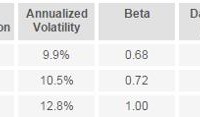
Low-volatility ETFs have close to $20 billion in AUM. Both USMV and SPLV achieve their objectives against the benchmark. USMV has been the more efficient and cheaper choice than SPLV thus far. Ever since I wrote my thesis on minimum-variance portfolios six years ago, I have maintained a strong interest in low-volatility investing. This type of investment has gained popularity over the last few years with the US markets now featuring 21 low-volatility ETFs that have combined assets under management of almost $20 billion. I have decided to take a look at how the largest funds in this space have performed from the risk perspective. For the purpose of this analysis, I have focused on the two flagship low-volatility ETFs – the iShares MSCI USA Minimum Volatility ETF (NYSEARCA: USMV ) and the PowerShares S&P 500 Low Volatility Portfolio ETF (NYSEARCA: SPLV ) – which have around $5 billion of AUM each. Both of these funds invest solely in the US stock market, making them easy to compare. The SPDR S&P 500 Trust ETF (NYSEARCA: SPY ) is used as the benchmark. Utilizing the freely available investor tool on InvestSpy and using the full data history, I obtained the following results: (click to enlarge) The table above reveals that both USMV and SPLV demonstrated substantially reduced beta and realized volatility than SPY. However, the degree of success differed, as USMV had a lower beta (0.68 vs. 0.72) and lower realized volatility (9.9% vs. 10.5%) compared to SPLV, making the former a superior performer from the risk perspective. In addition to that, USMV delivered a 6.7% higher total return than SPLV whilst both low-volatility ETFs trailed SPY. Looking at the correlations computed on the same analytical website, it turns out that both funds had a correlation with SPY of 0.88. Although the figure is relatively high, this is still a favorable finding given that these funds invest pretty much in the same universe of stocks as SPY. Analyzing the data only for the last year yields a similar result, as USMV again outperforms SPLV in all respects. However, the overall benefit from the low-volatility phenomenon has been weaker over the last 12 months, as beta values increased above 0.8 and annualized volatility was much closer to that of SPY’s, particularly in the SPLV’s case. (click to enlarge) The correlation coefficients have also changed in the past year with USMV and SPLV moving even closer together. It is interesting to note that USMV’s correlation coefficient with SPY has increased sharply to 0.95, making it a less desirable portfolio component from the diversification perspective. Summing up, USMV appears to have beaten SPLV thus far virtually in all respects, posting lower beta, lower realized volatility and higher returns. In addition to that, USMV was also a cheaper alternative, charging 0.15% as opposed to 0.25% by SPLV. However, it is important to note that markets constantly evolve and investors should monitor the performance of “smart beta” products on a regular basis. It is hard to make a case for SPLV now, but a simple change such as the recent spike in correlation with the S&P 500 may easily put USMV out of favor. Disclosure: I/we have no positions in any stocks mentioned, and no plans to initiate any positions within the next 72 hours. (More…) I wrote this article myself, and it expresses my own opinions. I am not receiving compensation for it (other than from Seeking Alpha). I have no business relationship with any company whose stock is mentioned in this article.