Tag Archives: load

Why Jack Bogle Is Wrong On Foreign Investing

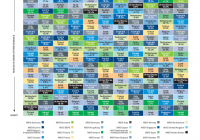
Jack Bogle, the founder and former CEO of The Vanguard Group, gave an interview to Bloomberg’s Carla Fried earlier this month. His views on investing in markets outside of the U.S. is wrong for many reasons. I will discuss two such reasons below. From the interview: You’ve often reminded investors that what’s done well in the past probably won’t do well in the future. So for a patient investor with a long horizon, where should they be investing today? I like the U.S. The U.S. is the most productive country in the world. It is the most rapidly growing of the industrialized nations, other than Switzerland. We still have plenty of problems, but we’re much better than France, Britain and Germany. And we don’t even want to talk about Italy and Greece. And importantly – people forget this too quickly – we have the most established government and legal institutions. When you look at global market capitalization it’s true that the U.S. accounts for about 48 percent and other countries 52 percent. But the top three markets outside the U.S. are the U.K., Japan and France. What’s the excitement about there? Emerging markets have great potential, but have fragile sovereigns and fragile institutions. I wouldn’t invest outside the U.S. If someone wants to invest 20 percent or less of their portfolio outside the U.S., that’s fine. I wouldn’t do it, but if you want to, that’s fine. Have you ever invested in international markets? Not really. Other than when I had small amounts when we launched [Vanguard] International Growth and the [Vanguard] International Index fund, I had small investments in both. It’s hard to believe that the differences in returns over the long term will be huge. That’s just not what we have seen for the most part. Why take the currency risk? Source: Jack Bogle: I Wouldn’t Risk Investing Outside the U.S. , Dec 9, 2014, Bloomberg U.S. investors should invest a portion of their portfolio in foreign stocks. They can invest via stocks of foreign companies trading on the U.S. markets, a mutual fund, an ETF or directly in foreign equity markets if they can access them. Despite the currency risk that Mr. Bogle mentioned, and many other risks, there are many advantages to investing in overseas stocks. 1. Diversification: By excluding foreign stocks, one loses the benefits of diversification. Diversification is one way to reduce risk. Including foreign stocks in a portfolio helps reduce risk. For example, though the U.S. stocks have done very well in 2013 and this year, there is no guarantee they will continue to outperform other markets in the future. No country has been the top performer consistently every year, as shown in the Callan’s Periodic Table of Investment Returns for 2013: (click to enlarge) Source: BlackRock 2. Many foreign markets have dividend yields that are much higher than the yields for the U.S. market. So even after accounting for currency risks and dividend withholding taxes, one can earn a higher return by investing in foreign stocks. As of December 22, the dividend yield for the U.S. equities is 1.9%, compared to 3.3%, 2.9% and 4.9 for UK, Canada and Norway, according to FT Market Data . Related ETFs: iShares MSCI Canada ETF (NYSEARCA: EWC ) iShares MSCI Australia ETF (NYSEARCA: EWA ) Global-X MSCI Norway ETF (NYSEARCA: NORW ) iShares MSCI United Kingdom ETF (NYSEARCA: EWU ) Disclosure: No positions.

Herzfeld Caribbean Basin Fund: Sell This CEF As It Jumps To Massive Premium

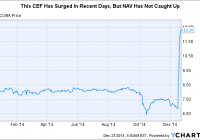
As the United States and Cuba have announced their intentions to normalize diplomatic relations, investors are excited by the prospect of economic investment in the Caribbean island nation. This has led to an over 81% jump in the shares of the Herzfeld Caribbean Basin Fund which has advanced to a 50.3% premium to NAV. Despite the fund’s ticker symbol (CUBA), the CEF has no direct exposure to Cuba and holds listed securities in a portfolio that could be built independently without such a premium. Shares of the Herzfeld Caribbean Basin Fund (NASDAQ: CUBA ) have surged by 81.2% in the past four trading sessions after the United States and Cuba announced their intentions to normalize their international relations. While the closed end fund has recently traded at a discount to NAV, the four-day rally has put the CEF at a 50.3% premium to Monday’s closing NAV. Investors have expressed optimism over the potential economic benefits of further diplomatic cooperation between the U.S. and Cuba; however, the fund does not actually own any non written off assets domiciled in Cuba. The fund lists the following as part of its investment objective: “The fund invests at least 80% of its total assets in a broad range of securities of issuers including U.S.-based companies that engage in substantial trade with, and derive substantial revenue from, operations in the Caribbean Basin Countries.”-Herzfeld Caribbean Basin Fund Investment Objective The fund’s ticker symbol has likely led to retail investor optimism despite the fund’s composition and the significant premium that it has jumped to. The Herzfeld Caribbean Basin Fund has AUM in the $30 Million range and charges a management fee of 1.45% of average daily net assets in addition to other expenses that amounted to roughly $270 thousand last fiscal year equating to a total annual expense ratio of around 2.4%. In addition to the concerns over the small size of the fund, other than in the past few trading sessions, it has experienced low levels of liquidity and trading volume. Having traded at a roughly 10% discount to NAV in its recent history, it is rather concerning that it has jumped to a 50.3% premium to NAV. CUBA data by YCharts Two Written-Off Assets May Be Reason For Investor Over-Optimism While the Herzfeld Caribbean Basin Fund owns shares of companies that would benefit from improved US-Cuba relations and general Cuban economic growth, however the fund does not actually own shares in any Cuban-domiciled corporations. The company does in fact have two written-off and transfer restricted Cuban assets both with a fair value of $0: $165 Thousand par Republic of Cuba bonds, 4.5%, 1977 that is in default and 700 shares of Cuban Electric Company that have a fair value of $0. Even if these assets were to surprisingly realize any sort of value, it would not likely be of any material significance to the fund. Rights Offering Proceeds Used To Both Fund Capital Gains Distribution And Add Capital To The CEF Earlier in December, the fund completed an oversubscribed rights offering that raised new capital for the CEF. The Herzfeld Caribbean Basin Fund sold 1.8 million shares at $6.77 per share equating to roughly $12.1 million in cash proceeds. Last Thursday, the fund announced its year-end distribution that will amount to $0.635 per share consisting of mostly long-term capital gains and some short-term capital gains. The recent rights offering will provide the necessary liquidity to pay the year-end distribution and will also leave the fund with extra capital to deploy as it sees fit. Additionally, two key members of the fund’s management hold large stakes in the CEF: Thomas J. Herzfeld, the chairman of the board, president and portfolio manager holds an 11.3% stake while his son, Erik M. Herzfeld who serves as a portfolio manager owns just over a 5% stake. While Cuba’s Economic Situation May Improve Materially, This Potential Does Not Provide Reason To Pay A 50.3% Premium For A Related Fund The latest news of increased international cooperation between the U.S. and Cuba may certainly have positive long-term impacts for Cuba’s economy. It may open the door for direct foreign investment to boost the country’s infrastructure and to draw in new capital. Cuba certainly has the potential to bring in mass amounts of tourist over the long term from a number of nations including the U.S. However, at 50.3%, the Herzfeld Caribbean Basin Fund does make a sensible investment decision. If an investor were so inclined to mimic the portfolio of the CEF, one could without paying such an immense premium to NAV. The recent news boosts the prospects for Cuba’s economy; however, investors should avoid the Herzfeld Caribbean Basin Fund as it trades at a massive premium and does offer direct exposure to the country. Note: Pricing is accurate as of the close of trading on Monday Dec. 22, 2014.

Will NRG Energy’s Residential Solar Ambitions Play Out?

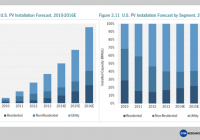
Summary NRG Energy is a uniquely forward-looking utility in its renewable energies commitment. NRG Energy’s entrance into the residential solar space could be the most important aspect of the company moving forward. The company boasts many unique advantages over its residential solar competitors. While there is little doubt that NRG Energy will become a major player in the residential solar sector, the company is unlikely to take over SolarCity as the market leader. NRG Energy (NYSE: NRG ) is primarily known as a fossil fuels utility, but it also has an affinity to renewable energies unlike any other utility company in the country. In 2013, they had even company ranked as the second largest utility-scale solar contractor, right behind First Solar (NASDAQ: FSLR ). Despite NRG Energy’s enormous presence in utility-scale solar generation, the company’s increasing residential solar focus is the most exciting aspect of the company. While the company is barely on the radar in the residential solar sector, having accounted for only 13.5 MW installed in 2013 as opposed to industry-leaders [SolarCity (NASDAQ: SCTY )] 280 MW, the company still has grand plans to become the largest residential solar company in the U.S. In order to evaluate the legitimacy of this claim, the company must be examined in relation to the current residential solar landscape. The State of the Residential Solar Industry The residential solar sector is currently in the process of heavy consolidation. Larger companies like SolarCity and Vivint Solar (NYSE: VSLR ) are devouring market share at an extremely rapid rate. In little more than a year, for instance, SolarCity and Vivint Solar went from a combined marketshare of about 33% to almost 60%. What is even more impressive about this industry-wide marketshare consolidation is that the process has not even come close to slowing down. It would not be terribly surprising to see SolarCity gain 50% of the marketshare within the next year or so. Analysts have repeatedly underestimated the economies of scale present in residential solar. The conventional wisdom has been that local/smaller companies would have an advantage over larger corporations due to their higher regional expertise. Despite this, it appears that the huge financing, structural, and integrations advantages that larger corporations posses vastly outweigh their relative weaknesses. This fact, of course, is great news for NRG Energy, as they are a huge company with virtually limitless resources, especially in context to the budding residential companies. NRG Energy has even gone so far as to state that “we’re a fortune 250 company that… is competing with some well-performing startups. While this is certainly an exaggeration, it nonetheless hints at the company’s huge comparative size. Graphical representation of residential solar’s potential (click to enlarge) Source: GTM Research Advantages NRG Energy’s residential market share is only a few percentage points, which makes the company’s goal of becoming the largest residential installer sound ridiculous. This claim though, is not as crazy as it sounds upon closer inspection. While NRG Energy has not installed many MW’s of residential solar, the company has spent years building out an extensive infrastructure . In addition, NRG Energy boasts many advantages that are unique to its situation. The most obvious advantage that NRG Energy possesses is its size. The company has been forward thinking enough to be one of the first large utilities to truly embrace the residential solar trend, and this foresight will pay huge dividends for the company in the future. The size of NRG Energy could give it a significant competitive advantage over its residential solar competitors in the form of cheaper capital, scaling, financing, etc. Even SolarCity, the largest residential installer, does not compare to the financial clout of NRG Energy. By virtue of being one of the first large utilities to enter into residential solar, NRG Energy has set itself up in a great position over its future competitors. In addition, NRG Energy is one of the largest utilities in the U.S., boasting over 2 million retail customers. The company’s 2 million customer base will give it an unrivalled platform of potential customers. Even if a small percentage of this number were to switch to residential solar, this would give NRG Energy a residential market share on par with the likes of Vivint Solar, or even SolarCity. Of course, NRG Energy would not actually be gaining any new customers, as the company is essentially just converting some of its old customers to solar. Regardless, the market share they gain in the residential solar sector because of this is perhaps the most important outcome, as marketshare is perhaps the most important metric in an early stage industry. The residential solar is poised to be huge, and any opportunity to gain market share early on should be taken. NRG Energy’s commitment to residential solar cannot be denied. The company is so serious about this blooming sector that is has even created a separate division for it called NRG Home Solar. As per Kelcy Pegler (President of NRG Home Solar), “we are in this residential solar space to win.” Potential Obstacles/Risks Despite all the advantages that NRG Energy would enjoys, taking over SolarCity as the top residential solar company would be an extremely tall order. NRG Energy is somewhat late to the game, and the company still has a lot of catching up to do. The good news is that the only real competition in the residential sector so far is SolarCity and Vivint. Despite this, these two companies, especially SolarCity, are extremely well-managed and competitive. First off, it is highly unlikely that NRG Energy would have a cost structure anywhere near that of SolarCity, and to a lesser degree Vivint Solar. In order to stay competitive with the top residential companies, NRG Energy may have to sacrifice its margins early on to stake out a significant piece of market share. While this may be troublesome for smaller companies, NRG Energy has a balance sheet that could sustain the potential cash bleed. Additionally, while the company is considered forward thinking for a utility, it is highly unlikely that NRG Energy compares to SolarCity in terms of innovation. SolarCity has been virtually pushing the residential solar industry by itself for the past few years. In fact, it could be argued that the residential solar industry is in the state it is today precisely because of SolarCity. While there is little doubt that NRG Energy’s residential solar team is talented, it hardly compares to SolarCity’s management team, which boasts the likes of Elon Musk, Lyndon Rive, Peter Rive, Brad Buss, etc. Conclusion NRG Energy’s residential goals are certainly ambitious, with the company planning to have 35,000 to 40,000 installations by the end of 2015. Although this number would only be a fraction of SolarCity’s, it is still a huge leap from where they are today. The company is in fact planning a stupendous growth rate of 300-400% for the next few years. If any company can threaten the dominance of SolarCity, it is NRG Energy. Despite this, it is highly unlikely that NRG Energy will be able to overtake SolarCity as the market leader. On top of the fact that SolarCity already owns 40% of the residential solar market share, the company has intangibles that NRG Energy will unlikely be able to overcome, even in light of NRG Energy’s numerous advantages. Having said that, there is a distinct possibility of NRG Energy becoming a huge player in the residential solar space, and even beating out Vivint Solar for the number 2 spot. Given the massive potential of the residential solar industry, NRG Energy’s entrance into residential solar will be a win no matter what. With a market capitalization of $9.16B, NRG Energy’s valuation is pretty much in line with comparable fossil fuel utilities. This valuation though, largely ignores the company’s involvement in the immensely promising solar sector. At its current market capitalization, the company holds great upside in the long-term.