Tag Archives: load

Lack Of U.S. Wage Growth Puts These ETFs In Focus

The U.S. is creating jobs fast, but is slow in boosting wage growth. While the buzz about poor wage growth has been doing rounds for long, the unexpected and steepest fall in average U.S. hourly wage for December since 2006 cast a dark cloud over the country’s economic growth story. Average hourly earnings dipped 0.2% sequentially in December, and November average hourly earnings were adjusted down to a 0.2% increase. On a year-over-year basis, average hourly earnings in December were up 1.7%. This indicates that the brighter overall job picture was courtesy of the low-wage category. Thanks to this downbeat data, positive sentiments that shaped up over the U.S. investing in last few months, suffered a brief (seemingly) setback to start 2015. The U.S. dollar dipped against the yen, though slightly, following not-so-enthusiastic payrolls. Several emerging market currencies, however, including Taiwan’s dollar and Indonesia’s rupiah had witnessed a notable ascent following the payroll data. The WisdomTree Emerging Currency ETF ( CEW) , which provides a diversified play on emerging market currencies, added 0.24% on January 9th. Added to this is the inflationary outlook, which will likely remain grave in the days to come due to the unending oil rout. In fact, a beneficial driver like lower greenback also failed to perk up oil investing. Bloomberg analysts envisaged that U.S. consumer prices possibly grew 0.7% year over year in December, the five-year lowest. Most of the market participants started to believe that a solemn inflationary picture and a lackluster wage scenario will delay the hike in U.S. interest rates. We expect this shaky investor sentiment to take charge of the market movement at least for a few days. An upbeat economic data report is urgently needed to lift investors’ mood which is already sinking due to global growth worries. Greenback Gives Up Given the change in the market fundamentals and slide in the greenback following the latest wage data, investors might think about shorting U.S. dollars to take advantage. PowerShares DB U.S. Dollar Bearish Fund (NYSEARCA: UDN ) This fund could be the prime beneficiary of the falling USD as it offers exposure against a basket of world currencies. These include the euro, Japanese yen, British pound, Canadian dollar, Swedish krona and Swiss franc. This is done by tracking the Deutsche Bank Short U.S. Dollar Index Futures Index Excess Return plus the interest income from the fund’s holdings of U.S. Treasury securities. In terms of holdings, UDN allocates nearly 57.6% in euros while 25% collectively is in Japanese yen and British pounds. All of these currencies nudged up after the U.S. wage growth report. The $37.1 million fund charges 80 bps in fees a year from investors. This ETF was up 0.5% on January 9 but failed to sustain the gains after hours. Tilt to Treasuries Like 2014, the 10-year Treasury note too was off to a great start this year with yield slipping even below 2% since October. Notably, this was the best yearly start treasuries experienced in 17 years thanks to a spike in market volatility. Demand for 30-year treasury bonds was so high that yields plunged to the lowest level since July 2012. Investors seeking to ride this environment might take interest in iShares 20+ Year Treasury Bond ETF (NYSEARCA: TLT ) . This ultra-popular long-term Treasury ETF with an asset base of $6.6 billion – TLT – has added more than 4% so far in the New Year. TLT charges 15 bps in fees. Glitters of Gold After a tumultuous 2014, gold finally heaved a sigh of relief. Soft global growth, persistent plunge in oil and now the prospect of a delayed rate hike in the U.S. returned the shine of the yellow metal. On January 9, the SPDR Gold Trust ETF (NYSEARCA: GLD ) – the product tracking gold bullion -added about 1.14%. In the year-to-date frame, this $27.6 billion fund was up 3.2%. The ETF charges 40 bps in fees. Bottom Line As a caveat, investors should note that the outlook is quite rough for the inverse dollar and gold ETF. This is more the case for UDN, which tracks the greenback against currencies like the presently nine-year low euro. These ETFs will turn out winners as long as volatility and downbeat sentiments over the U.S. market prevail. Thus, investors need to be aware of the market at large before considering these investment options.
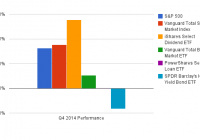
The 5 Funds – Q4 2014 Portfolio Review

Summary Reviews the performance of The 5 Funds Portfolios. The Vanguard REIT Index was the top performing ETF in the portfolios last quarter. Junk Bonds and International ETFs were the worst performers. Each quarter I plan to update my 3 portfolios: The Aggressive 5, The Moderate 5, and The Conservative 5 and show the performance from the previous quarter, as well as since inception. I’ll also give an update on why I’m making some of the changes and my quick market update. Hopefully this will be helpful for people either following my portfolios or creating their own ETF portfolio. The Conservative 5 Name Symbol Type Allocation Change Vanguard Total Stock Market Index ETF (NYSEARCA: VTI ) Large Cap Blend 25% +5% 1 iShares Select Dividend ETF (NYSEARCA: DVY ) Mid-Cap Value 16% +1% 3 Vanguard Total Bond Market ETF (NYSEARCA: BND ) Intermediate Term Bond Fund 35% None PowerShares Senior Loan ETF (NYSEARCA: BKLN ) Short Term Bond Fund 0% -10% 2 SPDR Barclay’s High Yield Bond ETF (NYSEARCA: JNK ) High Yield Bond Fund 9% -1% 3 iShares Floating Rate Bond (NYSEARCA: FLOT ) Short Term Bond Fund 10% +10% 1 Cash Cash 5% -5% 2 Updated 1/4/2015 Add Allocation Reduce Allocation Investment Drift (No New Trades Required) Conservative 5 Performance* Conservative 5 SPY (S&P 500) Last Month -0.6% -0.3% QTD 2.0% 4.9% YTD – – Since Inception (10/1/2014) 2.0% 4.9% Std Dev. compared to SPY .31 1.0 As of 12/31/2014 Performance by ETF January 2015 Update The biggest update to the Conservative 5 Portfolio ​is the removal of PowerShares Senior Loan ETF and replacing it with the iShares Floating Rate Bond. The reason for the change is that I’m concerned with the amount of volatility in BKLN. As we saw, it took a few large dips in the 4th quarter of 2014. BKLN consists of a lot of lower quality bonds which is the reason for the volatility, FLOT is a more conservative, less volatile ETF which allows us to increase our position in VTI without adding much additional volatility to the portfolio. We continue to favor equities over bonds in 2015 and feel as rates rise and bonds are hurt, the equity market should outperform. We have also reduced the cash position in the account to 5% and moved that money over to Vanguard Total Stock Market Index. This move will add slightly more risk to the portfolio, but the overall risk of the portfolio should not be increasing significantly. The Moderate 5 Name Symbol Type Allocation Change Vanguard Total Stock Market Index ETF VTI Large Cap Blend 60% +5% 1 Vanguard FTSE Developed Markets ETF (NYSEARCA: VEA ) Large Cap International 5% -5% 2 Vanguard FTSE Emerging Markets ETF (NYSEARCA: VWO ) Emerging Markets 0% -5% 2 Vanguard Total Bond Market ETF BND Intermediate Bond 20% None Vanguard REIT ETF (NYSEARCA: VNQ ) REIT 5% None PowerShares QQQ ETF (NASDAQ: QQQ ) Large Cap Growth 5% +5% 1 Cash Cash 5% None Updated 1/4/2015 Add Allocation Reduce Allocation Investment Drift (No New Trades Required) Moderate 5 Performance* Moderate 5 SPY (S&P 500) Last Month -1.1% -0.3% QTD 3.3% 4.90 YTD – – Since Inception 3.3% 4.9% Std. Dev compared to SPY .63 1.0 ​ As of 12/31/2014 Performance by ETF January 2015 Update We made 2 fairly large updates to The Moderate 5 portfolio during this reallocation, both of which focused on reducing our international exposure and increasing U.S. exposure. We have seen emerging markets really struggle lately because of the rising dollar and many EM countries, like Russia, are oil exporters, so the lower oil prices have weighed on their economy. We have replaced our Emerging Markets ETF with QQQ, which is a technology themed U.S. growth ETF. We believe that the tech sector will continue to grow in 2015 and this should be a good compliment to the Vanguard Total Stock Market ETF already in the portfolio. We also reduced the Vanguard FTSE Developed Markets ETF because we are still concerned with international exposure and would prefer to have that money in the U.S. for now. That being said, we are keeping a close eye on Europe and Japan as we think both could do well this year. Don’t be surprised if we add back to our international position later in the year as Europe, Japan, and even China have promised to keep interest rates low and money pumping into these economies as the U.S. looks to rise rates as QE is now completed. The Aggressive 5 Name Symbol Type Allocation Change Vanguard Total Stock Market Index ETF VTI Large Cap Blend 66% +1% 3 Vanguard FTSE Developed Markets ETF VEA Large Cap International 9% -1% 3 Vanguard FTSE Emerging Markets ETF VWO Emerging Markets 0% -5% 2 PowerShares QQQ ETF QQQ Large Cap Growth 10% None Vanguard REIT ETF VNQ REIT 5% None iShares Russell 2000 (NYSEARCA: IWM ) Small Cap Blend 5% +5% 1 Cash Cash 5% None Updated 1/4/2015 Add Allocation Reduce Allocation Investment Drift (No New Trades Required) Aggressive 5 Performance* Aggressive 5 SPY (S&P 500) Last Month -1.3% -0.3% QTD 4.2% 4.9% YTD – – Since Inception (10/1/2014) 4.2% 4.9% Std. Dev compared to SPY .92 1.0 Performance by ETF January 2015 Update Only 1 large change this quarter to The Aggressive 5 Portfolio which focuses on reducing our international exposure and increasing U.S. exposure. We have seen emerging markets really struggle lately because of the rising dollar and many EM countries, like Russia, are oil exporters, so the lower oil prices have weighed on their economy. We have replaced our Emerging Markets ETF with iShares Russell 2000 Index. We saw small cap companies struggle in 2014 and think that they could rebound in 2015 now that their valuations are more attractive than where they were a year ago. We believe 2015 will be a good year for the market and typically small company stocks outperform the S&P 500 in that type of environment. We didn’t make a change to the Vanguard FTSE Developed Markets ETF, but the allocation percentage dipped by 1% because of their under performance over the past quarter. As discussed above, we are keeping a close eye on Europe, Japan, and even China, as we think these economies could do well this year. *Performance is measure by Morningstar and assumes no trade commissions. Assumes trades were placed on 10/1/14 at the closing price on that day.

Avoid The Value Trap To Achieve Higher Returns

Summary Be wary of value traps in banks, oil and consumer stocks. My sweet attraction to Tootsie Roll goes sour. I paid a premium for my top stocks. Value investors spend their lives in the trenches buying stocks at deep discounts to their peers. They believe their bottom feeding will produce top returns. But sometimes these discounted stocks are a “Value Trap” that never go anywhere. Investopedia says, “The trap springs when investors buy into the company at low prices and the stock never improves. Trading that occurs at low multiples of earnings, cash flow or book value for long periods of time might indicate that the company or the entire sector is in trouble, and that stock prices may not move higher.” There are value traps in all sectors, but I believe traps are common in Oil, Banking and Consumer stocks. I will explore value traps in all three sectors. Candy stocks In the 1990s and 2000s, I had success investing in the William Wrigley Co., achieving 15% annual returns until the stock was sold to Mars at 32 times expected earnings in 2008. I was sad to see that stock leave my portfolio. I looked for other candy companies to purchase. I invested some money in Tootsie Roll (NYSE: TR ). Tootsie Roll has a great story and popular products that are part of American confectionery history, its most well known ad campaign in the 1970s was “How many licks does it take to get to the center of a Tootsie Pop?” The company has solid fundamentals, minimal debt, good cash flow and popular brands. TR trades at a P/E of 29, similar to Hershey (NYSE: HSY ). In the mid 2000s, I bought a few shares of TR at $24 per share, but the stock never went anywhere. I figured some day the Gordon family that owns the majority of stock in Tootsie Roll would eventually sell out and relinquish control. Ellen and Melvin Gordon have run Tootsie Roll for decades and have no plans to step down. After holding my Tootsie Roll stock for a year, I sold the shares for about the same price that I had paid for them. The stock moved to $29.80 per share recently. There is more value in Tootsie Roll, but how long can investors wait for that to be realized? I started buying Hershey stock at around $65 per share. Hershey was up 193% over the past five years compared with 25% for Tootsie Roll. I’m glad I put my money with Hershey. Energy Investors who chased the energy sector seeking deep-discount stocks with fat dividend yields have taken some hits lately. The energy play has produced big-time losses due to the -50% drop in oil prices. Stocks like Sandridge Energy (NYSE: SD ) are hurting. Low oil prices will cut demand for Sandridge’s oil and gas exploration business. SD was down -67% over the past three months. I see many investors looking for an opportunity in Seadrill (NYSE: SDRL ). Seadrill is trading at forward 3.68 P/E and trailing 1.22 P/E. The stock is trading at half of its stated book value. It looks cheap. But a closer look and you see earnings growth is not there. In fact, YOY quarterly earnings growth is a negative -47%. I question SDRL’s $20.93 book value. With oil prices cut in half, the company’s assets are probably worth substantially less at this time. SDRL cut its dividend to save cash. SDRL will lose business in 2015. Who wants to pay for its expensive ocean drilling systems if cheap oil is plentiful on land? Banking I know bankers who really got hammered with the stock market crash in 2008-09. Bank of America (NYSE: BAC ) used to trade over $40 per share in the mid 2000s, but fell to $3.00 per share in 2009. The stock recently hit $16.90 per share, but has never fully recovered its pre-recession share price. Meanwhile if you had owned the S&P500 or (NYSEARCA: SPY ) before, during and after the Great Recession, you would have recovered your principle by 2012 and made phenomenal returns of 32% in 2013 and 13.5% in 2014. BAC is trading at 81% of book value. Citi is trading at around 80% of tangible book value. This may be a classic value trap. Banco Santander S.A. (NYSE: SAN ) is trading around 86% of book value compared with Wells Fargo (NYSE: WFC ) trading at 1.67 times book value. SAN has decided to raise more capital through issuing stock. This will dilute shareholder value. Banks are over-regulated, pay high expenses on legal issues and deal with a low-interest rate environment that makes it difficult to earn money. Regulators want banks to maintain high capital levels. With interest rates so low, banks can’t pay much on savings accounts. Every time you turn around, a lawmaker wants to propose new, tougher standards for banks. Banks already spend a lot of money on internal controls, legal and compliance. Don’t buy bank stocks with the idea interest rates are going up because we may see low interest rates for many more years. The 10-year Treasury actually fell from 3.00% to 2.00% in 2014. U.S. bond yields remain low due to worldwide pressures keeping rates down. The Federal Reserve is in no hurry to raise rates, although it hinted we might see an uptick in rates by summer 2015. If I had waited for deep-discount prices on my favorite stocks, I might not have bought them except in 2009 when all financial assets deflated. I paid a premium for my favorite stocks and bought them on the dips. Now these stocks represent the most consistent and profitable returns in my portfolio. These quality stocks are Berkshire Hathaway (BRK.B, BRK.A), Union Pacific (NYSE: UNP ), Hershey, Church & Dwight (NYSE: CHD ), Boston Beer (NYSE: SAM ) and Dominion Resources (NYSE: D ). I bought these stocks using a multiple-buy-on-the-dips approach that reduced risk and increased my returns. A stock’s value is really dependent on a stock’s future earnings potential. Positive, upside surprises on earnings usually drive stocks higher. If a company produces higher levels of earnings year after year without diluting shares, the stock eventually will move up in price. But if the prospects for earnings growth is taken away, the stock may never appreciate. Conclusion Buy companies that generate large amounts of cash daily, have minimal or no debt and that don’t get in trouble with the government. Watch out for the value trap. I’m staying away from oil and banking stocks to devote more capital to my winners. Don’t chase losers into the hole of no return. Money not lost is money ahead.