Tag Archives: load

Investors Are Scared – Getting Long Volatility Again

Last week I offered up a playbook for volatility for this year. Since that time I’ve shorted volatility and subsequently gotten long. I’ll continue to use a hedged position selling calls against the VXX until the volatility outlook changes. Last week I wrote a piece regarding volatility in the new year and my playbook for how to survive the strong moves up and down in volatility as measure by the short term VIX ETF (NYSEARCA: VXX ). At the time I had no positions as I was waiting for a more definitive move up or down in order to stake my claim on the VXX. I wrote I wanted to see a bigger move up before shorting and since the time the article was published, VXX has moved sharply to the upside to trade near $35 as I write this. So what have I done since the last article and what am I doing going forward? After being out of the VXX for a couple of weeks I actually decided to get short volatility after another move up following my article. I used the inverse short term VIX (NASDAQ: XIV ) ETF to do so to try and capture a move down in the VXX. I went long XIV on the 7th and captured a very nice move down in volatility only to have it reversed on Monday the 12th. After seeing the move down in volatility was short lived I closed my XIV position for a very small gain (after riding the XIV up and back down) and went long VXX again. Why did I go long? There is a lot of stuff going on in the financial world. Oil and other commodities continue to signal that a recession is coming, Greece is once again on the verge of breaking up the Euro and here at home, the market hangs on the Fed’s every word in terms of any potential volatility that could be introduced from the central bank raising rates and pulling stimulus. These factors make me think the likely move in volatility is up in the short term, not down. I’m currently long VXX while selling calls against my position. I did this for two reasons. First, in case I’m wrong, VXX can move down in a hurry and crush you. This is the same problem the short volatility ETFs have and that’s why I trade in and out so much and why you’ve got to be careful. The calls give me some cushion on the downside in exchange for taking away my upside in case volatility collapses. Second, I sold the calls simply because premiums are huge. Slightly out of the money calls can be sold for 5% of the ETFs price – for an option that expires in a week. Think about that one; that kind of yield for five or six trading days is unbelievable and it provides not only huge amounts of cash for your portfolio but a nice bit of protection to the downside. I went long VXX at $33.30 and sold weekly 33 calls against my position for $1.46, expiring four days after I sold them. Given the move up in the VXX to $34.40, I’ve given some upside away but I’m still collecting the huge premium in the meantime, offering 3.5% yield and some downside protection as I sold in the money calls. Given the outlook for continued volatility I think the best course of action going forward is hedged bets in the VXX. Last October and again in December of last year I went long the inverse VXX ETF (NYSEARCA: SVXY ) or the VXX itself with no protection as the situation warranted because I felt strongly I could predict what volatility was doing. But given all of the places we can expect news from in the short term, I don’t feel confident enough to just buy VXX or XIV. I like the covered call play on VXX right now but if VXX spikes to the high $30s, as I said in my last article, I’ll look at doing the same think with XIV. But for now, I’m long VXX until something changes and when it does, I’ll be sure to let you know. Additional disclosure: I’m long VXX hedged with short calls but may trade out of this position at any time.
Time In, Not Timing, Is Everything

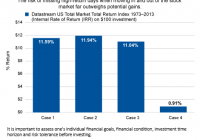
Editor’s note: Originally published on December 22, 2014 Market timing can be a perilous game that long-term investors should avoid playing. It’s difficult to get it right. And the time spent on the sidelines waiting for “the right moment” presents big risks to your portfolio. Last week proved to be a roller-coaster ride for investors and an important reminder for investors to stay the course in the face of short-term market gyrations. Stocks dropped dramatically in the first half of the week, as the price of oil continued to fall and Russia raised interest rates in a desperate attempt to defend the ruble. That all changed on Wednesday afternoon, when the FOMC announcement halted the selloff. The announcement and accompanying projections appeared to soothe markets and actually change the mindset of investors, sending stocks sharply higher. Heading for the Exits Unfortunately, many investors had sold out of stock funds by then and missed that rebound. In fact, according to EPFR Global data, the week ending Wednesday saw the biggest outflows from equity funds since 2005. This is troubling because it shows that investors continue to let their emotions get the better of them. Moving in and out of the stock market based on the headlines is hazardous to the health of investors’ long-term portfolios, and puts financial goals at risk. In light of last week’s market tumult and the response from investors, I feel compelled to repeat the findings of a study published in early 2014 by my colleagues on the Economics & Strategy team at Allianz Global Investors. Their research shows the dangers of market timing. Specifically, the study looked at the performance of the Datastream US Total Market Total Return Index from 1973 through the end of 2013, comparing four different investment approaches: 1. Investing $100 at the start of the first year and adding an additional $100 at the start of each subsequent year. 2. Investing $100 on the day of the lowest index level of the year and adding an additional $100 each year on the day of the lowest index level of that year—the best day of the year to invest. 3. Investing $100 on the day of the highest index level of the year and adding an additional $100 each year on the day of the highest index level of that year—the worst day of the year to invest. 4. Investing $100 each year at the start of the year as in the first approach, but assuming one misses the returns of the best three trading days in each year. The results provide a strong cautionary tale: Time in the market beats timing the market. The returns are actually quite similar in the first three hypothetical scenarios, ranging from 11% to 11.9% in annualized terms. However, the fourth hypothetical produces dramatically lower performance: an annualized return of just under 1%. In other words, it doesn’t matter when you get in, it matters that you stay in for the long haul. Equally compelling are the results of Morningstar’s research on the disparity between mutual fund returns and mutual-fund shareholder returns. Over the 10 years ending Dec. 31, 2013, Morningstar found a widening performance gap between investors and the funds themselves. That makes sense given that investors became extremely risk averse in the wake of the global financial crisis, shunning stocks even as they rebounded. The scars from the crisis clearly run deep and have exacerbated investors’ emotional responses to market events. Breaking down the numbers, Morningstar shows that the typical investor gained 4.8% on an annualized basis over that 10-year period versus 7.3% annualized for the typical mutual fund. The gap is caused by the investor’s time (or lack thereof) in the stock market. In fact, market timing takes a bigger bite out of investor returns than fees for active management. Poor Timing Mutual fund flows in 2012 reveal the perils of market timing. Flows in 2012 Show Poor Timing 2012 Flows ($ Billion) Subsequent Return 2013 (%) U.S. Equity -93,677 35.04 Sector Equity 3,264 18.90 International Equity 13,604 13.19 Allocation 20,399 15.40 Taxable Bond 269,760 0.15 Municipal Bond 50,313 -3.40 Alternative 14,781 -4.85 Commodities 1,365 -9.10 Source: Morningstar. Looking ahead to 2015, we expect more market turbulence and rotation among different styles and asset classes. In this type of environment, it’s critical that investors remember the importance of developing a long-term plan in an emotional vacuum—and adhering to it even when the world around us seems to be panicking. In short, investors don’t plan to fail, but they often fail to plan. The key is to have a plan—and then stick with it. These are words to invest by as we prepare for 2015 and beyond.

SLYV Doesn’t Offer Enough Value For My Portfolio

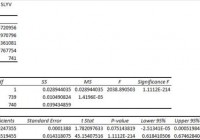
Summary I’m taking a look at SLYV as a candidate for inclusion in my ETF portfolio. The expense ratio is a tad high, but diversification isn’t bad. The correlation with SPY isn’t bad, but the daily returns are more volatile than SLYG. I don’t think I’ll be using SLYV in the foreseeable future. I’m not assessing any tax impacts. Investors should check their own situation for tax exposure. Investors should be seeking to improve their risk adjusted returns. I’m a big fan of using ETFs to achieve the risk adjusted returns relative to the portfolios that a normal investor can generate for themselves after trading costs. I’m working on building a new portfolio and I’m going to be analyzing several of the ETFs that I am considering for my personal portfolio. One of the funds that I’m considering is the SPDR® S&P 600 Small Cap Value ETF (NYSEARCA: SLYV ). I’ll be performing a substantial portion of my analysis along the lines of modern portfolio theory, so my goal is to find ways to minimize costs while achieving diversification to reduce my risk level. What does SLYV do? SLYV attempts to provide results which are comparable (before fees and expenses) to the total return of an unnamed index that tracks small capitalization “value” equity securities in the U.S. By not defining a specific index, it would be difficult for SLYV to fall short of that objective. It may sound like I’m unimpressed with the fund before I even begin the analysis. To an extent, that’s true. I want to see a specific index named so that investors can check how accurately the ETF is tracking that index. I checked the official prospectus to see if there was a mistake. It seems there really is no defined index. SLYV falls under the category of “Small Value”. Does SLYV provide diversification benefits to a portfolio? Each investor may hold a different portfolio, but I use (NYSEARCA: SPY ) as the basis for my analysis. I believe SPY, or another large cap U.S. fund with similar properties, represents the reasonable first step for many investors designing an ETF portfolio. Therefore, I start my diversification analysis by seeing how it works with SPY. I start with an ANOVA table: (click to enlarge) The correlation is about 85.6%, which is great for Modern Portfolio Theory. The lower correlation makes it much easier to mix the ETF into a portfolio and take advantage of the benefits of diversification. My goal is risk adjusted returns, and my method is minimizing risk. Standard deviation of daily returns (dividend adjusted, measured since January 2012) The standard deviation is moderately high, but not terrible. For SLYV it is .9673%. For SPY, it is 0.7300% for the same period. SPY usually beats other ETFs in this regard, and the low correlation with SPY makes the higher standard deviation acceptable. Mixing it with SPY I also run comparisons on the standard deviation of daily returns for the portfolio assuming that the portfolio is combined with the S&P 500. For research, I assume daily rebalancing because it dramatically simplifies the math. With a 50/50 weighting in a portfolio holding only SPY and SLYV, the standard deviation of daily returns across the entire portfolio is 0.8183%. If an investor wanted to use SLYV as a supplement to their portfolio, the standard deviation across the portfolio with 95% in SPY and 5% in SLYV would have been .7354%. Ironically, when I compared the growth version of this fund (NYSEARCA: SLYG ), which is very similar except for investing in “growth” securities, SLYG had lower correlation and a lower standard deviation of returns. I would have expected SLYG to have lower correlation than SLYV, but I would not have expected it to exhibit a smaller standard deviation of returns. In short: SLYV performed worse on both risk metrics than SLYG. Liquidity The average trading volume was a little over 30,000 shares, which is high enough that I’m not concerned. Why I use standard deviation of daily returns I don’t believe historical returns have predictive power for future returns, but I do believe historical values for standard deviations of returns relative to other ETFs have some predictive power on future risks and correlations. Yield & Taxes The distribution yield is 1.36%. The SEC yield is 1.37%. That yield isn’t terrible, but investors won’t be able to retire on yields that are significantly under 2%. In my opinion, this is a difficult space for an ETF to be in. The “value” realm can be associated with less volatility and higher yields which make it more appealing for retirees. This “value” ETF doesn’t have enough yield to be strong in the category but offered more volatility and correlation to SPY than the growth ETF. I’m not a CPA or CFP, so I’m not assessing any tax impacts. Expense Ratio The ETF is posting .25% for an expense ratio. I want diversification, I want stability, and I don’t want to pay for them. The expense ratio on this fund is not too bad, but I’d like to see it lower for an ETF that invests in U.S. equity securities. Market to NAV The ETF is at a .17% premium to NAV currently. Premiums or discounts to NAV can change very quickly so investors should check prior to putting in an order. I wouldn’t want to pay a premium greater than .1% when investing in an ETF, unless I could find a solid accounting reason for the premium to exist. Largest Holdings Just like SLYG, the diversification is fairly solid. No investment is over 1% of the portfolio, but that also isn’t diversified enough to explain the .25% expense ratio. (click to enlarge) Conclusion I’m currently screening a large volume of ETFs for my own portfolio. The portfolio I’m building is through Schwab, so I’m able to trade SLYV with no commissions. I have a strong preference for researching ETFs that are free to trade in my account, so most of my research will be on ETFs that fall under the “ETF OneSource” program. I just don’t see enough benefits to SLYV to try to use it in the portfolio. Due to the low correlation, an investor may find a 1% exposure to be very reasonable. For me, 1% simply isn’t large enough when investing in ETFs. Additional disclosure: Information in this article represents the opinion of the analyst. All statements are represented as opinions, rather than facts, and should not be construed as advice to buy or sell a security. Ratings of “outperform” and “underperform” reflect the analyst’s estimation of a divergence between the market value for a security and the price that would be appropriate given the potential for risks and returns relative to other securities. The analyst does not know your particular objectives for returns or constraints upon investing. All investors are encouraged to do their own research before making any investment decision. Information is regularly obtained from Yahoo Finance, Google Finance, and SEC Database. If Yahoo, Google, or the SEC database contained faulty or old information it could be incorporated into my analysis. The analyst holds a diversified portfolio including mutual funds or index funds which may include a small long exposure to the stock.