Tag Archives: lists

5 Ways To Play Rising Rates With Hedged And Inverse ETFs

The recent U.S. labor market data yet again corroborated the sturdy U.S. economic growth. While weak wage growth has been bothering the investing world for quite some time, a better than expected average hourly earnings data finally wiped out investors’ fears. In this backdrop, most have started speculating a sooner than expected hike in the Fed interest rates, which have been at a rock-bottom level for long. Yields on 10-year Treasury notes crossed the 2% mark on February 10 for the first time after January 8, 2015. Fixed-income investing had enjoyed a great show in 2014 and so far in 2015, especially in the longer part of the yield curve. However, the prospect of rising rates and risks to capital gains of the bond holdings have left investors jittery about the safety of their portfolios and brought rate rise worries back on the table. Given the situation, many investors are definitely pulling their money out of the bond market. At a time like this when investors are extremely cautious about rising rate risks and stock market volatility, investments in U.S. bonds with significant protection against potential rising rates can be good bets. Some opportunistic investors could capitalize on this backdrop in the form of inverse ETFs too (read: Two Interest Rate Hedged ETF Launches from iShares ). iShares Interest Rate Hedged High Yield Bond ETF (NYSEARCA: HYGH ) This fund holds in its basket iShares iBoxx $ High Yield Corporate Bond ETF (NYSEARCA: HYG ) while taking short positions in U.S. Treasury futures to diminish rising rate concerns. HYGH has a weighted average maturity of 4.60 years while its effective duration stays ultra-low at 0.32 years. HYGH is high yield in nature as evident from its 30-day SEC yield of 5.47%. HYGH charges 0.55% of expense ratio. The fund has added about 2% in the last five trading sessions (as of February 10, 2015) (see all the junk bond ETFs here). ProShares High Yield Interest Rate Hedged ETF (BATS: HYHG ) HYHG is another ETF, which has an interest rate hedge built into its strategy as it takes a short position in U.S. Treasury futures. Like HYGH, it also has a pretty high yield (and a modest expense ratio of just 50 basis points) of 5.9% in 30-Day SEC terms, indicating that this could be a safer bond and yield play for investors anxious about the possibility of rising rates. This $125.4 million ETF was up 1.9% in the last five trading sessions (as of February 10, 2015) (read: 5 Dividend ETFs to Buy for Income in 2015 ). ProShares Investment Grade-Interest Rate Hedged ETF (BATS: IGHG ) This investment grade fund too offers interest-hedge benefit to investors. The fund looks to track the Citi Corporate Investment Grade (Treasury Rate-Hedged) Index, which comprises long positions in USD-denominated investment grade corporate bonds issued by both U.S. & foreign domiciled companies while adopting short positions in US Treasury notes or bonds of approximate equivalent duration to the investment grade bonds. The index seeks to achieve an overall effective duration of zero. Its 30-Day SEC yield stands at 3.32% (as of February 10, 2015) while it charges 30 bps in annual fees. The fund was up 1.1% in the last five trading sessions (as of February 10, 2015). Barclays Inverse US Treasury Aggregate ETN (NASDAQ: TAPR ) The note provides investors a unique strategy to hedge against or benefit from the rising U.S. dollar interest rates by tracking the Barclays Inverse US Treasury Futures Aggregate Index. This benchmark employs a strategy, which follows the sum of the returns of the periodically rebalanced short positions in equal face values of each of the 2-year, 5-year, 10-year, long-bond and ultra-long U.S. Treasury futures contracts (read: Interest Rate Speculation: A Boon for TAPR ETF ). If the price of each Treasury futures contract increases or decreases by 1% of its face value, the value of the index would decrease or increase by 5% over the same period. The fund charges 43 bps in annual fees and trades in light volume of under 5,000 shares per day on average, ensuring additional cost in the form of a wide bid/ask spread. The fund has added about 16.6% in the last five trading sessions. iPath US Treasury 5-year Bear ETN (NASDAQ: DFVS ) The fund looks to track inverse movements in the yields from buying 5-year U.S. T-Notes. To do this, its underlying index tracks the returns of an investment in a weighted “short” position in relation to 5-year Treasury contracts. This $4.8 million ETF was up about 8.9% in the last five trading sessions. The fund charges 75 bps in fees. Bottom Line As a caveat, investors should note that these inverse products are suitable only for short-term traders as these are rebalanced on a daily basis (see: all the Inverse Bond ETFs here). Still, for ETF investors who are bearish on the bond market in the near term, any of the above products could make an interesting choice.
Is UNG On Its Road To Recovery?

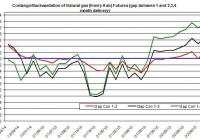
Summary The price of UNG rallied in recent weeks. The colder-than-normal weather could further push up the demand for natural gas. The storage is still expected to be higher than normal by the end of March. The energy market has started to heat up again as the price of The United States Natural Gas ETF, LP (NYSEARCA: UNG ) rose by 4% since the beginning of the month. Let’s review the latest developments in the natural gas market. In the natural gas futures market, there is a change, in which the market is slowly moving from backwardation to contango. The contango in the futures market indicates an expected rise in natural gas prices in the subsequent weeks. But a rise in the contango could also result in UNG underperforming natural gas prices due to roll decay. The chart below presents the changes in the contango/backwardation in the futures market for the coming months. Source of data taken from EIA The weakness in the natural gas market was driven by lower-than-normal demand for heating this winter. During the past several weeks, the average extraction from the natural gas underground storage was around 81 Bcf per week, as indicated in the table below. Source of data taken from EIA In the past week, the EIA reported a 160 Bcf withdrawal from storage, which was slightly below market expectations and lower than the 5-year average – 178 Bcf. The extraction from storage tends to last until the end of March. So we are likely to have only a month and a half more of withdrawals from storage. Next week, the extraction is expected to be close to the 5-year average. The average deviation from temperatures was only around 1.81; this suggests, at face value, an extraction from storage of around 180 Bcf. Since the week-over-week changes also include a lot of noise, these conclusions should be taken with more than a grain of salt. Last week, the demand for natural gas declined by 7.6% and was nearly 20% below the demand recorded the same week last year. Conversely, production continues to slowly pick up (rose by 0.1% in the past week) and is 13% higher than last year. According to the latest news from Baker Hughes (NYSE: BHI ), gas rigs have dropped by 14 to reach 300 rigs. Despite the drop in demand, it’s still well above the supply, which is likely to maintain a high level of volatility in UNG prices in the near term. The demand for natural gas is likely to pick up in the coming weeks on account of expected lower-than-normal weather throughout the East, including the Midwest and Northeast. Moreover, heating degree days are projected to be higher than normal, which could also suggest a rise in demand for natural gas for heating purposes. The big picture, however, still shows the natural gas storage to be slightly above the 5-year average level by April. The EIA also projects, for now, the underground storage to be around 43 Bcf above the 5-year average by the end of March – it will reach a total of 1,699 Bcf. Despite the drop in rig count and only modest gain in production in the past week, the storage continues to fall at a slower pace than normal, which is likely to bring it above the 5-year average by the end of the extraction season. The colder-than-normal weather could bring back up UNG prices in the near term, but this rally may not last long if production keeps building up and demand doesn’t exceed current market expectations. For more see: Contango in Natural Gas Market Disclosure: The author has no positions in any stocks mentioned, and no plans to initiate any positions within the next 72 hours. (More…) The author wrote this article themselves, and it expresses their own opinions. The author is not receiving compensation for it (other than from Seeking Alpha). The author has no business relationship with any company whose stock is mentioned in this article.

Stealing Someone’s Homework

Unit trusts are a simple way to invest, but their fee structures may be cost prohibitive for some. Unit trust companies, in their fact sheets, provide proven selection processes that one is able to replicate. By using their proven track records, one is able to develop a nice portfolio that works well with a “Buy and Watch” philosophy. Equity unit investment trusts are interesting allocation vehicles that have been around since the Investment Company Act 1940. They are investment companies, and the easiest description one can give is they provide a list of researched stocks that one can hold for periods ranging from 15 months to four years. They are unmanaged, as the stocks are selected with the philosophy of holding them throughout the maturity period. When the trust matures, one can take the value of the investment at NAV, or reinvest everything in another portfolio as a “rollover”. Rollovers are usually free. Conceptually, I like them, because they fit well within a “Buy and Hold” strategy, but allow one to make periodic changes over the years. The fee structures, though, make them prohibitive for those who are looking for a way to keep costs down. Fees for First Trust’s Capital Strength Portfolio average an initial 1.975% per year. Invesco’s Dividend Income Leaders Strategy Portfolio has an average annual initial fee of 2.36%. Both of these annual fees are reduced to 1.475% and 1.56% respectively with the free rollovers they provide. There are break points for high net worth investors where the fees can be reduced to 0.725% for First Trust and 0.32% for Invesco. Don’t misread as one saying these strategies do not work. They do. The question is whether one wants to pay the fees. If you don’t, then steal their homework. If one studies the fact sheets these companies provide, they do have fairly easy strategies that can be replicated on one’s own. Take the Capital Strength Portfolio for example. The fact sheet has these parameters for its stock selection process: Begin with the S&P 500 Cash greater than $1 billion Long Term Debt/Market Value of Equity < 30% Return on Equity > 15% Cash Flow Analysis and Analyst Judgment Hold for 24 months Does this strategy work? It sure does. I ran a general backtest to see how this approach performed since 1989. The results? How does an average annual return of 14.46% (σ = 23.82%) work for you? The S&P 500 averaged 10.14% during the same period; an excess of 430 basis points that is nothing to sneeze at. Given that a basic portfolio screen returns around 30 stocks, this is a fairly manageable strategy if one is willing to let the strategy play out over a two year period. The following table provided is a list of potential stocks for a 24 month portfolio: Ticker Name AAPL Apple Inc ACN Accenture PLC ADP Automatic Data Processing Inc. AFL AFLAC Inc AGN Allergan Inc. AVGO Avago Technologies Ltd BEN Franklin Resources Inc BIIB Biogen Idec Inc CA CA Inc CMI Cummins Inc. CTSH Cognizant Technology Solutions Corp EXPD Expeditors International of Washington Inc. FLR Fluor Corp GD General Dynamics Corp GOOG Google Inc GRMN Garmin Ltd INTC Intel Corp JNJ Johnson & Johnson LLY Eli Lilly and Co LRCX Lam Research Corp MA MasterCard Inc MSFT Microsoft Corp NKE Nike Inc PCLN Priceline Group Inc (The) PG Procter & Gamble Co (The) PH Parker-Hannifin Corp QCOM QUALCOMM Inc. SLB Schlumberger Ltd TROW T. Rowe Price Group Inc WDC Western Digital Corp XOM Exxon Mobil Corp YHOO Yahoo Inc Is there another way, though? What if you want to be a completely passive investor, but like this approach to stock selection? Well, there is an option for that too. Using the Capital Strength Index, which has many of the same screening criteria, The First Trust Capital Strength ETF (NASDAQ: FTCS ) is a nice way to go. It is a managed ETF with a moderate fee structure (0.76% gross), and has performed nicely since inception, and still beats the S&P 500. The way I see it, this is a nice passive way to invest, and still get performance from one’s portfolio. The 30 or so stocks are easy to watch and hold, and one only has to restructure biannually. It is an idea one should consider, if indexing is not part of the strategy. It is suggested here to study the strategies, and find one that works for you. If you would rather someone else do the work, then hire the companies and buy one of their portfolios. If that is even too much work, buy the ETF. Happy Investing! Disclosure: The author is long CTSH, QCOM. (More…) The author wrote this article themselves, and it expresses their own opinions. The author is not receiving compensation for it (other than from Seeking Alpha). The author has no business relationship with any company whose stock is mentioned in this article.