Tag Archives: lists

Bet On The American Consumer With These 3 ETFs

You pretty much have to believe in the resiliency of the U.S. consumer, as spending comes as second nature to most Americans. And given some of the recent economic trends, we could definitely see a burst in purchasing in the near term by this consumption-hungry group. Recent Trends After years of stagnation, the job market is finally starting to come back, giving plenty of lower income consumers some extra cash. And, with the market finally seeing some wage inflation raises, more money is going into consumers’ pockets all the time. Consumers are also seeing strong stock prices which makes many feel wealthier and thus more likely to spend, while the current state of the housing market doesn’t hurt matters either. After all, a house is the biggest investment for most people so with the Case-Schiller 20 city well off of the post-crash lows, the general mood is much improved as well. But arguably the most important trend for consumers lately is the sudden crash in oil prices. Crude has fallen to levels unseen in years, reducing gas costs for millions of Americans. These small savings each week are finally starting to add up, and are basically a massive tax cut for the middle class, freeing up dollars for discretionary purchases. Impact These trends set up nicely for the consumer sector, and in particular, the cyclical space. However, it is worth noting that we have yet to truly see a stock price impact, as many consumer stocks and funds have not led the market higher so far in 2015. This is actually great news for investors as it suggests there is still time to get in on the sector before consumers reallocate their new-found money to discretionary purchases. And thanks to ETFs, we don’t have to guess which particular company will benefit the most, as we can just buy the whole sector instead. For investors seeking to apply this approach to their portfolios, we have highlighted three consumer discretionary ETFs below which could be excellent choices in this type of environment. All three are quite diversified and have significant holdings in mid or small cap stocks, giving them a big tilt towards U.S.-centric companies: PowerShares DWA Consumer Cyclicals Momentum Portfolio ETF ( PEZ ) This fund looks to identify companies that are showing relative strength characteristics in the consumer cyclical space. The ETF seeks to hold at least 30 stocks in its portfolio, while it will charge an expense ratio of 60 basis points a year. Current holdings are focused on specialty retail (23%), airlines (15.5%), and hotels/restaurants/leisure (14.8%). However, it is worth noting that the product is pretty well spread out from an individual holding perspective, as no single company makes up more than 5.3% of total assets. We should also point out that the fund has a pretty health allocation to small and mid cap securities as these make up close to 60% of the portfolio. Currently, the fund has a Zacks ETF Rank #2 (Buy) and a medium risk outlook. Guggenheim S&P Equal Weight Consumer Discretionary ETF ( RCD ) For another way to play the consumer market, RCD is an excellent choice for those seeking an equal weight approach. The fund takes the S&P 500 consumer discretionary sector, and instead of weighting by market cap, gives each company in the space the same level of holdings. This results in a fund that has about 21% of its assets in specialty retail, 17% in media, and then 12.8% in the hotel/restaurant/leisure category. And due to the equal weight approach, no single company makes up more than 1.6% of assets. The ETF puts about half its portfolio in mid caps and the rest in large caps, which compares to roughly 80% large caps for the cap-weighted Consumer Discretionary Select Sector SPDR ETF (NYSEARCA: XLY ). RCD currently has a Zacks ETF Rank #3 (hold) and it has a medium ETF Risk rating. PowerShares S&P SmallCap Consumer Discretionary Portfolio ETF ( PSCD ) If you are looking to just zero in on small cap securities in the consumer space, PowerShares’ PSCD will be tough to beat. The fund targets a subset of the S&P SmallCap 600 Index, focusing on about 90 companies that are in the business of providing consumer goods and services. The fund has a heavy focus on specialty retail (29%) and hotels/restaurants/leisure (about 29% each), followed by apparel (13.8%), and household durables (11.1%). It is pretty spread out in terms of individual holdings too, as only Jack In The Box (NASDAQ: JACK ) and Buffalo Wild Wings (NASDAQ: BWLD ) have allocations greater than 3% in the portfolio. The entire portfolio is focused on small caps, though it is worth pointing out that growth leads the way with a 40% holding. The fund has a Zacks ETF Rank #2 (Buy), though it has a high ETF Risk outlook.
Income-Oriented ETF Provides Exposure To Infrastructure Boom

By DailyAlts Staff Investors seeking exposure to global infrastructure assets have a new and attractive option, thanks to the February 11 launch of the Guggenheim High Income Infrastructure ETF (NYSEARCA: GHII ). The new ETF is the first infrastructure ETF to weight its holdings according to 12-month trailing dividend yield, rather than market capitalization or some other measure. The result is an investment vehicle that provides exposure to public services, toll roads, airports, water, pipelines, utilities, and other essential services around the world, with a focus on generating current income for its investors. Global Exposure The Guggenheim High Income Infrastructure ETF tracks the S&P High Income Infrastructure Index, which is composed of the S&P Global BMI’s 50 highest-dividend-paying companies in the energy, transportation, and utilities sectors. The fund and its underlying index have a global footprint, with only about one-fifth of components domiciled in the United States. The fund’s top holdings include investments in Australia (14%), China (9%), Spain (8%), and Italy (8%); and it also has significant exposure to infrastructure assets in Britain, Canada, Singapore, and France. “The infrastructure asset class offers investors the opportunity to realize enhanced return and capital appreciation,” said a Guggenheim spokesperson. “Offering strong cash flow potential, assets with typically long life spans, as well as relatively low volatility and significant barriers to entry, infrastructure provides investors with access to an emerging segment of the market aligned with the global recovery.” Continued Infrastructure Spending The launch of the Guggenheim High Income Infrastructure ETF appears to be well-timed, as governments around the world – despite fiscal and monetary woes – are planning ambitious new rounds of infrastructure spending. Oxford Economics and PwC project global infrastructure spending will total nearly $78 trillion between 2014 and 2025; with about 60% of that attributable to the Asia Pacific. In the U.S., the White House says that infrastructure investment will continue to be needed even after the economy reaches full employment, but that “time is running out to make these needed investments under ideal economic conditions.” Shares of the Guggenheim High Income Infrastructure ETF face an expense ratio of 0.45% – two basis points less than the 0.47% charged by the rival iShares Global Infrastructure ETF (NYSEARCA: IGF ).

SKYY: Tech ETF Investors Look Up To The Cloud

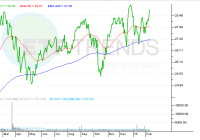
Summary Investors are turning to the cloud computing space. Focus on the First Trust ISE Cloud Computing Index fund. Cloud computing explained and industry overview. Investors are piling into the cloud computing industry and sector-related exchange-traded funds to capture a quickly growing segment of the digital age. The First Trust ISE Cloud Computing Index ETF (NasdaqGM: SKYY ) , which tracks a modified equally weighted index of companies engaged in the business activity of supporting or utilizing cloud computing services, now has $408.5 million in assets under management. SKYY has seen its AUM burgeon twofold over the past year, attracting $214.9 million in net inflows since January 2014, according to ETF.com data. Cloud computing refers to a mode of accessing digital information from the internet through web-based tools and applications, instead of directly connecting to a server. The desired data and software packages are stored in servers where a consumer can access them from anywhere as long as one has access to the internet. Investors are anticipating a significant shift in technology, as old packaged and desktop software are pushed aside, while consumers and businesses shift into simpler web- and mobile phone-based services, reports Ari Levy for CNBC . The global cloud computing market is expected to expand 30% per year and hit $270 billion by 2020. SKYY breaks down its component holdings into several sub-sectors. Pure play cloud computing companies are comprised of direct service providers for the cloud, which include network hardware/software, storage and cloud computing services. Non-pure play cloud computing companies are those that provide goods and services in support of the cloud computing space. And lastly, are the technology conglomerate cloud computing companies that directly utilize or support the use of cloud computing. SKYY includes one of the largest tilts toward Netflix (NASDAQGS: NFLX ) at 4.4% of the ETF’s underlying portfolio, along with other companies that utilize cloud computing services, like Amazon (NASDAQGS: AMZN ) at 3.9%. The broad ETF, which includes 39 companies involved with cloud computing, provides a diversified way for investors to access the sector, as valuing individual companies could be unorthodox. While the cloud computing space has attracted more investment dollars, observers are unsure how to properly value the companies For example, of the 26 index members to recently go public, 21 are losing money on generally accepted accounting principle basis, with a combined $388.7 million in the red last quarter – many of the companies opt to incur large expenditures upfront and amortize costs later through revenue streams. Consequently, traditional price-to-earnings ratios may not properly reflect valuations. Instead, most of these cloud computing-related business models rely on churn and retention – it takes about a year for a customer to become profitable due to costs of sales and market, so the companies rely on renewal rates, which is why subscriber rates are so important for companies like Netflix as witnessed in its last earnings report. First Trust ISE Cloud Computing Index Fund (click to enlarge) Disclosure: The author is long AMZN. (More…) The author wrote this article themselves, and it expresses their own opinions. The author is not receiving compensation for it. The author has no business relationship with any company whose stock is mentioned in this article.