Tag Archives: investing ideas

Beyond India: Look At These Overlooked Broad Emerging Market ETFs

For the past one year, India has been dominating the broad emerging markets, thanks to the enormous ascent of its stock market on pro-growth political hopes, declining inflation – which was once a botheration for the economy – and the latest interest rate cut to spur growth. While its supremacy is still prevalent in the emerging market space, one might be concerned about the overvaluation issues associated with the Indian stocks and the related ETFs. Presently, the biggest and broader emerging market ETF – the Vanguard FTSE Emerging Markets ETF (NYSEARCA: VWO ) and the broader U.S. market SPDR S&P 500 Trust ETF (NYSEARCA: SPY ) sport a P/E (TTM) of 12 and 17 times, respectively, while iShares MSCI India Index ETF (BATS: INDA ) has a P/E (TTM) of 19 times. Secondly, a drastic slump in oil price played its role in facilitating the India ETFs’ upward journey. This was because the country imports more than 75% of its oil requirements. With global oil prices falling about 50% in the last six months, Indian foreign reserves found real reasons to cheer about. However, it remains to be seen how the Indian economy handles the situation when the oil price bottoms and reverses the trend. Also, some analysts believe that the not-so-enthusiastic December 2014 corporate results, a later-than-expected rebound in the investment cycle and overvaluation with respect to the future profit growth potential might stress out the Indian market. Given this situation, some cautious investors might begin to reconsider their emerging market investments and look for broader exposure, rather than sticking to any particular nation. After all, the emerging market space should continue to enjoy cheap money inflows, thanks to QE starting in the eurozone and the easy money policy in most developed nations, despite the likely beginning of policy tightening in the U.S. this year. In light of this, we have highlighted four overlooked ETFs that are tracking emerging markets from around the world (See all emerging market equities ETFs here ). Market Vectors MSCI Emerging Markets Quality ETF (NYSEARCA: QEM ) This fund has attracted $5.3 million in AUM. It charges a 50 bps fee per year, and trades in a paltry volume of around 1,500 shares a day, ensuring additional cost in the form of a wide bid/ask spread. The product tracks the MSCI Emerging Markets Quality Index, and holds 201 stocks in its basket (Read: QEM: A Higher Quality Emerging Market ETF? ). The ETF is slightly tilted toward the top four firms – China Mobile, Tencent Holdings, Taiwan Semiconductor and Samsung Electronics – that collectively make up for more than 20% of total assets. Other firms hold not more than 3.01% share, suggesting modest diversification across each security. The holding pattern reflects the fund’s focus on Asian countries like China (20.7%), India (13%), Taiwan (13.0%), South Korea (12%) and South Africa (11.1%), which take the top five country spots. In terms of sector holdings, Information Technology dominates the portfolio at 34%, followed by Consumer Staples (16.8%), Telecommunication Services (12.6%) and Financials (11.5%). The fund has gained 6.2% since the start of the year (as of February 13, 2015) and more than 8.5% in the last two weeks. The fund yields 2% annually (as of the same date). Behind its decent performance is quality exposure across a number of deserving sectors in the emerging markets and a focus on high-quality criteria like high return on equity, stable year-over-year earnings growth and low financial leverage. The fund trades at a P/E (TTM) of 15 times. iShares MSCI Emerging Markets EMEA Index ETF (NASDAQ: EEME ) This fund has amassed about $8.8 million in assets so far, and trades in volumes of 2,000 shares a day, resulting in additional cost in the form of a wide bid/ask spread over and above the expense ratio of 49 bps a year. The fund is tilted toward South Africa (46.2%), Russia (20.9%), while the third country, Turkey, gets a meager allocation of 9.64%. As far as sectoral diversification is concerned, Financials gets about 34% of the basket, followed by Energy (16.6%) and Consumer Discretionary (14.8%). The latest cease-fire between Ukraine and Russia and the record rally in the South African stocks led the fund way higher. The fund has gained 4.2% so far this year (as of February 13, 2015) and about 6.6% in the last two weeks. The fund yields 3.1% annually (as of February 13, 2015). It trades at a P/E (TTM) of 10 times. ALPS Emerging Sector Dividend Dogs ETF (NYSEARCA: EDOG ) The product tracks the S-Network Emerging Sector Dividend Dogs Index, which gives exposure to a basket of large-cap and high-yield stocks domiciled in the emerging markets. The index takes up an equal-weighted approach to assign weights to securities (Read: ALPS Debuts Dividend ETF in Emerging Market Space ). The index applies the “Dogs of the Dow” theory in the stock selection process. The product looks to hold about 50 stocks with this approach. The ETF offers a solid level of diversification, as both sector and country exposure is limited to five securities. Russia (11.2%), South Africa (10.4%), Brazil (10.3%), China (10%) and Thailand (9.65%) are some of the nations that the fund puts heavy weight on. EDOG has generated about $11.3 million in assets, and trades in 10,000 shares a day. It charges 60 bps in fees. The fund is up 6% in the YTD frame (as of February 13, 2015), while it yields 3.2%. The need for higher yield should be the key to the fund’s future success. EGShares Emerging Markets Domestic Demand ETF (NYSEARCA: EMDD ) EMDD seeks to tap the exponentially rising domestic demand of the emerging market space. The fund puts heavy weight on South Africa (20.2%), China (19.2%), Mexico (16%) and India (11.1%). It has an asset base of $35 million, and trades in volumes of more than 5,000 shares a day. The fund charges 85 bps in fees. Holding about 50 stocks in its portfolio, the fund does not put more than 5.37% assets in one stock. EMDD was up 5% so far this year, and has added about 3.5% in the last two weeks. The P/E (TTM) of the fund stands at 17 times.
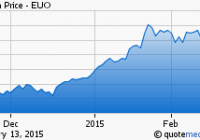
Up 20% In 3 Months Since My Recommendation, Sell EUO Stakes Now

The ProShares UltraShort Euro (EUO) ETF is up 20% over the three months since I recommended it, but I’m suggesting investors close their stakes here. The factors that came against the euro are about to reverse, and I see the euro gaining strength against the dollar near-term. A favorable Greece resolution is imminent in my opinion, and the European economy is steadying. The dollar is overextended versus the euro and against other currencies and should give way now, and thus the EUO ETF’s success should end here. In mid-November, I suggested investors buy the ProShares UltraShort Euro (NYSE: EUO ). Today I’m suggesting investors close the position and take the 20% profit earned over the 3 month period. I see the factors that have worked against the euro about to reverse, so sell the EUO ETF and take your gain. Holding Period Chart of EUO +20% at Seeking Alpha If you agreed with my investment thesis on the EUO ETF shared on November 19, 2014 when I suggested investors buy the ProShares UltraShort Euro , well then you have generated a 20% paper profit in the three month holding period through the February 13 close. It’s now time to close the stake, as I am anticipating the euro will strengthen against the dollar from here. My main thesis in the aforementioned report was keyed on a potential Russian rebuttal to Europe’s hand in sanctions against it. However, the curiously timed and perhaps not coincidental drop in oil prices that occurred this winter handcuffed Russia, in my opinion. It seems to have effectively kept the cash-strapped, energy based Russian Federation from acting in the manner I anticipated it might. I speculated Russia could cut off the flow of energy into Europe in the middle of winter and harm the euro’s value against the dollar. While this is still possible, the also curiously timed recently stepped up effort by European leaders to drive a peace initiative between Ukraine and the Russian backed rebels in the East of the country is serving the same purpose, again keeping Russia from acting against Europe. Importantly, in my November report, I also said that a weakening European economy and the potential for European Central Bank (ECB) extraordinary action had been serving the dollar versus the euro and should continue to add support to the dollar. This proved to be a continuing driver against the euro, assisted by the critical political developments in Greece that later followed. In essence, the Greek issue took the place of my Russian factor and drove the euro down versus the dollar, and led the ProShares UltraShort Euro up 20% over the three month period. Intensifying fear of a Greek exit from the euro-zone has been the booster of the dollar against the euro year-to-date, and affected a great deal more than just the currencies in my opinion. In the uncertainty, demand for U.S. treasuries drove U.S. interest rates down, and thus major U.S. financial sector issues in Bank of America (NYSE: BAC ), J.P. Morgan Chase (NYSE: JPM ) and others. The stronger dollar has played an important role in the fall of oil prices along with supply issues in my view. And the uncertainty around Europe and how it might affect the United States economy worked against U.S. equities this year in my view. But all this is about to change. I anticipate a favorable resolution between Greece and its European partners is imminent. The removal of the palpable fear that has gathered around this issue should serve a U.S. market rally in my opinion. Improving expectations have already begun to drive U.S. interest rates higher, and the dollar recently gave way a bit to the euro. European economic expectations are also improving in my opinion and Japan just exited recession . As the euro gains its strength back against the overextended dollar, the EUO ETF, which is a bet against the euro, should give way. Thus, while still ahead of the announcement of a Greek deal, you have time momentarily to close the investment I suggested in November. If you need a place to invest your gains from the EUO play, on the same thesis, I have recently suggested investors look to: the UDN ETF contra-dollar investment; or a short of the UUP ETF ; and a short of the iPath S&P VIX (NYSE: VXX ); or long investments in financial sector beneficiary Bank of America , which should rise on higher U.S. interest rates. Also, I’ve suggested Greek issues including the National Bank of Greece (NYSE: NBG ) and the Global X FTSE Greece 20 ETF (NYSE: GREK ). Readers may review my column for more. Disclosure: The author is long GREK, NBG, BAC. (More…) The author wrote this article themselves, and it expresses their own opinions. The author is not receiving compensation for it (other than from Seeking Alpha). The author has no business relationship with any company whose stock is mentioned in this article. Additional disclosure: I’m short VXX and UUP.

American Century Makes Its Liquid Alts Move

By DailyAlts Staff American Century has been fairly quiet on the liquid alternatives front as the product category has experienced a boom since the 2008 financial crisis. In 2011, the firm launched two “130/30” funds and a market-neutral fund, and it has been operating another equity market-neutral fund since 2005, but American Century has largely been on the sideline of the liquid alts movement. That is, until now. On February 3, American Century filed paperwork with the Securities and Exchange Commission (SEC) seeking approval for three new alternative mutual funds. The firm has also initiated a new brand for its alternatives business and filed to trademark the brand “AC Alternatives,” which is used on the new line of alternative mutual funds. The AC Alternatives Income Fund The AC Alternatives Income Fund’s stated objective is providing investors with “diverse sources of income.” In pursuit of this objective, the fund’s managers will combine several distinct strategies designed to capture current yield, while also seeking to protect inflation-adjusted purchasing power through capital appreciation. Some of the fund’s strategies and investments will include: Corporate credit strategies Structured credit strategies Real estate strategies MLP strategies Income-oriented equity strategies The fund will also pursue PWP overlay strategies, which involve “exploiting market opportunities, managing inflows and outflows of fund assets and/or hedging against certain risks” identified by sub-advisor PWP. Arrowpoint Partners and Good Hill Partners are also listed as sub-advisors to the fund, but according to the prospectus, PWP “may make recommendations to the advisor to terminate and replace underlying sub-advisors from time to time.” The AC Alternatives Equity Fund The AC Alternatives Equity Fund will employ several equity strategies, with low correlation to one another and the broad market, in pursuit of capital appreciation. As with the AC Alternatives Income Fund, PWP is a sub-advisor and PWP overlay strategies are among the equity strategies that will be utilized by the AC Alternatives Equity Fund. Other strategies include: Long-only Long/short Event driven Trading oriented strategies In addition to the overlay strategies, PWP will also sub-advise the fund’s event driven and trading strategies, while Passport Capital will sub-advise its long/short equity strategies. The AC Alternatives Multi-Strategy Fund Finally, the AC Alternatives Multi-Strategy Fund will pursue four distinct strategies managed by four different sub-advisors, as well as four additional strategies sub-advised by PWP. The strategies, which span asset classes, are listed below with their sub-advisors in parenthesis: Long/short credit (Good Hill Partners) Long/short credit (MAST Capital) Event driven (Levin Capital) Long/short equity (Passport Capital) Overlay (PWP) Global macro (PWP) Real assets (PWP) Trading strategies (PWP) American Century’s Existing Alts The three new alternative mutual funds will join American Century’s current lineup of liquid alts, which include a pair of “130/30” funds (arguably not an alternative strategy since it has a beta of 1.0 to its benchmark) and a pair of market-neutral equity funds. The “130/30” funds, which average 130% long and 30% short equity exposure, have outperformed their long-only counterparts. The American Century Core Equity Plus Fund (MUTF: ACPVX ), with approximately $170 million in fund assets, has a five-star rating from Morningstar and generated a 14.99% return for the year ending January 30. The American Century Disciplined Growth Plus Fund (MUTF: ACDJX ), with approximately $33 million in fund assets, also has a five-star rating, and it generated an even better 20.21% return for the year ending January 30. The American Century Market Neutral Value Fund (MUTF: ACVVX ) launched at the same time as the two “130/30” funds and currently has approximately $76 million of fund assets. It has a four-star rating from Morningstar and generated a 3.31% return for the year ending January 30, which was still enough to rank it in the top 19% of its category. American Century’s oldest liquid alts product, the American Century Equity Market Neutral Fund (MUTF: ALHIX ), also has a four-star rating. It returned 2.07% for the year ending January 30 and currently has approximately $117 million of fund assets. For more information, visit americancentury.com .