Tag Archives: history

What Does History Tell Us About Consolidated Edison’s Valuation?

Shares of Consolidated Edison have previously traded at a valuation comparable to today’s mark. This article looks at what happened then, noting that while the P/E ratios are similar, today’s dividend yield is lower. In the end it comes down to your expectations, but it appears as though shares of ED are exchanging hands at the upper end of their historical range. Shares of Consolidated Edison (NYSE: ED ) increased in price by about 19% during 2014 — moving from $55.28 at the beginning of the year to $66.01 at year-end. If you add in dividends received, equating to $2.52 per share , your total return would have been roughly 24% — a full 10% higher than the S&P 500 index (NYSEARCA: SPY ). Despite the strong underlying business, this wouldn’t be something that you would expect moving forward. Utilities don’t routinely provide market-beating returns, at least not year-in and year-out. During the past 12 months the company reported earnings per share of $4 . With today’s share price around $68, this translates to a P/E ratio nearing 17, a dividend yield of 3.7% and payout ratio of 63%. The valuation approached similar levels during 2012 and 2013, but really you have to go back to 2007 to make a reasonable historical comparison — one or two years of history isn’t as telling as eight might be. At the end of 2006 the company reported adjusted earnings per share around $3 . During March of 2007, shares were changing hands around $51 resulting in a trailing P/E ratio near 17 — much like today. The dividends declared that year equaled $2.32, for a dividend yield of 4.6% and a payout ratio near 80%. Today the dividend yield and payout ratio is lower, but has a similar earnings multiple. So how did things end up for the investor of 2007, partnering with the company at a higher valuation and lower dividend yield than what was recently available? As previously mentioned, the stock price went from $51 to $66 — a 29% total increase or an annual increase of about 3%. Here’s a look at the dividends received: 2007 = $1.74 2008 = $2.34 2009 = $2.36 2010 = $2.38 2011 = $2.40 2012 = $2.42 2013 = $2.46 2014 = $2.52 Note that this particular investor would have missed a dividend payment in 2007 due to the March purchase date. In total you would have collected $18.62 per share in dividends for a total value of roughly $85 or a 6.8% annualized compound return. Earnings per share grew by nearly 4% over this time, while the dividend grew by just over 1% per year. Shares would have traded at roughly the same beginning and end P/E, which means the return was a function of earnings growth and an above average dividend. If the company is able to grow earnings and dividends by a similar amount moving forward, you might expect returns to be in the 6% to 8% range — quite reasonable for a slow growing utility with a steady eddy dividend. However, these assumptions are based on the same historical growth and the same future earnings multiple. Let’s look at different possibilities to get a better feel for where shares to stand today. Although Consolidated Edison has previously traded with a similar valuation as it does today — call it 17 times trailing earnings — it hasn’t traded much higher than this, at least not in the last few decades. So it wouldn’t be especially prudent to suggest that shares might trade at 22 times earnings next year or something of the sort. It’s possible, sure, but that wouldn’t be a particularly cautious expectation. Instead, you might imagine that an earnings multiple closer to 14 or 15 would be more appropriate — as has been the historical norm. Analysts are expecting intermediate-term earnings growth to be in the 2% to 3% range — let’s call it 3%. While the dividend could grow at a faster rate, the company’s recent history isn’t especially impressive in this regard. For illustration, let’s use a dividend growth rate of 2%. If the dividend per share were to grow by 2% annually, this could mean collecting 20% of your original investment in the form of dividends within five years. However, 3% earnings growth and future P/E of 15 would mean that the share price would effectively stagnant. As such, your total return expectation would be entirely dependent on the dividend resulting in roughly 4% returns on an annualized basis. Of course all of this is speculation — Consolidation Edison could grow much faster or even slower in the future. However, using information like this can better prepare you for making financial expectations. In a reasonably rosy “good case” an investor of today could see total annual returns in the 6% to 8% range. These returns are dependent on shares either trading with a higher than normal P/E ratio or else seeing the business perform better than expected. Your base case would be 3% to 5% yearly returns, effectively collecting the dividend payment along the way. This payment would be expected to grow — as it has for the last 40 years — albeit at a relatively slow pace. Finally, a downside case — say 1%-2% earnings growth and a 14 P/E — might indicate yearly returns of just 1%-2%. Whether or not today’s price is “too high” for Consolidation Edison is up to you, but keep in mind that its more difficult to “grow out of overpaying” for a slower growth utility. What does history tell us about Consolidated Edison’s current valuation? By starting with a higher earnings multiple, it’s possible to see reasonable returns in the future but not altogether prudent to expect them.
History Shows That Silver Prices Should Start To Grow

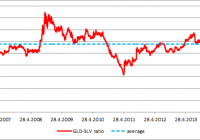
Summary The historical analysis of the gold-silver ratio shows that silver price should start to grow. The value of the gold-silver ratio is almost 75 which is significantly above the long term average. The last two tops (2003 and 2008) were just shy of the 80 level and they were followed by significant increases of the silver price (180% and 315%). There is a significant potential of another huge gains for the iShares Silver Trust ETF shareholders. Historical analysis shows that the iShares Silver Trust ETF (NYSEARCA: SLV ) shareholders may see some interesting gains in the coming years. There are two generally recognized wisdoms that contradict each other. The first one says that the historic results are no guarantee of future performance; the second one says that only a fool repeats the same thing and expects different results. Both of them are applicable to financial markets. Although you can be never sure what the markets will do, there are some patterns that tend to repeat themselves. When you follow such a pattern there is a high probability that the performance of the asset will be similar to the previous cases. There is approximately 19 times more silver than gold in nature. This number was somehow reflected in the historical fixed gold-silver ratios. The ratio was set at 12 in the Roman Empire and at 15 during the era of bimetallism in the 19th century. Today the ratio is not fixed, but moves according to the actual gold and silver prices. The average gold-silver ratio was approximately 55 during the last 44 years. But this is only the average value, the actual values ranged from 17 in January 1980 to 97 in February 1991. The current high valuations don’t reflect the difference in the abundance of gold and silver in the nature and moreover they, don’t reflect even the difference in the abundance of the disposable mined silver and gold. Almost all of the mined gold is being hoarded and most of the mined silver is being consumed by various industrial applications. As a result there is less disposable silver than gold in the world. The GLD-SLV ratio The gold-silver ratio can be tracked also using the SPDR Gold Trust ETF (NYSEARCA: GLD ) and the iShares Silver Trust ETF. During the lifetime of both (chart below), the average GLD-SLV ratio has been 5.77. The highest value was recorded on October 10th, 2008. The GLD price of $83.22 and SLV price of $9.8 resulted in the GLD-SLV ratio of 8.49. The lowest value (3.20) was recorded on April 25th, 2011 at the GLD price of $146.87 and SLV price of $45.83. As we can see, the way from the top to the bottom took 639 trading days. During this time period GLD gained 76.5% and SLV increased by whopping 440%. On the other hand, from April 2011 to present SLV lost 67% of its value while GLD declined only by 22%. (click to enlarge) Source: own calculations The outperformance of SLV during precious metals bull markets and its underperformance during precious metals bear markets is caused by its volatility, which is significantly higher compared to gold. The chart below shows the 20-day moving coefficients of variation for GLD and SLV. The volatility of SLV is significantly higher compared to GLD, regardless of the actual market trend. Source: own calculations But the changing GLD-SLV ratio itself doesn’t tell us anything about the market direction without a further analysis. It is a ratio which means that it is impacted by the price moves of both of the assets. When the GLD-SLV ratio grows it doesn’t mean that the GLD price must grow. The ratio can grow when GLD price declines, but the SLV price must decline even stronger and vice versa. The behavior of both of the assets during particular phases of the GLD-SLV ratio development are shown by the chart below. The chart shows that the declines of the GLD-SLV ratio are related to the growth phases of the gold and silver price cycle and the increases of the ratio usually happen during the decline phases of the gold and silver price cycle. (click to enlarge) Source: own calculations The Long term picture The chart below shows the long term development of the gold-silver ratio calculated from the average monthly gold and silver prices. The chart shows the major tops and bottoms of the gold-silver ratio as well as the metal prices related to the particular local extremes (gold price : silver price). The color of the number shows whether the price of the metal increased or decreased compared to the preceding extreme. (click to enlarge) Source: own calculations Thanks to this chart we can come to three important conclusions: The most important tops of the ratio are almost always associated with a decline of the silver price. The most important bottoms of the ratio are always related with an increase of the silver price. While the direction of the silver price is quite reliably predictable (as shown by points 1. and 2.), predictions of the gold price direction based on the gold-silver ratio development are much less reliable. We can also see that the ratio is approaching 80 right now. The last two approaches to this border were followed by strong declines of the gold-silver ratio and huge silver bull runs, when the silver price increased by 180% and 315% respectively. Conclusions The historical records show that the gold-silver price ratio as well as the GLD-SLV ratio should start to decline in the coming months and years. The major declines of this ratio are always accompanied by a strong silver bull market. The current value of the ratio is approximately 75. The last two times when the ratio attacked the level of 80, the value of the ratio collapsed and silver achieved triple digit gains. If the history should repeat itself once again, the holders of physical silver, SLV or another ETF that tracks the price of the physical silver, should record significant profits. Additional disclosure: The author is long physical silver.

Artesian Resources: Small Company, Big Dividends

Summary Water utilities operate in stable, recession-proof markets. ARTNA has a 17-year streak of raising its dividend. Valuations appear stretched, however. Water is essential and companies that provide it often enjoy stable revenues and earnings. Artesian Resources (NASDAQ: ARTNA ) is one such provider of water and water-related services. It’s actually the eighth largest publicly owned water utility in the United States by capitalization, despite a market cap of just about $193 million. The business Artesian is actually a holding company consisting of wholly-owned subsidiaries offering water, wastewater services, and related services. The primary subsidiary, however, is Artesian Water Company, which contributes 88% of the overall company’s revenues. While the company primarily operates in Delaware, it has also expanded into Maryland and Pennsylvania as well. The company tends to get 88-90% of its revenues from water sales, and operates in three different segments: Water Division: provides water service to residential, commercial, industrial, governmental, municipal, and utility customers through its Artesian Water, Artesian Water Maryland, and Artesian Water Pennsylvania subsidiaries. Wastewater Division: bills customers in Maryland and Delaware a flat fee, providing the company with revenues unaffected by weather changes. Non-regulated Division: provides contract water and wastewater operation services to private, municipal, and governmental institutions through the Artesian Utility subsidiary. This division also includes Artesian Development, a real estate holding company. According to the company’s 2013 annual report, one of its main strategic goals is “to significantly increase customer growth, revenues, earnings and dividends by expanding our water, wastewater and Service Line Protection Plan services across the Delmarva Peninsula.” Expansion requires water Artesian may be a small company, but it operates in a few markets that seem to be growing quickly, and expansion always requires water and wastewater services. Artesian Water Company is the oldest and largest public utility on the Delmarva Peninsula, and has provided it water since 1905. The subsidiary currently provides more than 7.3 billion gallons of water annually to about 300,000 people. Much of the land encompassed by the Delmarva Peninsula is rural with a few large population centers, such as Dover, the capital of Delaware. The peninsula also tends to rely heavily on agriculture. Focusing on Delaware Artesian believes that due to a number of factors, including a lower relative cost of living, attractive financing rates for construction and mortgages, and lower property and income tax rates, Delaware is especially attractive for growth opportunities going forward. There is also an availability of development sites in relatively close proximity to the Atlantic Ocean, so future home and retirement community development is also expected to expand the company’s customer base. One of ARTNA’s municipal customers for instance, the town of Middletown, Delaware, has gone from a population of a little over 6,000 people in 2000 to roughly 19,418 people in 2012 — an increase of over 200%. According to the company: …population growth in this area is expected to continue for some time as a result of ongoing and future residential, commercial and industrial construction. As population growth continues in Middletown and other areas in Delaware, we believe that the demand for water will increase, thereby contributing to an increase in our operating revenues. Because Artesian is a total water resource management company, it offers expertise in everything from identifying and supplying new sources of water, developing wells, treating and delivering water to customers, as well as other wastewater management services. This gives it a wide moat and a distinct advantage to capitalize on much of the growth and development in the parts of the state where it’s located. Valuations and fundamentals Artesian last reported earnings on November 5, with net income coming in at $3.3 million– an increase of 27% from last year’s third quarter. This translated to diluted EPS of $0.37, with revenues increasing by a little over 8%, coming in at $19.6 million. Revenue from water sales was the primary driver, also increasing by a tad over 8% and totaling $17.7 million. For the first nine months of this year, net income has increased by 9% to $7.4 million on revenues of $54.4 million. The company has also bumped its dividend twice this year, and shares currently yield 4%. The company has close to a two decade history of raising its dividend, and over the last five years its increases have averaged 3.2%. ARTNA Debt to Equity Ratio (Annual) data by YCharts The company’s balance sheet doesn’t appear to be in the best shape, especially with free cash flow turning negative. The payout ratio sits at 86% as well, so the dividend is safe for now, but there isn’t a lot of breathing room. The bottom line While Artesian appears to be a good income play in the water utilities space, shares also look a little stretched at almost 22 times earnings and 18 times forward earnings. The 4% yield is nice, but the balance sheet isn’t that great liquidity-wise and the company holds a lot of debt. This wouldn’t be as big of a concern to me if the company was spinning out a bunch of free cash flow, but it isn’t. It does operate in a very capital-intensive industry as well, which can offset stable revenues and earnings and negatively affect cash flow when infrastructure upgrades or any other capex issue arises. Due to its smaller size, it also doesn’t take as much to “move the needle” when it comes to growth in relation to its larger peers, either. Continual growth and expansion in its core markets could inject growth into the company rather quickly. ARTNA looks like a good candidate for the watchlist until valuations become more attractive and/or the company’s balance sheet looks a little stronger. Its dividend history is impressive and I like the company, I just wouldn’t want to pay too much for it.