Tag Archives: handle

A Top-Ranked India ETF To Tap The Growing Consumer Sector

The Indian stock market has hardly looked back from the astounding journey it set forth on in May 2014 following the formation of the new government. Most economic factors are presently in favor of Asia’s third-largest economy, including the revival of the currency, a drastic fall in inflation thanks mainly to the oil price crash and an improvement in current account deficit. India’s wholesale price inflation – which was an acute concern leading to a series of rate hikes in the past couple of years – plunged to a five-year low in September. Though India’s Q3 GDP growth rate of 5.3% was not great, analysts from HSBC expect over 6% growth rate from this nation next year. This is noteworthy since the nation’s bourses suffered a lot last year as foreign investors remained skittish about putting more capital in the nation, leaving many questions about the potential of the country in the near term. Actually, given that India isn’t a commodity-oriented emerging market like its BRIC brothers Brazil or Russia, the nation has immensely benefited from the recent natural resource weakness. If this is not enough, Credit Suisse forecasts that Indian economy will log ‘fastest USD nominal growth in the world’ next year as noted by Reuters. To add to this, Credit Suisse believes that Indian equities are not pricey relative to the nation’s growth outlook. This recent bullish tone did spread cheers across every corner of the Indian economy as evident by at least a 25% return received from each India ETF this year. However, some specific corners need special mention. One such space is the Indian consumer sector. What Drives Consumer Sector Higher? The middle income population in India is mushrooming. This fraction of the population has an inclination to spend on discretionary items like travel and leisure which in turn boosts the sales of consumer products like automobiles and personal goods. For example, auto sales displayed a speedy annual expansion of 10% in November (yoy). Notably, auto sales are often regarded as a well-being of an economy. Lower fuel prices seemed to have done the trick. Moreover, with cooling inflation, many are speculating a rate cut in the coming days, though no such thing has taken place formally as of yet. And if in any case, the interest rate goes down, the auto industry should soar. India basically has a compelling investment proposition with its rising importance as a ‘consumer driven’ economy. As per Indian Brand Equity Foundation (IBEF), the present consumer spending will likely grow two-fold by 2025. The consumer confidence score rose to 126 in Q3 of this year from an all-time low of 92 reached in Q1 of 2010. The market is motivated by favorable demographics and expanding disposable income. IBEF also predicts that per capita income in India will likely see a meaningful CAGR of 5.4% within the span of 2010-2019 with food products and personal care taking about 65% share of the market revenue. Other forecasts by IBEF include doubling of the consumer durables market by FY15 from FY10. The young generation’s inclination toward tech-driven products will also facilitate this growth trajectory. This calls for a bullish stance over the consumer sector of the Indian economy. Here we would like to highlight the Zacks top-ranked ETF providing exposure to this very corner of the Indian market. EGShares India Consumer ETF ( INCO ) has a Zacks ETF Rank #1 (strong Buy) with a Medium risk outlook and we expect it to outperform most of its peers in the coming months meaning it could be an excellent pick for investors seeking more exposure to this economy. INCO in Focus This ETF targets the consumer industry of India and follows the Indxx India Consumer Index. It holds 30 stocks in its basket and has amassed $21.5 million in its asset base. The fund trades in a paltry volume of 15,000 shares, suggesting additional cost in the form of wide bid/ask spread beyond the expense ratio of 0.89%. The fund offers a moderately concentrated bet in the top 10 holdings as indicated by its 52% exposure to these stocks. Among individual holdings, MRF Ltd., Motherson Sumi Systems Ltd. and Bosch Ltd form the top positions of the fund with total investment of 17.7%. The fund allocates 79.42% of its asset base to consumer goods. A small proportion of the asset base has also been assigned to Industrials (15.4%) and Consumer Services (4.8%). Industry-wise, automobiles – which is presently a well-performing sector in India – accounts for 37.5% followed by personal goods (27.14%) and industrial engineering (15.4%). INCO has hit a low of $19.64 and a 52-week high of $34.89. The fund is currently hovering near its 52-week high price and could be an interesting choice in 2015 for investors seeking more Indian market exposure.
Low Inflation And Higher Growth Keep GLD Down

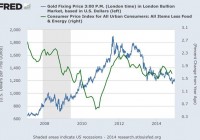
Summary The recent higher-than-expected GDP report may also suggest the rise in U.S. economy will steer investors away from gold and into other assets. The recent PCE report showed a core inflation of only 1.4%. The ongoing lower inflation is likely to keep dragging down the price of GLD. The gold market continued to show a high level of volatility in the past several weeks. Nonetheless, the SPDR Gold Trust (NYSEARCA: GLD ) is nearly flat for December and only 1.2% during 2014. But the ongoing low inflation and signs of recovery in the U.S. economy are likely to further drive down GLD over the coming months. This week didn’t offer a whole lot of news items but there were two reports that came out from the Bureau of Economic Analysis: the final update on the U.S. GDP for the third quarter and the PCE monthly update. On the one hand, the GDP growth rate was revised up again to 5%. The revision was from 3.9% back in the second estimate. Even after subtracting the change in private inventories, the growth rate remains at 5% – so the growth mostly came from private and public sectors. Part of this revision came from higher real nonresidential fixed investments that grew by 8.9%. The recovery of the U.S. economy is a step in the direction towards the FOMC raising rates next year, which is likely to bring down the price of GLD further. Another issue to consider is the progress in the U.S. inflation: The recent PCE report showed that the core PCE annual rate slipped to 1.4%. The relation between GLD and inflation concerns is a close one and may have played a major role in the progress of GLD. (click to enlarge) Source of chart is from FRED’s web site Albeit the U.S. inflation remained low in the recent year, the progress in other measures, most notably the U.S. money base, drove bullion bugs towards GLD. Even M1 showed a sharp rise. If we were to examine the change in M1 and the progress of the gold during the past few years, we can see that following the economic recession, as the growth rate in M1 picked up, so did gold rally. (click to enlarge) Source of chart is from FRED’s web site But after the end of QE2 and then QE3, the growth in M1 has tapered down, which also coincided with the drop in GLD. This doesn’t mean we are in a situation where inflation actually substantially increased. Only that the steps the FOMC implemented, including low rates and QE programs, led to higher concerns over a potential rise in inflation – all the rise in M1 and U.S. money base had some people think prices are about to pick up anytime soon (some still think so) and may reach double digits. The last time U.S. inflation reached double digits was back in the early 80’s – back then gold prices reached their highest level, for that time. This high inflation led the Fed to raise rates, which soon brought down inflation expectations – and then gold soon followed. This time around, however, the circumstances are a bit different. Some were concerned about higher inflation that led to higher GLD prices. Nevertheless, the U.S. inflation remained low. (click to enlarge) Source of chart is from FRED’s web site But the current depressed prices, which are likely to come further down considering oil is at its current low level and the FOMC’s decision to end QE3 and perhaps even raise rates by mid-2015 have only reduced the fear factor of the U.S. inflation rearing its head. Some still think that the FOMC’s cash injections to the U.S. economy may eventually result in a spike in inflation down the line – like a time-release bomb. But this scenario seems, for now, less likely. As times passes, the price of GLD is likely to further suffer from U.S. inflation remaining well below 2%. The potential rise in the Federal Reserve’s cash rate is also likely to raise the yields of U.S. treasuries, which could diminish the appeal of GLD as an investment. I have referred to this point in the past . It’s a competing theory but it too plays the same role the inflation based theory plays. So where does it leave GLD? The recovery of U.S. economy and a little growth in inflation don’t vote well for GLD. The FOMC’s policy is still likely to play the main role in the progress of GLD. This year, the tapering of QE3 didn’t have a strong adverse impact on GLD as it slipped by only 1.2% (year to date). Most of the impact was already priced in when Bernanke announced this decision back in June 2013. The main change will be the rate hike and subsequent raises. For now, the FOMC keeps dropping hints of a rate raise soon but keeps us guessing because, well, perhaps some FOMC members aren’t so sure about making this rate hike next year. Until we get a clear guidance, the price of GLD isn’t likely to do much and only slowly come down. For more see: What are the advantages of GLD?

Competition Heats Up In The Global Tactical ETF Space

With the launch of the Cambria Global Asset Allocation ETF (NYSEARCA: GAA ), Cambria Funds looks to compete with the AdvisorShares ETF that Cambria previously managed; and with the new zero-management fee alternative mutual fund offered by Aspiration Funds. The Cambria Global Asset Allocation ETF debuted on December 9. The ETF’s objective is to replicate the results of the Cambria Global Asset Allocation Index, which allocates assets across asset classes in pursuit of absolute positive returns. Investing in the new ETF will provide investors with exposure to stocks, bonds, commodities, and currencies, diversified across geographic markets and economic sectors. While Aspiration Funds made headlines with their innovative “name your own price” management fees, the new alternative ETF from Cambria Funds goes even further, with a flat management fee of 0.00% (that’s not a typo). Being an ETF, the new Cambria fund doesn’t charge a 12b-1 fee, either, and its net-expense ratio is just 0.29%. The only catch to the ultra-low fees is that the new ETF invests in other ETFs, some of which are managed by Cambria, and the underlying ETF managers will collect management fees. The Cambria Global Asset Allocation ETF typically invests in other ETPs (exchange-traded products), with roughly 40% of its assets allocated to equities, 40% to fixed-income, and 20% to other asset classes such as commodities and currencies. The goal is to gain diversification benefits through asset allocation, in order to dampen volatility, limit drawdowns, and keep investors in the market, long-term, so that their gains can compound. Cambria Investment Management serves as the new ETF’s investment advisor, and its portfolio managers are Mebane Faber and Eric Richardson. Previously, Cambria managed a similar ETF for AdvisorShares, now known as the AdvisorShares Morgan Creek Global Tactical ETF (NYSEARCA: GTAA ) and managed by Mark Yusko of Morgan Creek Capital. Through December 22, GTAA had gained 4.6% in 2014, but its net-expense ratio of 1.63% is 134 basis points higher than GAA’s. 2015 is shaping up to be a big one for liquid alts, and the competition between these ETFs likely foreshadows many similar showdowns to come. Liquid alts investors, who gain additional investment options and benefit from the downward pressure on fees, have reason to look forward to the New Year. For more information, visit the new fund’s website .