Tag Archives: function

GLD And Its Relation To The Greek Elections, ECB’s QE And FOMC Meeting
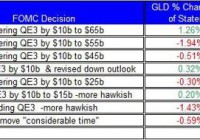
The rise in uncertainty in Europe over the recent Greek elections results in ECB’s QE program play in favor of GLD. Will the upcoming FOMC meeting and GDP update for the fourth quarter impact the direction of GLD? The market has revised down the probabilities of a rate hike in the coming FOMC meetings. The results of the latest elections in Greece along with ECB’s decision to start its quantitative easing program have provided back-wind for the SPDR Gold Trust ETF (NYSEARCA: GLD ). Let’s examine the recent developments in Europe and the upcoming reports in the U.S. including FOMC statement and GDP update. The latest news about election results in Greece, in which the extreme left party Syriza won, is likely to bring this country one step closer towards leaving the European Union, could stir up the markets, raise the uncertainty levels and depreciate the Euro against leading currencies. But it’s not likely to have substantial long-term adverse ramifications on the EU, as suggested in this analysis . This news along with ECB’s decision to implement a $1.3 trillion QE program could still drive higher the demand for precious metals investments including GLD, which tend to strive when central banks devalue their currency and the uncertainty level in the markets rise. Nonetheless, bear in mind that the ongoing rally of the U.S. Dollar against the Euro and other currencies will eventually curb down the rise in the price of GLD. This week the FOMC will convene for the first time this year. In the previous meeting back in December, the FOMC concluded its meeting with the decision to repurpose the term “considerable time” with respect to the timing of the rate hike; the FOMC kept the term as a reference point to its current policy – the normalization process will continue to be data dependent and a rate hike won’t happen anytime soon with the key word being patience: “… the Committee judges that it can be patient in beginning to normalize the stance of monetary policy.” Moreover, in the press conference that followed, FOMC Chair Yellen also pointed out that the FOMC is likely to raise rates in the next couple of meetings. (click to enlarge) Source of data: FOMC’s site and Bloomberg This time, the FOMC meeting will include a press conference or an update for the economic progress of the U.S. But the last updates by the IMF and World Bank showed that the U.S. economy is likely to grow in 2015 by 3.6% and 3.2%, respectively. In both cases, these organizations revised up their assessments from their previous estimates, in part, due to low oil prices. The current low oil prices are also likely to bring down GLD – after all potential rise in inflation is among the main reasons for people to invest in gold assets such as GLD. Well, this doesn’t seem to be the case. Despite the expected higher growth in GDP, the markets have started to revise their expectations about the next rate hike of the FOMC. According to the CME , the probability of a rate hike in the June meeting is currently only 12% – a month ago this probability was around 30%. Further, the implied probability of a rate hike in the July meeting has been updated from 57% a month ago to 28%. So the markets have updated their projections based on the current low inflation. The low inflation could eventually result in the FOMC pushing forward the first and subsequent rate hikes. Such a scenario is likely to keep pushing up the price of GLD: After all, low cash rate tends to translate to low long-term treasury yields. If U.S. treasury yields remain low, this could contribute to the short-term recovery of GLD. But the upcoming FOMC meeting isn’t likely to stir up the markets considering Yellen’s promise not to rock the boat in the next two meetings. Therefore, the market reaction is likely to moderate and GLD isn’t expected to do much – we could see a similar reaction as we did in the last meeting. Another report to consider is the upcoming GDP report – first estimate for the last quarter of the year. The current estimates are for the GDP report to show a gain of 3.1%. In the past, these reports didn’t seem to have much of a strong impact on the prices of GLD, as you can see in the table below. Source of data taken from Bloomberg and BEA Nonetheless, this report is still likely to influence FOMC members with respect to their rate decision. If the U.S. economy keeps showing a steady growth, this is likely to bring the FOMC closer to pushing the trigger on the rate hike. Despite the latest developments in Europe, the direction of GLD is mostly related to the changes in U.S. including the FOMC’s policy and the progress of the U.S. economy. If the FOMC were to push forward its first rate hike, this could keep up the price of GLD. For more see: What are the advantages of GLD?
Are Multi-Asset Funds A Threat To The Fund Industry?

By Detlef Glow The chase for yield by all kinds of investors has driven up the popularity of so-called multi-asset funds, since the funds promise to be widely diversified and therefore able to generate returns from all kinds of assets. In a number of cases the promise also extends to all kinds of market conditions, since some of the funds have the ability to use shorts or so-called market-neutral strategies. With regard to the investment objectives of multi-asset funds, these funds can be considered as really actively managed funds. That mixed- or multi-asset funds are privileged products for European investors is shown in the impressive inflows these funds have been able to gather. Asset allocation funds were not only the best selling fund sector for 2013 (+€61.6 bn), they also led the table for the first 11 months of 2014. In this period asset allocation products gathered €63.3 bn, far ahead of the second and third best selling sectors: mixed-asset conservative (+€27.9 bn) and bonds EUR (+€27.5 bn). The strong inflows into the multi-asset sector, combined with the fact that more and more fund promoters are launching multi-asset products to benefit from this trend, have raised questions and concerns about multi-asset products. One of these questions is whether all of these new managers are able to handle multi-asset portfolios, especially in tough times. Will these managers be able to meet the expectations of their investors in bear markets? The fear behind this question is linked to the negative image of the fund industry that stemmed from a number of absolute return funds failing to meet their goals during the 2008 financial crisis. From my point of view this is a valid concern: some managers may not be able to handle rough markets. They might not be experienced in the use of shorts, or they may not have the right risk management tools in place. Another point of concern is that some asset managers try to run their multi-asset portfolios with small teams to cover a large number of asset classes, or they are managing these portfolios in addition to other portfolio management tasks. In this regard, investors should make sure the fund management team of their fund is focused on the multi-asset portfolio and has enough resources to handle all the asset classes in the portfolio. The second major concern I have heard often in recent months is about fund flows. Since multi-asset products seem to have been the investment of choice of both institutional/professional and private investors in the past two years, some observers state that the flows might have reached their peak. Investors may start to pull out their money from these funds, which could lead to major outflows and therefore disruptions in some asset classes. I do not think that private investors will stop investing in multi-asset products as long as the funds fulfill their investment objectives and the goals of the investors. But it looks a bit different on the institutional side. New regulations such as Solvency II, with its high reporting standards, may cause some outflows from mutual funds, regardless of whether the fund promoters are able to deliver holdings data and other statistics on time. Another reason for outflows might be because asset managers are using multi-asset funds instead of buying the single building blocks and building multi-asset portfolios of their own. That would be the only way for them to have their asset allocation fully under control. From my point of view both concerns are valid; institutional outflows could easily offset inflows, which might cause outflows from the asset allocation sector. Even so, I would not expect any major disruptions in the utilized asset classes from this, since major outflows are unlikely to happen from one day to the next. In addition, I don’t think all the institutional investors who have bought multi-asset funds are able to manage this kind of portfolio in-house and therefore need an external manager to participate in these broadly diversified investment strategies. I would assume some questions and concerns around multi-asset funds are valid, but as long as at least the major funds in this market segment continue to deliver on their investment objective, the fund category is not a major threat for the European mutual fund industry. From my point of view, the major risk for the fund industry would be if one of the top-selling funds in this segment fails to deliver on its investment objective or faces major losses during a crisis. That would once again damage the reputation of the fund industry, which might then irrevocably lose investors’ trust. The views expressed are the views of the author, not necessarily those of Thomson Reuters.

High Yield Dividend ETFs – A Tale Of The Tape

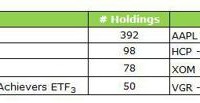
Summary These high-yield dividend ETFs offer greater yield than S&P 500. ETFs offer greater diversification than individual stocks. Unlike mutual funds, ETFs can be traded throughout the day. “Do you know the only thing that gives me pleasure? It’s to see my dividends coming in.” – John D. Rockefeller (as quoted by John Lewis in Cosmopolitan) Dividends are a beautiful thing. They are the portion of earnings that the board of directors decides to pay to shareholders. You can use dividends to purchase additional shares under a dividend reinvestment plan, have them deposited back into your brokerage account, or sent to you in the form of a check. While some view dividend paying companies as less risky than those who reinvest all earnings, others see dividends as an illusion, arguing that dividends are not tax efficient and pointing out that removing capital from a company could impact future profits or earnings ability. I view dividends as an amusing consequence of investing in companies that generally produce more cash than they need to fund ongoing operations. While I prefer dividend paying companies to non-payers, my bias is generally routed in the emotional side of personal finance and investing rather than some fundamental thesis that a portfolio of dividend payers is superior to the alternative. Much is said on Seeking Alpha about dividends and dividend paying stocks. But far less is said about their better diversified and arguably more fundamentally sound counterparts, dividend-oriented ETFs. I think most people like to own individual stocks rather than ETFs because it makes them feel they are somehow more connected to their investing strategy. They can read earnings releases, pore over 10-Qs and 10-Ks, lament on insider trading, and all the other things that investors like to do to feel a connection to their portfolio. In this article I will give up those dividend investing birthrights, and take a comprehensive and quantitative approach to analyzing four “high-yield” dividend ETFs to determine if the hands off approach has the merits fundamentally embedded ETF investing. Profiling the contenders (unless otherwise stated, market prices, NAV and SEC yield as of 1/23/15) : Vanguard High Dividend Yield ETF (NYSEARCA: VYM ) This ETF seeks to track the performance of the FTSE High Dividend Yield Index, which measures the investment return of common stocks of companies characterized by high dividend yield. Market price: $68.74 30-day SEC Yield: 2.93% Number of holdings: 392 iShares Core High Dividend ETF (NYSEARCA: HDV ) This ETF seeks to track the investment results of an index composed of relatively high dividend paying U.S. equities. Market price: $77.34 30-day SEC Yield: 3.45% Number of holdings: 78 Powershares High Yield Equity Dividend Achievers Portfolio ETF (NYSEARCA: PEY ) This ETF is based on the NASDAQ US Dividend Achievers 50 Index and will normally invest at least 90% of its total assets in dividend paying stocks that comprise the index. Market price: $13.51 30-day SEC Yield: 3.21% Number of holdings: 50 SPDR S&P Dividend ETF (NYSEARCA: SDY ) This ETF seeks to provide investment results that, before fees and expenses, correspond generally to the total return performance of the S&P 500 High Yield Dividend Aristocrats Index. Market price $79.32 30-day SEC Yield: 2.19% Number of holdings: 98 1) Diversification Diversification is the process of reducing non-systematic risk by investing in a variety of assets or asset classes that (hopefully) do not move up or down in value at the same time or magnitude. As the 2008 financial crisis taught us , there are certain unforeseeable events (think global recession, world wars) that no amount of diversification can protect us from. Despite this qualifier, I still prefer the perceived spreading of risk as opposed to the all-eggs-in-one-basket watched very closely mentality. a) Number of holdings While more isn’t necessarily better, too little can be not enough. In general, there are eight sectors or broad categories of businesses: Basic Materials, Services, Conglomerates, Consumer Goods, Financial, Technology, Healthcare, Industrial Goods and Utilities. Within each sector is a number of industries (Consumer Goods includes beverages and office supplies, Services includes auto dealerships and airlines). According to Yahoo, there are roughly 190 industry categories . An ETF need not be comprised of companies in every industry, since certain common economic factors are primary drivers across unrelated industries. Think general contractors and residential builders performing well during a housing boom. (click to enlarge) Winner : Vanguard’s quantity of holdings is sufficient to represent an investment in every major industry category nearly twice over. While it has a hefty stake in Apple, which is tough to call high yielding at less than 2% , it still has a broad base of companies that is almost four times larger than the runner up, SPDR. b) Sector Representation Vanguard High Dividend Yield Sector Allocation (Courtesy of Vanguard) iShares Core High Dividend Yield Sector Allocation (Courtesy of Blackrock) Powershares High Yield Equity Dividend Achievers (Courtesy of Invesco) SPDR S&P Dividend ETF Sector Allocation (Courtesy of State Street Global Advisors) Winner: Vanguard. All three other funds have at least 20% of their holdings concentrated in a single sector. Not so for Vanguard, who limits their sector exposure to 18.10%. What is interesting to note, and should be reviewed by investors based on their own personal preferences and profiles, is that even though these funds all have the same general approach, (high-yield and diversification), their composition is quite different. With the exception of Consumer Goods/Staples (which is the second largest sector for each) sector weighting is all over the map. Utilities makes up less than 10% of the Vanguard ETF, but is over 25% for Powershares. iShares has less than 1% Financials, but for SPDR, Financials make up its most significant holdings. 2) Fees Fees are important, that goes without saying. But unlike actively managed funds, with fees that average nearly .9% , ETFs as a whole are considered low-cost alternatives. But even with their general cost effectiveness compared to managed alternatives, it is still worth looking into which fees of index funds to make sure you keep as much of your hard earned money as possible. (click to enlarge) Winner: Vanguard. No surprise here. Vanguard’s low-cost approach to investing is something the company is very proud of. Honorable mention to iShares, which is within striking distance of Vanguard and three and four times cheaper than SPDR and Powershares, respectively. 3) Total return HDV Total Return Price data by YCharts Winner: Powershares. Past performance does not guarantee future results, and these ETFs are designed to primarily track an index. But at the end of the day, over the past five years, PEY has outperformed its competition from 8% to nearly 20%. 4) Liquidity The ability to get out of a great investment is just as important as the ability to get in. While ETFs are generally regarded as having higher liquidity than mutual funds (primarily because they can be traded throughout the day, rather than just at the end), there are reasons to avoid ETFs with excessively low volume. Chief among these are higher bid-ask spreads, which may result in the inability to profitably execute a short-term trade (not a real issue for long-term investors). However, one of the issues that arises from low liquidity (a deviation between price and NAV) can actually be an opportunity. If an ETF is trading slightly below its NAV, but the market is not active enough for it to quickly resume equilibrium, you can shave a few points off your basis by looking for opportune entry points. (click to enlarge) Winner: SPDR. More volume means better pricing (both in relation to NAV and narrow bid/ask spreads). Honorable mention everybody else. All of these ETFs provide adequate liquidity to be considered both investable and tradeable. 5) Price/earnings multiple Winner: Vanguard. It is trading at a discount both to its high dividend ETF peers but also to the S&P 500, NASDAQ and Dow Jones Industrial average . 6) Yield (click to enlarge) Winner: iShares. While all but SPDR best the 30-year Treasury yield, none of these ETFs beat the 6 stock semi-weekly dividend portfolio I wrote about recently. So, which high yield dividend should you own? Vanguard! The low-cost investing house has outdone itself with its Vanguard High Dividend Yield ETF. It has assembled a large, diverse group of stocks that pay above average dividends at rock-bottom fees trading at a reasonable price/earnings multiple. While yield is not the end-all be-all of investing, for those with assets that need income, a high-yield dividend ETF can be a perfect way to get diversified equity exposure without hitching your wagon to just a handful of stocks. A word of caution: Do your homework. Monitor your holdings. Just because one of these funds is right for your portfolio right now, doesn’t mean it will stay that way forever. Depending on rebalancing frequency, a large run up in price of an individually large stock or sector can result in a fund that is incompatible with your goals or risk preferences.