Tag Archives: function

Momentum In High Yield Has Shifted: Buy Some Protection
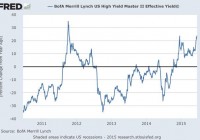
Summary Since bottoming on May 27, junk bond yields have begun steadily rising again. Corporate profits indicate that yields will continue to rise. With default risk increasing, buy credit protection for high upside. Starting around the latter half of 2014, one of the major changes to take hold in the market (besides the rise of the dollar index and collapse in oil prices) has been with bond yields. Junk bond yields have been rising substantially and quickly over the past few months. Much of the change has been due to oil prices, but another cause has been the weakening of corporate profits starting in 2014. With the trend continuing strong through the first half of 2015, there is still time to buy protection against rising yields. As profits fall and oil prices stay low, rising default rates are likely in the future. In fact, default rates in junk bonds have risen to their highest level in 6 years. This article will examine the current state of the junk bond market, the sustainability of current trends, and also recommend a way to play the rising yields and default risks using a credit default swap ETF. Current State of Bond Yields (click to enlarge) Since the European Debt Crisis, which peaked in 2012, junk bond yields had been steadily falling outside of a small blip in 2014. Starting around the end of 2014, however, the increase in yields began in earnest and is now accelerating to the quickest pace since 2011. Yields are spiking, and while this is still far from what is seen during a credit crisis, the warning signs are there. Junk bond yields are now more than 20% higher than they were just a year ago, and there is no sign of an impending correction. On the contrary, the fundamentals seem to be pointing toward a further rise in junk bond yields. Explaining Recent Price Action (click to enlarge) Much of the current trend in junk bond yields can be explained by referring back to oil prices. As oil prices started to fall in 2014, yields immediately began to rise in response. When the oil price bottomed at the start of 2015, yields steadied a bit, though the trend toward rising yields remained. There was hope that oil prices would continue to rebound in the second quarter of the year, but those hopes have been dashed as oil has stood its ground around $60 a barrel. At this point, yields have responded by rising even more and accelerating. While oil explains much of this phenomenon, the increase in yields cannot be blamed totally on the black liquid. (click to enlarge) Another major trend that came about starting in 2014 has been falling corporate profits. These numbers have been showing consistent deterioration since then, and while the Q1 2015 numbers give a sign of possible hope, the historical record does not look good. The last time that corporate profits fell this much, bond yields soared in response after about a year and a half. If that sets any precedent, then bond yields are again about to soar either at the end of this quarter or in the next, especially if corporate profits are weak yet again. Given the past, now is absolutely the time to buy protection against rising yields and bond defaults. The ProShares CDS Short North American HY Credit ETF (BATS: WYDE ) may be the perfect way to play the current situation. As the ETF is short high yield credit, it profits when default rates rise, as the ETF owns a broad basket of high yield credit default swaps. While offering protection against default risk, WYDE has also shown itself to protect against time decay. Since its inception in August of 2014, WYDE has lost less than 5% of its value. CDS protection does have a cost over time, and given that it has lost so little over the time, WYDE is a safe way to play the high yield bond market with little time decay. Summary and Action to Take Junk bonds are a risky proposition right now. Oil prices look to have stalled and a quick recovery to previous levels looks a long way off. In addition, corporate profits have been weak and have been deteriorating at a pace not seen since the onset of the financial crisis. Now is the perfect time to buy protection against a spike in junk bond yields by buying credit default swaps. For the small retail investor, CDS exposure is difficult, and thus gaining exposure via the WYDE ETF may be the perfect way to do so. Disclosure: I am/we are long WYDE. (More…) I wrote this article myself, and it expresses my own opinions. I am not receiving compensation for it (other than from Seeking Alpha). I have no business relationship with any company whose stock is mentioned in this article.

Will FedEx’s Q4 Spell More Trouble For Transport ETFs?

The transportation sector has given an ugly performance this year in spite of a strengthening economy, better job conditions and cheap fuel. The major culprit is the strong dollar, which is eroding the profitability of big transporters. The rough trading is expected to continue for the sector in the months ahead, especially after a disappointing fourth quarter 2015 earnings report from bellwether FedEx (NYSE: FDX ). The courier company lagged our estimates on revenues and earnings and guided lower, dampening investors’ mood. However, the numbers were better than the year-ago quarters. Q4 FedEx Results in Detail Earnings per share climbed 4.7% year over year to $2.66 but missed the Zacks Consensus Estimate by four cents. Revenues rose 2.5% year over year to $12.1 billion but fell shy of our estimate of $12.39 billion owing to negative currency translation and lower fuel surcharges. FedEx’s ongoing three-year cost cutting measures in the FedEx Express unit, which started in late 2012, are largely paying off and are expected to continue doing so in the coming quarters. This profit-improvement plan will continue to boost revenue and profitability. However, a strong dollar and lower fuel surcharges will likely keep on hurting the company’s profitability in fiscal 2016. As a result, the second largest U.S. package delivery company provided fiscal 2016 earnings per share guidance of $10.60-$11.10, the midpoint of which is below the Zacks Consensus Estimate of $10.90. Investors should note that FedEx is in the process of acquiring the Dutch parcel-delivery company TNT Express ( OTCPK:TNTEY ) for €4.4 billion ($4.8 billion). The buyout is expected to close in the first half of calendar year 2016. The acquisition, pending European regulatory approvals, would bolster its global footprint, particularly in the European markets with many untapped nations like the UK and France. The deal would create the third-largest delivery company in Europe after United Parcel Service (NYSE: UPS ) and Deutsche Post ( OTCPK:DPSGY ). Hence, the transaction will give a big boost to the company’s competitive position and future growth story. That being said, FedEX has a solid Growth Style Score of ‘A’ with some flavor of value as it also has a Value Style Score of ‘B’. Further, the stock has a favorable Zacks Rank #3 (Hold) and a solid industry Rank in the top 43% at the time of writing. Market Impact FDX shares dropped as much as 3.3% in yesterday’s trading session following disappointing results on elevated volumes of nearly 2.5 times than the average. This represents the biggest one-day fall so far this year. Given this, many investors may want to tap the beaten down price of FDX by considering either of the following ETFs: iShares Transportation Average ETF (NYSEARCA: IYT ) The ETF tracks the Dow Jones Transportation Average Index, giving investors exposure to the small basket of 20 securities. Out of these, FedEx occupies the top position in the basket with 13.5% of assets. Within the transportation sector, railroad takes the top spot with 46.8% share in the basket while air freight and logistics (30.1%), and airlines (15.2%) round off the top three. The fund has accumulated nearly $870 million in AUM while it sees good trading volume of around 438,000 shares a day. It charges 43 bps in fees per year from investors and lost 0.3% on the day following the earnings results. The product is down 8.3% in the year-to-date time frame and has a Zacks ETF Rank of 3 or ‘Hold’ rating with a High risk outlook. SPDR S&P Transportation ETF (NYSEARCA: XTN ) This fund follows the S&P Transportation Select Industry Index and uses almost an equal weight methodology for each security. Holding 50 stocks with AUM of $399.2 million, FedEx takes the fourth spot with a 2.7% share in the basket. The product is heavily exposed to trucking which accounts for 36.2% of total assets while airlines make up for another one-fourth share. Airfreight & logistics, and railroads account for 22.7% and 11% share, respectively. The fund charges 35 bps in fees per year from investors and trades in a moderate volume of about 83,000 shares a day. XTN was down 0.6% at the close after FedEx earnings were released and 8.5% so far in the year. The fund has a Zacks ETF Rank of 1 or ‘Strong Buy’ rating with a High risk outlook. Original Post

Fire The CEO, Then Buy The Stock?

There is a widely-held perception that CEOs don’t tend to last very long at big companies – maybe just three or four years on average. The truth, however, is not that bad if you are a CEO (or a person who loves one). The average CEO at a Fortune 500 company actually lasts about 8 to 10 years. Still, because the CEO is the face of the company and critical to its success, CEO turnover can cause volatility in a stock’s price – especially if it is unexpected and especially if the CEO leaves in less-than-voluntary circumstances. The latest example comes from Twitter (NYSE: TWTR ). Dick Costolo, who has announced he will be gone effective July 1, had served as Twitter’s CEO since 2010 and helped take the company public in 2013. The nice thing about being the CEO of a private company is that you have the luxury of time. You can more easily focus on the long term. Once you go public, however, you have a stock price that investors constantly monitor. Your stock is like a voting machine, and your stock price tells you how investors think you’re doing. Investors were telling Dick Costolo that he wasn’t doing well at all. After a brief run-up following the IPO, shares of Twitter, which has never been a profitable company, faded. Today, the stock sells for less than the first trade at the IPO. Investors were telling Costolo loud and clear that it was time to go. He asked the Board of Directors to name a replacement. That’s all well and good, but from my perspective, I don’t really care if Costolo was a good or bad CEO. As far as I’m concerned, the more important question is, does it make sense to buy the stock now that the CEO is gone? That’s what lots of investors thought when Costolo’s departure was announced. Twitter stock rallied almost 7% in after-hours trading right after the company announced that Costolo was stepping down. (That may have been a blow to his ego, although it did boost the value of his own shares and options by millions of dollars – at least temporarily.) However, the euphoria did not last. When the market opened for trading the next morning, half the gains were gone. By the end of that day, the stock was back to pre-resignation levels. And by the end of the following trading day, the stock had tanked 3.2% below where it had been just before the announcement of Costolo’s resignation. Investors apparently came to the conclusion that Twitter’s problems went well beyond Costolo’s personal inability to implement a winning strategy. McDonald’s (NYSE: MCD ) provides a bit of a counter example. When CEO Don Thompson resigned in January, the stock rallied 5.1% by the end of the following day. But in McDonald’s case, the stock kept going higher. In fact, it rallied for more than a month. It has given up some ground since, but it remains higher than it was before Thompson’s resignation. With McDonald’s, investors seem to believe that the problems were more closely associated with the CEO than they were with any fundamental problem with the business. McDonald’s has to make its hamburgers more popular and it has a lot to prove, no doubt. But Twitter, remember, as popular as its service already is, has yet to prove that it even can be a profitable business. So, in general, does it make sense to buy the stock when an unpopular CEO steps down? For the short term, the answer appears to be yes; but only if you can act quickly enough to buy the stock before the run-up. Keep in mind that these kinds of announcements are typically made during non-trading hours. For you to have made money on Twitter, you would have had to be sitting at your trading desk rapidly buying and selling when the market was closed. For the longer run, the answer depends. The more investors believe that the company’s troubles are due to bad management and not to a broken business model, the more the stock will rally – and keep rallying – when the unpopular CEO resigns. But if investors think the company’s problems are so endemic that even a new star CEO can’t fix them, you will be better off taking a pass.