Tag Archives: etfs

Trading Against Your Bias: How And Why
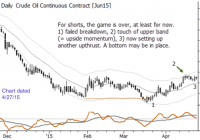
I initiated a short in crude oil back in July, and an astute reader sent me a good question. For many weeks/months, I had been operating with the assumption that crude oil was probably putting in a long-term bottom based on the action back in March/April of 2015; his question was how and why did I take a short against that bias. It’s a good and instructive question, so I thought I’d share the answer with you here. One of the advantages of writing about financial markets and publishing that work every day is that I have a record of what I was thinking and saying at any point in time. As I’ve written many times, I think journaling is one of the key skills of professional trading – this is a form of that. Let me set the background with some charts from a few months ago. A good place to start is in the aftermath of the 2014-2015 sell-off in crude oil. The market bounced in February 2015, set up another short attempt that more or less ran out of steam around the previous lows, and then rallied strongly off those March lows. In early April, I began to work with the idea that crude may have just put in a bottom. A chart says it better: (click to enlarge) Back in April, the case for a bottom in crude oil. Over the next few months, this thesis appeared to be playing out, but it’s important to remember that a bottom is a process. We don’t (usually) identify the absolute extreme of a move and then expect the market never to return. No, it’s far more likely that the market will go flat a while (check), and perhaps even re-test the previous extreme. This is normal, and it may even be those retests that really hammer the bottom in place. It’s easy to imagine hordes of traders thinking that crude oil is going to $20, entering short on a breakdown, and then watching in dismay as the market explodes to new highs after barely taking out the previous lows. A market will do whatever it can, at any time, to hurt the largest number of traders This, in fact, is nearly a principle of market behavior: A market will do whatever it can, at any time, to hurt the largest number of traders. That’s not just cynicism, I think it’s a legitimate consequence of the true nature of the market . Now, we certainly don’t want to be one of those gullible traders who gets tricked into shorting at exactly the wrong time, do we? So what do we do when the market gives us a nice, fat pitch right over the center of the plate, like this? A nice setup for a short, but what about the higher time frame conflict? And just to complete (or, perhaps, to further complicate) the picture, here’s the weekly chart from the same day: Thoughts on that higher time frame. So, just to clarify the situation here, in some bullet points, are the most important elements of market structure at the time we might have been thinking about a short entry: Within the past year, this market had a historic decline. Many people are inclined to think “Too far, too fast,” and that the move will reverse. On the other hand, maybe something fundamentally has changed. At the very least, we need to be aware that these might not be “normal” market conditions. After that historic decline, oil put in what looked like the first part of a bottom: A retest of lows, strong upside momentum off those lows, and then, daily consolidation patterns breaking to the upside. Following that step, the market went flat and dull, perhaps setting up a breakout trade. That breakout was to the downside, and a clear daily bear flag formed after the breakdown. Taking a short could mean going against the longer-term bottom (if it is forming), so what do we do? Many traders end up paralyzed with multiple time frames, as it’s easy to get overwhelmed with information. This is obviously a mistake, but there are also gurus who oversimplify the subject, saying, for instance, to only take a trade when it lines up with the higher-time frame trend. Though this idea is elegant and appealing, it falls short on several counts. For one, the best trades often come at turns, and if you wait to see an established trend, you’ll miss those trades; and even more importantly, the moving average-based trend indicators people use do not work like they think. (In fact, when a moving average trend indicator tells you a market is in an uptrend, at least for stocks, the stock is more likely go down !) Managing the conflicts How do we resolve all of this? I think this is a question that every trader must answer as part of his or her own trading plan. The one thing you probably cannot do is take each case as a new thing and try to make up rules for each situation. It’s far better to have a plan, and to then to follow that plan with discipline. For me, the answer is that a trade is just a trade. I have never been able to prove that having multiple time frames aligned actually increases the probability of those trades. (Though, those examples do sell books!) The way I think about it, if I have a higher-time frame trade that points up and a lower-time frame trade that points down, one of those trades will likely fail. I don’t know which, and I can’t know which in advance. If I knew the higher-time frame trend was more likely to work, I’d just trade that one, but in all intellectual honesty, I don’t know that. No one does. It’s possible that higher-time frame trend will fail because of the meltdown on the lower time frame, and if I’m positioned with that lower time frame, then I will be happy. It’s also possible I will get my first profit target even if the higher-time frame pattern “wins”, so I may be able to make money on both sides of the trade. Perhaps I want to skip the lower-time frame trade and just look for a higher-time frame trade around the previous low – that’s also a viable strategy. What matters is that I know what I will do in advance, and that I am honest about the limitations and constraints. We can only work within the laws of probability, and there are certainly limits to what can be known. It’s not a question of my competence as a trader, but of molding the methodology to fit the realities of the market. A trade is just a trade – avoid complications, and simplify.
TIAA-CREF Lifestyle Conservative Fund, August 2015

Objective and strategy The TIAA-CREF Lifestyle Conservative Fund (MUTF: TSCLX ) seeks long-term total return, consisting of both current income and capital appreciation. It is a “fund of funds” that invests in the low-cost Institutional Class shares of other TIAA-CREF funds. It is designed for investors targeting a conservative risk-return profile. In general, 40% of the fund’s assets are invested in stocks and 60% in bonds. The managers can change those allocations by as much as 10% up or down depending upon current market conditions and outlook. Adviser TIAA-CREF. It stands for “Teachers Insurance and Annuity Association – College Retirement Equities Fund,” which tells you a lot about them. They were founded in 1918 to help secure the retirements of college teachers; their original backers were Andrew Carnegie and his Carnegie Foundation. Their mission eventually broadened to serving people who work in the academic, research, medical and cultural fields. More recently, their funds became available to the general public. TIAA-CREF manages almost $900 billion dollars for its five million investors. Because so much of their business is with highly-educated professionals concerned about their retirement, TIAA-CREF focuses on fundamentally sound strategies with little trendiness or flash and on keeping expenses as lower as possible. 70% of their investment products have earned four- or five-star ratings from Morningstar and the company is consistently rated as one of America’s best employers. Manager John Cunniff and Hans Erickson, who have managed the fund since its inception. Management’s stake in the fund We generally look for funds where the managers have placed a lot of their own money to work beside yours. Mssrs. Cunniff and Erickson each have $500,001 – $1,000,000 invested in the fund, which qualifies as “a lot.” Opening date December 9, 2011. Many of the funds in which the managers invest are much older than that. Minimum investment $2,500. That is reduced to $100 if you sign up for an automatic investing plan. Expense ratio 0.87% on $115 million in assets, as of July 2015. That’s about average for funds of this type. Comments Lifestyle Conservative offers many of the same attractions as the Vanguard Star Fund (MUTF: VGSTX ) but does so with a more conservative asset allocation. Here are three arguments on its behalf. First, the fund invests in a way that is broadly diversified and pretty conservative . 40% of its money is invested in stocks, 40% in high-quality bonds and the last 20% in short-term bonds. That’s admirably cautious. They then take measured risks within their various investments (for example, their stock portfolio is more tilted toward international stocks and emerging markets stocks than are their peers) to help boost returns. Second, TIAA-CREF is very good. There are two sorts of funds, those which simply buy all of the stocks or bonds in a particular index without trying to judge whether they’re good or bad (these are called “passive” funds) and those whose managers try to invest in only the best stocks or bonds (called “active” funds). TSCLX invests in a mix of the two with active funds receiving about 90% of the cash. CREF’s management teams tend to be pretty stable (the average tenure is close to nine years); most managers handle just one or two funds and most invest heavily (north of $100,000 per manager per fund) in their funds. CREF and its funds operate with far lower expenses than its peers, on average, 0.43% per year for funds investing primarily in U.S. stocks. Even their most expensive fund charges 40% less than their industry peers. Every dollar not spent on running the fund is a dollar that remains in your account. Third, Lifestyle Conservative is a very easy way to build a very well-diversified portfolio. Lifestyle Conservative builds its portfolio around 15 actively-managed and three passively-managed TIAA-CREF funds. They are: Which invests in Large-Cap Growth Large companies in new and emerging areas of the economy that appear poised for growth. Large-Cap Value Large companies, mostly in the U.S., whose stock is undervalued based on an evaluation of their potential worth. Enhanced Large-Cap Growth Index Quantitative models try to help it put extra money into the most attractive stocks in the U.S. Large Cap Growth index; it tries to sort of “tilt” a traditional index. Enhanced Large-Cap Value Index Quantitative models try to help it put extra money into the most attractive stocks in the U.S. Large Cap Value index. Mid-Cap Growth Medium-sized U.S. companies with strong earnings growth. Mid-Cap Value Temporarily undervalued mid-sized companies. Growth & Income Large U.S. companies which are paying healthy dividends or buying back their stock. Small-Cap Equity smaller domestic companies across a wide range of sectors, growth rates and valuations. International Equity Stocks of stable and growing non-U.S. companies. International Opportunities Stocks of foreign firms that might have great potential but a limited track record. Emerging Markets Equity Stocks of firms located in emerging markets such as India and China. Enhanced International Equity Index Quantitative models try to help it put extra money into the most attractive stocks in the International Equity index. Global Natural Resources Firms around the world involved in energy, metals, agriculture and other commodities. Bond High quality U.S. bonds. Bond Plus 70% investment grade bonds and 30% spicier fare, such as emerging markets bonds or high-yield debt. High-Yield Mostly somewhat riskier, higher-yielding bonds for U.S. and foreign corporations. Short-Term Bond Short-term, investment grade U.S. government and corporate bonds. Money Market Ultra-safe, lower-returning CDs and such. Bottom Line Lifestyle Conservative has been a fine performer since launch. It has returned 7.5% annually over the past three years. That’s about 2% per year better than average, which places it in the top 20% of all conservative hybrid funds. While it trails more venturesome funds such as Vanguard STAR in good markets, it holds up substantially better than they do in falling markets. That combination led Morningstar to award it four stars, their second-highest rating.

Tactical Asset Allocation – August 2015 Update

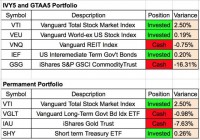
Here are the tactical asset allocation updates for August 2015. All portfolio updates are online as part of Paul’s GTAA 13 Portfolio New sheet. First, for the basic portfolios – the GTAA5 and the Permanent Portfolio. There was one change in the GTAA5 portfolio. Bonds (NYSEARCA: IEF ) went back to invested this month. GTAA5 is now 60% invested and 40% cash. For the timing version of the Permanent Portfolio there were no changes this month. The TAA version of the Permanent Portfolio is 50% invested and 50% in cash just like last month. Now for the more aggressive GTAA AGG3 and AGG6 portfolios. There are no changes for either AGG3 or AGG6 this month. Notice that the Vanguard REIT Index ETF (NYSEARCA: VNQ ) replaced the Vanguard Intermediate-Term Government Bond Index ETF (NASDAQ: VGIT ) in the top 6 ETFs, but since VNQ is under its 200-day it is not an investable position thus there are no changes from last month for AGG6. AGG6 has only 5 positions like the last 2 months with the rest of the portfolio in cash. Performance for the portfolios so far this year is in the table below. Numbers are for each month. The figures are estimates taken from a variety of sources. I don’t do detailed performance tracking until the end of the year. If you’re a fan of the Antonacci dual momentum GEM and GBM portfolios, GEM continues to be invested in US stocks (NYSEARCA: VTI ), and the bond momentum option of the GBM portfolio continues to be invested in US long-term government bonds (NASDAQ: VGLT ). No changes from last month. I’ve also made my Antonacci tracking sheet shareable so you can see the portfolio details for yourself. That’s it for this month. These portfolios signals are valid for the whole month of August. As always, post any questions you have in the comments. Share this article with a colleague